

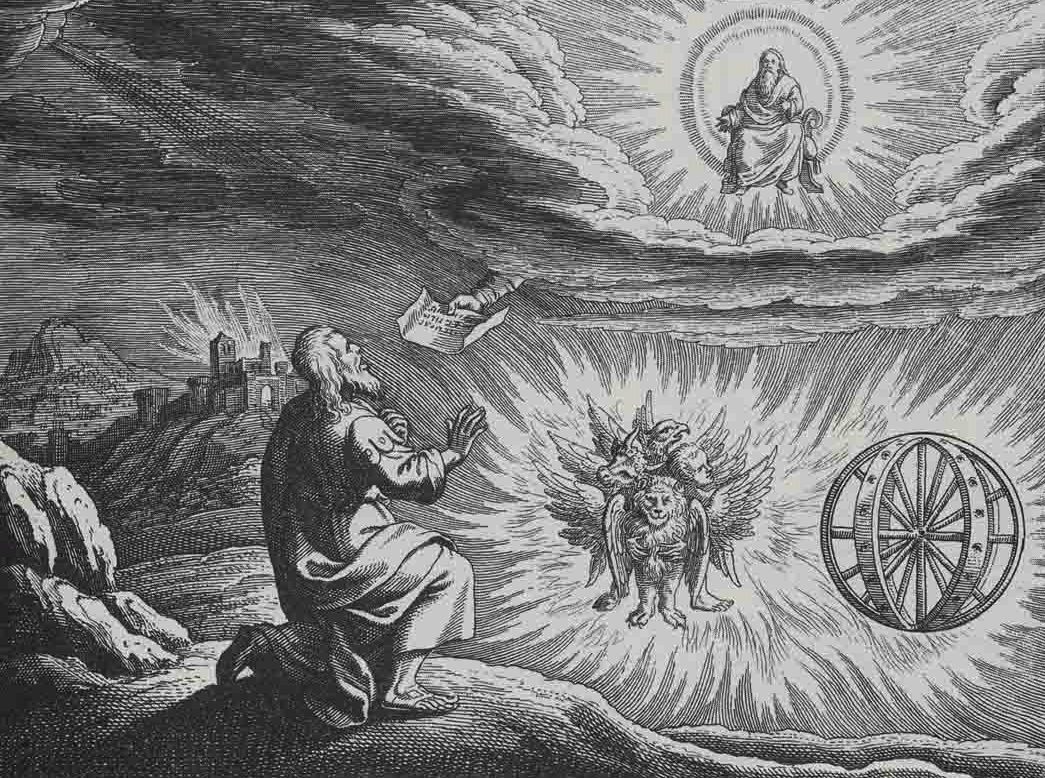
Few Bible passages draw more late-night speculation than the first chapter of Ezekiel. A priest in exile by a river in Babylonia sees fire, four winged creatures, and wheels “full of eyes.” Since the 1970s, some writers have argued that he was describing a spacecraft. Here is the evidence, kept separate from the interpretation.
What the text says
Ezekiel dates his vision to the fifth year of King Jehoiachin’s captivity, by the river Chebar “in the land of the Chaldeans.”
And I looked, and, behold, a whirlwind came out of the north, a great cloud, and a fire infolding itself…
Ezekiel 1:4, KJV
He describes four “living creatures” with four faces each (man, lion, ox and eagle) and four wings. Beside each one is a wheel:
…their appearance and their work was as it were a wheel in the middle of a wheel.
Ezekiel 1:16, KJV
Above them is a firmament and a throne, with “the appearance of a man” upon it. Ezekiel’s own conclusion is in verse 28: “This was the appearance of the likeness of the glory of the Lord. And when I saw it, I fell upon my face.”
The ancient-astronaut reading
- Erich von Däniken, in Chariots of the Gods? (1968), argued that many ancient religions were reactions to contact with visitors from space who were mistaken for gods.
- Josef F. Blumrich, an engineer at NASA’s Marshall Space Flight Center, set out to disprove the idea and ended up endorsing it. His book The Spaceships of Ezekiel (English edition 1974) included engineering drawings of the craft he believed Ezekiel saw.
Problems with the theory
- Ezekiel tells us what he saw. In chapter 10 he identifies the creatures himself: “I knew that they were the cherubims” (Ezekiel 10:20). The vision ends with a throne and the glory of God, not a landing.
- The language is comparative. The chapter is full of “likeness,” “appearance” and “as it were.” The prophet is describing a vision that strains language, not writing a parts list.
- The translation was stretched. Critics, including Ronald Story in Guardians of the Universe? (1980), argued that Blumrich adjusted biblical quotations to fit his spacecraft. The book is widely regarded as pseudoscience.
- The symbols recur. The same four likenesses, a lion, a calf, a man and an eagle, appear among the four living creatures around God’s throne in Revelation 4:7.
| Claim | Text | Interpretation |
|---|---|---|
| Ezekiel saw a whirlwind, fire and four creatures | Yes, Ezekiel 1:4-14 | Agreed by all |
| There were wheels within wheels, full of eyes | Yes, Ezekiel 1:15-21 | Symbolic, or mechanical? |
| The creatures were cherubim | Ezekiel 10:20 says so | The text’s own reading |
| It was a spacecraft | Not stated in the text | Modern speculation from 1968 and later |
Our view: Read Ezekiel for yourself. The prophet says he saw the glory of God, and he fell on his face. The space-age reading tells us more about the 1970s than about the sixth century BC. The vision has been taken seriously in Jewish and Christian tradition for more than two thousand years on its own terms.
Related: The Book of Enoch and Göbekli Tepe and the limits of speculation.
Sources
- Bible Gateway, Ezekiel 1 (KJV)
- Bible Gateway, Ezekiel 10:15-22 (KJV)
- Wikipedia, The Spaceships of Ezekiel (publication details and criticism)
- Wikipedia, Chariots of the Gods?
- Bible Gateway, Revelation 4 (KJV)
Featured image: Ezekiel-Vision-Merkaba, by Matthaeus (Matthäus) Merian (1593-1650). Public domain, via Wikimedia Commons. See all image credits.