

← Back to the timeline Colonial Era1717
Few organizations have had more written about their origins, and few have had more of it invented. Here is what the documents actually show about how a trade of cathedral builders turned into the world’s best-known fraternity.
The working masons
Freemasonry’s own historians agree on the starting point. The United Grand Lodge of England (UGLE) says the general view of Masonic scholars is that its roots “lie with the medieval stonemasons that built our castles and cathedrals.” The Masonic Service Association of North America puts it the same way: no one knows with certainty how or when the fraternity formed, but the most widely accepted theory traces it to the stonemasons’ guilds of the Middle Ages, where its language and symbols originate.
- Operative masons were working builders. They moved from job to job, met in “lodges” (originally the workshop on a building site) and used passwords and signs to prove their training to a new employer.
- The Old Charges were the masons’ handbooks: a legendary history of the craft plus rules of conduct. The oldest, the Regius Poem, is commonly dated to about 1390.
Scotland: the first lodge records
The paper trail of real lodges begins in Scotland.
- On December 28, 1598, William Schaw, the king’s Master of Work, issued the Schaw Statutes, rules for Scottish mason lodges covering apprentices, wardens, safety on scaffolding and settling quarrels.
- The Lodge of Edinburgh (Mary’s Chapel) No. 1 keeps minutes going back to July 1599. The lodge itself describes them as the oldest minutes of any lodge still working, and says they reflect a “wholly operative” lodge of working masons.
- Mount Vernon’s encyclopedia, in an entry by a George Washington Masonic National Memorial curator, dates the beginning of the change to the first recorded gentleman joining an Edinburgh stonemasons’ lodge in 1599.
From builders to gentlemen
Over the 1600s, men who never cut stone began joining lodges. Historians call them speculative or “accepted” masons, as opposed to operative ones. Confirmed UGLE cites Elias Ashmole’s diary account of his initiation in a lodge in Warrington in 1646 as the first recorded initiation of an English speculative mason. From the 1660s, UGLE says, there is more evidence of gentlemen being made Freemasons. The tools of the trade, such as the square, compasses, level and plumb, became symbols for moral lessons. That is the core of the fraternity to this day.
1717: the first Grand Lodge
According to the traditional account, on St. John’s Day, June 24, 1717, four London lodges met at the Goose and Gridiron tavern in St. Paul’s Churchyard. They declared themselves a Grand Lodge and elected Anthony Sayer as Grand Master. UGLE calls it “the first Grand Lodge in the world.” The other three lodges met at the Crown, the Apple-Tree Tavern and the Rummer and Grapes.
What followed is better documented:
| Year | Event |
|---|---|
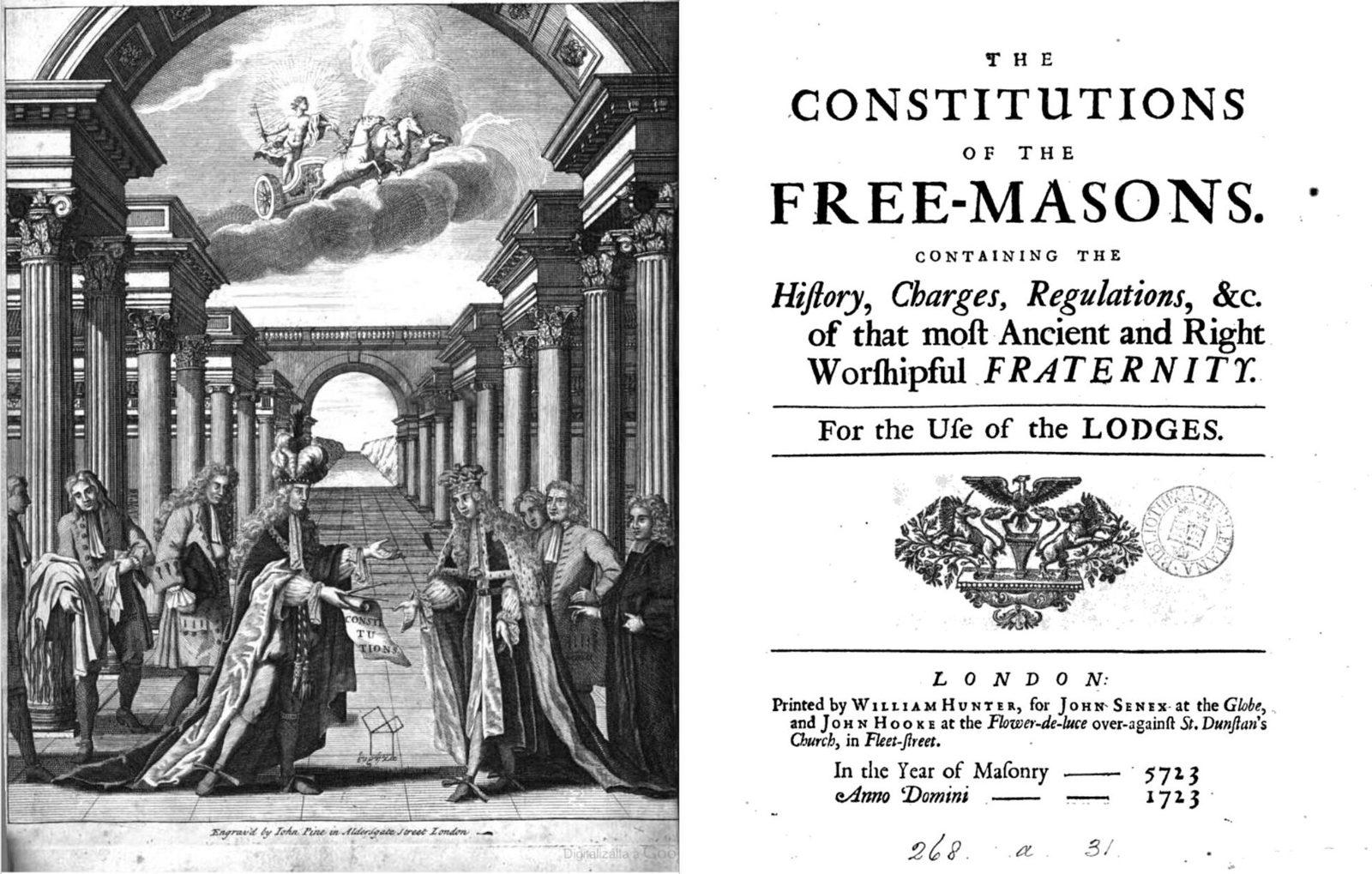
| 1723 | The new Grand Lodge publishes its rulebook, The Constitutions of the Free-Masons, compiled by James Anderson |
| 1725 | Grand Lodge of Ireland established |
| 1736 | Grand Lodge of Scotland established |
| 1751 | A rival “Antients” Grand Lodge forms in London. It calls the original body the “Moderns.” |
| 1813 | The two English Grand Lodges unite on December 27 as the United Grand Lodge of England |
Where historians disagree
The 1717 story comes from Anderson’s second edition of the Constitutions, published in 1738, more than 20 years after the event. In a 2017 paper, historians Andrew Prescott (University of Glasgow) and Susan Mitchell Sommers reviewed Anderson’s evidence and concluded that “little credence can be placed on it.” Drawing on William Stukeley’s diaries and an early minute book of the Lodge of Antiquity, they argue the Grand Lodge was not really established until the Duke of Montagu became Grand Master in 1721. Reported The 1717 date remains the official one, and the tercentenary was celebrated in 2017. The academic case for 1721 is a serious one, made in a paper given at a Masonic research conference. The exact date is debated. The broad picture is not.
Origin traditions and the record
| Claim | What the written record shows |
|---|---|
| Freemasonry was founded by King Solomon’s builders | A traditional teaching of the Craft, passed mouth to ear by design rather than written down, so the documentary record can neither confirm nor rule it out. |
| It descends directly from the Knights Templar | No surviving document connects the medieval Templars to Freemasonry. The medieval Templars were suppressed in the 1300s. The Masonic “Knights Templar” degree is a later addition: Smithsonian Magazine credits Thomas Smith Webb, a ritual writer of the 1790s, with creating it. |
| It began in 1717 | Lodges existed before 1717. That year (or 1721) marks the first Grand Lodge in the written record, not the first Masons. |
| Its origins are completely unknown | The Scottish records, the Old Charges and the London Grand Lodge give a solid outline in the written record, even though the transition from operative to speculative is still debated. |
Bottom line: Freemasonry grew out of real working lodges of stonemasons, took in gentlemen over the 1600s and organized under Grand Lodges in the 1700s. Its legends are legends, and its own historians say so. The records are interesting enough without them.
Freemasonry series: 1. Origins · 2. The American founding · 3. Service and charity · 4. Conspiracy theories · 5. Religion · Part of Secret Societies
Sources
- United Grand Lodge of England, History of Freemasonry
- Grand Lodge of South Carolina, Frequently Asked Questions (text from the Masonic Service Association of North America and Masonic Information Center)
- Grand Lodge of British Columbia and Yukon, The Regius Poem (text and translation)
- Masonic High Council, The Schaw Statutes of 1598 (text)
- Lodge of Edinburgh (Mary’s Chapel) No. 1
- George Washington’s Mount Vernon, Digital Encyclopedia: Freemasonry (Mark A. Tabbert)
- Smithsonian Magazine, “The Masonic Murder That Inspired the First Third Party in American Politics” (on Thomas Smith Webb’s rituals)
- Prescott, A. and Sommers, S. M., “Searching for the apple tree: revisiting the earliest years of organised English freemasonry” (2017), University of Glasgow Enlighten
Featured image: Anderson’sConstitutions, by Christophe Dioux. Public domain, via Wikimedia Commons. See all image credits.