

Secret Societies: This entry is one of many in our Secret Societies section. Each one separates what is documented from what is myth, and every claim is labeled and sourced.
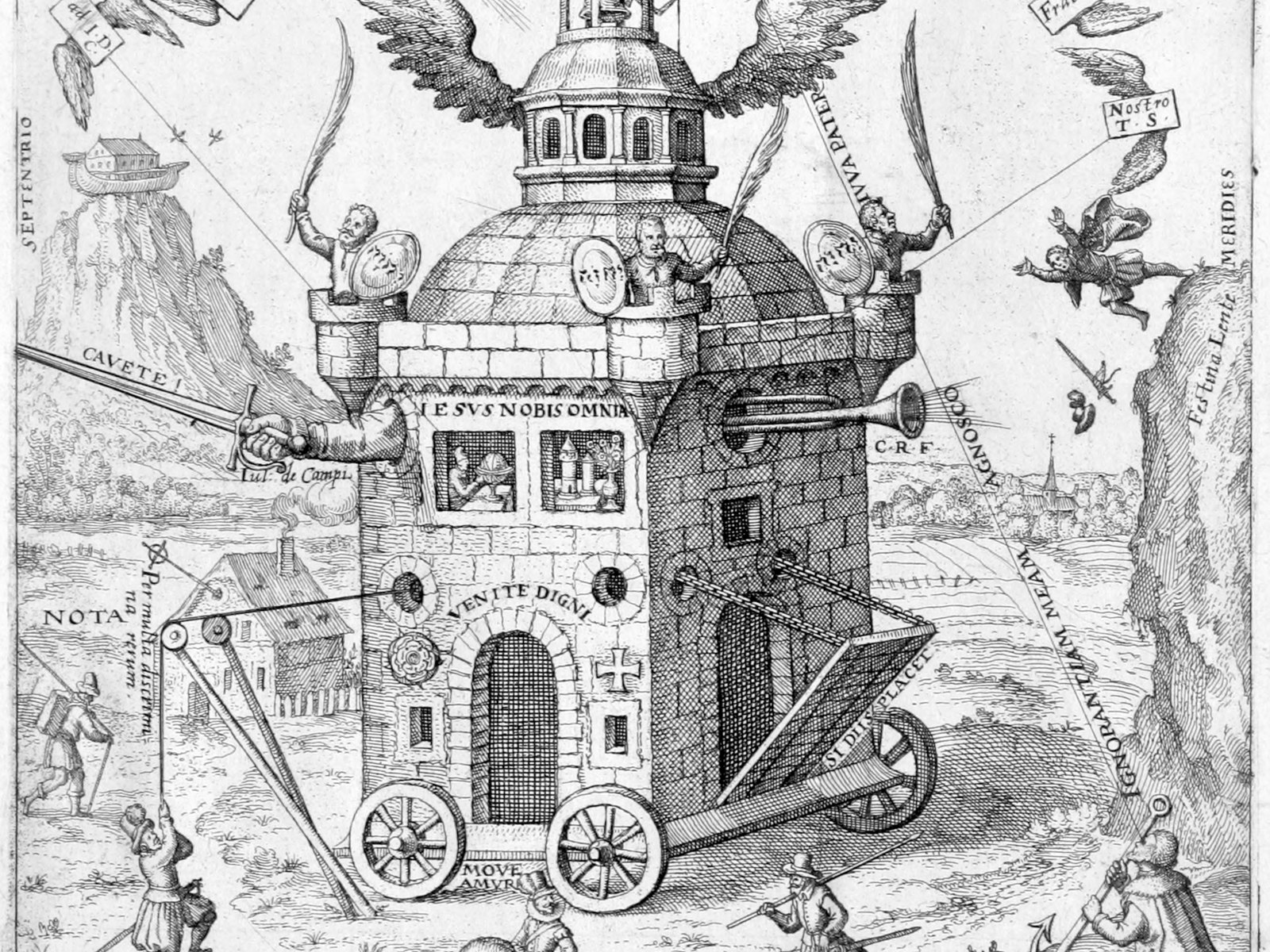
The Rosicrucian story begins with print, not with a lodge. Between 1614 and 1616, three anonymous works appeared in Germany describing a hidden brotherhood founded by a figure called Christian Rosenkreuz.
A short history
- The manifestos. The Fama Fraternitatis (1614), the Confessio Fraternitatis (1615) and The Chymical Wedding of Christian Rosenkreutz (1616) called for a reform of learning and religion and invited readers to contact the brotherhood (Brill).
- Authorship. The Fama and Confessio were printed anonymously in Kassel. The German theologian Johann Valentin Andreae later admitted in his memoir that he wrote The Chymical Wedding, and he dismissed it as a mere play (Brill).
- The reaction. Readers across Europe published replies and appeals, but no brotherhood ever came forward in public. The episode is often called the “Rosicrucian furore.”
- Later groups. Many organizations have since taken the Rosicrucian name. The largest, the Ancient and Mystical Order Rosae Crucis (AMORC), was founded in New York in 1915 by H. Spencer Lewis. It is based in San Jose, California, where it runs the Rosicrucian Egyptian Museum (Encyclopedia.com; KQED).
Documented vs. myth
The documented facts are the pamphlets, their dates, the debate they caused and the modern groups that use the name. Whether an organized brotherhood existed in 1614 is not supported by evidence. Many modern groups describe an ancient lineage, but that is a claim of faith and tradition, not a historical record.
Claims checked
Claim: The Rosicrucian manifestos were published in 1614 to 1616.
✅ Confirmed  Factual Lean note: Dated printed works that survive in libraries, discussed in peer-reviewed scholarship.
True (Brill).
Claim: A real Rosicrucian brotherhood existed in 1614 and has met in secret ever since.
⚠️ Disputed
Not supported. No members came forward when the pamphlets appeared, and scholars connect the texts to Andreae and his circle rather than to an existing order. Modern orders were founded much later (Brill; Encyclopedia.com).
Claim: Isaac Newton, Francis Bacon and Benjamin Franklin were Rosicrucians.
❓ Unconfirmed
Unconfirmed. AMORC lists such figures among famous Rosicrucians, but this is the order’s own tradition, not documented membership (Encyclopedia.com).
Bottom line: The Rosicrucians began as a literary and religious mystery in the 1600s. Later organizations adopted the name and the ideals. Claims of an unbroken secret line go beyond what the records show.
Label key
- ✅ Confirmed An official record, or two or more independent outlets, agree.
- ❓ Unconfirmed Reported or claimed, but not yet independently verified.
- ⚠️ Disputed Contradicted by the evidence or by credible sources, or actively contested.
- Factual Straight reporting that holds up across outlets on different sides.
 Leans Left The facts hold, but the coverage tilts left: one-sided, loaded language, missing context or a single anonymous source.
 Leans Right The facts hold, but the coverage tilts right: one-sided, loaded language, missing context or a single anonymous source.
 Likely Propaganda State-run or state-aligned media, a militant press office, a partisan campaign or group, or unverifiable spin.
Each story gets one confidence tag and one source-lean label, plus a one-line Lean note explaining the call. Every side is held to the same standard. More on how we cover the news.
Sources
- Brill, Reformation, Revolution, Renovation, ch. 3: The Authors and the Rosicrucian Worldview
- Encyclopedia.com, Rosicrucianism
- Rosicrucian Order AMORC, History (the order’s own account)
- KQED, San Jose’s Egyptian Museum and its Rosicrucian roots
Featured image: Templeofrosycross highres, by Schweighardt, Theophilus. Public domain, via Wikimedia Commons. See all image credits.