

The federal fiscal year runs from October 1 to September 30. For fiscal 2026, the Treasury’s Monthly Treasury Statement shows the government took in about $5.40 trillion and spent about $7.40 trillion, a deficit of about $1.99 trillion.
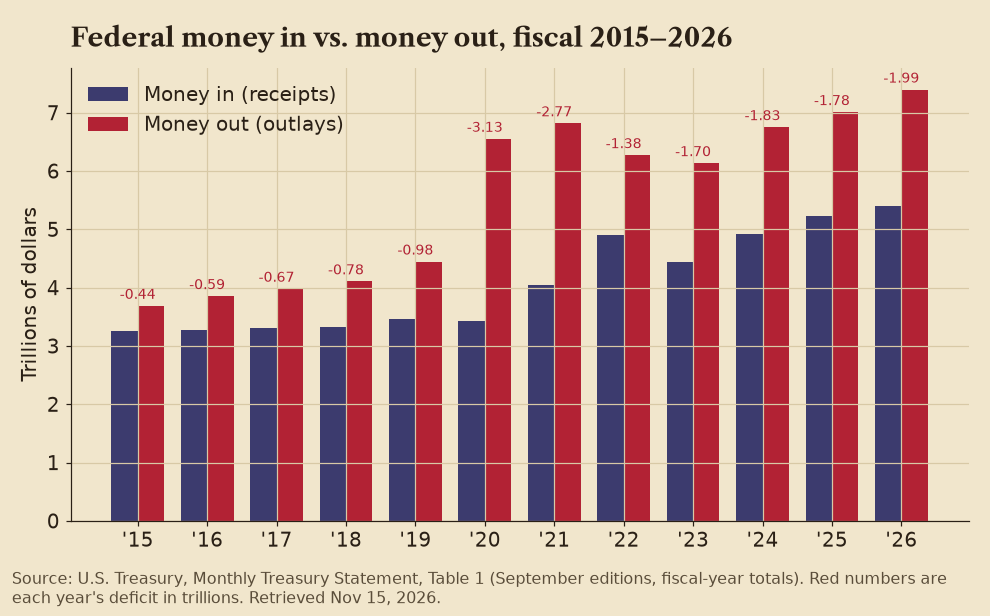
✅ Confirmed  Factual Lean note: Totals are from the Treasury’s own September Monthly Treasury Statements.
How to look up spending yourself
- USAspending.gov: Created under the Federal Funding Accountability and Transparency Act of 2006 and expanded by the DATA Act of 2014. Search by recipient, place, agency or program, down to individual contracts and grants.
- Treasury Fiscal Data: Monthly receipts and outlays, the debt and interest costs, with downloadable data.
- Congressional Budget Office: Nonpartisan cost estimates for bills and long-term budget outlooks.
- Agency inspectors general and GAO: Audits of waste, fraud and improper payments.
What to watch for
- Mandatory spending, such as Social Security, Medicare and Medicaid, plus interest on the debt, runs on autopilot unless Congress changes the law. Only the discretionary part is set each year in appropriations.
- A contract award is not the same as money paid out. USAspending shows both “obligations” and “outlays.”
- Grants often pass through states and nonprofits, so follow sub-awards too.
Label key
- ✅ Confirmed An official record, or two or more independent outlets, agree.
- ❓ Unconfirmed Reported or claimed, but not yet independently verified.
- ⚠️ Disputed Contradicted by the evidence or by credible sources, or actively contested.
- Factual Straight reporting that holds up across outlets on different sides.
 Leans Left The facts hold, but the coverage tilts left: one-sided, loaded language, missing context or a single anonymous source.
 Leans Right The facts hold, but the coverage tilts right: one-sided, loaded language, missing context or a single anonymous source.
 Likely Propaganda State-run or state-aligned media, a militant press office, a partisan campaign or group, or unverifiable spin.
Each story gets one confidence tag and one source-lean label, plus a one-line Lean note explaining the call. Every side is held to the same standard. More on how we cover the news.
Sources
- U.S. Treasury, Monthly Treasury Statement (Fiscal Data)
- USAspending.gov
- Congressional Budget Office
- U.S. Government Accountability Office