

Most American elections are run by thousands of county officials using paper trails, bipartisan poll workers and post-election checks. Every layer has weak points. Here are the main ones, and the safeguards built to catch problems.
Voter rolls
- The problem: Rolls include people who moved or died, because removing names is slow by law. The National Voter Registration Act of 1993 limits how and when officials can remove voters, to protect eligible voters from being purged by mistake.
- The safeguards: States match rolls against death records, motor-vehicle data and change-of-address lists, and many share data through interstate programs. Federal tools such as DHS’s SAVE system help check citizenship.
- Fair point, both sides: An outdated roll is not proof that anyone voted illegally, but it is an opening that should be closed.
Mail ballots
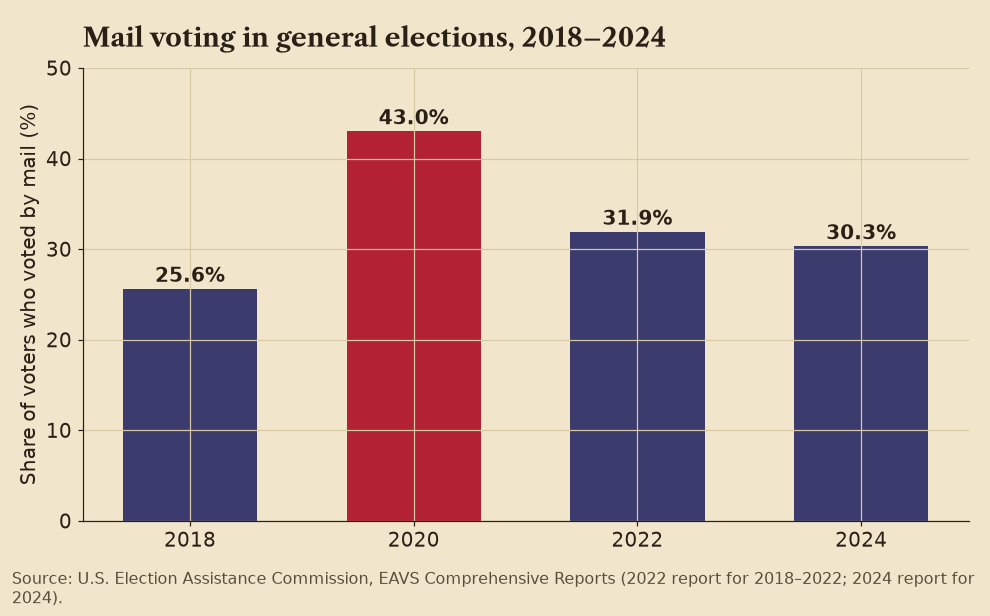
Mail ballots are where most documented large-scale fraud has happened, as in North Carolina in 2018 and Paterson in 2020, because the ballot leaves official custody. Mail voting surged in 2020 and has settled at about three in ten voters since.
- Safeguards: signature matching, ID numbers on envelopes (required in Texas since 2021), witness requirements in some states, ballot tracking, and rules limiting who may collect other people’s ballots.
- Texas: Mail voting is limited to voters 65 and older, voters who are sick or disabled, out of the county, expecting to give birth, or confined in jail but eligible.
✅ Confirmed  Factual Lean note: Mail-vote shares from the U.S. Election Assistance Commission; Texas rules from the Election Code and the Secretary of State.
Audits and chain of custody
- Paper: Most voters now cast or produce a paper ballot that can be recounted by hand.
- Audits: Many states hand-count a sample of ballots after each election. “Risk-limiting audits” use statistics to confirm the machine count with high confidence.
- Chain of custody: Logs, numbered seals, bipartisan teams and, in Texas’s larger counties, video monitoring of ballot-counting areas.
Voter ID
According to the National Conference of State Legislatures, 36 states have laws requesting or requiring voters to show some identification at the polls. Texas requires one of seven forms of photo ID, with an affidavit option for voters who have a reasonable impediment to getting one.
- Supporters say ID stops in-person impersonation and builds confidence, and polls show broad support across parties.
- Critics say in-person impersonation is the rarest kind of fraud (Heritage lists few such cases) and ID rules can burden eligible voters.
✅ Confirmed Factual Lean note: NCSL’s state-by-state tracker and the Texas Secretary of State.
Label key
- ✅ Confirmed An official record, or two or more independent outlets, agree.
- ❓ Unconfirmed Reported or claimed, but not yet independently verified.
- ⚠️ Disputed Contradicted by the evidence or by credible sources, or actively contested.
- Factual Straight reporting that holds up across outlets on different sides.
 Leans Left The facts hold, but the coverage tilts left: one-sided, loaded language, missing context or a single anonymous source.
 Leans Right The facts hold, but the coverage tilts right: one-sided, loaded language, missing context or a single anonymous source.
 Likely Propaganda State-run or state-aligned media, a militant press office, a partisan campaign or group, or unverifiable spin.
Each story gets one confidence tag and one source-lean label, plus a one-line Lean note explaining the call. Every side is held to the same standard. More on how we cover the news.
Sources
- U.S. Election Assistance Commission, 2024 EAVS Comprehensive Report (PDF)
- U.S. Election Assistance Commission, 2022 EAVS Comprehensive Report (PDF)
- NCSL, Voter ID Laws
- Texas Secretary of State, Required identification for voting in person
- Texas Secretary of State, Voting by mail
- U.S. Department of Justice, The National Voter Registration Act