

← Back to the timeline Wars & the Modern Age1944
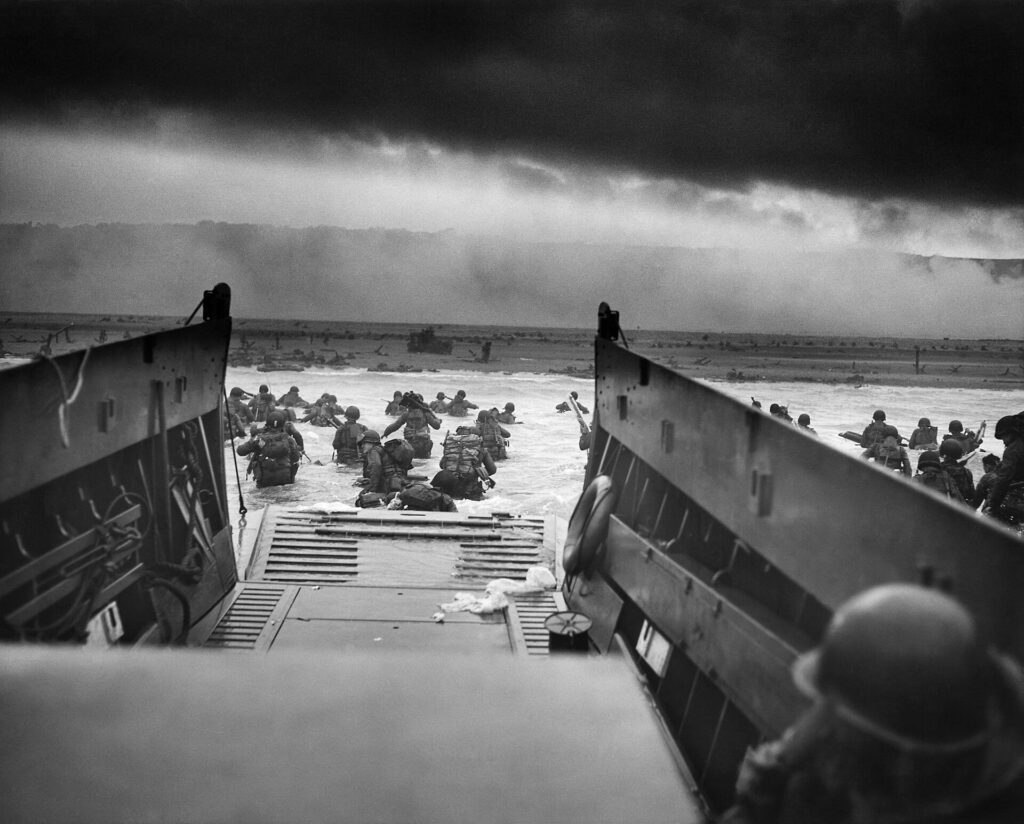
On June 6, 1944, Allied forces under General Dwight D. Eisenhower landed on five beaches in Normandy, France. It was the largest seaborne invasion in history and opened the long-awaited second front against Nazi Germany in Western Europe.
At a glance
| Date | June 6, 1944, delayed one day by storms |
|---|---|
| Code names | Operation Overlord (the invasion); Operation Neptune (the assault phase) |
| Beaches | Utah and Omaha (U.S.), Gold and Sword (British), Juno (Canadian) |
| Forces | 156,115 troops landed, including 23,400 airborne; 6,939 naval vessels; 11,590 aircraft |
| Allied dead | 4,436 named on the National D-Day Memorial wall: 2,519 Americans and 1,917 from other Allied nations |
The story
Paratroopers of the U.S. 82nd and 101st Airborne and the British 6th Airborne dropped behind the beaches overnight. At dawn, after naval and air bombardment, the seaborne waves went in. Utah Beach had the lightest losses. At Omaha, where the bombing had missed many German guns, the first waves were cut down, and about 2,400 Americans were killed, wounded or missing there before troops fought their way up the bluffs.
Twelve Allied nations took part. By June 30, more than 850,000 men had landed in Normandy. Paris was liberated on August 25, 1944, and Germany surrendered unconditionally in May 1945.
Eisenhower had written a short note to release if the landings failed, taking the blame entirely on himself. He never needed it.