

← Back to the timeline Wars & the Modern Age1969
On July 20, 1969, NASA's Apollo 11 lunar module Eagle landed in the Moon's Sea of Tranquility. Neil Armstrong, followed by Buzz Aldrin, became the first people to walk on another world, while Michael Collins circled overhead in the command module Columbia.
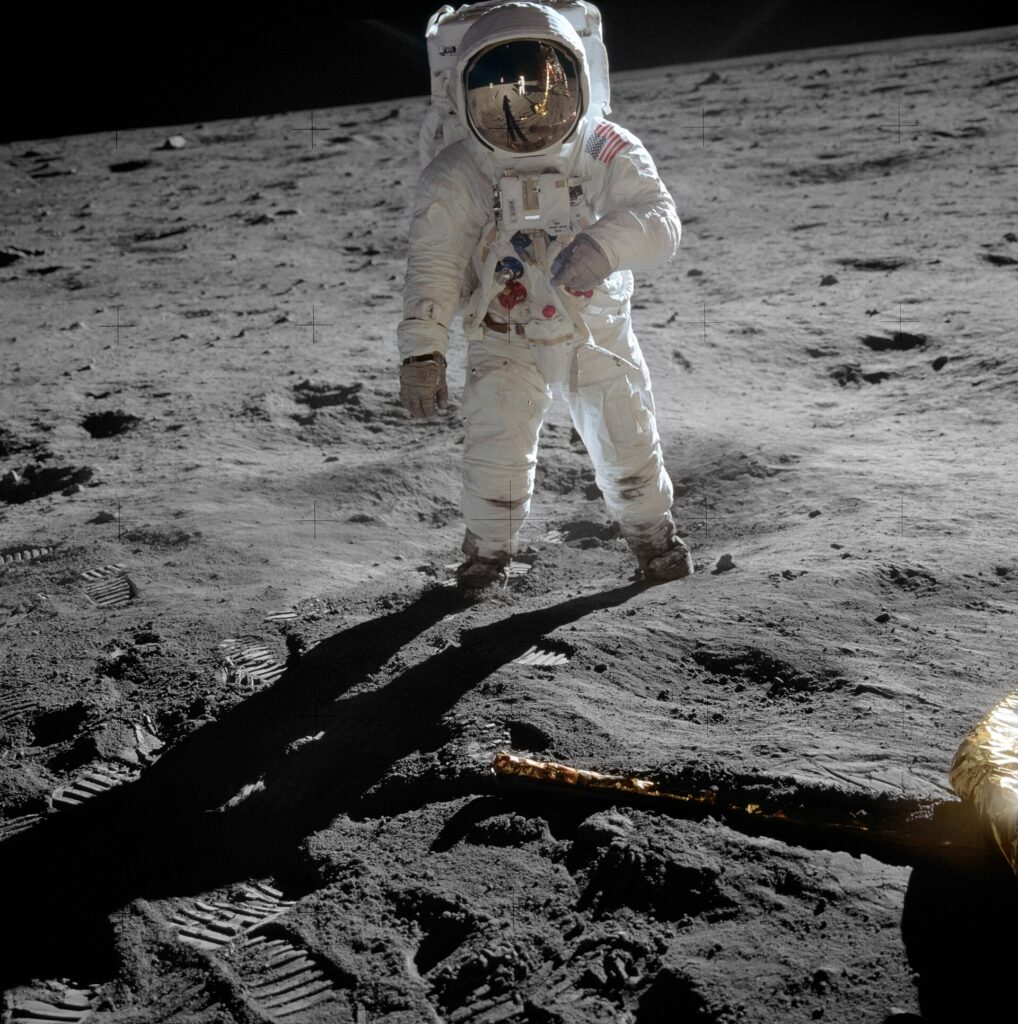
At a glance
| Launch | July 16, 1969, 9:32 a.m. EDT, Saturn V from Launch Pad 39A in Florida |
|---|---|
| Landing | July 20, 1969, Sea of Tranquility |
| First step | "One small step for a man, one giant leap for mankind" |
| On the surface | 21 hours, 36 minutes, including a moonwalk of more than two and a half hours |
| Return | Splashdown in the Pacific on July 24, 1969; recovered by USS Hornet |
| Audience | An estimated 650 million people watched on television |
The story
Apollo 11 met the goal President John F. Kennedy set before Congress on May 25, 1961: land a man on the Moon and return him safely to Earth before the decade was out. Armstrong took manual control during the final descent to steer around a boulder-strewn crater and set down about four miles past the planned point.
On the surface the two men set up a seismometer and a laser reflector that scientists still use to measure the distance to the Moon, collected rock and soil samples, and left a plaque reading, "We came in peace for all mankind." They also left medallions honoring the three Apollo 1 astronauts and two Soviet cosmonauts who had died.
Five more Apollo crews landed through December 1972. In all, 12 Americans have walked on the Moon.