

← Back to the timeline Middle Ages & Reformationc. 1455
By about 1455, Johannes Gutenberg's workshop in Mainz, Germany, had finished printing a Latin Bible with movable metal type. It was the first major book printed that way in Europe, and it started a revolution in how ideas spread.
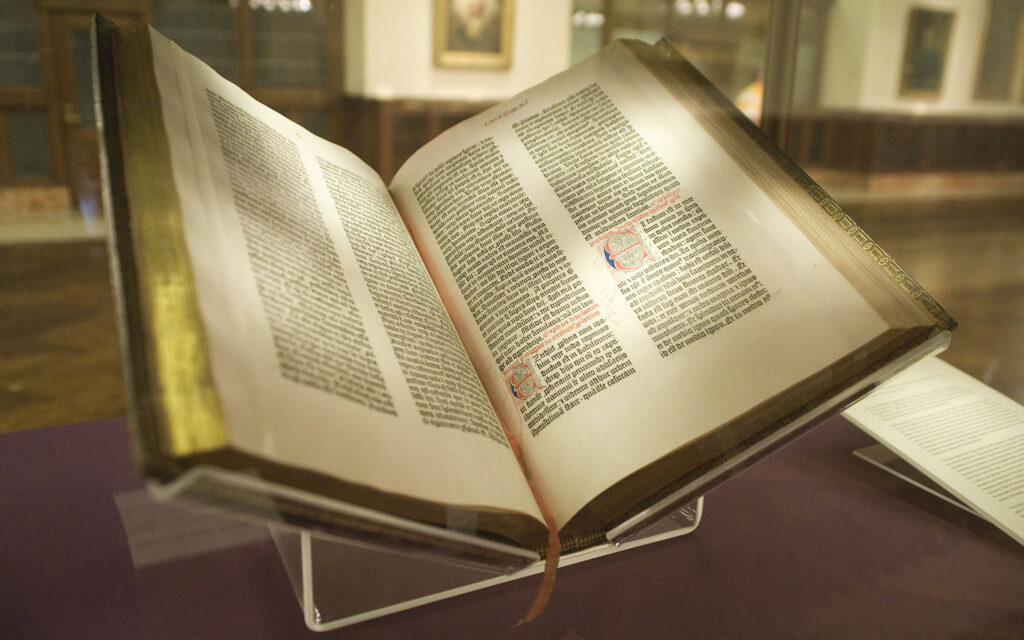
At a glance
| Date | Completed by about 1455 |
|---|---|
| Where | Mainz, in the Holy Roman Empire (today Germany) |
| Text | The Latin Vulgate Bible, set mostly in 42 lines per column, hence the name "42-line Bible" |
| Copies | Scholars estimate about 160–180 were printed, some on paper and some on vellum |
| Survivors | Fewer than 50 copies survive, complete or in part |
| Where to see one | The Library of Congress, the British Library, the Harry Ransom Center in Texas and others |
The story
Gutenberg, a goldsmith by training, brought several inventions together: a hand mold for casting large numbers of identical metal letters, an oil-based ink that would stick to metal, and a screw press adapted from the presses already used for wine and paper. Each page was set letter by letter, inked and pressed, and the type could then be reused.
A letter written in March 1455 by Enea Silvio Piccolomini, who later became Pope Pius II, reports that he had seen sections of the Bible for sale at Frankfurt and that the lettering was so clean it could be read without glasses. That same year Gutenberg lost a lawsuit to his financial backer, Johann Fust, who took over much of the business.
Printing spread fast. Within about 50 years, presses were running in more than 200 European towns. Books became cheaper, more people learned to read, and by 1517 printed pamphlets could carry an argument, such as Luther's, across a continent in weeks.