

← Back to the timeline Colonial Era1620
This month marks the anniversary of one of the most quoted documents in American history. The Mayflower Compact was signed aboard ship off Cape Cod on November 11, 1620, by the old calendar. That is November 21 on the modern calendar.
Why they needed it
When the Mayflower anchored in what is now Provincetown Harbor, some passengers questioned the leaders’ authority. The Pilgrims’ patent covered a settlement in the northern part of the Virginia Colony, and it was not valid in New England. William Bradford wrote of “discontents & murmurings” among some, and “mutinous speeches” from others. Edward Winslow’s account in Mourt’s Relation says that, “observing some not well affected to unity,” the leaders thought it good to “combine together in one body.”
The answer was an agreement among the passengers themselves.
What it says
…do by these presents solemnly and mutually, in the presence of God, and one of another, covenant and combine our selves together into a civil body politic, for our better ordering and preservation… and by virtue hereof to enact, constitute, and frame such just and equal laws… as shall be thought most meet and convenient for the general good of the Colony, unto which we promise all due submission and obedience.
The Mayflower Compact, 1620, as recorded by William Bradford
- It opens “In the name of God, Amen,” and states that the voyage was undertaken “for the glory of God, and advancement of the Christian faith.”
- The signers remained “loyal subjects” of King James.
- The original document has been lost. Its wording survives in Bradford’s history, Of Plymouth Plantation.
- The Pilgrim Monument and Provincetown Museum lists 41 signers.
What it was, and what it wasn’t
Pilgrim Hall Museum in Plymouth offers a careful verdict. The compact “was an interim document that governed the colonists only until an official charter was obtained.” The Council for New England granted a new patent in 1621. Calling the compact a forerunner of the Declaration of Independence or the Constitution, the museum says, “is an exaggeration.”
The museum also says the compact did embody the Pilgrims’ lasting principles: a “civil body politic” distinct from the church, and the rule of “just and equal laws.”
| Claim | Verdict |
|---|---|
| It was America’s first constitution | Overstated. It was a temporary agreement until a charter arrived. |
| It founded government on the consent of the governed | Fair. The signers bound themselves to laws they would make together. |
| It was a religious document | Partly. It invokes God and the Christian faith, but it creates a civil body, not a church. |
| It shows an early instinct for self-government | Yes, and later Americans drew on it |
Our view: Do not inflate it and do not dismiss it. In a crisis, a group of ordinary people chose written, mutual, lawful self-government under God over chaos. That habit, more than any one document, is what made America.
Sources
- Pilgrim Hall Museum, The Mayflower Compact
- Pilgrim Hall Museum, Peter Brown: 17th Century Documents (Bradford’s account of the compact)
- Pilgrim Monument and Provincetown Museum, Mayflower Compact (text and signers)
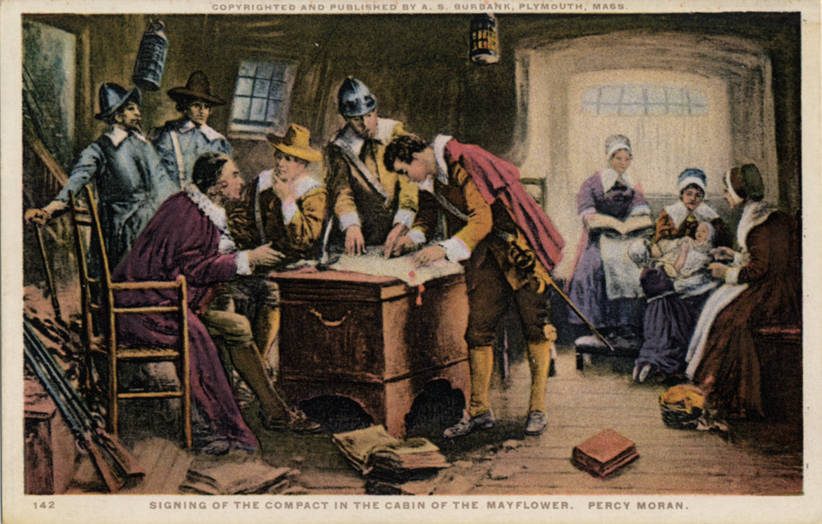
Featured image: Copyrighted and Published by A S Burbank, Signing of the Compact in the Mayflower, Percy Moran (NBY 22135), by Percy Moran (A. S. Burbank print). Public domain, via Wikimedia Commons. See all image credits.