

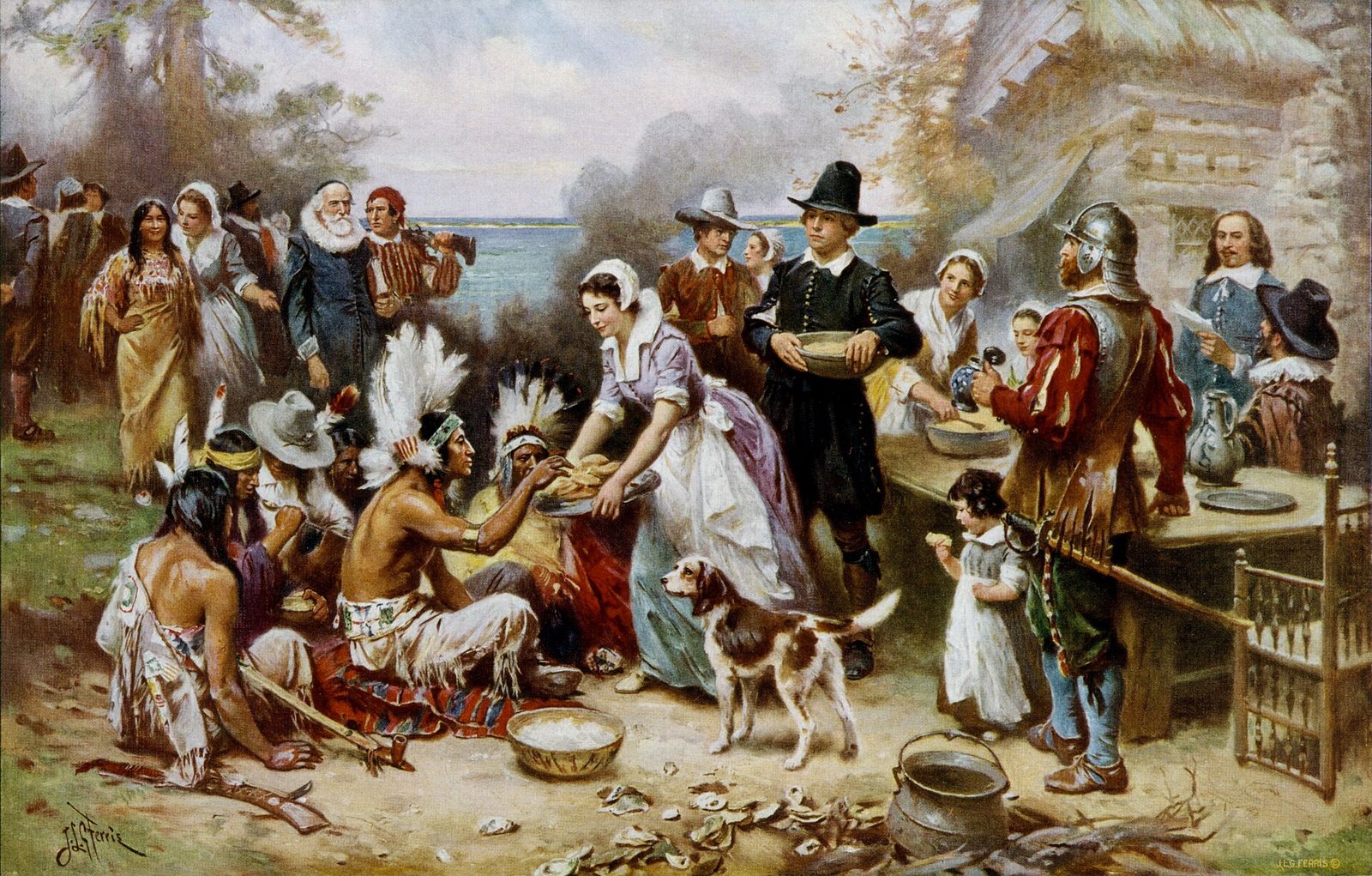
With Thanksgiving coming up, the internet fills with confident claims about the 1621 feast, both rosy and cynical. Pilgrim Hall Museum points out that there are exactly two primary sources for that autumn in Plymouth. Both are short. Read them, and you know more than most of the arguments do.
Source 1: Edward Winslow (December 11, 1621)
Winslow wrote a letter to a friend in England, published in 1622 in the book now called Mourt’s Relation:
…our harvest being gotten in, our governor sent four men on fowling, that so we might after a special manner rejoice together, after we had gathered the fruits of our labors… many of the Indians coming amongst us, and amongst the rest their greatest king Massasoit, with some ninety men, whom for three days we entertained and feasted, and they went out and killed five deer, which they brought to the plantation and bestowed on our governor…
Edward Winslow, Mourt’s Relation (modern spelling, via Pilgrim Hall Museum)
Source 2: William Bradford
Bradford’s history, Of Plymouth Plantation, describes that autumn’s plenty without describing the feast itself:
And besides waterfowl there was great store of wild turkeys, of which they took many, besides venison, etc.
William Bradford, Of Plymouth Plantation (modern spelling)
What the record supports
| Claim | Source says |
|---|---|
| There was a harvest celebration in autumn 1621 | Yes (Winslow) |
| It lasted three days | Yes (Winslow) |
| Massasoit and about 90 of his men attended | Yes (Winslow) |
| The Wampanoag brought five deer | Yes (Winslow) |
| Turkey was served | Possible. Bradford says they took many wild turkeys that season. Winslow says “fowl.” |
| It was called “Thanksgiving” at the time | Not in either source. Winslow calls it rejoicing. |
| It became an annual holiday from then on | No. The national holiday came from later proclamations. |
Who was there
Pilgrim Hall counts 53 Pilgrims at the feast: 22 men, 4 married women, 5 adolescent girls, 9 adolescent boys and 13 young children. They were all the Mayflower survivors. Bradford’s list shows how many had died in the first winter and spring. No other ship reached Plymouth until the Fortune, which arrived in November 1621, right after the celebration. Confirmed Winslow also wrote that “by the goodness of God, we are so far from want” in that season. Both writers credited Providence for the harvest.
Our view: The real story is better than the myth and the counter-myth. A remnant of survivors who had buried half their people held a three-day harvest celebration with roughly 90 Wampanoag guests who brought venison, and they thanked God. Tell that story at your table.
Sources
- Pilgrim Hall Museum, Primary Sources for “The First Thanksgiving” at Plymouth
- Gilder Lehrman Institute, Full text of Edward Winslow’s letter, December 11, 1621 (PDF)
- General Society of Mayflower Descendants, Thanksgiving History
Featured image: The First Thanksgiving cph.3g04961, by Jean Leon Gerome Ferris. Public domain, via Wikimedia Commons. See all image credits.