

The national debt is the total the federal government owes, built up from every year it spent more than it collected. The Treasury publishes it daily in its “Debt to the Penny” report.
The numbers
- On November 12, 2026, total public debt outstanding was about $40.61 trillion.
- About $32.82 trillion of that is “debt held by the public,” owed to investors, banks, foreign governments and the Federal Reserve. About $7.78 trillion is owed to federal trust funds such as Social Security.
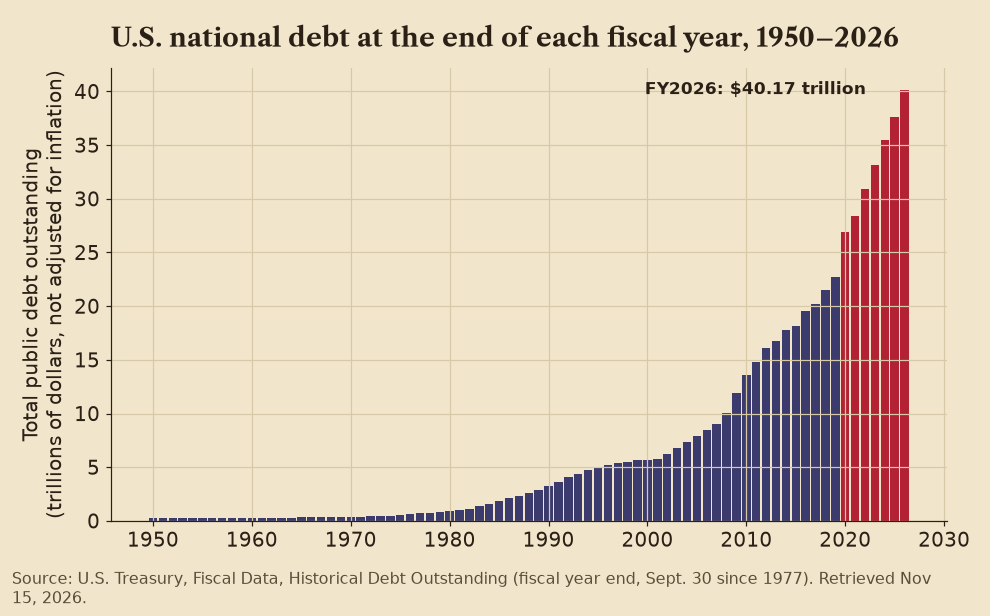
- At the end of fiscal 2026 (September 30), the debt stood at $40.17 trillion, up from $26.95 trillion at the end of fiscal 2020 and $5.67 trillion in 2000.
✅ Confirmed  Factual Lean note: Straight from the Treasury’s Debt to the Penny and Historical Debt Outstanding datasets.
How it got here
Debt rose under presidents and Congresses of both parties: wars in Afghanistan and Iraq, the 2001, 2003 and 2017 tax cuts, the 2008 financial crisis, pandemic relief in 2020 and 2021, and the steady growth of Social Security, Medicare and interest. The chart does not adjust for inflation or the size of the economy. Measured against the economy, debt held by the public is near the record set just after World War II, according to the Congressional Budget Office.
✅ Confirmed Factual Lean note: CBO’s long-term budget outlooks track debt as a share of GDP.
Why interest matters
As rates rose after 2022, interest became one of the fastest-growing parts of the budget. Every dollar spent on interest is a dollar not available for defense, roads or tax relief, and it is owed no matter which party is in charge.
What it means for your wallet
- Heavy federal borrowing can push up interest rates for everyone.
- Future taxes or spending cuts are the eventual bill. How to split them is the real political fight.
- Watch the debt-limit deadlines: a standoff can rattle markets even when it ends in a deal.
Not financial advice. This is general education from public sources, not financial advice for your situation. Talk to a qualified professional before you act.
Label key
- ✅ Confirmed An official record, or two or more independent outlets, agree.
- ❓ Unconfirmed Reported or claimed, but not yet independently verified.
- ⚠️ Disputed Contradicted by the evidence or by credible sources, or actively contested.
- Factual Straight reporting that holds up across outlets on different sides.
 Leans Left The facts hold, but the coverage tilts left: one-sided, loaded language, missing context or a single anonymous source.
 Leans Right The facts hold, but the coverage tilts right: one-sided, loaded language, missing context or a single anonymous source.
 Likely Propaganda State-run or state-aligned media, a militant press office, a partisan campaign or group, or unverifiable spin.
Each story gets one confidence tag and one source-lean label, plus a one-line Lean note explaining the call. Every side is held to the same standard. More on how we cover the news.
Sources
- U.S. Treasury, Debt to the Penny
- U.S. Treasury, Historical Debt Outstanding
- Congressional Budget Office, Budget and Economic Outlook
- Treasury, America’s Finance Guide: National Debt