

Analysis. A long, sourced look at the data center boom: what is being built and why, what it does to power bills, water, land and neighbors, what the public thinks, and what governments are doing about it. Facts are tagged and linked. The one section of opinion is labeled Our view (opinion). The map below holds 102 sites, and you can download its data.
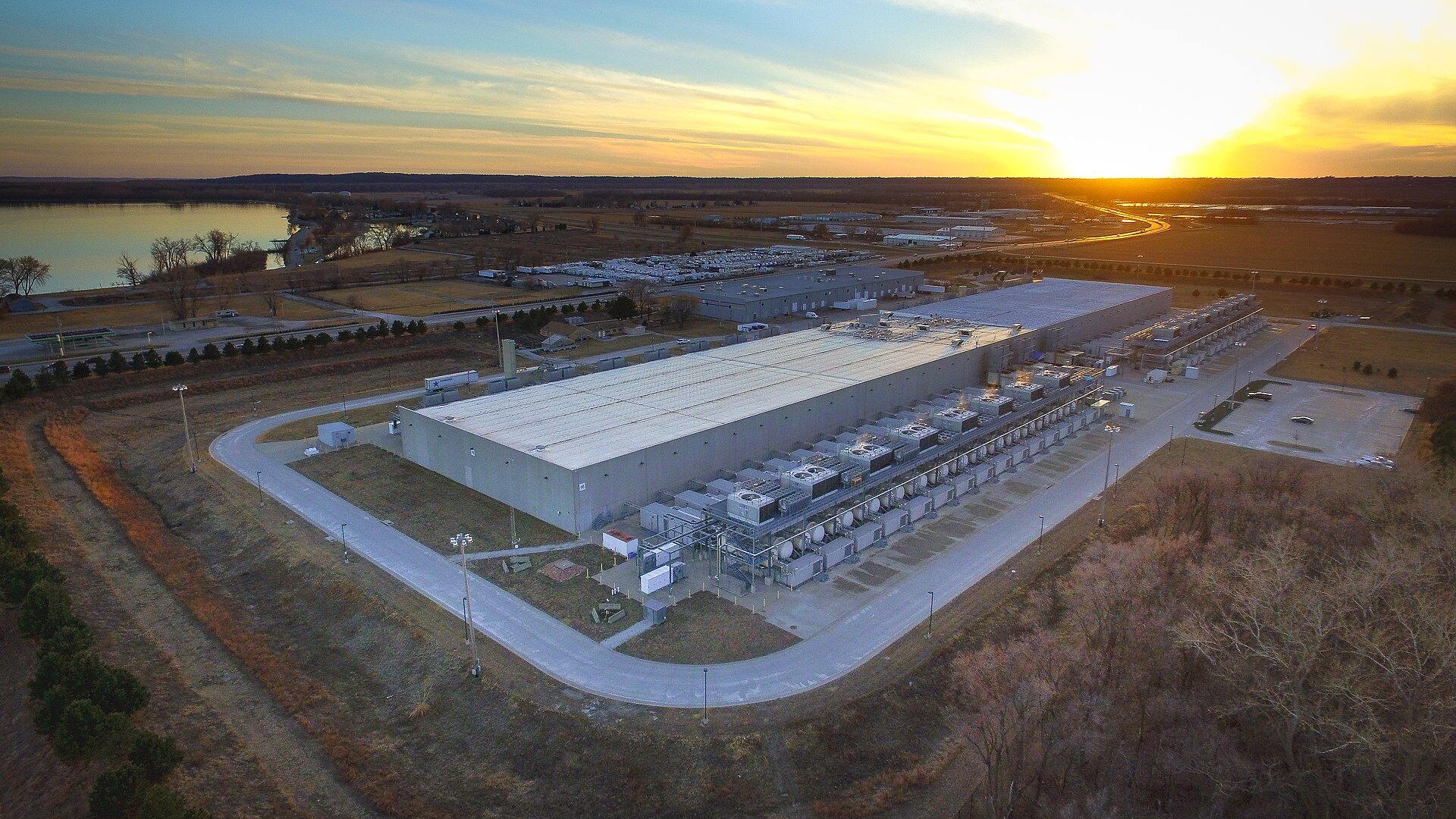
Every search, streamed show, bank transfer and chatbot answer runs through a data center: a large, windowless building packed with computers, cooling gear and power equipment. For most of the internet age, these buildings grew quietly. Artificial intelligence changed that. The biggest new campuses draw as much power as a city, cost tens of billions of dollars, and are going up in farm towns and suburbs that had never heard the word “hyperscale.”
The result is one of the most lopsided debates in American life right now. Tech companies and both major parties in Washington call these buildings vital to the economy and national security. Most Americans, in poll after poll, do not want one near their home. Both sides have real facts on their side. This piece lays them out.
At a glance
- 4.4% of U.S. electricity went to data centers in 2023 (176 TWh). Lawrence Berkeley National Laboratory projects 6.7% to 12% by 2028. LBNL, Dec. 2024
- 485 TWh of electricity went to data centers worldwide in 2025, up 17% in a year. The IEA projects about 950 TWh by 2030, roughly 3% of global demand. IEA, April 2026
- $720 billion to $740 billion is what Amazon, Alphabet, Microsoft and Meta guided for 2026 capital spending, most of it for AI infrastructure. company guidance, Oct. 2026
- $325/MW-day, the price cap, is where the PJM grid’s latest capacity auction cleared. It still came up 6,831 MW short of its reliability target. The grid’s independent monitor says data center load added $6.27 billion to that one auction’s cost. PJM, Monitoring Analytics
- 61% to 70% of Americans oppose a new data center in their area, across five national polls taken from March to September 2026. Gallup, NPR/PBS/Marist
- 39% of Loudoun County, Virginia’s budget, or $1.2 billion, came from data center property taxes in FY2026. Loudoun County
✅ Confirmed  Factual Lean note: All figures are from government agencies, grid operators, published company guidance or national pollsters, linked above.
What a data center is, and what AI changed
A data center is a building for computers, along with the electricity, cooling, fiber and security those computers need. Older data centers were measured in a few megawatts. A megawatt (MW) is roughly what several hundred homes use on average. Today’s AI campuses are measured in hundreds of megawatts, or gigawatts (GW). One gigawatt is 1,000 MW, about the output of a large nuclear reactor.
AI changed the math in three ways. Training a frontier model takes tens or hundreds of thousands of specialized chips running side by side for months. Those chips pack far more heat into each rack, so operators are moving from air cooling to liquid cooling. And because the chips are expensive and in short supply, companies want them running as close to nonstop as they can, which means steady, enormous power demand.
The IEA reports that the energy used per AI task is falling fast, by at least ten times a year in recent years. Use is growing even faster, though, and newer tasks such as video generation, reasoning and AI “agents” can take hundreds or thousands of times more energy per query than a simple text answer. That is why total demand keeps climbing even as the chips get more efficient. IEA, Key Questions on Energy and AI
✅ Confirmed Factual Lean note: Efficiency and growth figures are from the IEA’s April 2026 report.
The AI boom paying for it
The money behind this build is larger than anything in modern business history. The IEA notes that five large tech companies spent more than $400 billion on capital projects in 2025, more than global investment in oil and gas production, and expects another 75% jump in 2026. IEA
| Company | 2026 capital spending guidance | Note |
|---|---|---|
| Amazon | About $220 billion | Expects “meaningfully more” in 2027 |
| Alphabet (Google) | $195 billion to $205 billion | Expects a significant increase in 2027 |
| Microsoft | About $170 billion (calendar 2026) | Cut from $175 billion; delayed third-party capacity |
| Meta | $135 billion to $145 billion | Raised the floor from $130 billion |
| Total | About $720 billion to $740 billion | Bases differ by company |
Some warning signs sit beside those numbers. Alphabet reported negative free cash flow for a second straight quarter, and Meta for one quarter, because spending outran the cash their businesses brought in. Microsoft said some of the outside capacity it had ordered arrived late. CNBC, Oct. 29, 2026
Stargate and the gigawatt campuses
- Stargate. On Jan. 21, 2025, OpenAI, SoftBank, Oracle and the Abu Dhabi fund MGX announced a company that “intends to invest $500 billion over the next four years,” starting with $100 billion. OpenAI By September 2025 the partners named sites in Texas, New Mexico, Ohio and the Midwest, bringing planned capacity to “nearly 7 gigawatts.” OpenAI Epoch AI counts seven Stargate sites with more than 9 GW planned. Epoch AI
- Abilene, Texas is the only Stargate site running. Oracle said on Sept. 10, 2026 that six of eight buildings, 618 MW, had been delivered. Epoch AI, citing Oracle
- PORTS-Pike, Ohio. In August 2026 OpenAI agreed to lease about 8 GW of computing capacity at the former Portsmouth uranium enrichment plant. The first 800 MW is due in 2028, and later phases need new gas plants and transmission lines. OpenAI
- Project Camellia, Georgia. OpenAI is contracting 3.2 GW from Georgia Power, delivered from 2028 to 2032. OpenAI
- Others. Epoch AI’s satellite tracking estimates xAI’s Colossus 2 in Memphis at about 946 MW, Amazon’s Project Rainier campus in New Carlisle, Indiana (used by Anthropic) at about 1,037 MW, and Meta’s Hyperion in Louisiana at roughly 2.2 GW when its first phase is done. These are estimates; see the map for sources. Epoch AI
✅ Confirmed Factual Lean note: Company announcements, earnings statements and an independent satellite-based tracker.
Why it matters for America and the world
Supporters make four main arguments. Each has evidence behind it.
- It is the backbone of the economy. Cloud services, payments, hospitals, logistics and government systems all run in data centers. The White House calls data center infrastructure “the foundation of the internet, cloud computing, and AI” and says it “supports our economic and national security.” White House, March 2026
- The AI race is a contest of power and buildings. The IEA’s head, Fatih Birol, put it this way: “there is no AI without energy,” and countries that offer “secure, affordable and rapid access to electricity will be one step ahead.” IEA
- It can pay for the grid of the future. The IEA reports that tech firms signed about 40% of all corporate renewable power deals in 2025, and that deals between data center operators and planned small nuclear reactors grew from 25 GW to 45 GW. IEA
- AI may make industry more efficient. The IEA estimates proven AI uses could cut energy costs in energy-heavy industries by 3 to 10 percentage points. IEA
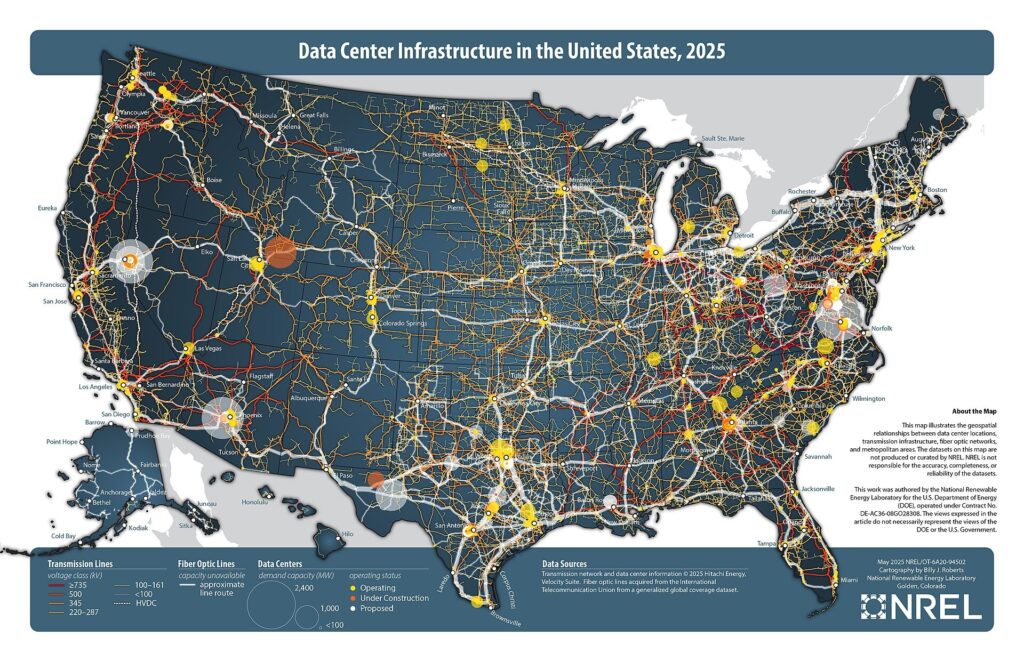
The world picture. The U.S. leads, but it is not alone. In Ireland, a European hub for U.S. tech firms, data centers used 23% of all metered electricity in 2025, up from 5% in 2015. That is close to the 28% used by every home in the country. Central Statistics Office, Ireland The map also shows large AI campuses in Malaysia’s Johor state, northern China, the UAE, the Nordics and the UK.
✅ Confirmed Factual Lean note: Quoted claims are attributed. Irish figures are official statistics.
The map: 102 data centers, built, building and proposed
The map opens with a count of tracked sites in each state or country. Tap a number to zoom in, then tap a dot for what is known about that site: operator, status, years, power, estimated cost, water where it is known, and source links. Use the checkboxes to filter by status. Turn on the density layer to see where sites cluster. Drag the year slider, or press play, to watch the build-out from 2018 to the projected picture in 2030.
Map: AI and hyperscale data centers
Numbers show how many tracked sites are in each state or country. Zoom in or tap a number to see the sites, then tap a dot for its facts and sources.
Site counts by state and country
Download the data: JSON · CSV. Most sites and all est. figures come from Epoch AI (CC BY 4.0). Years after 2026 are projections.
What the map shows today: 77 operating, 21 under construction, 3 proposed and 1 blocked or withdrawn. One marker, Loudoun County, stands for a whole county: about 245 buildings.
Read this before you use the numbers. This is not a list of every data center. There are thousands, and no complete public list exists. Most sites here come from Epoch AI’s Frontier Data Centers dataset (CC BY 4.0), which tracks the largest AI campuses using satellite photos, permits and company statements. Power, cost and water figures for those sites are Epoch AI estimates, not company disclosures, and anything after November 2026 is a projection. We added a handful of notable proposed or contested projects from company statements, government pages and news reports, each linked. Locations are approximate. Square footage and cooling type are blank for most sites because operators rarely publish them. Where a fact is not public, we left it blank.
Impacts on local communities
Power bills and grid strain
This is the biggest fight, and the facts here are more nuanced than either side tends to admit.
- Demand is real. U.S. data centers used 176 TWh in 2023, 4.4% of the nation’s electricity. LBNL projects 325 to 580 TWh by 2028. LBNL
- The mid-Atlantic grid is short. PJM runs the grid for all or part of 13 states and D.C. Its July 2026 auction for 2028–29 cleared at the $325/MW-day cap, cost $16.4 billion, and still fell 6,831 MW short of its reliability requirement. PJM PJM’s independent market monitor wrote that “there would have been no shortfall but for the forecast data center load,” and that data center load raised costs for other customers by $6.27 billion in that auction and by $29.4 billion over the last four. Monitoring Analytics, Oct. 30, 2026
- Bills have risen, but not by the viral number. A widely shared figure says bills near data centers rose “as much as 267%.” That number came from a Bloomberg analysis of wholesale prices at certain grid points, not household bills. PolitiFact rated a senator’s use of it Mostly False, while noting that average U.S. residential rates rose 42% in five years and data centers are “a major driver in some places.” From March 2021 to March 2026, rates rose 94% in D.C., 74% in Maryland and 58% in New York. PolitiFact, June 12, 2026
- Not every factor is data centers. PolitiFact also cites a 2026 LBNL report pointing to equipment costs, an aging grid and clean energy rules as other causes. PolitiFact
- It can cut the other way. Georgia Power says its large-load contracts, including OpenAI’s, will deliver about $950 million a year in savings for other customers starting in 2029, because big customers help cover fixed grid costs. That is the utility’s own estimate. Georgia Power FOX 5 Atlanta reports that new Georgia Tech research finds data centers raise local wages but bring about a 5% rise in residential electricity prices. FOX 5 Atlanta
✅ Confirmed Factual Lean note: Grid figures are from PJM and its independent monitor. The 267% claim is explained by a fact-checker. The savings claim is the utility’s own.
Water
Many data centers cool their chips by evaporating water, the way sweat cools skin. LBNL estimates U.S. data centers used about 66 billion liters of water directly in 2023, about 17.4 billion gallons. That is small next to farming or power plants nationally, but it can be large for one town’s system. Generating the electricity those data centers used took another 800 billion liters, about 211 billion gallons, at power plants. LBNL projects that hyperscale sites alone could use 60 to 124 billion liters (about 16 to 33 billion gallons) directly by 2028. LBNL
Newer AI campuses increasingly promise closed-loop cooling that is filled once and recirculated. OpenAI says the ongoing water use at its Ohio and Georgia sites will be “comparable to an office building,” and has pledged to publish the actual figures once designs are final. OpenAI The catch is that closed-loop, air-cooled systems generally use more electricity, so the water saved on site can show up as more power demand. Where Epoch AI has estimated a site’s water use, the map shows it.
✅ Confirmed Factual Lean note: National estimates are from LBNL. Company water claims are attributed and not yet verified by public data.
Noise
Thousands of cooling fans make a constant low hum that carries. In Great Oak, a 291-home neighborhood outside Manassas, Virginia, residents have complained since 2022 about four Amazon data centers, one about 600 feet from some back decks. In 2022 a county police reading in one yard measured 60.1 decibels, above the 55-decibel nighttime limit. Amazon’s own 48-hour study averaged 52.3 decibels at night, within the limit. Prince William Times In early 2025, residents said dozens of Amazon’s emergency diesel generators fired up and sounded like “a hair dryer right on your ear.” Prince William Times
Amazon told WUSA9 that it meets all relevant sound standards, installed sound shrouds, and was “reengineering and installing new equipment to continue to eliminate unwanted sounds.” WUSA9
✅ Confirmed Factual Lean note: Measurements from both the county police and Amazon are reported side by side.
Land and farmland
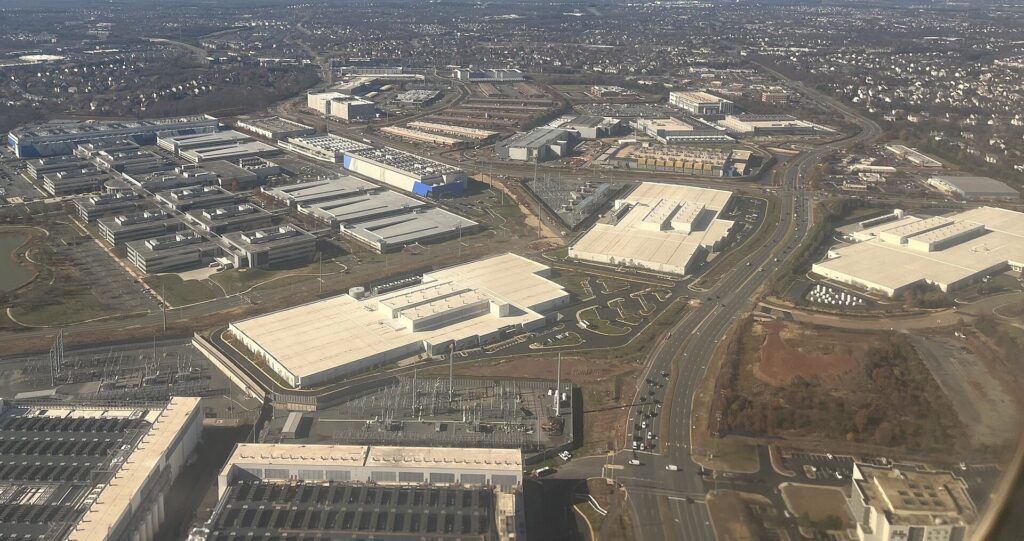
- Prince William Digital Gateway, Virginia: a proposed 23-million-square-foot complex on 2,100 acres next to Manassas National Battlefield Park. Courts voided its rezonings for defective public notice, and the developer dropped its last appeal in July 2026. Virginia Business
- Project Marvel, Bessemer, Alabama: about 700 acres rezoned from agricultural to light industrial in November 2025 on a 5–2 vote, and 914 more acres in April 2026. WBRC, ABC 33/40
- Loudoun County, Virginia: about 245 data center buildings totaling 58.3 million square feet, built or under construction. Loudoun County
Tax breaks vs. jobs and tax revenue
This is where the trade-off is clearest. Data centers are expensive buildings full of very expensive equipment, so they pay large local property taxes. They employ few people once built.
- The case for: In Loudoun County, data centers paid $1.2 billion in real and personal property taxes in FY2026, 39% of the county budget. The FY2027 budget projects $1.3 billion, or 40%. Loudoun County
- The cost: Virginia’s sales tax exemption on data center equipment cost the state about $1.4 billion in FY2025 and has averaged $812 million a year over five years, its largest incentive by far. The state’s auditors estimated the exemption returned 13 to 26 cents in state tax revenue for every dollar it cost from FY2021 to FY2025. They also found it supported tens of thousands of jobs across the state’s economy. JLARC, Economic Development Incentives 2026
- Construction jobs vs. permanent jobs: Project Marvel promises 1,000 construction jobs and 330 permanent ones averaging $112,550 a year. WBRC Project Blue near Tucson expects about 180 workers. KOLD OpenAI’s 8 GW Ohio campus cites 35,000 construction jobs over six years and 2,500 permanent jobs. OpenAI
✅ Confirmed Factual Lean note: Revenue and cost figures are from the county and the state’s own legislative auditors. Job counts are developer projections.
Diesel backup, gas turbines and emissions
Data centers keep backup generators, usually diesel, sized above their peak load so they never go dark. A presentation for the national association of state air regulators counted 188 Virginia data center air permits as of Oct. 1, 2025, and about 18,000 MW of backup generation in Northern Virginia alone. NACAA presentation An advocacy group’s analysis of all Virginia permits through 2025 puts the statewide total at 27 GW across more than 10,500 units. Better Data Center Project (advocacy group)
Because grid hookups can take years, some developers now build their own gas power on site. The IEA says such projects are “largely in the United States.” IEA The most disputed case is xAI’s Colossus 2 in Memphis. In April 2026 the NAACP, represented by the Southern Environmental Law Center and Earthjustice, sued xAI under the Clean Air Act over gas turbines in Southaven, Mississippi, that it says run without permits. The case is pending. SELC
LBNL estimates the electricity U.S. data centers used in 2023 came with about 61 billion kilograms of CO2-equivalent emissions, based on local grid mixes. LBNL
❓ Unconfirmed Factual Lean note: Permit totals come from a regulators’ slide deck and an advocacy analysis, not an official statewide tally. The xAI claims are allegations in a pending lawsuit.
What people are saying
| Poll | Dates | Oppose local data center | Support |
|---|---|---|---|
| Gallup | March 2–18, 2026 | 70% | About 25% (“barely a quarter”) |
| Annenberg Public Policy Center | June 16–July 19, 2026 | 61% (up from 49% in spring) | 14% |
| UMass Amherst | Aug. 21–26, 2026 | 65% | 11% |
| Economist/YouGov | Aug. 28–31, 2026 | 63% | 19% |
| NPR/PBS News/Marist | Sept. 14–15, 2026 | 65% (registered voters) | 25% |
Opposition crosses party lines but is not even. In the Economist/YouGov poll, 71% of Democrats, 66% of independents and 52% of Republicans opposed a local data center, and 60% of all adults expected one to raise their power bills. YouGov In the Marist poll, Republicans were split, 46% in favor and 44% opposed. PBS Annenberg found opposition highest among adults under 30, at 70%. Annenberg
That opposition is stopping projects. Data Center Watch, a research group that tracks local fights, counted at least 75 projects worth about $130 billion blocked or delayed in the first quarter of 2026, and at least 45 more worth nearly $68 billion in the second. Q1 report, Q2 report
✅ Confirmed Factual Lean note: Five independent national polls with published methods. The project counts come from one tracking group.
Voices on both sides
- Sen. Bernie Sanders (I-Vt.), calling for a national pause in December 2025: “This moratorium will give democracy a chance to catch up with the transformative changes that we are witnessing.” Business Insider
- Gov. Ron DeSantis (R-Fla.), signing a law to keep data center costs off household bills: “You should not pay one more red cent for electricity because of a hyperscale data center as an individual.” FOX 13 Tampa Bay
- Josh Levi, president of the Data Center Coalition, the industry’s trade group: “Data centers are committed to being responsible and responsive partners in localities where they operate.” He added that in Georgia the industry “supported over 187,000 jobs” and “generated $2.1 billion in state and local taxes in 2024.” Those are industry figures. FOX 5 Atlanta
- The White House, announcing a pledge by seven tech companies to pay for their own power: “the American people should not be footing the bill.” White House fact sheet
- Michael Turner, Bessemer City Schools superintendent, backing Project Marvel, called the vote “critically important to the future of our students.” Councilman Cleo King, who voted no, said residents nearby “just wasn’t represented.” WBRC
- Vivek Bharathan, a Tucson-area opponent of Project Blue, as construction began on county land after the city had rejected it: “Seeing the construction is really heartbreaking.” KOLD
- Roger Yackel, a Prince William County resident: “I am not against data centers. I am against building noisy data centers next to residential community.” WUSA9
How governments are responding
States
- New York became the first state with a statewide pause. Gov. Kathy Hochul’s Executive Order 62 (July 14, 2026) holds state environmental permits for new data centers of 50 MW or more until a statewide environmental review is done. Local permits are not affected. Governor’s office A broader bill with its own one-year moratorium at 20 MW passed the Legislature on June 4 and is awaiting her action. NY Senate
- Maine passed a moratorium on data centers over 20 MW through November 2027. Gov. Janet Mills vetoed it. Maine Morning Star, NCSL
- 16 states considered bans or moratoriums in 2026, according to the National Conference of State Legislatures. Most failed or remain in committee. NCSL
- Texas (SB 6, signed June 2025) requires new large loads to accept curtailment rules so they can be cut off in grid emergencies. Texas Legislature
- Ohio regulators approved an AEP Ohio tariff making large data centers pay for at least 85% of the power they reserve, whether they use it or not. AEP
- Florida (SB 484, signed May 2026) requires special tariffs for customers of 50 MW or more, bars shifting their costs to other customers, and adds water permit rules for large data centers. Florida Senate
Federal
- July 2025: President Trump signed an executive order to speed federal permitting for data centers, as part of the administration’s AI Action Plan. White House
- March 2026: Amazon, Google, Meta, Microsoft, OpenAI, Oracle and xAI signed the White House’s Ratepayer Protection Pledge, agreeing to “build, bring, or buy” new power and to pay for grid upgrades for their data centers. The pledge is voluntary and relies on utilities and states to enforce it. White House fact sheet, proclamation
- June 2026: The Federal Energy Regulatory Commission ordered the six regional grid operators it oversees to justify or change how they connect large loads such as data centers, including how costs are assigned. Responses are due in November 2026. FERC
✅ Confirmed Factual Lean note: Laws, orders and filings linked to the issuing governments.
Advantages and challenges, side by side
| Advantages | Challenges |
|---|---|
| Large property tax base. Loudoun gets 39% of its budget from data centers. | Few permanent jobs per dollar invested. States give large tax breaks with partial payback. |
| Thousands of construction jobs during multi-year builds. | Construction surges end, and permanent staffing is in the hundreds. |
| Pays for new power plants, transmission and nuclear deals that others can use. | Grid shortfalls and higher capacity prices in PJM. Risk of costs landing on households. |
| Underpins the cloud, AI and national security computing. | Diesel backup, on-site gas turbines and emissions. |
| Closed-loop designs can use little water on site. | Evaporative cooling can strain local water. Disclosure is spotty. |
| Can act as a flexible grid resource. OpenAI’s Georgia site says it can cut 1,000 MW in a crunch. | Constant fan noise near homes. Large rezonings of farm and rural land. |
| Most of the build is privately financed. | If AI demand disappoints, communities and utilities may be left with stranded buildings and grid upgrades. |
Our view (opinion)
Opinion. Everything above is sourced fact. This section is our judgment, and readers may weigh it differently.
Data centers are not the villain in this story, and they are not a free lunch either. The country does need the computing. The question that matters most is who pays and who decides.
On cost, the fair rule is simple, and both a Republican governor in Florida and a Democratic governor in New York have landed close to it: a company that brings a gigawatt of new demand should pay the full cost of serving it, in writing, enforced by state regulators. A voluntary pledge is a start. A tariff is a guarantee. The PJM monitor’s numbers suggest households in the mid-Atlantic are already carrying some of this bill.
On decisions, the backlash shown in the polls is not anti-technology hysteria. A lot of it is a reaction to secrecy: nondisclosure agreements, code-named projects and rezonings voted on before the public knows who the tenant is or how much water and power it will use. Projects that disclose those numbers up front, and put community benefits in binding agreements, deserve more trust. Projects that cannot do that probably should not get tax breaks.
And on the boom itself, prudence is warranted. When the biggest companies in the world are spending more than their businesses earn on buildings that take years to fill, towns and utilities should make sure they are not the ones left holding the risk if demand falls short.
What we could not verify, and what we left out
- No complete list of data centers exists. The map covers large AI campuses tracked by Epoch AI plus a few notable additions. Thousands of smaller and older facilities, including most colocation buildings in Northern Virginia, are not shown one by one.
- Power, cost and water figures on the map are mostly estimates from Epoch AI’s satellite and permit analysis, and years after 2026 are projections. Companies rarely confirm them.
- Water use is rarely disclosed site by site. We left it blank where no estimate exists.
- Square footage and cooling type are blank for most sites because operators do not publish them consistently.
- Jobs and community benefits are developer projections unless noted.
- The diesel generator totals come from a regulators’ presentation and an advocacy group’s analysis of permits, not an official statewide tally.
- What we left out: claims we could not trace to a primary source, including viral per-query energy and water numbers for chatbots, and project rumors without filings or company statements.
Found an error, or know a project we should add? We will correct it and note the change here.
Sources
- Lawrence Berkeley National Laboratory, 2024 United States Data Center Energy Usage Report
- IEA, Key Questions on Energy and AI (April 2026)
- IEA press release, April 16, 2026
- CNBC, Oct. 29, 2026: capex forecasts
- Supercycle, hyperscaler capex roundup, Oct. 2026
- OpenAI, Announcing the Stargate Project (Jan. 21, 2025)
- OpenAI, five new Stargate sites (Sept. 2025)
- Epoch AI, OpenAI Stargate: where the US sites stand
- Epoch AI, Frontier Data Centers dataset (CC BY 4.0)
- OpenAI, PORTS-Pike (Aug. 17, 2026)
- OpenAI, Project Camellia (July 22, 2026)
- White House fact sheet, Ratepayer Protection Pledge (March 4, 2026)
- White House, Ratepayer Protection Pledge proclamation
- White House, Accelerating Federal Permitting of Data Center Infrastructure (July 2025)
- Central Statistics Office (Ireland), Data Centres Metered Electricity Consumption 2025
- PJM, 2028/2029 capacity auction results (July 2026)
- Monitoring Analytics (PJM market monitor), 2028/2029 BRA analysis, Oct. 30, 2026
- PolitiFact, How much have data centers increased electricity prices? (June 12, 2026)
- Bloomberg, AI data centers and electricity prices (2025)
- Georgia Power, OpenAI contract approval
- FOX 5 Atlanta, data center protest and industry statement
- Prince William Times, Great Oak noise (2022)
- Prince William Times, noise ordinance (2025)
- WUSA9, data center noise
- Virginia Business, Digital Gateway ends (July 6, 2026)
- WBRC, Bessemer rezoning (Nov. 18, 2025)
- ABC 33/40, Bessemer rezoning (April 21, 2026)
- KOLD, Project Blue construction (April 24, 2026)
- Loudoun County, Data Centers: The Loudoun Story
- JLARC, Economic Development Incentives 2026
- NACAA, Virginia data center air permitting presentation
- Better Data Center Project, Diesel Generators at Data Centers (2026)
- Southern Environmental Law Center, xAI lawsuit (April 14, 2026)
- Gallup, Americans Oppose AI Data Centers in Their Area
- Annenberg Public Policy Center survey
- UMass Amherst Poll, Sept. 2026
- Economist/YouGov poll, Aug. 28–31, 2026
- PBS News/NPR/Marist poll
- Data Center Watch, Q1 2026
- Data Center Watch, Q2 2026
- Business Insider, Sanders moratorium (Dec. 2025)
- FOX 13 Tampa Bay, DeSantis signs data center law
- New York Executive Order 62
- New York Senate Bill S10642
- NCSL, Which States Are Banning Data Centers?
- Maine Morning Star, LD 307
- Texas SB 6 (enrolled)
- AEP, PUCO adopts data center tariff
- Florida SB 484 (2026)
- FERC, large load interconnection show-cause orders (June 2026)
Label key
- ✅ Confirmed An official record, or two or more independent outlets, agree.
- ❓ Unconfirmed Reported or claimed, but not yet independently verified.
- ⚠️ Disputed Contradicted by the evidence or by credible sources, or actively contested.
- Factual Straight reporting that holds up across outlets on different sides.
 Leans Left The facts hold, but the coverage tilts left: one-sided, loaded language, missing context or a single anonymous source.
 Leans Right The facts hold, but the coverage tilts right: one-sided, loaded language, missing context or a single anonymous source.
 Likely Propaganda State-run or state-aligned media, a militant press office, a partisan campaign or group, or unverifiable spin.
Each story gets one confidence tag and one source-lean label, plus a one-line Lean note explaining the call. Every side is held to the same standard. More on how we cover the news.