

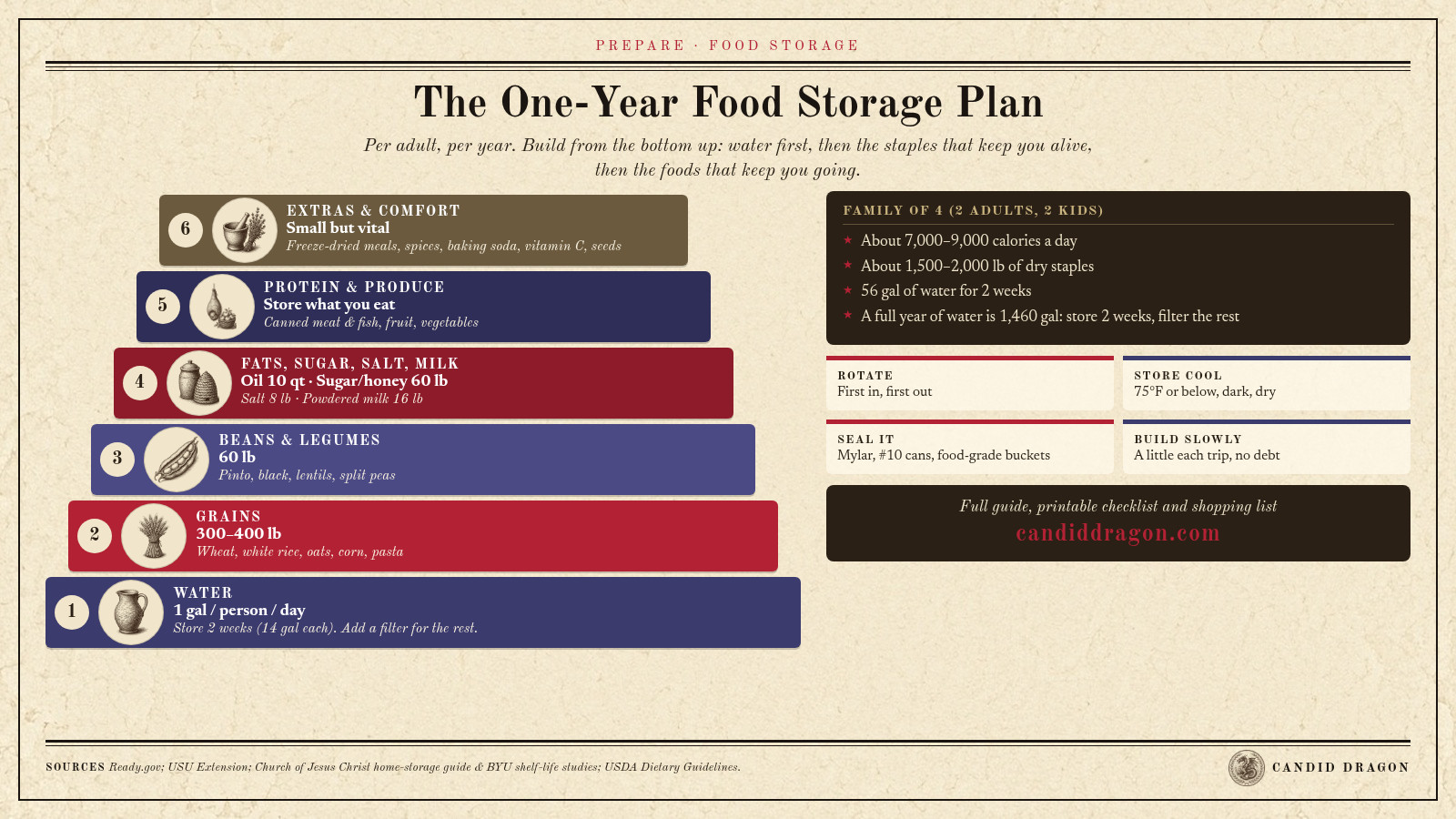
A year of food in the house is not paranoia. It is the same insurance your grandparents kept in the cellar. It covers storms, layoffs, supply-chain hiccups and the month nobody can get to the store. This plan shows how much a household actually needs, what to store first, and how to build it without going into debt. We the people win when every family can feed itself for a while.
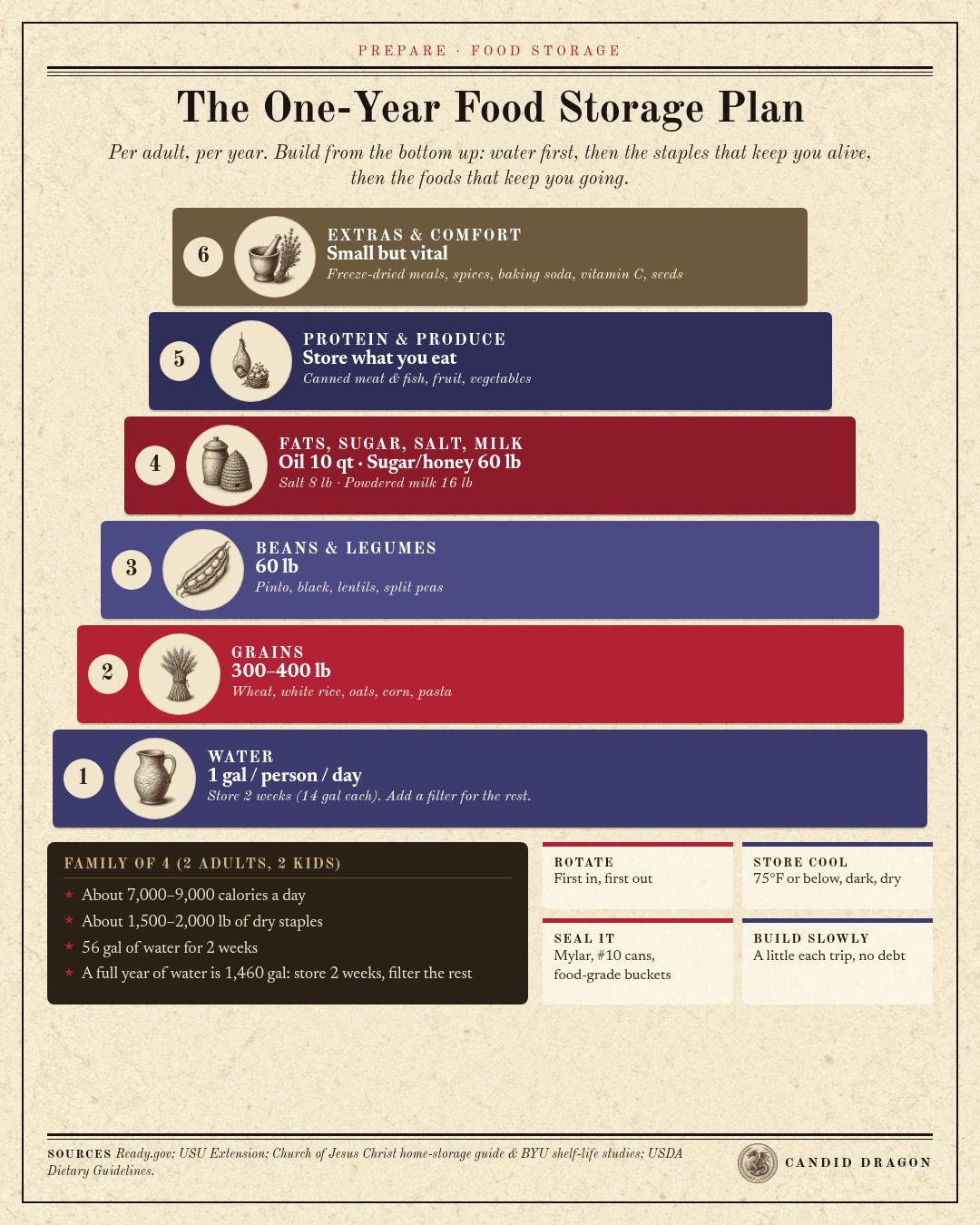
How much your household needs
Start with calories. The federal Dietary Guidelines estimate that adults need roughly 1,600 to 3,000 calories a day depending on age, sex and activity, and children 4 to 13 need about 1,200 to 2,600. Nutrition labels use 2,000 a day as the standard. A family of two adults and two school-age kids needs about 7,000 to 9,000 calories a day, or roughly 2.6 to 3.3 million calories a year.
The long-standing “basics” list, used by Utah State University Extension and the Church of Jesus Christ of Latter-day Saints’ home-storage program, gives one adult enough calories for a year:
| Basic food | Per adult, 1 year | Family of 4* | Calories it adds (our math) |
|---|---|---|---|
| Grains (wheat, white rice, oats, corn, pasta) | 300–400 lb | 1,140–1,520 lb | about 1,230–1,640 a day |
| Legumes (dry beans, lentils, split peas) | 60 lb | 228 lb | about 260 a day |
| Sugar or honey | 60 lb | 228 lb | about 290 a day |
| Cooking oil | 10 qt (about 19 lb) | 38 qt | about 210 a day |
| Nonfat powdered milk | 16 lb | 61 lb | about 70 a day |
| Salt | 8 lb | 30 lb | 0 |
| Water (2-week reserve) | 14 gal | 56 gal | — |
| Total dry food | about 465–565 lb | about 1,750–2,140 lb | about 2,050–2,450 a day |
*Family of 4 assumes two adults and two children aged 7 to 10. The church guide counts children 3 and under at 50% of an adult portion, 4 to 6 at 70%, 7 to 10 at 90%, and 11 and up at 100%. Our calorie math uses typical USDA values per pound: about 1,500 for wheat, 1,570 for beans, 1,750 for sugar, 4,000 for oil and 1,640 for powdered milk.
✅ Confirmed  Factual Lean note: Amounts from USU Extension and the church’s published one-year guide; calorie ranges from the federal Dietary Guidelines. The per-day calorie column is our arithmetic.
Checking the popular charts. Some widely shared one-year charts list only 150 to 300 lb of grain per person and 1,000 to 1,500 lb total for a family of four. That falls short. USU Extension says a family of four’s long-term supply “could weigh as much as 1500-2000 lbs.” Many charts also leave out oil, sugar and salt, which supply a large share of the calories and make the rest edible.
The six tiers, explained
1. Water
Ready.gov says to store at least one gallon per person per day, for drinking and sanitation, and more for children, nursing mothers, sick people and hot climates. The church guide suggests a two-week reserve: 14 gallons per person, 56 for a family of four.
A full year of water for four people is about 1,460 gallons. Storing that is impractical for most homes. The better plan is a two-week stored supply plus a way to make more water safe: a well or rain catchment, a good filter, and bleach or boiling as backup. More in the water plan below.
2. Grains
The calorie base. Hard red or white wheat, white rice, rolled oats, dry corn and pasta all store 30 years or more when packed dry and kept cool. White rice outlasts brown rice, whose oils go rancid. Wheat needs a grain mill; rice and oats do not. Store a mix.
3. Beans and legumes
Protein and fiber that store for decades. Old beans take longer to soften, which is one reason the church guide recommends storing baking soda. Pressure-canned beans are a fast option you can make yourself; see How to Can Food at Home.
4. Fats, sugar, salt and milk
The pieces most charts forget. Oil packs about 4,000 calories per pound but goes stale, so rotate it every one to two years. Sugar, honey and salt keep indefinitely. Powdered milk adds calcium and protein and keeps about 20 years sealed.
5. Protein and produce
The basics alone are short on vitamins A, C, B12 and E and on calcium, USU Extension warns. Fill the gap with what your family already eats: canned meat, tuna and chicken, canned and dried fruit and vegetables, peanut butter, and home-canned or dehydrated garden food. Store what you eat, and eat what you store.
6. Extras and comfort
Small items that matter a lot: freeze-dried meals for fast, light food, spices, bouillon, baking soda and baking powder, yeast, cocoa and drink mixes, vitamin C tablets or a multivitamin, and a seed bank for growing more. Comfort food keeps morale up, especially for kids.
Your water plan
- Store: two weeks at one gallon per person per day. Sealed store-bought water is simplest. Refill your own food-grade containers every six months.
- Find: your water heater tank, ice and the liquid in canned food are emergency reserves. Know how to shut your main valve.
- Treat: CDC calls boiling the best method: a rolling boil for one minute, or three minutes above 6,500 feet. With unscented bleach of 6% or 8.25% strength, use 8 drops per gallon and wait 30 minutes.
- Filter: a filter turns any reasonably clear source into drinking water. Pick one that meets EPA and NSF standards, and know what it does and does not remove.
What we use: LifeStraw, small and large
Our own kits use LifeStraw filters, a small one for the go-bags and a large gravity unit for the house. The specs below come straight from the maker’s product pages:
| Filter | What it is for | Filter life (maker’s spec) | What it removes (maker’s spec) |
|---|---|---|---|
| LifeStraw Personal | Go-bags, cars, every family member’s kit | Up to 1,000 gal (4,000 L) | Bacteria and parasites (0.2-micron microfilter). Not viruses. |
| LifeStraw Family | Home, for a family | Up to 4,755 gal (18,000 L), about 3.1 gal per hour | Viruses, bacteria and parasites (0.02-micron ultrafilter) |
| LifeStraw Mission | Home or camp, 12-liter gravity bag | Up to 4,755 gal (18,000 L) | Viruses, bacteria and parasites |
| LifeStraw Community | Large households, groups, a homestead | Up to 26,000 gal (100,000 L), 50-liter tank | Viruses, bacteria and parasites |
❓ Unconfirmed Factual Lean note: Filter capacities and removal rates are the manufacturer’s published specs, which it says are independently certified; we have not lab-tested them ourselves.
Storage containers and conditions
- Cool: the shelf-life studies assume 75°F or cooler. USU Extension says grains keep best at 40°F or below. Warmer storage shortens life. A closet on an inside wall beats a hot garage.
- Dry: dry staples must be about 10% moisture or less before you seal them with oxygen absorbers. Moist food in a low-oxygen package can cause botulism.
- Dark and sealed: #10 cans, Mylar-type bags with oxygen absorbers, PETE plastic bottles and food-grade buckets all work. Mylar inside a bucket stops both moisture and mice.
- Off the floor: keep containers on shelves or pallets, away from walls and pipes.
- Canned goods: never use cans that are bulging, leaking, deeply dented or rusted.
How long it lasts
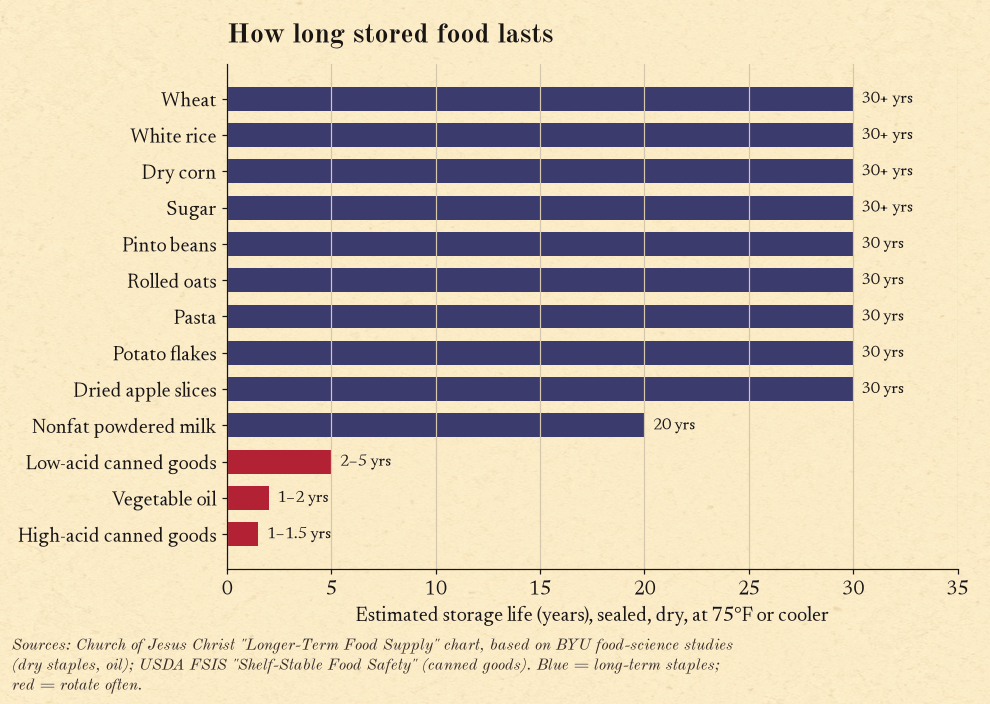
✅ Confirmed Factual Lean note: BYU food-science studies as published by the church’s home-storage program, and USDA FSIS guidance for canned foods.
Rotate: first in, first out
Write the month and year on everything. New purchases go to the back or bottom; you eat from the front. Cook from storage once a week so your family learns to like it and nothing expires. Check oil, canned goods and vitamins twice a year.
The 12-week build plan, on a budget
The church guide says it plainly: do not go into debt for food storage. Build it over time. Here is one way to get a few weeks of everyday food plus the start of a long-term supply in 12 weeks, spending a little extra each shopping trip.
| Week | Add this | Goal |
|---|---|---|
| 1 | Water: one case per person, plus a filter | 3 days of water |
| 2 | Canned meat, tuna, peanut butter | 1 week of protein |
| 3 | Rice, pasta, oats (25 lb bags are cheapest per pound) | Calorie base starts |
| 4 | Dry beans and lentils; baking soda | Protein that keeps |
| 5 | Oil, sugar or honey, salt | Basics for about 1 month |
| 6 | Canned fruit and vegetables | Vitamins A and C |
| 7 | More water: 2 weeks per person | Water goal met |
| 8 | Powdered milk, spices, bouillon | Flavor and calcium |
| 9 | Freeze-dried meals or a bucket kit | Fast, light food |
| 10 | Mylar bags, oxygen absorbers, buckets | Repack bulk grain |
| 11 | Manual can opener, camp stove and fuel | Cook without power |
| 12 | Vitamins, comfort food, seed bank | Fill the gaps; take inventory |
Then repeat the cycle, adding bulk grain and beans each month until you reach your long-term goal.
Small-space pantry tips
- Under beds: flat #10 cans and low bins fit well.
- Closet floors and behind the couch: stack sealed buckets.
- Hallway linen closet: shelves of canned goods with a rotation list taped inside the door.
- Use stackable water jugs, and fill a tub water bladder when a storm is coming.
- Store calorie-dense foods first. Oil, peanut butter, grains and beans give the most calories per square foot.
Simple pantry meals
- Rice and beans with canned tomatoes and spices
- Oatmeal with powdered milk, sugar or honey and dried fruit
- Pasta with canned chicken and a jar of sauce
- Bean and canned-vegetable soup with bouillon
- Skillet flatbread from flour, salt, baking powder, oil and water
- Pancakes from flour, powdered milk, powdered egg, baking powder, sugar and oil
Your 72-hour kit
Long-term food lives at home. If you have to leave, you need a grab-and-go kit for three days: water, ready-to-eat food, a filter, light, radio, first aid, medicine, documents and cash. Our 72-hour kit checklist follows the Ready.gov list. Add a LifeStraw Personal for each person and a small first aid kit.
Seed bank: what we keep
Food storage runs out. Seeds make more. We keep a few sealed packs of heirloom, open-pollinated vegetable seed. Unlike hybrids, open-pollinated varieties grow true from saved seed, so one season’s harvest can supply the next season’s planting.
- Store them cool, dark and dry. Illinois Extension recommends below 45°F in a sealed jar or bag, such as in the refrigerator. Let the container warm to room temperature before you open it so moisture does not condense on the seed.
- Know their life span. Onion seed lasts about a year; tomato about four; cucumber and lettuce about five. See the full chart in our off-grid guide.
- Test before you trust. Iowa State Extension suggests a germination test about a month before planting: roll 10 seeds in a damp paper towel, keep it warm, and count how many sprout.
- Rotate. Plant from your seed bank every year and refill it with fresh seed or seed you saved yourself.
Printable checklist
| ✔ | Item | Per adult / year | Family of 4 | Have now |
|---|---|---|---|---|
| ☐ | Water stored | 14 gal (2 weeks) | 56 gal | _____ |
| ☐ | Water filter | 1 personal straw | 4 personal + 1 gravity unit | _____ |
| ☐ | Bleach, unscented | — | 1 gal, replace yearly | _____ |
| ☐ | Grains | 300–400 lb | 1,140–1,520 lb | _____ |
| ☐ | Legumes | 60 lb | 228 lb | _____ |
| ☐ | Sugar or honey | 60 lb | 228 lb | _____ |
| ☐ | Cooking oil | 10 qt | 38 qt | _____ |
| ☐ | Powdered milk | 16 lb | 61 lb | _____ |
| ☐ | Salt | 8 lb | 30 lb | _____ |
| ☐ | Baking soda and powder, yeast | 2 lb | 8 lb | _____ |
| ☐ | Canned meat and fish | to taste | to taste | _____ |
| ☐ | Canned or dried fruit and vegetables | to taste | to taste | _____ |
| ☐ | Freeze-dried meals | optional | optional | _____ |
| ☐ | Vitamin C or multivitamin | 1 year | 4 people x 1 year | _____ |
| ☐ | Seed bank | — | 1–2 vault kits | _____ |
| ☐ | Manual can opener, stove, fuel | — | 1 set | _____ |
Shopping list
Quantities are for a family of four (two adults, two children). Scale up or down for your household.
| ✔ | Item | Family of 4 | Where to buy |
|---|---|---|---|
| ☐ | Water filter, personal | 4 | LifeStraw · Amazon · Walmart |
| ☐ | Water filter, family gravity | 1 | LifeStraw Family · LifeStraw Mission · Amazon |
| ☐ | Stackable water containers | 8–12 | Amazon · Walmart · Academy |
| ☐ | Rice, wheat, oats in bulk | 1,140–1,520 lb over time | Costco · Walmart · Augason Farms |
| ☐ | Dry beans and lentils | 228 lb over time | Costco · Walmart · Amazon |
| ☐ | Oil, sugar or honey, salt, powdered milk | see table above | Costco · Walmart · Augason Farms |
| ☐ | Freeze-dried meals | optional | Mountain House · Costco · Amazon |
| ☐ | Mylar bags and oxygen absorbers | 40–60 bags | Amazon · Walmart |
| ☐ | Food-grade 5-gallon buckets and gamma lids | 20–30 | Lowe’s · Amazon · Walmart |
| ☐ | Heirloom seed vault | 1–2 kits | Amazon · Walmart |
| ☐ | Unscented bleach and a manual can opener | 1 each | Walmart · Target |
About these links: We get nothing for them. No sponsors, no affiliate codes, no kickbacks. We list several stores so you can compare prices and buy wherever you like. Prices and stock change, so check before you buy.
Label key
- ✅ Confirmed An official record, or two or more independent outlets, agree.
- ❓ Unconfirmed Reported or claimed, but not yet independently verified.
- ⚠️ Disputed Contradicted by the evidence or by credible sources, or actively contested.
- Factual Straight reporting that holds up across outlets on different sides.
 Leans Left The facts hold, but the coverage tilts left: one-sided, loaded language, missing context or a single anonymous source.
 Leans Right The facts hold, but the coverage tilts right: one-sided, loaded language, missing context or a single anonymous source.
 Likely Propaganda State-run or state-aligned media, a militant press office, a partisan campaign or group, or unverifiable spin.
Each story gets one confidence tag and one source-lean label, plus a one-line Lean note explaining the call. Every side is held to the same standard. More on how we cover the news.
Sources
- Ready.gov, Water
- Ready.gov, Food
- Utah State University Extension, A Guide to Food Storage for Emergencies (PDF)
- Utah State University Extension, Storing White Rice
- Church of Jesus Christ, Ensign, “Food Storage for One Year” (2006)
- Church of Jesus Christ, Longer-Term Food Supply (BYU shelf-life chart)
- BYU Magazine, “Ask An Expert: New Tips for Old Food”
- USDA FSIS, Shelf-Stable Food Safety
- USDA and HHS, Dietary Guidelines for Americans 2020–2025 (PDF)
- CDC, How to Make Water Safe in an Emergency
- LifeStraw, product pages (Personal, Family, Mission, Community)
- Iowa State University Extension, How to Store Seeds and Test Germination Rates
- University of Illinois Extension, Seed Viability and Germination (PDF)
The Candid Dragon preparedness series
- Going Completely Off-Grid (the top of the ladder)
- The One-Year Food Storage Plan
- How to Can Food at Home (plus drying, freeze-drying and Mylar)
- The Family Medical and Trauma Kit
- Layered Home Defense
- Hunting and Food Procurement
- The 72-Hour Kit · Water Storage Basics · Preparedness Checklists · All of Prepare