

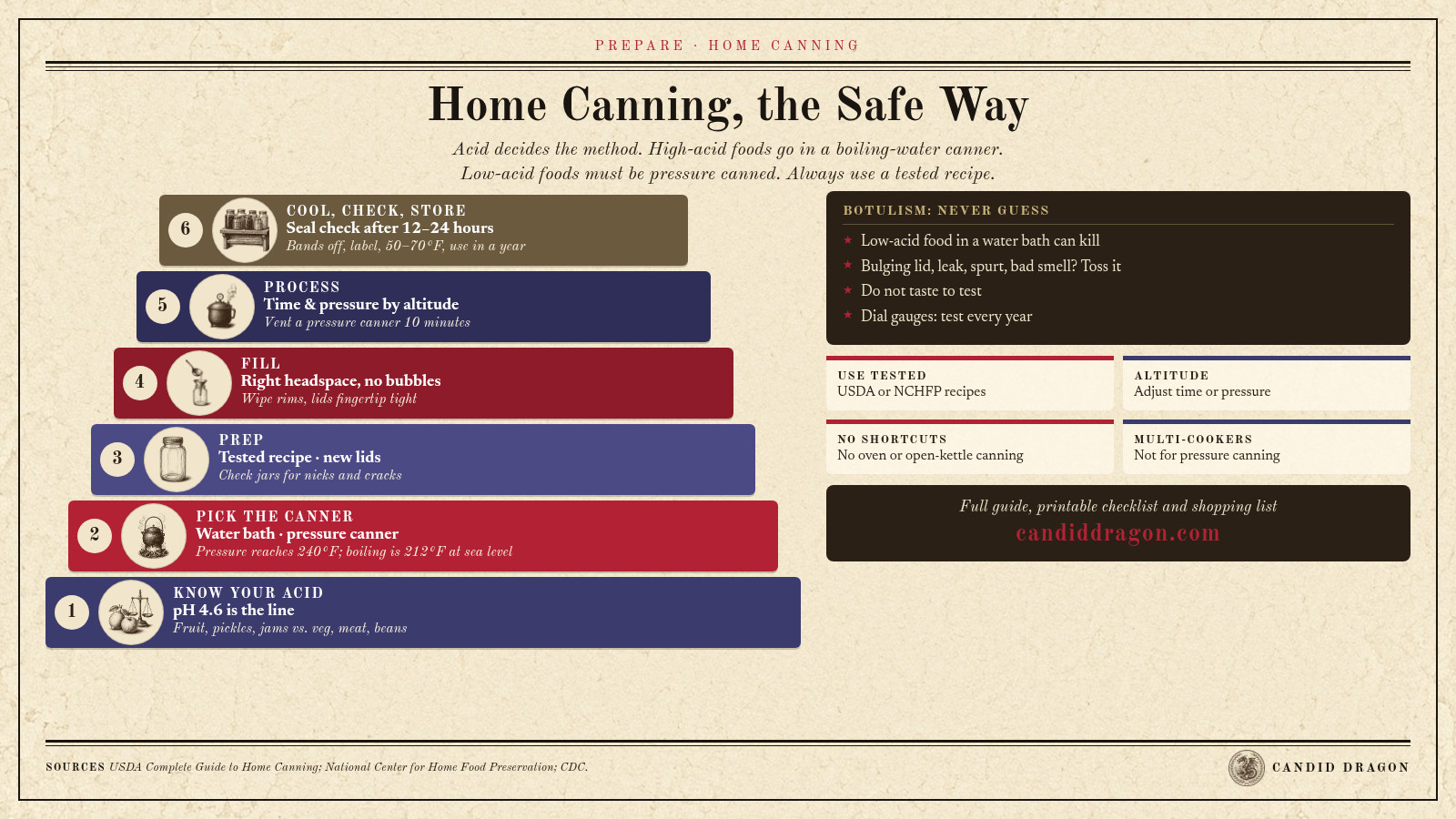
Home canning turns a summer garden or a good sale into a shelf of food that needs no power. Done right, it is safe and satisfying. Done wrong, it can make you very sick. The rules are simple, they come from decades of USDA testing, and they are not optional.
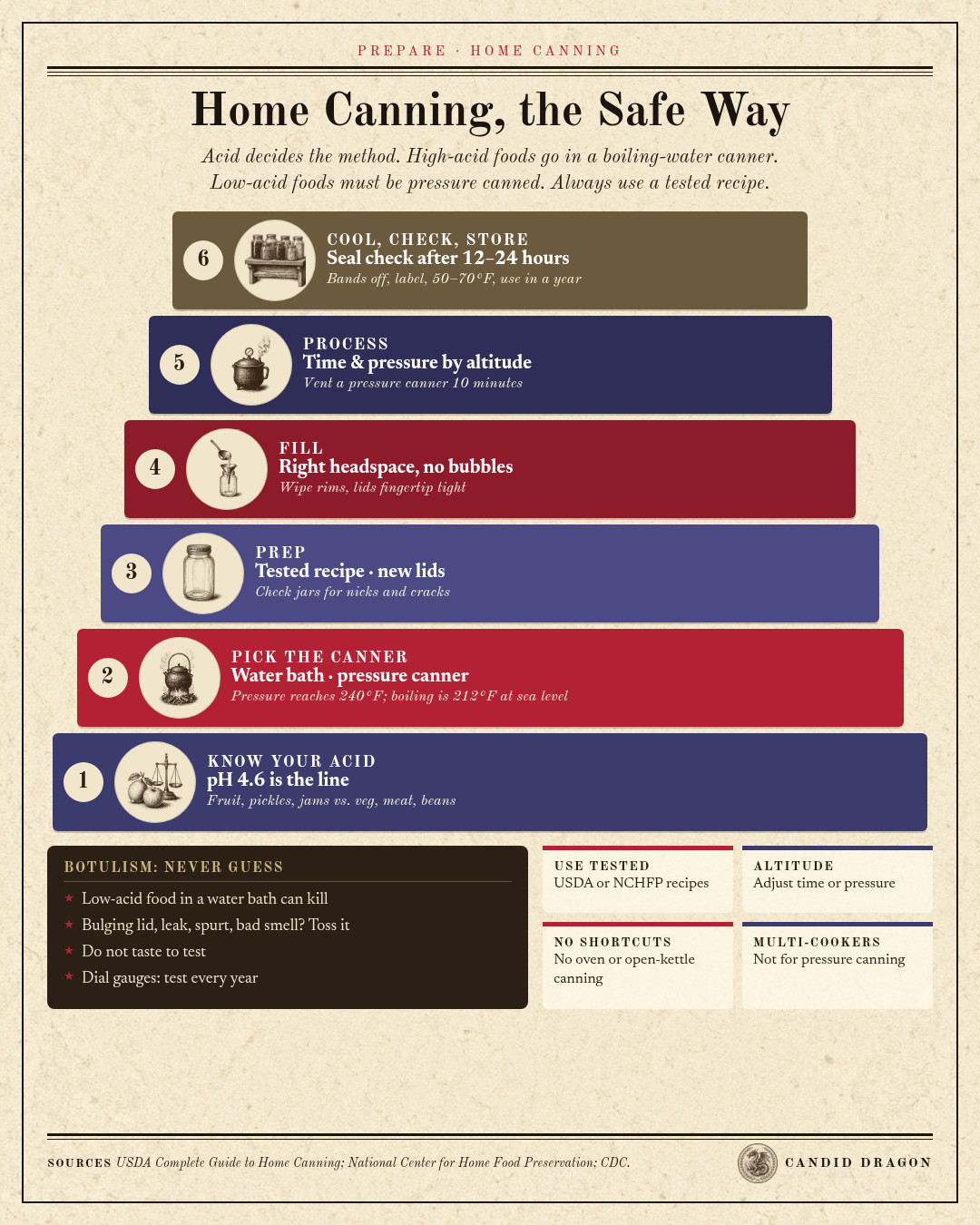
Water bath or pressure canner? Acid decides
| Method | Use it for | Why |
|---|---|---|
| Boiling-water canner (212°F at sea level) | Fruits, jams and jellies, pickles, sauerkraut, and tomatoes with added acid | Acid (pH 4.6 or lower) keeps botulism spores from growing, so boiling temperature is enough. |
| Pressure canner (240°F at about 10 to 15 psi) | Vegetables, meat, poultry, fish, dry beans, soups and stocks, and recipes that mix them in | Low-acid foods can harbor Clostridium botulinum spores. Only about 240°F destroys them in a practical time. |
Tomatoes sit near the line, so the USDA guide calls for added acid: 2 tablespoons of bottled lemon juice or ½ teaspoon citric acid per quart, half that per pint.
✅ Confirmed  Factual Lean note: USDA Complete Guide to Home Canning and the National Center for Home Food Preservation.
Equipment
- A boiling-water canner, or any deep pot with a rack and lid that covers the jars by 1 to 2 inches
- A pressure canner (dial or weighted gauge) for low-acid food. NCHFP does not recommend electric multi-cookers for pressure canning.
- Mason-type canning jars, new flat lids and screw bands
- Jar lifter, canning funnel, headspace tool or ruler, bubble remover, lid wand
- Clean towels, a timer, and a tested recipe from USDA, NCHFP, your extension office or a current Ball guide
Step by step
- Pick a tested recipe and follow it exactly: jar size, pack style and processing time. Never improvise with low-acid food.
- Inspect and wash jars. Discard any with nicks or cracks. Use new flat lids every time.
- Prepare the food as the recipe says, raw pack or hot pack.
- Fill to the recipe’s headspace, remove air bubbles, and wipe the rims clean.
- Lid them with bands screwed on fingertip tight.
- Process. Water bath: jars covered by at least an inch of water; start timing at a full rolling boil. Pressure canner: let steam vent for 10 minutes, close the vent, reach the recipe’s pressure, then start timing. Keep it at or above that pressure the whole time.
- Let it cool naturally. Turn off the heat and let a pressure canner drop to zero on its own. Never force-cool it.
- Rest the jars 12 to 24 hours, undisturbed.
- Check seals. The lid should not flex. Refrigerate and eat any jar that did not seal.
- Store. Remove the bands, wash the jars, label contents and date, and store cool and dark, ideally 50 to 70°F. Use within a year for best quality.
Altitude changes everything
Water boils at a lower temperature as you go up, so processing must change. Every USDA recipe lists times or pressures by elevation. NCHFP’s peaches recipe, for example, adds 5 minutes of boiling-water time between 1,001 and 3,000 feet. For many low-acid vegetables, a dial-gauge canner goes from 11 psi at up to 2,000 feet to 1 more psi for each additional 2,000 feet, and a weighted-gauge canner goes from 10 psi to 15 psi above 1,000 feet. Find your elevation and use your recipe’s table.
| Your elevation | Boiling-water canner | Dial-gauge (many low-acid vegetables) | Weighted-gauge |
|---|---|---|---|
| 0–1,000 ft | Recipe time | 11 psi | 10 psi |
| 1,001–2,000 ft | Add time per recipe | 11 psi | 15 psi |
| 2,001–4,000 ft | Add time per recipe | 12 psi | 15 psi |
| 4,001–6,000 ft | Add time per recipe | 13 psi | 15 psi |
| 6,001–8,000 ft | Add time per recipe | 14 psi | 15 psi |
Always check the specific recipe. Some foods use different times and pressures.
Safety: botulism and spoilage
Botulism is rare but deadly. CDC says home-canned foods, especially low-acid vegetables, are a common cause of foodborne botulism. You cannot see, smell or taste the toxin. Never water-bath can low-acid food, and never taste food to test it. When in doubt, throw it out.
- Discard any jar with a bulging or unsealed lid, leaks, liquid that spurts when opened, mold, foam, or a bad smell. Do not taste it. Bag it, throw it where children and pets cannot reach it, and clean any spill with a bleach solution.
- Have dial gauges tested every year; many extension offices do it. Weighted gauges do not need testing.
- Do not use oven canning, open-kettle canning, dishwashers or canning powders. They are not safe methods.
- Botulism symptoms include double or blurred vision, drooping eyelids, slurred speech, and trouble swallowing or breathing. It is a medical emergency: call 911.
✅ Confirmed Factual Lean note: CDC and NCHFP guidance.
Other ways to preserve food
Dehydrating
Drying removes the water that germs need. A dehydrator gives steady heat and airflow. NCHFP and university extension guides cover fruits, vegetables and herbs. For jerky, USDA recommends heating meat to 160°F (poultry to 165°F) before drying, then drying at a steady 130 to 140°F. Store dried food airtight in a cool, dark place, and freeze or vacuum seal it for longer life.
Freeze-drying
Home freeze dryers remove nearly all the water at low temperature, so food keeps its shape and flavor and rehydrates quickly. They are expensive and slow, and there is little independent research on home units. Makers advertise storage of up to 25 years when food is sealed in Mylar with oxygen absorbers. Treat that as a manufacturer’s claim. Raw meat and eggs that were freeze-dried raw still have to be handled and cooked as raw food.
❓ Unconfirmed Factual Lean note: Long shelf-life figures for home freeze-dried food come from manufacturers, not independent studies.
Vacuum sealing, Mylar and oxygen absorbers
- Vacuum sealing greatly extends freezer life and the life of dry goods. It does not make perishable food shelf-stable: vacuum-sealed meat, fish and vegetables still need the refrigerator or freezer.
- For long-term dry storage, seal dry foods (about 10% moisture or less) such as wheat, rice, beans and oats in Mylar-type bags with oxygen absorbers, then put the bags in buckets.
- Moist foods sealed without oxygen can grow botulism. Never use oxygen absorbers with moist food.
- Open an oxygen-absorber pack only when you are ready to seal, and use the absorbers within minutes.
Printable checklist
| ✔ | Item | Starter kit |
|---|---|---|
| ☐ | Boiling-water canner with rack | 1 |
| ☐ | Pressure canner (dial or weighted) | 1 |
| ☐ | Canning jars, pints and quarts | 2–4 dozen |
| ☐ | New flat lids | enough for every jar, every season |
| ☐ | Jar lifter, funnel, headspace tool, lid wand | 1 kit |
| ☐ | Tested recipe book | 1 (the USDA guide is free) |
| ☐ | Bottled lemon juice or citric acid | 1 |
| ☐ | Dehydrator | optional |
| ☐ | Vacuum sealer and bags | optional |
| ☐ | Mylar bags and oxygen absorbers | 40–60 |
Shopping list
A starter kit for one household. Jars last for years; buy new flat lids each season.
| ✔ | Item | Family of 4 | Where to buy |
|---|---|---|---|
| ☐ | Canning jars, lids and starter kits | 2–4 dozen jars | Ball · Walmart · Amazon |
| ☐ | Pressure canner | 1 | Presto · All American · Amazon · Walmart |
| ☐ | Boiling-water canner | 1 | Walmart · Amazon |
| ☐ | Canning tool kit | 1 | Amazon · Target |
| ☐ | Food dehydrator | 1 | Amazon · Walmart |
| ☐ | Home freeze dryer | optional | Harvest Right |
| ☐ | Vacuum sealer | 1 | Costco · Amazon |
| ☐ | Mylar bags and oxygen absorbers | 40–60 | Walmart · Amazon |
About these links: We get nothing for them. No sponsors, no affiliate codes, no kickbacks. We list several stores so you can compare prices and buy wherever you like. Prices and stock change, so check before you buy.
Building long-term storage? Pair this with the One-Year Food Storage Plan.
Label key
- ✅ Confirmed An official record, or two or more independent outlets, agree.
- ❓ Unconfirmed Reported or claimed, but not yet independently verified.
- ⚠️ Disputed Contradicted by the evidence or by credible sources, or actively contested.
- Factual Straight reporting that holds up across outlets on different sides.
 Leans Left The facts hold, but the coverage tilts left: one-sided, loaded language, missing context or a single anonymous source.
 Leans Right The facts hold, but the coverage tilts right: one-sided, loaded language, missing context or a single anonymous source.
 Likely Propaganda State-run or state-aligned media, a militant press office, a partisan campaign or group, or unverifiable spin.
Each story gets one confidence tag and one source-lean label, plus a one-line Lean note explaining the call. Every side is held to the same standard. More on how we cover the news.
Sources
- USDA Complete Guide to Home Canning (2015 revision), via NCHFP
- National Center for Home Food Preservation, Canning
- NCHFP, Selecting the Correct Processing Time
- CDC, Home-Canned Foods and Botulism
- USDA FSIS, Jerky and Food Safety
- National Center for Home Food Preservation, Drying
- Church of Jesus Christ, Longer-Term Food Supply (moisture and oxygen-absorber warning)
The Candid Dragon preparedness series
- Going Completely Off-Grid (the top of the ladder)
- The One-Year Food Storage Plan
- How to Can Food at Home (plus drying, freeze-drying and Mylar)
- The Family Medical and Trauma Kit
- Layered Home Defense
- Hunting and Food Procurement
- The 72-Hour Kit · Water Storage Basics · Preparedness Checklists · All of Prepare