

Not legal advice. Self-defense and weapons laws differ by state and city and change often. This is general information from public sources. Read your state’s statutes and talk to a licensed attorney in your state.
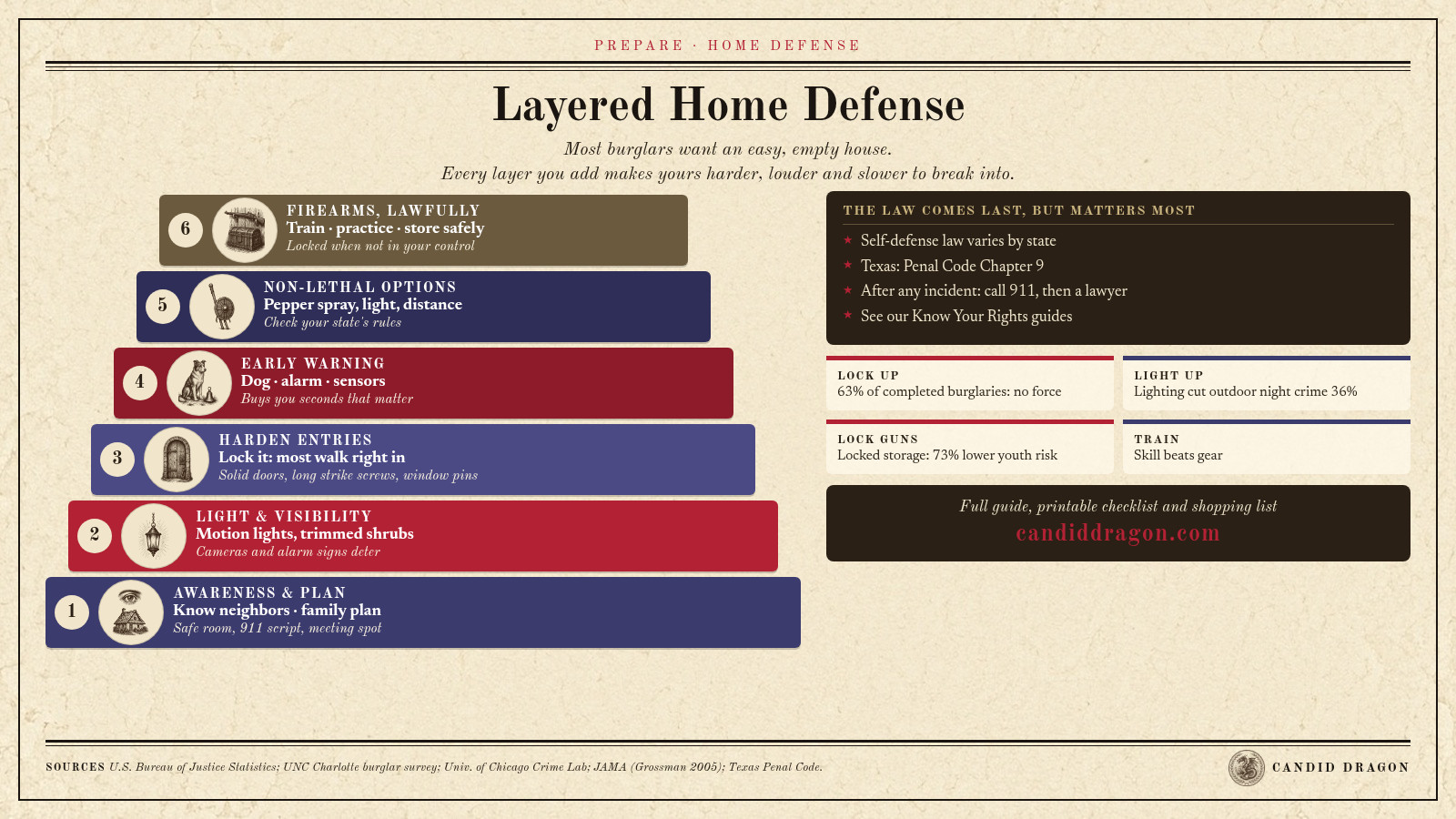
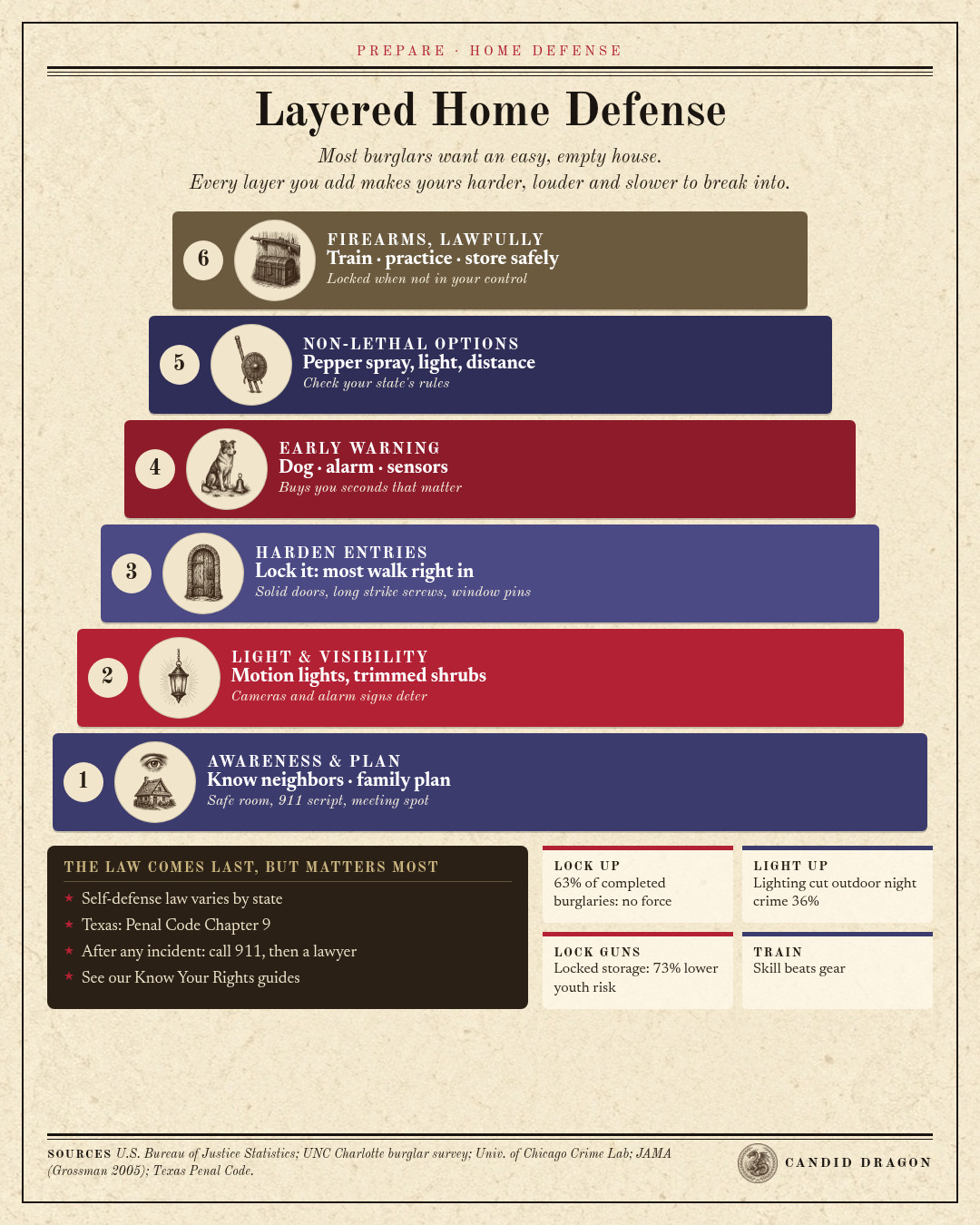
Self-defense starts long before anyone reaches your door. Most burglars want an easy, empty house, and most never expect a fight. Each layer below makes your home harder, louder and slower to break into. The last layers are for the rare moment it comes to that. All of it is lawful and within reach of an ordinary family.
What the numbers say about burglary
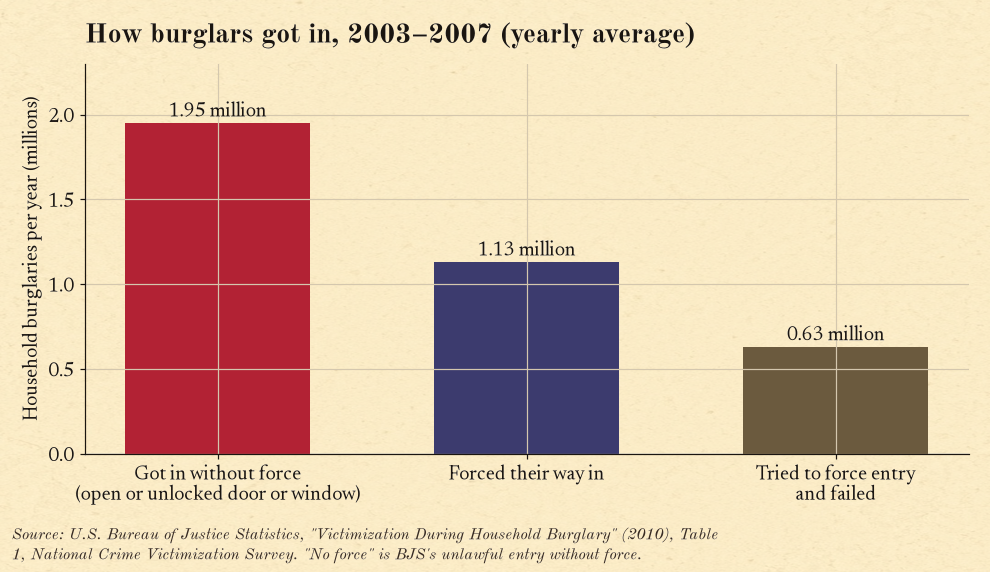
- From 2003 to 2007, Americans suffered about 3.7 million household burglaries a year. Someone was home in about 28% of them, and in about 7% a household member was attacked or threatened, according to the Bureau of Justice Statistics.
- Of completed burglaries, about 63% involved no forced entry: an open or unlocked door or window.
- In violent burglaries, the offender was someone the victim knew 65% of the time, and a stranger 28% of the time.
- In a 2012 UNC Charlotte survey of 422 imprisoned burglars, about 60% said an alarm would make them look for another target, and 41% said their burglaries were usually “spur of the moment.”
✅ Confirmed  Factual Lean note: Federal crime-victimization survey data and a university offender survey. The survey was funded by an alarm-industry foundation, which we note.
Layer 1: Awareness and a plan
- Know your neighbors and trade phone numbers. They notice what you miss.
- Agree on a family plan: who calls 911, where everyone goes, and a meeting place outside.
- Pick a safe room with a solid door, a lock, a phone charger and a flashlight.
- Don’t advertise: break down boxes from new electronics, and don’t post trips online until you are home.
Layer 2: Light and visibility
Burglars prefer cover. A randomized experiment in New York City public housing, run by researchers including the University of Chicago Crime Lab, found that adding outdoor lighting led to at least a 36% drop in nighttime outdoor serious crime. At home, that means motion lights at every door, shrubs trimmed below window height, and visible cameras or a video doorbell.
✅ Confirmed Factual Lean note: Peer-reviewed randomized trial, Journal of Quantitative Criminology (2021).
Layer 3: Harden the entries
- Lock everything, every time. It is free and it closes the most common way in.
- Solid-core or metal exterior doors with a deadbolt that throws at least an inch.
- Reinforce the strike plate with long screws that reach the wall framing, not just the door jamb.
- Sliding doors: a bar or dowel in the track, and an anti-lift pin.
- Windows: working latches, pin locks, and security film on ground-floor glass near locks.
- Garage: keep it closed, and secure the opener’s emergency release.
Layer 4: Early warning
Every second of warning matters. A monitored or self-monitored alarm, door and window sensors, cameras that alert your phone, and a dog that barks at strangers all buy time to wake up, call 911 and get your family to the safe room.
Layer 5: Non-lethal options
Pepper spray is legal for adults in Texas and most states, though some states limit size, strength or where you can buy it. Check your state’s rules. A bright flashlight, a loud alarm and distance are tools too. Practice with an inert training canister so you know the spray pattern and range.
Layer 6: Firearms, lawfully and responsibly
The Second Amendment protects the right to keep and bear arms, and the Supreme Court has held that it covers a handgun in the home for self-defense. With that right comes responsibility: training, practice and safe storage.
- Training: take a basic safety and marksmanship class, then a defensive-handgun class. In Texas, adults 21 and older may carry a handgun without a license under the 2021 permitless-carry law, but the state License to Carry course still teaches use-of-force law and the license has practical benefits, including recognition in other states.
- Practice: regular range time, plus dry-fire practice with an unloaded gun and no ammunition in the room.
- Safe storage: a gun that is not in your direct control should be locked. Quick-access biometric or keypad safes keep a home-defense gun both secure and ready.
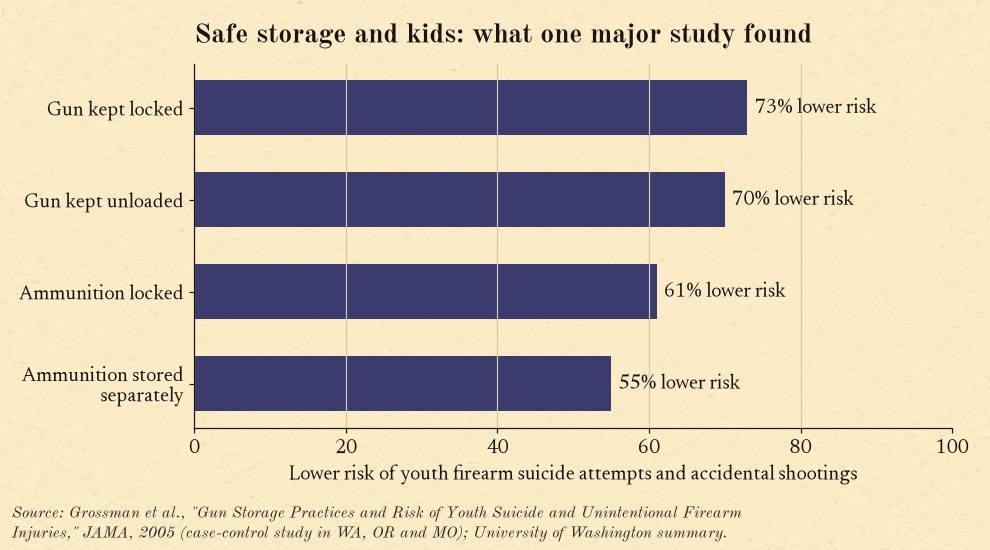
Texas law (Penal Code §46.13) makes it a crime to leave a loaded firearm where a child younger than 17 can get to it, with some exceptions. Free cable locks are available through Project ChildSafe and many local police departments.
✅ Confirmed Factual Lean note: Peer-reviewed JAMA study and Texas statute.
Legal basics: know before you need it
- Self-defense law varies by state. Some states impose a “duty to retreat” outside the home; most, including Texas, have castle-doctrine rules for your home, vehicle and workplace.
- In Texas, Penal Code Chapter 9 covers force and deadly force (§§9.31 and 9.32), including when force is presumed reasonable against someone who unlawfully and with force enters your occupied home, and when deadly force may be used to protect property (§§9.41 and 9.42). Every word in those sections matters. Read them yourself.
- Deadly force is a last resort, for an immediate threat of death or serious injury. Shooting a fleeing person, warning shots and threats can bring serious charges.
- After any defensive incident: get safe, call 911, give basic facts, and ask for a lawyer before giving a detailed statement.
- More on your rights in our Know Your Rights section.
Printable checklist
| ✔ | Item | Family of 4 |
|---|---|---|
| ☐ | Family plan, meeting spot, safe room | 1 plan, practiced |
| ☐ | Motion lights at every entry | 3–4 |
| ☐ | Video doorbell or cameras | 1–4 |
| ☐ | Deadbolts with long strike-plate screws | every exterior door |
| ☐ | Sliding-door bar and pins | each slider |
| ☐ | Window pins or locks | each ground-floor window |
| ☐ | Alarm or sensors | 1 system |
| ☐ | Pepper spray (where legal) and a training canister | 1 per adult |
| ☐ | Flashlight at each bedside | 4 |
| ☐ | Quick-access safe and cable locks | 1 per firearm |
| ☐ | Training class and range time | every adult who owns a gun |
Shopping list
Quantities are for a family of four (two adults, two children). Scale up or down for your household.
| ✔ | Item | Family of 4 | Where to buy |
|---|---|---|---|
| ☐ | Motion-sensor security lights | 3–4 | Lowe’s · Amazon |
| ☐ | Video doorbell or cameras | 1–4 | Amazon · Target · Costco |
| ☐ | Door reinforcement and strike plates | each door | Lowe’s · Amazon |
| ☐ | Sliding-door security bar | each slider | Lowe’s · Walmart |
| ☐ | Pepper spray and inert trainer (check state law) | 1 per adult | SABRE · Academy · Walmart |
| ☐ | Quick-access gun safe | 1 or more | Academy · Bass Pro Shops · Amazon |
| ☐ | Free cable gun locks | 1 per firearm | Project ChildSafe |
About these links: We get nothing for them. No sponsors, no affiliate codes, no kickbacks. We list several stores so you can compare prices and buy wherever you like. Prices and stock change, so check before you buy.
Label key
- ✅ Confirmed An official record, or two or more independent outlets, agree.
- ❓ Unconfirmed Reported or claimed, but not yet independently verified.
- ⚠️ Disputed Contradicted by the evidence or by credible sources, or actively contested.
- Factual Straight reporting that holds up across outlets on different sides.
 Leans Left The facts hold, but the coverage tilts left: one-sided, loaded language, missing context or a single anonymous source.
 Leans Right The facts hold, but the coverage tilts right: one-sided, loaded language, missing context or a single anonymous source.
 Likely Propaganda State-run or state-aligned media, a militant press office, a partisan campaign or group, or unverifiable spin.
Each story gets one confidence tag and one source-lean label, plus a one-line Lean note explaining the call. Every side is held to the same standard. More on how we cover the news.
Sources
- U.S. Bureau of Justice Statistics, Victimization During Household Burglary (PDF)
- Blevins, Kuhns and Lee, Understanding Decisions to Burglarize from the Offender’s Perspective, UNC Charlotte (2012, PDF)
- UNC Charlotte, “Through the eyes of a burglar”
- Chalfin et al., Reducing Crime Through Environmental Design, Journal of Quantitative Criminology (2021)
- Grossman et al., Gun Storage Practices and Risk of Youth Suicide and Unintentional Firearm Injuries, JAMA (2005)
- University of Washington, summary of the 2005 safe-storage study
- Texas Penal Code Chapter 9
- Texas Penal Code Chapter 46 (§46.13)
- Texas Department of Public Safety, License to Carry
- Project ChildSafe
The Candid Dragon preparedness series
- Going Completely Off-Grid (the top of the ladder)
- The One-Year Food Storage Plan
- How to Can Food at Home (plus drying, freeze-drying and Mylar)
- The Family Medical and Trauma Kit
- Layered Home Defense
- Hunting and Food Procurement
- The 72-Hour Kit · Water Storage Basics · Preparedness Checklists · All of Prepare