

✅ Confirmed  Factual Lean note: Times, flight counts and the officially cited router failure come from the FAA, DOT, L3Harris and reporting from Reuters, AP, NBC, CBS, CNBC, the Wall Street Journal and others, which agree on the core facts.
On the afternoon of November 13, as the FAA outage unfolded, Candid Dragon reviewed the early chatter and first reports, before official statements and news coverage could shape or revise the story. This update revisits that first review, along with a follow-up assessment of whether the evidence pointed to an equipment failure or an attack, and tests both against what officials and major outlets have confirmed since. All times are Central.
The FAA halted all departures nationwide at 2:54 p.m. and reopened the airspace at 7:15 p.m. The 4-hour, 21-minute halt was the longest nationwide stop since September 11, 2001. Roughly 9,200 U.S. flights were canceled on Friday and more than 6,400 on Saturday. FAA leadership expected airline schedules to be mostly recovered by late Sunday.
🔄 Update, November 15, 2026, evening: The FAA’s own Q&A now names the two sites behind the data flood: a radar site in Amarillo, Texas, and a radio site in El Dorado, Arkansas, where L3Harris was deploying a new router. Transportation Secretary Sean Duffy said Sunday that both routers are at an L3Harris lab in Florida, with the FAA on site and the FBI helping, and that broadcasting has been turned off on all 69 of the new routers in the system. He said the Amarillo equipment had been replaced about three weeks earlier, and that officials still do not know whether the cause was installer error or a faulty router; he sees no indication of a hack. Duffy confirmed he is asking Congress for $50 billion; Democrats, including Rep. Jim Himes, say the department should first spend the $12.5 billion already approved. Close to 2,000 U.S. flights were canceled Sunday as of late afternoon, per FlightAware data cited by CNBC, with near-normal operations expected Monday. (ABC News, FAA Q&A, CBS News (Face the Nation), CNBC (Nov. 15))
🕒 Timeline
Early reports from those working the outage come first, followed by the official record:
- About 2:10–2:17 p.m.: Before any nationwide order, Chicago’s O’Hare and Midway are put under local ground stops for an equipment outage. (ABC 7 Chicago)
- 2:13 p.m.: A controller at O’Hare tells a flight, “we’ve been having a lot of comms issues.”
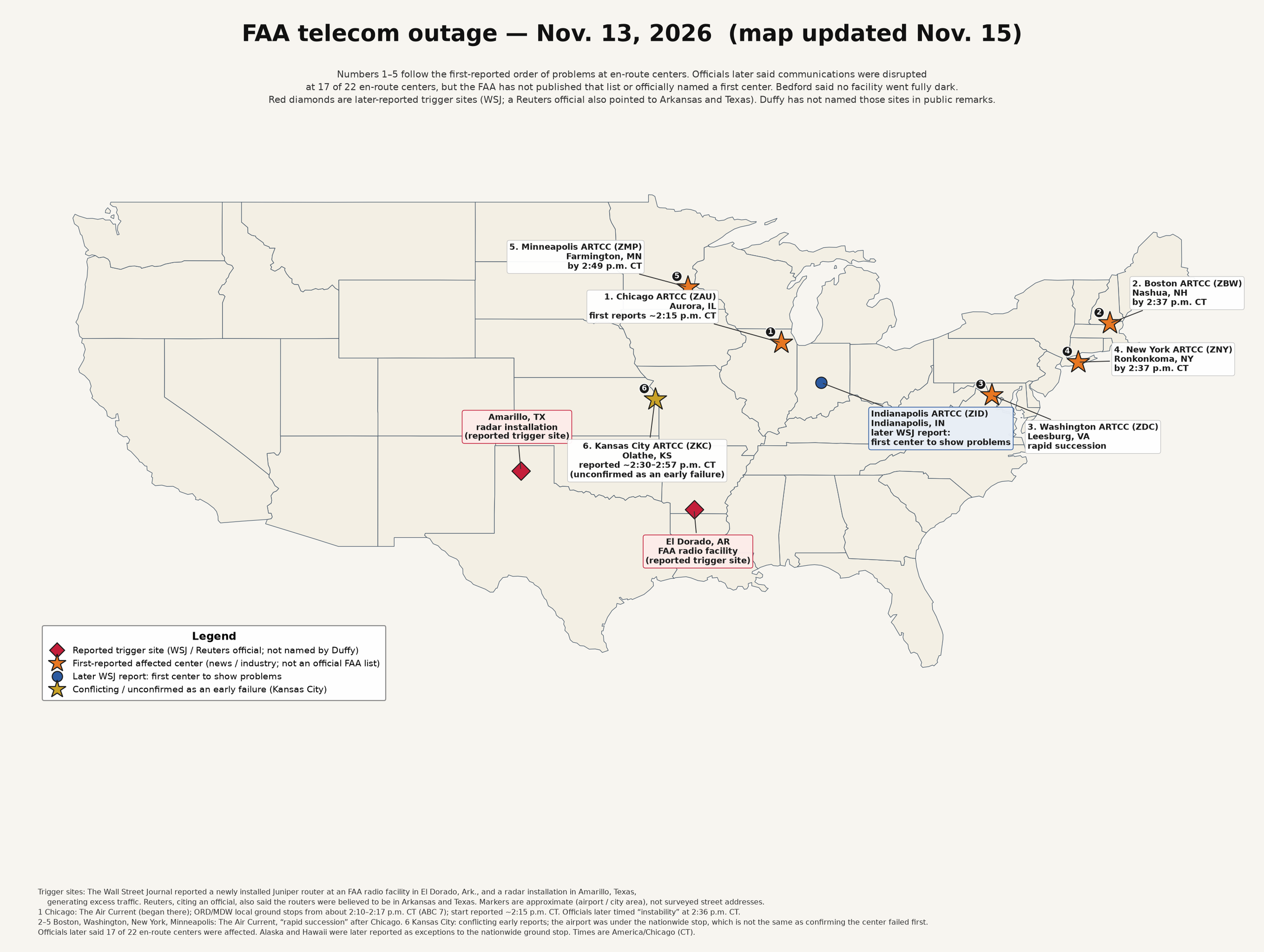
- About 2:15 p.m.: Chicago Center begins losing radio frequencies, according to the first industry reports.
- Within minutes: similar trouble is reported at the Boston, Washington, New York, and Minneapolis Centers. (The Air Current)
- 2:30 p.m.: The FAA’s command center in Washington learns that several centers have lost communications, radio frequencies, and radar. (The Air Current)
- 2:36 p.m.: According to Transportation Secretary Sean Duffy, this is when “instability” in radar and communications began — later than the first controller reports.
- 2:40 p.m.: Reports describe O’Hare and Midway as ground-stopped “for the Chicago Center outage.”
- 2:49 p.m.: A controller in Minneapolis confirms that the communications outage is nationwide.
- 2:54 p.m.: The FAA issues the nationwide ground stop. (FAA advisory, 20:54 UTC)
- 2:57 p.m.: Reports say all of Kansas City Center is ground-stopped. Kansas City’s place among the first failures remains unconfirmed by the FAA. Kansas City International Airport was covered by the nationwide stop, which is not the same as confirming that the center itself failed first.
- 3:08 p.m.: Radio traffic from Chicago Center: “We lost all frequencies and automation for handoff and strips.”
- 3:39 p.m.: An airline dispatcher reports being told by the FAA that 10 centers were down “and growing.” Officials later put the count at 17 of the FAA’s 22 en-route centers with disrupted communications.
- 7:15 p.m.: The ground stop is lifted and the airspace reopens. (Duffy)
- Shortly after: Delta and United begin resuming some flights, and departures restart gradually. According to the Transportation Department, more than 8,000 flight operations resumed Friday night.
- November 14: More than 6,400 U.S. flights are canceled and more than 8,000 delayed. FAA Administrator Bryan Bedford projects a largely normal operation by late Sunday.
- November 15: The FAA names Amarillo, Texas, and El Dorado, Arkansas, as the two likely sources of the data flood. Duffy says both routers are in an L3Harris lab in Florida and broadcasting is disabled on all 69 new routers; close to 2,000 flights are canceled. (ABC News, FAA Q&A)
🔄 How the Official Story Shifted
Industry sources first described the problem as lost radio frequencies and automation. The FAA’s own wording moved from “extraordinary circumstances” to a “communication issue” to a “telecom outage.” By Friday night, officials were attributing it to old routers overloaded by new equipment, and Duffy said the failure was in the legacy copper (TDM) portion of the network.
Saturday brought a more specific account. According to Duffy, L3Harris was performing routine maintenance at at least one remote FAA site, moving old copper lines to fiber — TDM to IP, analog to digital. During that work, a router being replaced began flooding other routers on the air traffic system with more than 1,000 connection attempts every four to five seconds, disrupting communications between controllers and aircraft as well as radar feeds. Once officials isolated the remote work, the systems recovered.
The Saturday version is more precise than Friday night’s, but it remains preliminary. Officials have not said whether a bad router, a bad install, or a bad configuration was at fault.
✅ What Was Known Then — and How It Has Held Up
- All U.S. departures were halted from 2:54 p.m. to 7:15 p.m. Central.
Verdict: Confirmed. Officially, the stop lasted 4 hours and 21 minutes. (FAA, NBC News)
- Controllers lost radio frequencies, radar data, and handoff automation, and in some places landlines.
Verdict: Holds up. Officials later described unstable communications with aircraft and unstable radar feeds. Bedford said no facility “went dark” and that “nothing was fully lost.” The FAA halted the whole country because it would not take the risk of a center losing contact with aircraft.
- Trouble started near 2:15 p.m., and Chicago Center was the first reported.
Verdict: Partly right. Early public reports still point to Chicago, starting about 2:15 p.m., and O’Hare was under a local stop as early as 2:10 p.m. Officials later placed the start of the “instability” at 2:36 p.m. According to later Wall Street Journal reporting, investigators saw the first communications problems at Indianapolis Center and then traced the surge in traffic to remote sites in Arkansas and Texas. The FAA has not officially identified the first center.
- The centers rely on a private FAA network run by L3Harris over ordinary U.S. phone-carrier lines.
Verdict: Confirmed. Its name is FAA Telecommunications Infrastructure, or FTI. Duffy said L3Harris “actually owns that network.” L3Harris says that, working with its telco partners and the FAA, it has finished more than 70 percent of the copper-to-fiber conversion.
- Officials blame aging routers and switches overloaded by newer equipment.
Verdict: Holds up, and the cause is now more specific. The overload is the official explanation. Saturday’s explanation is that a replacement router, installed during the copper-to-fiber cutover, overwhelmed the rest of the network. On Friday night, sources told CBS that old Cisco 600-series routers were involved. Later Wall Street Journal reporting said the excess traffic came from a newly installed Juniper router at an FAA radio facility in El Dorado, Arkansas, and from a radar site in Amarillo, Texas, and that officials turned off a broadcasting feature on about 60 Juniper routers. An official quoted by Reuters likewise put the routers in Arkansas and Texas, though Duffy has not identified those locations publicly. Hewlett Packard Enterprise, which owns Juniper, said its devices worked as intended and did not fail. Officials have yet to determine whether the equipment, the installation, or the configuration was at fault.
- National Weather Service radar kept working throughout; viral posts claiming it went down were false.
Verdict: Confirmed. Nothing since has brought that claim back.
❓ Open Questions Then — and What Has Been Answered
- Where exactly it began. Most reports pointed to Chicago; at least one pointed to Kansas City.
Answer: Still not settled officially. Early reports still favor Chicago. The Wall Street Journal later identified Indianapolis Center as the first to show problems, with the traffic coming from remote sites rather than from the center buildings. Kansas City has not been confirmed as the starting point; Kansas City International being under the nationwide stop is a separate fact.
- Which centers failed. The FAA had not named any.
Answer: There is still no official list. Officials have since put the number of affected en-route centers at 17 of 22, and Bedford said none lost service entirely. The five reported first — Chicago, Boston, Washington, New York, and Minneapolis — have not been retracted. Kansas City is still unconfirmed as an early failure, and the FAA has not published the 17 names.
- What failed first — a router, a switch, a line, or a software update.
Answer: The official account now blames a router at a remote site where copper-to-fiber work was underway. Still unstated is whether the device was defective or whether its installation or configuration caused the flood. Duffy has not officially named the site; the Wall Street Journal and an official who spoke to Reuters point to Arkansas and Texas.
- Whether the update reported by CBS and the Wall Street Journal was the trigger.
Answer: Partly answered, not settled. CBS reported Friday, based on multiple sources, that an update pushed to the private L3Harris network forced a reboot that ended in a crash. Mullin also spoke Friday about “patches” overwhelming older routers. The official Saturday account describes a router replacement during a copper-to-fiber conversion, not a nationwide software push, so the early “update” reports may have been a partial view of the same remote-site work. A union official told Reuters the problem was confined to two routers “updated” Friday. Investigators have not yet resolved whether configuration, hardware, or installer error was to blame.
- Whether a cyberattack has been fully ruled out.
Answer: The official position now is that this was not a cyberattack. On Saturday, Duffy tied the recovery to isolating the remote-site work and said “we don’t believe this was cyber at all.” Bedford said there was “zero evidence” of anything nefarious or related to AI. Friday night, Mullin said there was “actually no cyberattack” but that they were “still working through that process”; earlier that afternoon he had stopped short of ruling it out. No finished investigative report has been made public.
- Why two parts of the country kept working while the rest went down. DHS mentioned them without saying where.
Answer: Subsequent coverage identifies them as Alaska and Hawaii. An Alaska Airlines advisory exempted Alaska and Hawaii from the nationwide restrictions, and interisland flights in Hawaii kept running. Mullin has not officially confirmed those as the two areas he referred to.
🧭 The Early Read — and Whether It Held Up
The Nov. 13 review argued that when several centers lose radios, radar data, and even landlines within minutes of each other, the likely culprit is the shared network connecting them, not hardware inside any single building.
Verdict: Confirmed. The official account — a remote router on the L3Harris network flooding other routers — is a shared-network failure. Bedford’s statement that no facility went fully dark is consistent with that: the centers did not fail independently; the connections between them became unstable.
On timing, the follow-up assessment observed that scheduled FAA system work usually happens overnight — a deliberate change at 2:15 p.m. on a busy Friday would be out of the ordinary. Friday night’s official explanation did not involve an update pushed at 2:15; it described new equipment layered onto the old network over time until the legacy routers gave out — the kind of failure that can strike at any hour and is likelier at peak traffic.
Verdict: Partly right. It remains true that a scheduled daytime change at a major facility would be unusual. But on Saturday, Duffy said the work was being done during the day at a remote location, because a remote site “shouldn’t have that kind of impact,” and that switchovers at large facilities happen at night. He also said the timing of this kind of work will be reevaluated. The Friday-night reading — a gradual overload with no active change that afternoon — was therefore incomplete: conversion work was underway.
⚠️ Equipment Failure or Attack?
⚠️ Disputed Factual Lean note: The attack theory is disputed: DOT, FAA and DHS officials say they see no sign of a cyberattack, though the exact failed hardware and sites are not yet public.
The follow-up assessment said no one outside the investigation could yet put real odds on it, that the evidence leaned toward an equipment failure, and that an attack had not been ruled out.
Verdict: Holds up, and the case for an equipment failure is now stronger.
Points that favored an equipment failure:
- The outage jumped from one center to the next within minutes, the pattern of a network cascading under overload. — Confirmed. The official account describes a router flood spreading that way to 17 of 22 en-route centers.
- DHS reported “zero evidence” of a cyberattack at that point. — Holds up, and Duffy has gone further, saying he does not believe it was cyber at all.
- Two regions stayed up, consistent with a shared-network fault dividing along network boundaries. — Holds up. Subsequent coverage names Alaska and Hawaii, though officials have not fully explained the network cause.
Points that kept an attack open:
- DHS stopped short of certainty, and the NSA’s inquiry was still open. — Partly right, and partly overtaken. Accurate as of Friday; by Friday night and into Saturday, Mullin, Duffy, and Bedford had all said they did not believe it was a cyberattack, with Mullin noting the review was still in progress.
- No one had identified a specific failed part or explained what triggered it at that moment. — Partly right. The type of failure is now on record — a router flood during a copper-to-fiber cutover — but the precise fault is not, and Duffy has not formally identified the site.
- No FAA explanation existed for why those two regions stayed online. — Still largely true. There is a likely where (Alaska and Hawaii), but no official why.
- A major Microsoft outage occurred the day before; officials said the two were unrelated, but the timing was odd. — Holds up: a coincidence, and one the government rejects. Mullin cited “no connection” and “no reason to connect those two at all,” and no public evidence ties the two together. That timing alone is not a basis for an attack theory.
The question that remains is no longer “attack or telecom failure?” Officials say telecom. What is left is narrower — faulty hardware, a flawed installation, or a misconfiguration, and at which specific sites?
What would close it out is the FAA or L3Harris identifying the failed equipment, the sites, and what set off the flood — and releasing the list of the 17 centers.
❓ Unconfirmed Factual Lean note: The center locations come from early unofficial reports, and the trigger sites from the Wall Street Journal and one unnamed official speaking to Reuters. That is straight reporting, but it is not yet confirmed on the record.
⚠️ A note on the map: The numbered center locations are drawn from aviation journalists, controller radio, and airline staff. They are early reports, not an official FAA list. The Arkansas and Texas trigger sites are based on subsequent Wall Street Journal reporting and an official who spoke with Reuters; Duffy has not publicly identified them.
Label key
- ✅ Confirmed An official record, or two or more independent outlets, agree.
- ❓ Unconfirmed Reported or claimed, but not yet independently verified.
- ⚠️ Disputed Contradicted by the evidence or by credible sources, or actively contested.
- Factual Straight reporting that holds up across outlets on different sides.
 Leans Left The facts hold, but the coverage tilts left: one-sided, loaded language, missing context or a single anonymous source.
 Leans Right The facts hold, but the coverage tilts right: one-sided, loaded language, missing context or a single anonymous source.
 Likely Propaganda State-run or state-aligned media, a militant press office, a partisan campaign or group, or unverifiable spin.
Each story gets one confidence tag and one source-lean label, plus a one-line Lean note explaining the call. Every side is held to the same standard. More on how we cover the news.
Sources
- FAA Q&A
- ABC News
- CBS News (Face the Nation)
- CNBC (Nov. 15)
- The Air Current
- U.S. Department of Transportation
- FAA
- Reuters
- AP
- CBS
- Wall Street Journal
- USA Today
- CNBC
- NBC News
- ABC 7 Chicago
- L3Harris
- Controller audio