

⚠️ Disputed  Likely Propaganda Lean note: The viral claim cites a nameless “dark web” or “insider” source, offers no technical evidence, and is contradicted by the official record for November 17. Some later versions have been used to pitch cryptocurrency, including deepfake videos of the president.
Updates
🔄 November 15, 2026, evening CT: First published. A viral Facebook post circulating today retells a “dark web” warning that the internet dies on November 17. We will update this page if a U.S. or bank regulator issues a new warning about that date — or after November 17, with what actually happened that day. As of this writing, the only official event on the calendar is a one-minute test of the Emergency Alert System on radio and television.
🔄 November 15, 2026, evening CT: A separate viral post now claims the Pentagon and the FBI are telling Americans and other nations to stockpile supplies for a global catastrophe. It does not mention November 17, but it borrows from the same Pentagon FORTRESS news. Our chatter check on the stockpile claim found that the video is a real October 27 Fox News segment about military bases, and that no such call to the public was made.
A message circulating on Facebook, and in similar wording on X, TikTok and elsewhere, claims that a warning “from the dark web” says November 17 is the day the internet dies. In the version now spreading, everything connected gets hacked, a “COVID 2.0” begins, major banks are compromised and balances are wiped to zero, and then the global internet is locked down for three months while an advanced artificial intelligence patches the holes. People are told to stockpile food. Some posts add that the information is unverified. That caveat is worth taking seriously. Here is what can actually be checked.
Where the claim started
The date did not come from a dark-web leak. It came from a public, previously announced U.S. government test, which some accounts immediately recast as a doomsday signal.
On September 16, the Federal Communications Commission announced that FEMA would run a nationwide test of the Emergency Alert System on November 17, at 2:20 p.m. Eastern (1:20 p.m. Central), with December 3 as the backup date if needed. The next evening, September 17 at 6:17 p.m. Central, an X account named “The Apocalypse Begins 2026” (@revelation_2025) posted that “the storm is in November not September we’ve found it,” cited the FEMA and FCC test, and added, “I tell u THIS IS NOT A TEST,” along with claims that The Simpsons and the film Leave the World Behind had predicted it. As of November 15 that post had about 420,000 views and about 500 reposts. French public radio later found that alarmist videos about a November 17 blackout had been multiplying since late September.
Through October, the same account and others kept tying November 17 to a planned internet or power shutdown. On October 25, the account posted that “America goes dark” and is “disconnected from the internet” that day (about 130,000 views). The specific script now circulating — “COVID 2.0,” bank data wiped so accounts show zero, a three-month global internet shutdown while “super advanced AIs” patch every bug, and a list of supplies to stock — appeared on October 31 at 9:03 a.m. Central, in a post by a crypto-oriented X account, @GodsBurnt (display name Shibo, about 136,000 followers). The author said he had “just got off the phone with the most intelligent person I know” and that “rumors are that this global shutdown will start on November 17th.” He named no source that could be checked. That post had about 3.6 million views as of November 15.
The “dark web” framing arrived the next day. On November 1 at 3:03 p.m. Central, a Brazilian user, Wesley (@wesleysimplic), posted a Portuguese version headed “Direto da deepweb” (“straight from the deep web”). He said he had received the information from “an unconfirmed source,” quoted the same sequence of claims, added warnings about a depression, a world war and nuclear missiles, and wrote that people should not take it all literally. As of November 15 that post had about 5.4 million views — the single most-seen post we found. Later English posts, including the viral Facebook item circulating this weekend, kept that wording but often swapped “deep web” for “dark web,” and sometimes dropped the caveat.
How it spread
From those posts the story moved, with new details added at each telling, across languages and platforms. Franceinfo, in a November 13 investigation, traced a German-language TikTok video by a music producer (more than 1.2 million views at the time) and a Spanish-language Facebook video by a U.S.-based creator telling people to withdraw cash and prepare for accounts to hit zero and for up to three months without a connection (more than 15 million views). TF1’s fact-checkers, the next day, said the first place they found the November 17 date being recast as a coming “grand black-out” was a U.S. cryptocurrency account on X, and that some such posts urged people to empty bank accounts and put the money into crypto. Ukraine’s Centre for Countering Disinformation had already called the bank-wipe and three-month shutdown story a fake on November 9, saying it had no supporting evidence and had been glued onto ordinary government advice about keeping emergency supplies, plus the U.S. radio-and-television alert test.
A related, but distinct, strain used artificial intelligence. On November 10, Snopes rated as fake a set of videos that appeared to show President Trump announcing a 90-day U.S. power blackout and promoting cryptocurrency tokens. Snopes found that the clips were AI-altered from unrelated remarks, that the president had made no such announcement, and that no credible source had reported a nationwide outage. Those videos are not the same text as the “dark web” post, but they feed the same November panic about a weeks-long shutdown and, in those cases, a crypto pitch.
The rumor got a second wind after two real, and unrelated, outages this weekend. On November 13 the FAA ordered a nationwide ground stop after a telecommunications failure, and Microsoft reported a major Outlook and Microsoft 365 outage. Officials said neither was a cyberattack (more on that below). On X, a search for “November 17” together with internet, blackout, cyberattack, “dark web” or COVID returned about 4,400 posts in the past seven days, including about 2,050 on November 15 (UTC). That is a real spike in chatter. It is not evidence that the event described in the posts is going to happen.
What is actually scheduled on November 17
The only official U.S. event we can document for that afternoon is the Emergency Alert System test. FEMA and the FCC say radio, television, cable, satellite and wireline video providers will interrupt programming for about one minute with a message that begins, “This is a nationwide test,” and ends, “This is only a test. No action is required by the public.” The test will not be sent to cell phones as a Wireless Emergency Alert. It does not turn off electricity, the internet or banking systems. FEMA is required by law to run a nationwide test of the public warning system at least once every three years; this is the first such test since 2023. We have a separate explainer on how the November 17 alert test works, and how to make sure real warnings reach you.
We found no statement from CISA or the FBI, and no warning from the Federal Reserve, the FDIC or a major U.S. bank, announcing a planned global cyberattack, a three-month internet shutdown, or a wipe of customer balances on November 17. As of this writing, Snopes, Reuters, the Associated Press, PolitiFact and Lead Stories do not appear to have published a dedicated fact-check of this exact “dark web” text, though Snopes has separately debunked the Trump 90-day blackout videos, and European and Ukrainian official or public-broadcaster fact-checks have addressed the broader rumor.
What the claims get right — and what they get wrong
- The United States has something official on the calendar for November 17.
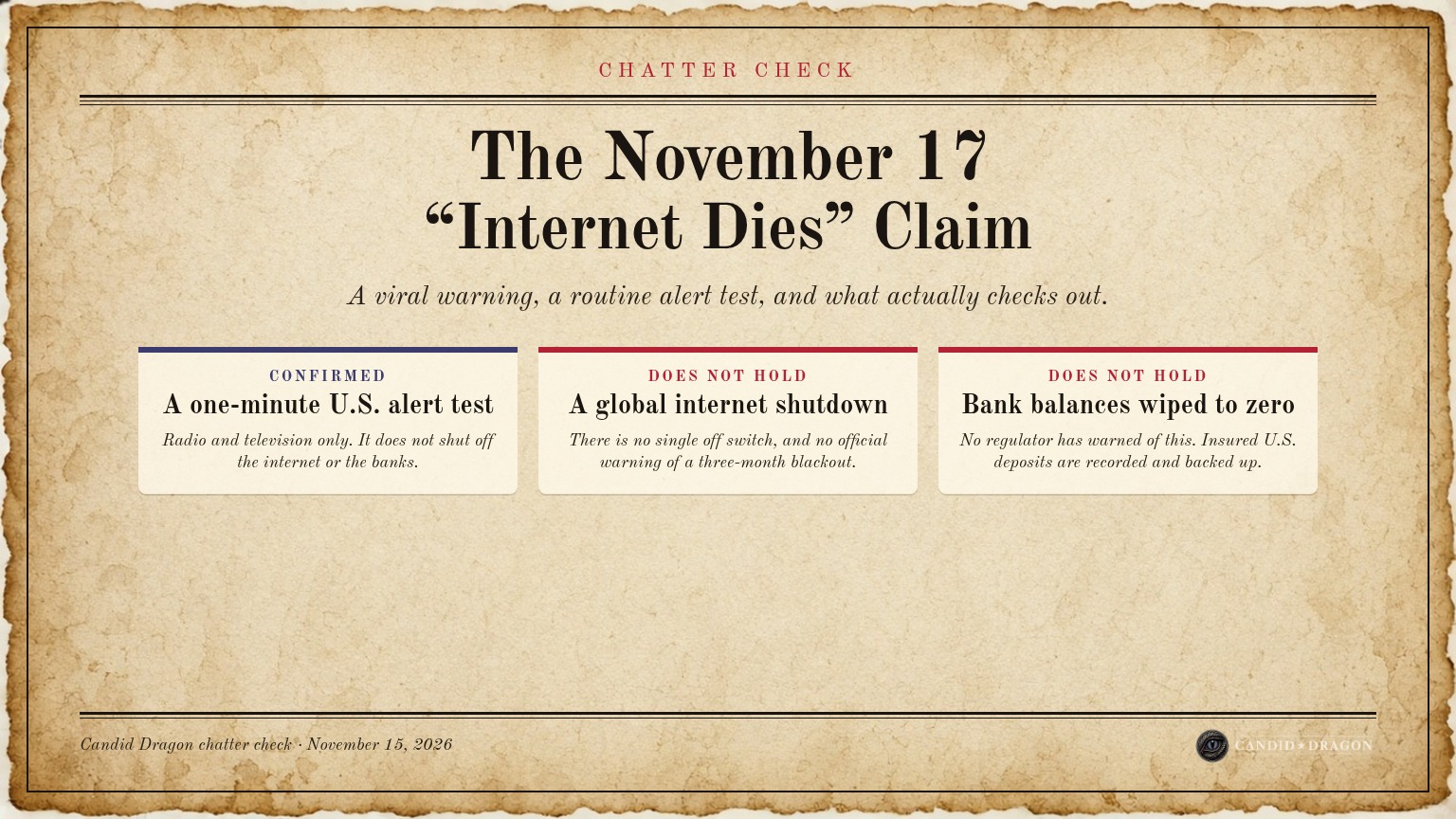
Verdict: Confirmed. It is a one-minute Emergency Alert System test on radio and television, announced in September. It is not a shutdown of the internet, the power grid or the banks. (FCC, Wisconsin Emergency Management, carrying the FEMA description)
- A “message circulating from the dark web” is the source of the warning.
Verdict: Unconfirmed, and unverifiable as stated. The earliest traceable posts are ordinary public accounts on X. The October 31 English template cited a phone call with an unnamed “intelligent person.” The “deep web” or “dark web” label was added on November 1. No post we found named a forum, a file, a handle or any other source that can be checked. An uncheckable source is not evidence.
- On November 17, everything connected to the internet will be hacked.
Verdict: Wrong, as a prediction with no supporting evidence. Real ransomware and data-theft attacks happen, and they are serious. They do not work as a single global “everything is hacked at once” event on a date announced weeks in advance on social media.
- A “COVID 2.0” begins that day.
Verdict: Wrong, as stated. The phrase is never defined in the posts we read — whether it is supposed to be a disease, a lockdown or only a metaphor — and no public-health agency has announced a pandemic or a digital “COVID 2.0” tied to November 17.
- Major banks will be compromised and balances wiped to zero, with no way to recover the true amount.
Verdict: Wrong, as a claim about what is going to happen on that date. No U.S. bank regulator has issued such a warning. Bank balances are not a single live number sitting on one computer. Depository institutions keep account records and backups so that, if a bank fails, the FDIC can pay insured deposits. The FDIC insures deposits at insured banks to at least $250,000 per depositor, per bank, per ownership category, and says that since it was founded in 1933, no depositor has lost a penny of FDIC-insured funds. That is not a promise that every computer system is unhackable. It is why a story about every balance in the world being erased, with no recovery, does not match how the system is built. (FDIC, Understanding Deposit Insurance)
- The global internet will be shut down for three months while an advanced AI patches every vulnerability.
Verdict: Wrong. The internet is a collection of thousands of independently operated networks. There is no single off switch a government, a hacker group or an “AI” can throw to take the whole world offline for a season. Real outages — including this week’s Microsoft disruption — have lasted hours or, at most, about a day, not months, and they were not a planned global lockdown.
- This weekend’s FAA ground stop and Microsoft outage are signs that the November 17 attack is starting.
Verdict: Wrong, on the official record we have. The FAA’s own Q&A says, “Based on all available evidence, we have no indication that this was a cyberattack or an outside nefarious actor.” It attributes the November 13 ground stop to legacy equipment that became unstable when data flooded the FAA network, with work at sites in Amarillo, Texas, and El Dorado, Arkansas. Microsoft said its outage “was a technical issue not related to cyber or AI / agents,” and that it was introduced during an earlier network-capacity upgrade. Timing alone is not proof of a plot. (FAA Q&A, The Verge, quoting Microsoft)
- Households should have some food, water and cash on hand because of this warning.
Verdict: Partly right, only as ordinary preparedness — not as a response to this rumor. A few days of food, water and cash is sensible in any season, for a storm, a power cut or a local outage. It is not evidence that a three-month global shutdown has been scheduled. Treating a viral “dark web” date as a reason to empty a bank account, or to buy a cryptocurrency pitched in a doctored video, is the part that does not hold up.
A short feasibility check
Two structural facts are worth keeping in view, because the rumor depends on ignoring both of them.
First, the internet has no master switch. Traffic is routed across many networks, in many countries, under many operators. A severe solar storm, a bad software update or a ransomware campaign can cause real, painful disruption — Snopes has repeatedly had to knock down recycled “internet apocalypse” headlines that overstate that risk — but that is not the same as a planned, worldwide, three-month shutdown announced in advance on Facebook.
Second, a bank balance is a legal record, not only a number on a screen. U.S. banks keep deposit records so the FDIC can determine what is insured if an institution fails. The FDIC’s deposit insurance is backed by the Deposit Insurance Fund and, the agency says, by the full faith and credit of the United States government. Cyberattacks on banks are a real threat, and customers can lose access for a time when systems go down. That is still a long way from a story in which every major bank is emptied to zero on the same morning and the true balances cannot be recovered.
This kind of date-specific rumor has a history
Date-stamped shutdown warnings are not new. QAnon circles have spent years circulating a “days of darkness” prophecy about a coming communications or power blackout that has not arrived on the dates it was promised. In 2023 and again in 2024, Snopes found that viral claims of a NASA warning about an imminent “internet apocalypse” overstated the science and put words in the agency’s mouth. The Trump 90-day blackout videos of this month fit the same pattern: a real or official-sounding hook (an alert test, a Pentagon resilience plan, a solar-storm paper) is stretched into a countdown. When the date passes, the story usually picks a new one.
What is still worth doing
None of this is an argument against ordinary readiness. A few days of drinking water, food you already eat, cash in small bills, flashlights, and a way to hear official alerts — including a battery or hand-crank radio — will help in a storm, a local outage or a real cyber incident that knocks a service offline for hours. That is a standing habit, not a reaction to an unverified November 17 prophecy. Our preparedness checklists, food-storage plan and guide to the November 17 alert test are written for that kind of calm preparation. If a bank, the FDIC, CISA or FEMA issues an actual customer warning, that is the time to treat it as news. A nameless “dark web” message is not that.
Our view: The claim does not hold up. A routine, previously announced one-minute alert test is being used as a hook for a much larger, evidence-free story. Stay ready in the ordinary way. Do not make sudden financial moves on the strength of an anonymous social-media warning.
Label key
- ✅ Confirmed An official record, or two or more independent outlets, agree.
- ❓ Unconfirmed Reported or claimed, but not yet independently verified.
- ⚠️ Disputed Contradicted by the evidence or by credible sources, or actively contested.
 Factual Straight reporting that holds up across outlets on different sides.
 Leans Left The facts hold, but the coverage tilts left: one-sided, loaded language, missing context or a single anonymous source.
 Leans Right The facts hold, but the coverage tilts right: one-sided, loaded language, missing context or a single anonymous source.
- Likely Propaganda State-run or state-aligned media, a militant press office, a partisan campaign or group, or unverifiable spin.
Each story gets one confidence tag and one source-lean label, plus a one-line Lean note explaining the call. Every side is held to the same standard. More on how we cover the news.
Sources
- X, @revelation_2025, September 17, 2026 (EAS test recast as “the storm”)
- X, @GodsBurnt, October 31, 2026 (English “COVID 2.0” / three-month shutdown template)
- X, @wesleysimplic, November 1, 2026 (Portuguese “Direto da deepweb” post)
- FCC, EAS Test Reporting System (November 17 test date and December 3 backup)
- Wisconsin Emergency Management, Nationwide Emergency Alert System Test on Nov. 17 (FEMA description of the test)
- Ready Harris, 2026 Nationwide Emergency Alert System Test (September 30 notice)
- Erie County Executive, FEMA and FCC to conduct test of nationwide Emergency Alert System
- LB.ua, Centre for Countering Disinformation debunks 17 November cyberattack rumour, November 9, 2026
- Snopes, “Are videos showing Trump announcing 90-day blackout real?”, November 10, 2026
- Franceinfo, investigation of how the November 17 blackout rumor spread, November 13, 2026
- TF1 Info, “Un black-out le 17 novembre”: where the rumor came from, November 14, 2026
- FAA, Nationwide Ground Stop: Questions and Answers, updated November 15, 2026
- The Verge, “Microsoft’s massive Outlook outage might be over,” November 13, 2026, quoting Microsoft’s statement
- FDIC, Understanding Deposit Insurance
- Snopes, “No, NASA Did Not Issue a Warning About a Pending ‘Internet Apocalypse,’” March 8, 2024
- The Economic Times, rumor of a massive cyberattack on November 17, November 15, 2026
Featured image: Candid Dragon almanac graphic, November 15, 2026. See all image credits.