

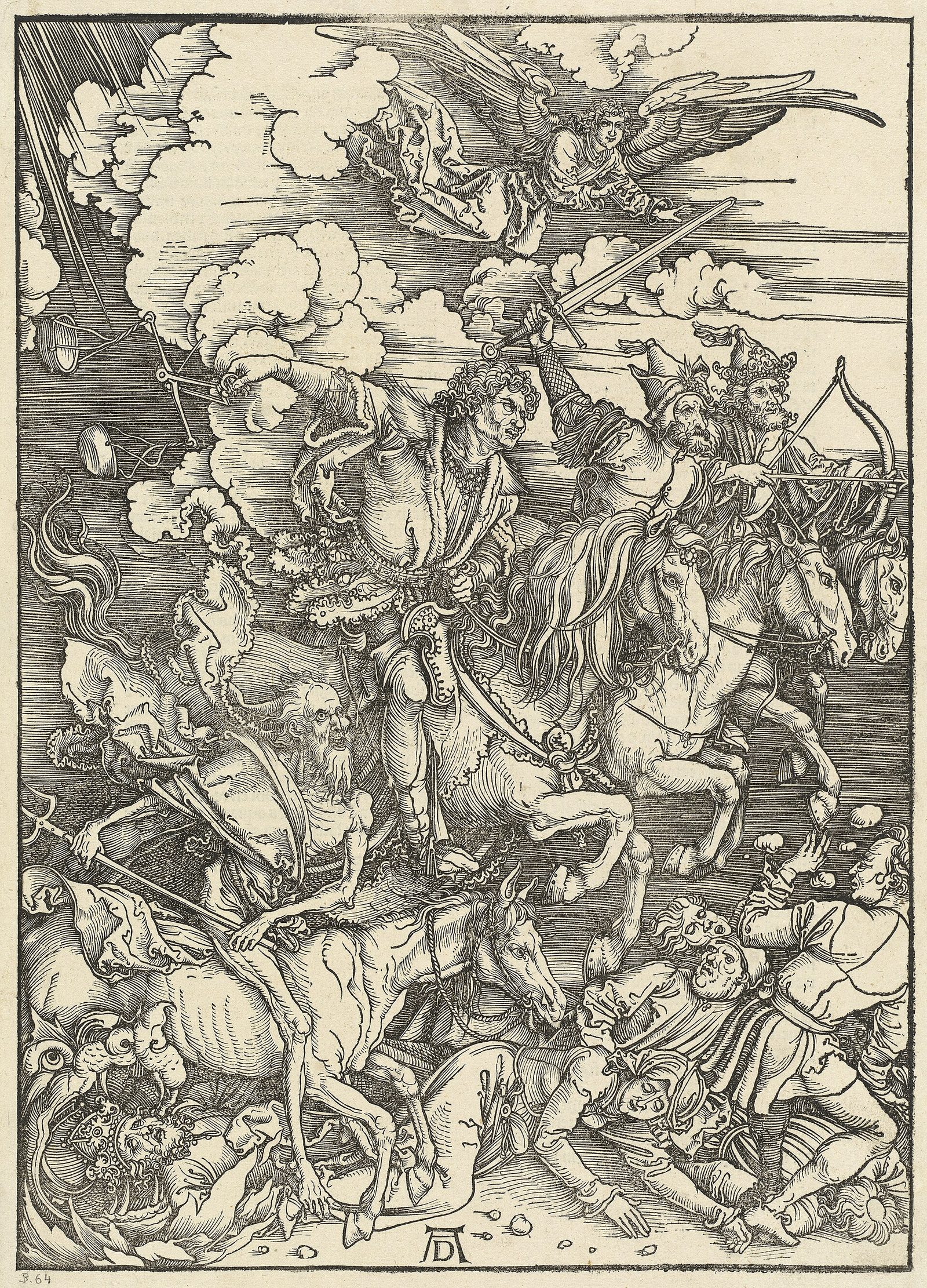
The Book of Revelation has two riders on white horses. Readers have argued for centuries about whether they are the same figure. Here are the texts first, then the main interpretations, so you can weigh them yourself.
The first rider: Revelation 6:1-2
And I saw when the Lamb opened one of the seals, and I heard, as it were the noise of thunder, one of the four beasts saying, Come and see. And I saw, and behold a white horse: and he that sat on him had a bow; and a crown was given unto him: and he went forth conquering, and to conquer.
Revelation 6:1-2, KJV
The second rider: Revelation 19:11-16
And I saw heaven opened, and behold a white horse; and he that sat upon him was called Faithful and True, and in righteousness he doth judge and make war. His eyes were as a flame of fire, and on his head were many crowns; and he had a name written, that no man knew, but he himself. And he was clothed with a vesture dipped in blood: and his name is called The Word of God. … And he hath on his vesture and on his thigh a name written, KING OF KINGS, AND LORD OF LORDS.
Revelation 19:11-13, 16, KJV
Side by side
| Detail | Revelation 6 | Revelation 19 |
|---|---|---|
| Context | First of seven seals, opened by the Lamb | Heaven opened, after the fall of Babylon |
| Name | None given | Faithful and True, The Word of God, King of Kings |
| Weapon | A bow | A sharp sword from his mouth |
| Crown | “A crown” (singular), given to him | “Many crowns” |
| Followed by | Red, black and pale horses: war, famine, death | The armies of heaven on white horses |
Reading 1: Christ, or the gospel, going out
An old view, found in some early commentators, takes the first rider as Christ or the victorious spread of the gospel. White stands for purity and victory, and in Revelation 19 the rider is plainly Christ.
Reading 2: a counterfeit, the Antichrist
Many modern readers, especially in futurist and dispensational traditions, see the first rider as a deceiver who imitates Christ. He is unnamed, his crown is handed to him, and he opens a sequence of war, famine and death. Revelation 19 then shows the real King.
Reading 3: conquest and empire
Other interpreters see the first horseman as military conquest in general, the first of four judgments that recur through history.
What the text settles, and what it doesn’t
The text does settle some things. The rider in chapter 19 is identified as The Word of God and King of Kings. The rider in chapter 6 is not named, and he works inside a chain of judgments that the Lamb has set loose. Whether he imitates Christ, represents Christ’s gospel, or represents conquest is a matter of interpretation. Sincere believers disagree.
Study tip: Read Revelation 6 with the rest of the seals (6:1-17), and Revelation 19 with chapters 17-20. Context does most of the interpretive work.
Sources
Featured image: Albrecht Dürer, The Four Horsemen, 1498, NGA 142352, by Albrecht Dürer. CC0, via Wikimedia Commons. See all image credits.