

What This Means for Your Wallet is our recurring explainer: one economic headline, one question. What changes for a regular household? Every edition uses official data with the source and date under the chart. Find every edition on Economy and Your Wallet.
The headline
Freddie Mac’s weekly survey put the average 30-year fixed mortgage rate at 7.11% on November 12, 2026. The record low was 2.65% in January 2021.
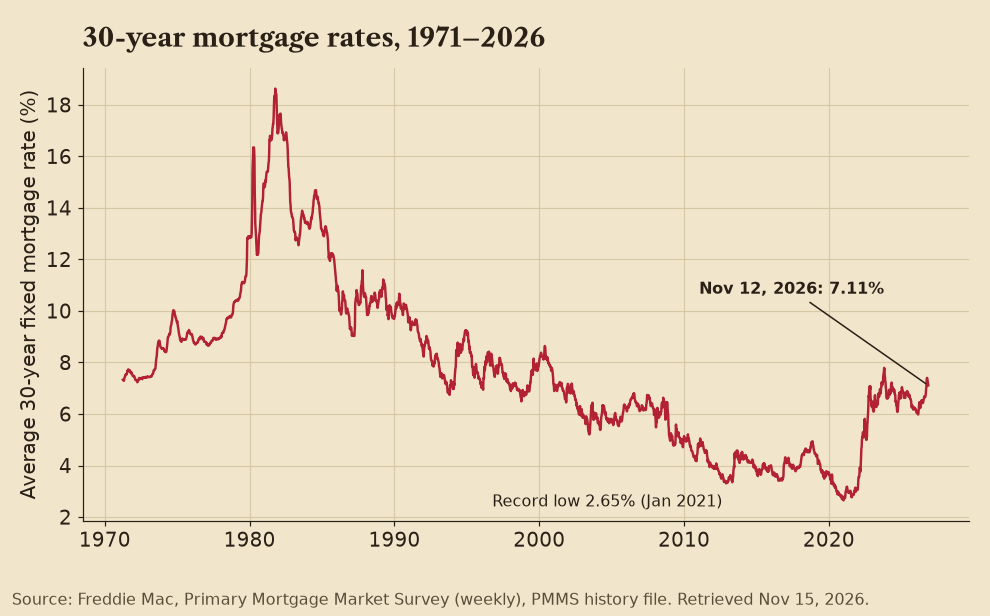
✅ Confirmed  Factual Lean note: Freddie Mac’s Primary Mortgage Market Survey has been published weekly since 1971.
What it means for your wallet
- The math: On a $300,000 30-year loan, principal and interest come to about $2,018 a month at 7.11%, compared with about $1,209 at 2.65%. That is before taxes and insurance.
- Owners with low rates tend to stay put rather than give up a cheap loan, which keeps the number of homes for sale low.
- Buyers can shop lenders (rates vary), compare points against a lower rate, and ask about assumable FHA or VA loans, which let a buyer take over a seller’s existing rate.
- Refinancing only pays off when the new rate is low enough to cover closing costs within the time you expect to stay.
✅ Confirmed Factual Lean note: Payment figures are standard amortization math on the published rates.
What moves mortgage rates
Mortgage rates track the 10-year Treasury yield more closely than the Fed’s short-term rate. Inflation expectations, federal borrowing and the Fed’s own holdings of mortgage bonds all feed in. See The Federal Reserve, Explained.
Not financial advice. This is general education from public sources, not financial advice for your situation. Talk to a qualified professional before you act.
Label key
- ✅ Confirmed An official record, or two or more independent outlets, agree.
- ❓ Unconfirmed Reported or claimed, but not yet independently verified.
- ⚠️ Disputed Contradicted by the evidence or by credible sources, or actively contested.
- Factual Straight reporting that holds up across outlets on different sides.
 Leans Left The facts hold, but the coverage tilts left: one-sided, loaded language, missing context or a single anonymous source.
 Leans Right The facts hold, but the coverage tilts right: one-sided, loaded language, missing context or a single anonymous source.
 Likely Propaganda State-run or state-aligned media, a militant press office, a partisan campaign or group, or unverifiable spin.
Each story gets one confidence tag and one source-lean label, plus a one-line Lean note explaining the call. Every side is held to the same standard. More on how we cover the news.
Sources
- Freddie Mac, Primary Mortgage Market Survey
- Consumer Financial Protection Bureau, Explore interest rates
- HUD, FHA loan assumption basics