

The Federal Reserve is America’s central bank, created by the Federal Reserve Act signed on December 23, 1913. It sets short-term interest rates, supervises many banks and acts as the lender of last resort in a crisis.
How it is set up
- Board of Governors: Seven members appointed by the President and confirmed by the Senate to 14-year terms. The chair serves a four-year term as chair.
- The FOMC: The Federal Open Market Committee, the seven governors plus five of the twelve regional Reserve Bank presidents, votes on rates at eight scheduled meetings a year.
- The mandate: Congress told the Fed in 1977 to pursue maximum employment and stable prices. The Fed formally set a 2% inflation target in 2012.
✅ Confirmed  Factual Lean note: From the Federal Reserve Board’s own descriptions and the statutes.
Where things stand
- Kevin Warsh was sworn in as Fed chair in May 2026, succeeding Jerome Powell.
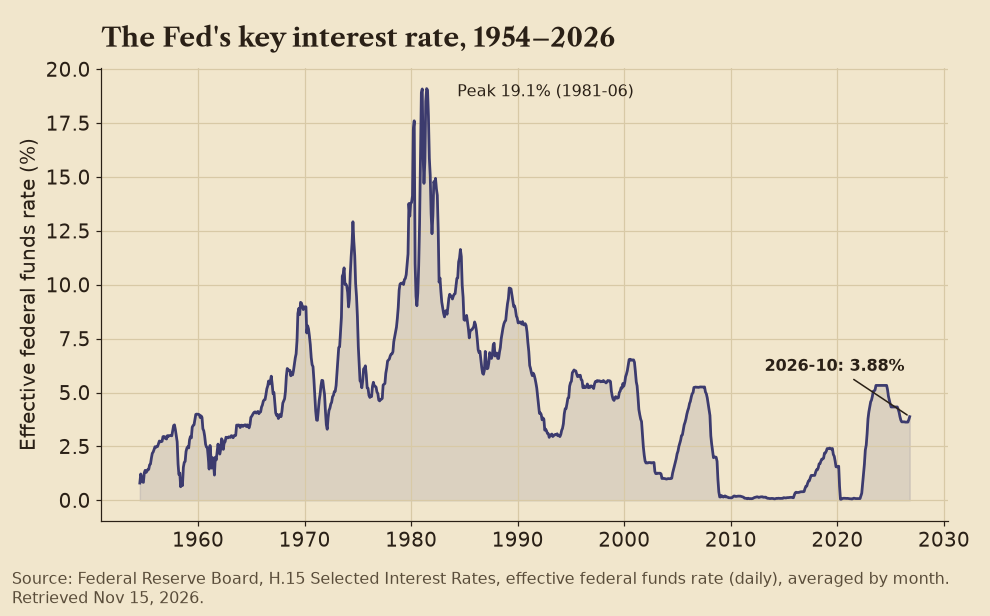
- On October 28, 2026, the FOMC voted 10–2 to hold its target range at 3.75% to 4.00%. The two dissenters wanted a hike. The effective rate averaged 3.88% in 2026-10.
- The committee’s statement said “Inflation remains elevated” and repeated its 2% goal.
✅ Confirmed Factual Lean note: Quoted from the FOMC statement and reported by CBS News and CNBC.
The independence debate
Presidents of both parties have pressured the Fed. Lyndon Johnson and Richard Nixon leaned on their chairs to keep rates low, and Nixon-era inflation is often blamed partly on that pressure. Donald Trump has publicly pushed for lower rates in both terms. Supporters of Fed independence argue that a central bank answering to elections will print money before every vote. Critics, including some in Congress on both sides, argue an unelected body has too much power over the economy and too little oversight.
✅ Confirmed  Leans Left Lean note: The history is documented; how much independence the Fed should have is a values question, and coverage of it tends to tilt left in major outlets.
What it means for your wallet
- Fed hikes and cuts flow quickly into credit card rates, home-equity lines and savings account yields.
- Mortgage rates follow longer-term Treasury yields, which react to the Fed but are not set by it. See our mortgage explainer.
Not financial advice. This is general education from public sources, not financial advice for your situation. Talk to a qualified professional before you act.
Label key
- ✅ Confirmed An official record, or two or more independent outlets, agree.
- ❓ Unconfirmed Reported or claimed, but not yet independently verified.
- ⚠️ Disputed Contradicted by the evidence or by credible sources, or actively contested.
- Factual Straight reporting that holds up across outlets on different sides.
- Leans Left The facts hold, but the coverage tilts left: one-sided, loaded language, missing context or a single anonymous source.
 Leans Right The facts hold, but the coverage tilts right: one-sided, loaded language, missing context or a single anonymous source.
 Likely Propaganda State-run or state-aligned media, a militant press office, a partisan campaign or group, or unverifiable spin.
Each story gets one confidence tag and one source-lean label, plus a one-line Lean note explaining the call. Every side is held to the same standard. More on how we cover the news.
Sources
- Federal Reserve Board, About the Fed
- Federal Reserve, FOMC statement, October 28, 2026
- Federal Reserve, H.15 Selected Interest Rates
- CBS News, Kevin Warsh sworn in as new Fed chair
- Federal Reserve, Statement on Longer-Run Goals (2012)