

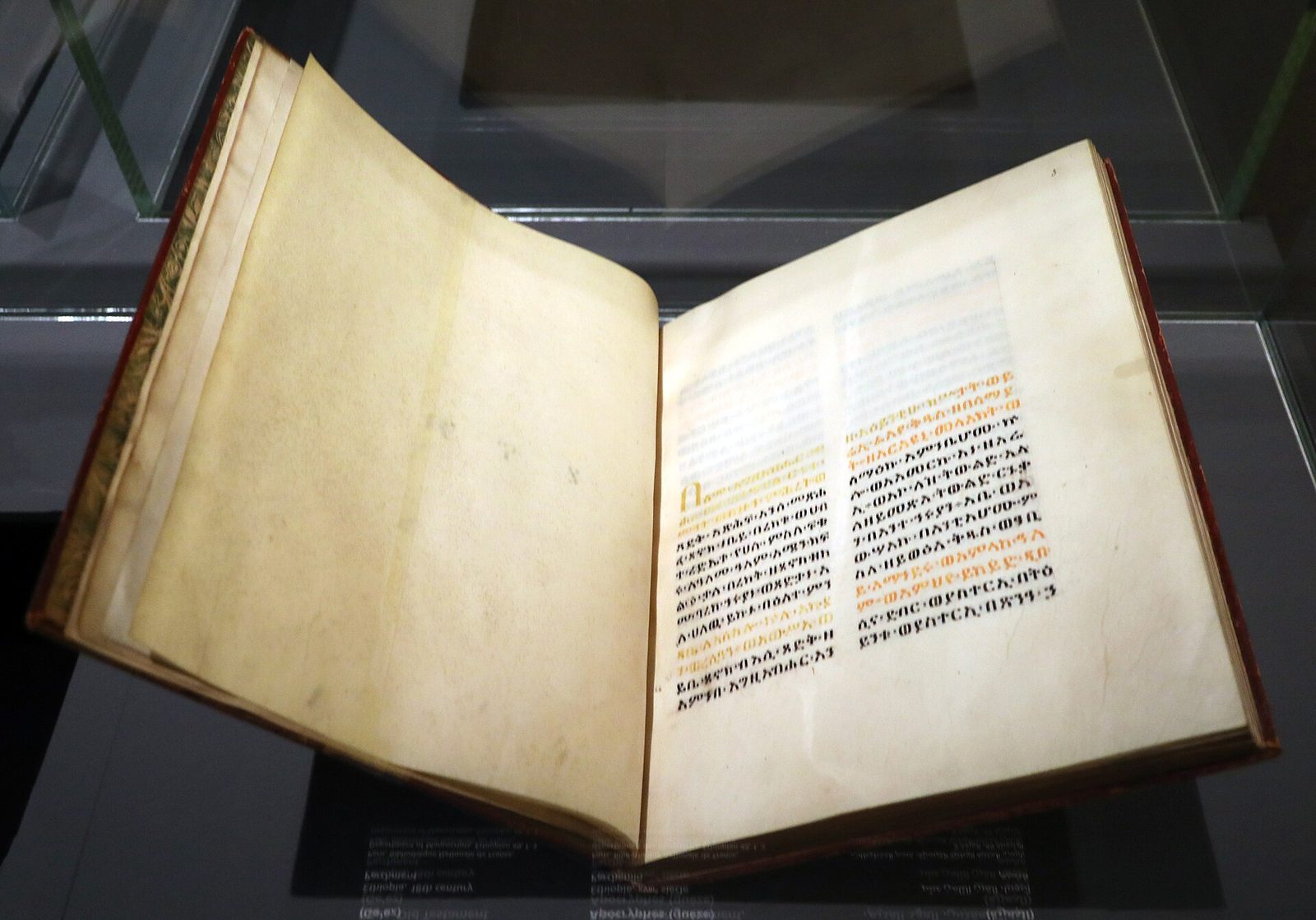
Few books outside the Bible stir as much curiosity as 1 Enoch. It tells of the Watchers, angels who came down and took human wives, and of their giant offspring. It is quoted, apparently word for word, in the New Testament. Yet it appears in almost no Bible on an American bookshelf. Here is the evidence, kept separate from the interpretations.
The New Testament quotes it
The Epistle of Jude, verses 14 and 15 (KJV):
And Enoch also, the seventh from Adam, prophesied of these, saying, Behold, the Lord cometh with ten thousands of his saints, To execute judgment upon all, and to convince all that are ungodly among them of all their ungodly deeds which they have ungodly committed, and of all their hard speeches which ungodly sinners have spoken against him.
Jude 1:14-15, King James Version
This prophecy closely matches the opening chapter of 1 Enoch. Christians have long debated what quoting it implies. Most churches hold that Jude quoting a true statement does not make the whole book Scripture, much as Paul quotes Greek poets in Acts 17.
Genesis 6 and the Nephilim
Enoch expands a short and mysterious passage:
There were giants in the earth in those days; and also after that, when the sons of God came in unto the daughters of men, and they bare children to them, the same became mighty men which were of old, men of renown.
Genesis 6:4, KJV
Enoch reads the “sons of God” as fallen angels, the Watchers. Others, including Augustine in City of God Book XV, read them as the godly line of Seth marrying the line of Cain. Both readings have defenders today. The text itself is brief.
The manuscripts
- Ethiopic: According to the Encyclopaedia Aethiopica, the complete work survives only in Ge’ez, the classical language of Ethiopia. Europe did not know the full text until James Bruce brought manuscripts to England in 1773.
- Dead Sea Scrolls: Aramaic fragments from Qumran Cave 4, edited by J.T. Milik, cover the Book of the Watchers, the Astronomical Book, the Dream Visions, the Epistle of Enoch, and the related Book of Giants. Encyclopaedia Aethiopica notes that the Parables section (chapters 37-71) has not been found at Qumran.
- Date: Scholars place its parts between roughly the 4th century BC and the 1st century AD.
Who keeps it as Scripture
The Ethiopian Orthodox Tewahedo Church’s 81-book canon includes Enoch. The church’s own site says its Old Testament was translated from the Septuagint and includes Enoch, Baruch and 3 and 4 Esdras.
Why most of the church set it aside
- Tertullian, writing around AD 200, defended Enoch but admitted it “is not received by some, because it is not admitted into the Jewish canon either.”
- In his Festal Letter of 367, Athanasius of Alexandria listed the books “included in the Canon.” Enoch is not among them, and the letter warns against books “called apocryphal.”
- Western and most Eastern churches followed lists like these. Enoch survived where the Ethiopian Church copied and kept it.
| Claim | Status |
|---|---|
| Jude quotes a prophecy found in 1 Enoch | Supported (compare Jude 1:14-15 with 1 Enoch 1) |
| Fragments were found among the Dead Sea Scrolls | Supported (Qumran Cave 4, Aramaic) |
| The Ethiopian Orthodox Church treats it as canon | Supported |
| It was “banned” in a single cover-up | Not supported. It was gradually left off canon lists. |
| Enoch himself wrote it before the Flood | A traditional belief. Scholars date it much later. |
Bottom line: Enoch is worth reading as an ancient Jewish book that shaped how the New Testament world thought about angels, judgment and the end of days. Read it alongside Scripture, not instead of it.
Sources
- Bible Gateway, Jude 1:14-15 (KJV)
- Bible Gateway, Genesis 6:1-4 (KJV)
- Encyclopaedia Aethiopica (via Habesha History), “Enoch, Book of”
- J.T. Milik, The Books of Enoch: Aramaic Fragments of Qumrân Cave 4 (1976), Internet Archive PDF
- Ethiopian Orthodox Tewahedo Church, The Canonical Books
- Tertullian, On the Apparel of Women, Book I, ch. 3 (New Advent)
- Athanasius, Festal Letter 39 (New Advent)
- Augustine, City of God, Book XV (New Advent)
Featured image: Etiopia, libro di enoch (in ge’ez), xviii secolo (bnf), by Francesco Bini. CC BY-SA 4.0, via Wikimedia Commons. See all image credits.