

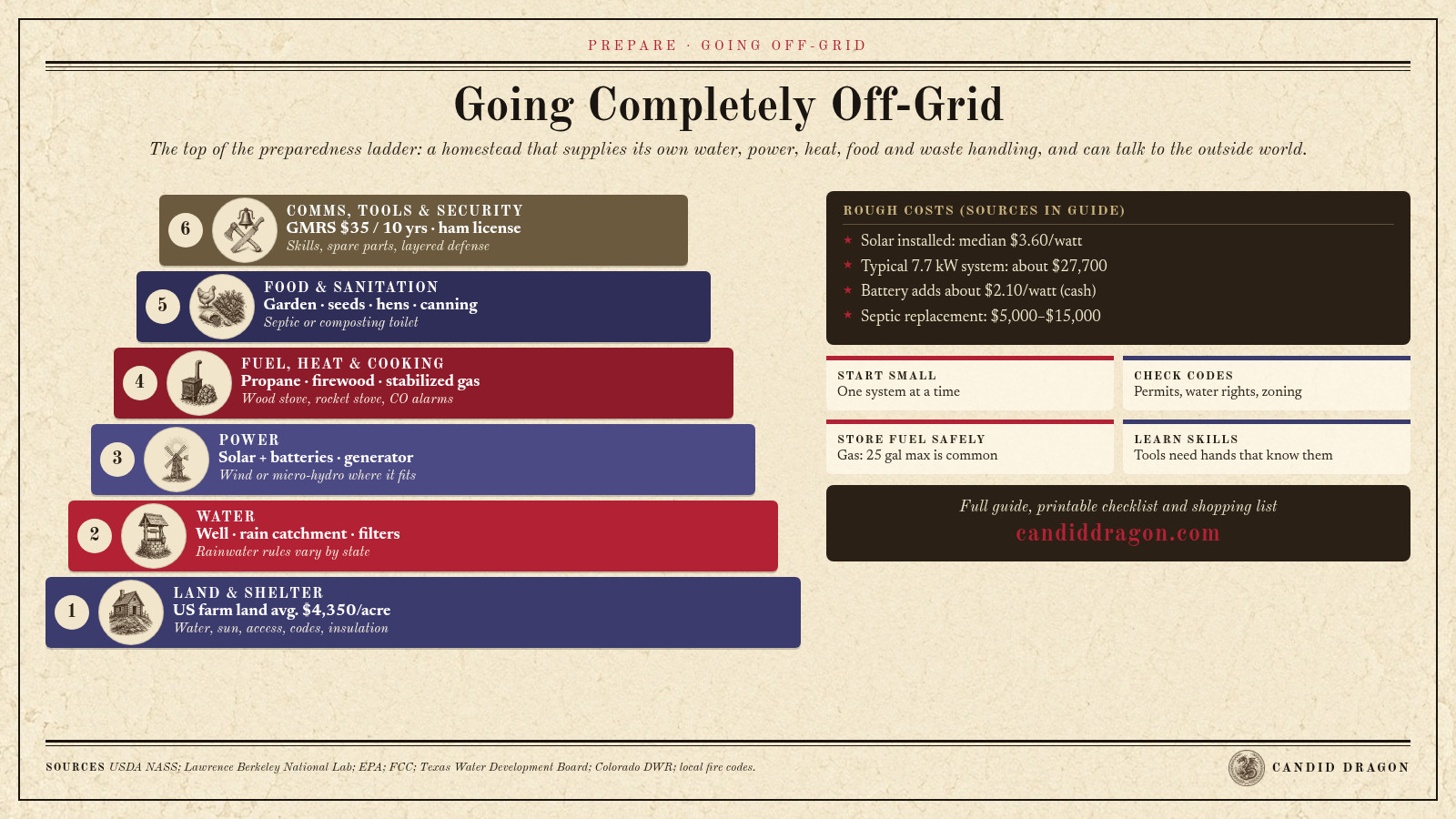
Going completely off-grid is the top of the preparedness ladder: a place that supplies its own water, power, heat, food and waste handling, and can still reach the outside world. It is expensive and it is work. It is also the most independent way to live. Build it one system at a time, start with what matters most in an emergency, and check every code and law before you dig.
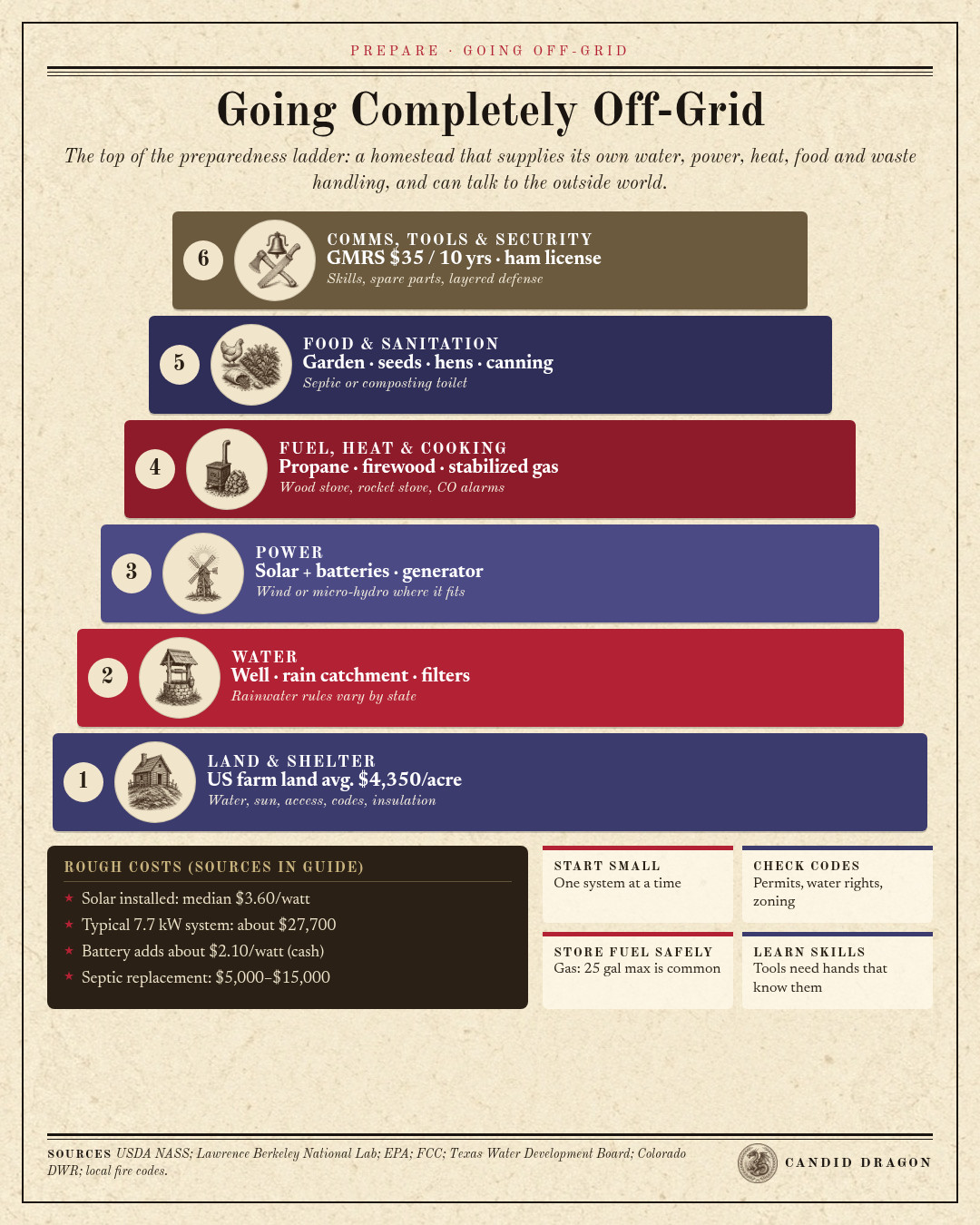
This guide sits on top of the rest of the series. Start with the One-Year Food Storage Plan, the Family Medical and Trauma Kit and Layered Home Defense, then add hunting and home canning as you go.
Why people are doing it
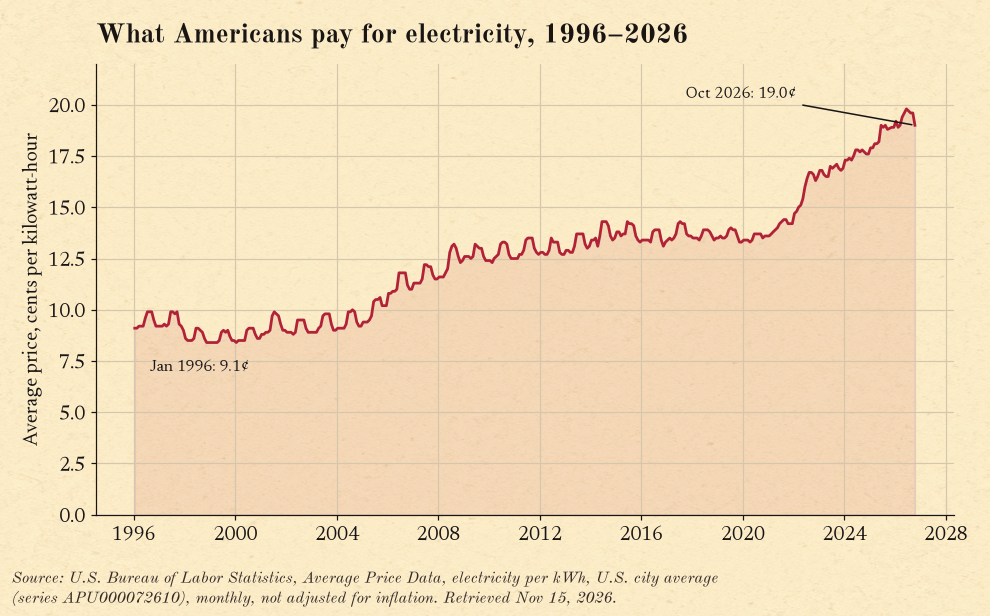
Grid power keeps getting more expensive, and outages from storms and strained grids show how much depends on it. Every system below reduces what you need from someone else.
✅ Confirmed  Factual Lean note: Bureau of Labor Statistics monthly price data.
1. Land and shelter
- Cost: USDA puts the 2025 average value of U.S. farm real estate at $4,350 an acre, and $2,970 in Texas. Pasture averaged $1,920 nationally. Raw land without utilities is often cheaper, but bringing in a well, power and a road can cost more than the land.
- Site selection: water first (well depth, rainfall, springs), then sun for solar, timber for heat, soil for a garden, year-round road access, distance to a hospital, and county rules on building and septic. Check flood maps and wildfire risk.
- Shelter: a small, well-insulated cabin or tiny home is cheaper to heat, cool and power. ENERGY STAR publishes recommended insulation levels by climate zone; going beyond them pays off quickly off-grid.
- Codes: even in rural counties, septic, wells and electrical work may need permits. Ask before you build.
✅ Confirmed Factual Lean note: USDA NASS Land Values 2025 Summary and ENERGY STAR guidance.
2. Water
- Well: the gold standard. EPA says private well owners are responsible for their own water and recommends testing every year for bacteria, nitrates and other contaminants. Plan a backup for the pump: solar, a hand pump, or stored water.
- Rainwater catchment: rules vary a lot by state. Texas encourages it: rainwater equipment is exempt from state sales tax, and homeowners associations cannot ban it. Colorado limits most homes to two barrels totaling 110 gallons, for outdoor use only. Check your state.
- Treatment: treat rainwater and surface water before drinking. Use a gravity filter that removes viruses, like those in our food guide’s water plan, with boiling or bleach as backup.
✅ Confirmed Factual Lean note: EPA, Texas Water Development Board (citing Texas Tax Code §151.355 and Property Code §202.007), and Colorado Division of Water Resources.
3. Power
- Solar with a battery bank: Lawrence Berkeley National Laboratory found the median installed price of home-owned solar in 2025 was $3.60 a watt before incentives ($3.00 for cash purchases). The median system, 7.7 kilowatts, works out to about $27,700 by our math. Adding a battery raised the median cash price by about $2.10 a watt of solar. Off-grid homes need far more battery than grid-tied ones to cover nights and cloudy stretches.
- Incentives: according to the IRS, the federal 30% residential clean-energy credit does not apply to systems placed in service after December 31, 2025. Check state and local programs.
- Generator: a backup for long cloudy spells. Never run one inside a home, basement or garage. CDC says to keep it outside at least 20 feet from any window, door or vent, and to use a battery-powered or battery-backup carbon monoxide detector.
- Wind and micro-hydro: small wind needs steady wind and open ground; micro-hydro needs a year-round stream with enough drop. The Department of Energy says a micro-hydropower plant (up to 100 kilowatts) can produce enough electricity for a single home, farm or ranch.
✅ Confirmed Factual Lean note: LBNL Tracking the Sun 2026 data update, IRS, CDC and DOE.
4. Fuel, heating and cooking
- Propane: runs stoves, heaters, refrigerators and generators, and keeps far longer than gasoline. Store cylinders outdoors, upright, and away from ignition sources.
- Gasoline: add fuel stabilizer and rotate it. Fire departments that follow the International Fire Code commonly cap home storage at 25 gallons in approved containers, no more than 10 of it in an attached garage and none in a basement, and some advise using stored fuel within six months.
- Wood: an EPA-certified wood stove burns cleaner and uses less wood. Burn only dry, seasoned wood. Install smoke and carbon monoxide alarms.
- Cooking: a wood or propane cookstove indoors; a rocket stove or grill outdoors only. A rocket stove cooks a meal on a handful of sticks.
❓ Unconfirmed Factual Lean note: Fuel-storage limits come from local fire departments citing the International Fire Code; your local code may differ.
5. Sanitation
- Septic system: EPA says replacing a conventional system costs $5,000 to $15,000, and recommends inspection every one to three years and pumping every three to five years, at about $250 to $500.
- Composting toilet: uses little or no water. Many counties still require a permit, or a septic system for graywater. Check with your health department.
- Keep a bucket-toilet kit as a backup for any system.
6. Food production
- Garden: grow what you eat most and what thrives in your county. Your extension office has planting calendars.
- Chickens: University of Florida Extension says a backyard hen lays about 200 to 240 eggs a year, so five or six hens cover most families of four. Rutgers recommends at least 1.5 square feet per laying hen inside the coop and 8 in the run.
- Small livestock: rabbits and goats are common next steps. Check zoning.
- Preservation: canning, drying and freezing carry the harvest through winter. See How to Can Food at Home and the One-Year Food Storage Plan.
Seed bank: what we keep
We keep sealed packs of heirloom, open-pollinated seed. Open-pollinated varieties grow true from saved seed, unlike most hybrids. Store seed cool, dark and dry in a sealed jar. Illinois Extension recommends below 45°F, such as in a refrigerator, and letting the jar warm to room temperature before opening. Test germination a month before planting: sprout 10 seeds in a damp paper towel and count. Plant from the bank every year and refill it with fresh or saved seed.
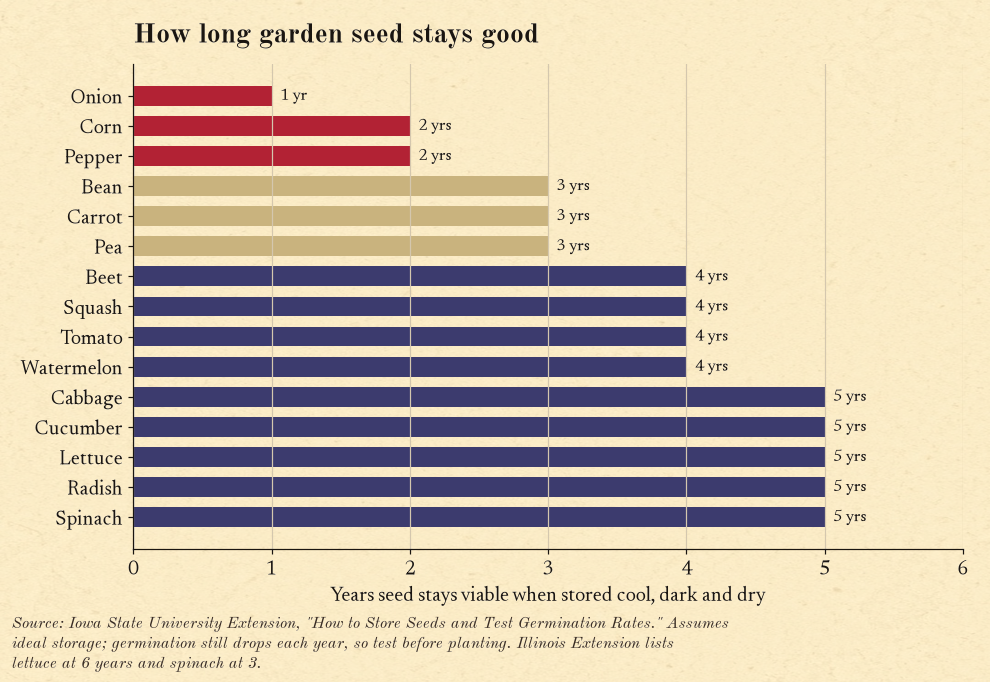
Seed-saving basics: start with easy, self-pollinating crops like beans, peas, lettuce and tomatoes. Save from your best plants, dry the seed fully, and label each jar with the variety and year.
✅ Confirmed Factual Lean note: Iowa State and Illinois Extension seed-storage guidance; University of Florida and Rutgers poultry guidance.
7. Communications
- NOAA weather radio with battery or hand crank. No license needed.
- GMRS radios: an FCC license costs $35, lasts 10 years, needs no exam, and covers your immediate family. Range is a few miles, more with a repeater.
- Ham (amateur) radio: the entry-level Technician license requires passing a 35-question exam; ARRL lists test sessions. Ham radio can reach across the state or the world without the internet or cell towers.
- Satellite messenger for remote areas without cell service.
✅ Confirmed Factual Lean note: FCC rules (47 CFR Part 95) and ARRL.
8. Tools, skills and security
- Hand and power tools, a chainsaw, spare parts and fluids for every engine, and printed manuals
- Skills: basic electrical, plumbing, small-engine repair, welding, first aid, food preservation and butchering. See Skilled Trades Are Preparedness.
- Security: remote places mean long response times. Apply every layer of Layered Home Defense, and keep a medical and trauma kit and the training to use it.
- Food from the land: Hunting and Food Procurement.
Rough cost ranges
| System | Rough cost | Source |
|---|---|---|
| Rural land | Average $4,350/acre U.S. farm real estate; $2,970 in Texas; $1,920 U.S. pasture (2025) | USDA NASS |
| Solar, installed | Median $3.60/watt; about $27,700 for the median 7.7 kW system (2025; our math) | LBNL |
| Battery added to solar | About $2.10 more per watt of solar for cash buyers (2025 median) | LBNL |
| Septic system | $5,000–$15,000 to replace a conventional system; $250–$500 per maintenance visit | EPA |
| GMRS license | $35 for 10 years, whole family | FCC |
| Family water filter | About $70–$100 list price (LifeStraw Family, Mission), Nov. 2026 | LifeStraw |
| Well drilling | Varies widely with depth and geology. Get local bids. | Local licensed drillers |
Prices change. Get local quotes before you plan.
Printable checklist
| ✔ | System | Done? |
|---|---|---|
| ☐ | Land with water, sun and access; codes checked | _____ |
| ☐ | Insulated shelter | _____ |
| ☐ | Well tested, or rain catchment that is legal and treated | _____ |
| ☐ | Gravity water filter and backup treatment | _____ |
| ☐ | Solar, batteries and inverter sized to your load | _____ |
| ☐ | Generator, fuel stabilizer and CO alarms | _____ |
| ☐ | Propane and firewood for one winter | _____ |
| ☐ | EPA-certified wood stove and an outdoor rocket stove | _____ |
| ☐ | Septic or permitted composting toilet; bucket backup | _____ |
| ☐ | Garden, seed bank and chickens | _____ |
| ☐ | Canning and drying equipment | _____ |
| ☐ | NOAA radio, GMRS radios, ham license | _____ |
| ☐ | Tools, spare parts, manuals | _____ |
| ☐ | Medical kit and training | _____ |
| ☐ | Layered security plan | _____ |
Shopping list
A starting list for one homestead. Size solar, batteries and fuel to your own load.
| ✔ | Item | Family of 4 | Where to buy |
|---|---|---|---|
| ☐ | Gravity water filter | 1–2 | LifeStraw Community · LifeStraw Mission · Amazon |
| ☐ | Rain barrels and catchment parts | as your state allows | Lowe’s · Tractor Supply |
| ☐ | Solar panels, batteries or a solar generator | sized to your load | Costco · Lowe’s · Amazon |
| ☐ | Portable generator, fuel cans, stabilizer, CO alarms | 1 each | Lowe’s · Tractor Supply · Walmart |
| ☐ | Wood stove or rocket stove | 1 | Tractor Supply · Amazon |
| ☐ | Composting toilet | 1 | Amazon · Lowe’s |
| ☐ | Heirloom seed vault | 1–2 kits | Amazon · Walmart |
| ☐ | Chicken coop, feeder and waterer | 1 setup | Tractor Supply · Walmart |
| ☐ | NOAA weather radio and GMRS radios | 1 + 4 | Amazon · Amazon · Walmart |
| ☐ | Ham radio license study | each operator | ARRL |
About these links: We get nothing for them. No sponsors, no affiliate codes, no kickbacks. We list several stores so you can compare prices and buy wherever you like. Prices and stock change, so check before you buy.
Label key
- ✅ Confirmed An official record, or two or more independent outlets, agree.
- ❓ Unconfirmed Reported or claimed, but not yet independently verified.
- ⚠️ Disputed Contradicted by the evidence or by credible sources, or actively contested.
- Factual Straight reporting that holds up across outlets on different sides.
 Leans Left The facts hold, but the coverage tilts left: one-sided, loaded language, missing context or a single anonymous source.
 Leans Right The facts hold, but the coverage tilts right: one-sided, loaded language, missing context or a single anonymous source.
 Likely Propaganda State-run or state-aligned media, a militant press office, a partisan campaign or group, or unverifiable spin.
Each story gets one confidence tag and one source-lean label, plus a one-line Lean note explaining the call. Every side is held to the same standard. More on how we cover the news.
Sources
- USDA NASS, Land Values 2025 Summary (PDF)
- Lawrence Berkeley National Laboratory, U.S. Distributed Solar and Storage: 2026 Data Update (PDF)
- IRS, Residential Clean Energy Credit
- U.S. Bureau of Labor Statistics, Average Price Data, electricity per kWh (APU000072610)
- EPA, Private Drinking Water Wells
- Texas Water Development Board, Rainwater Harvesting (PDF)
- Colorado Division of Water Resources, Rainwater, Storm Water and Graywater
- CDC, What to Do to Protect Yourself During a Power Outage
- Lehi City Fire Department, Home Fuel Storage Limits
- EPA, Burn Wise
- EPA, Why Maintain Your Septic System
- ENERGY STAR, Recommended Home Insulation R-Values
- U.S. Department of Energy, Types of Hydropower Plants
- University of Florida IFAS, Raising Backyard Chickens for Eggs (PDF)
- Rutgers Cooperative Extension, Helpful Hints for Small Flock Management
- Iowa State University Extension, How to Store Seeds and Test Germination Rates
- University of Illinois Extension, Seed Viability and Germination (PDF)
- FCC, General Mobile Radio Service (GMRS)
- ARRL, Getting Licensed
The Candid Dragon preparedness series
- Going Completely Off-Grid (the top of the ladder)
- The One-Year Food Storage Plan
- How to Can Food at Home (plus drying, freeze-drying and Mylar)
- The Family Medical and Trauma Kit
- Layered Home Defense
- Hunting and Food Procurement
- The 72-Hour Kit · Water Storage Basics · Preparedness Checklists · All of Prepare