

← Back to the timeline The American Founding1781
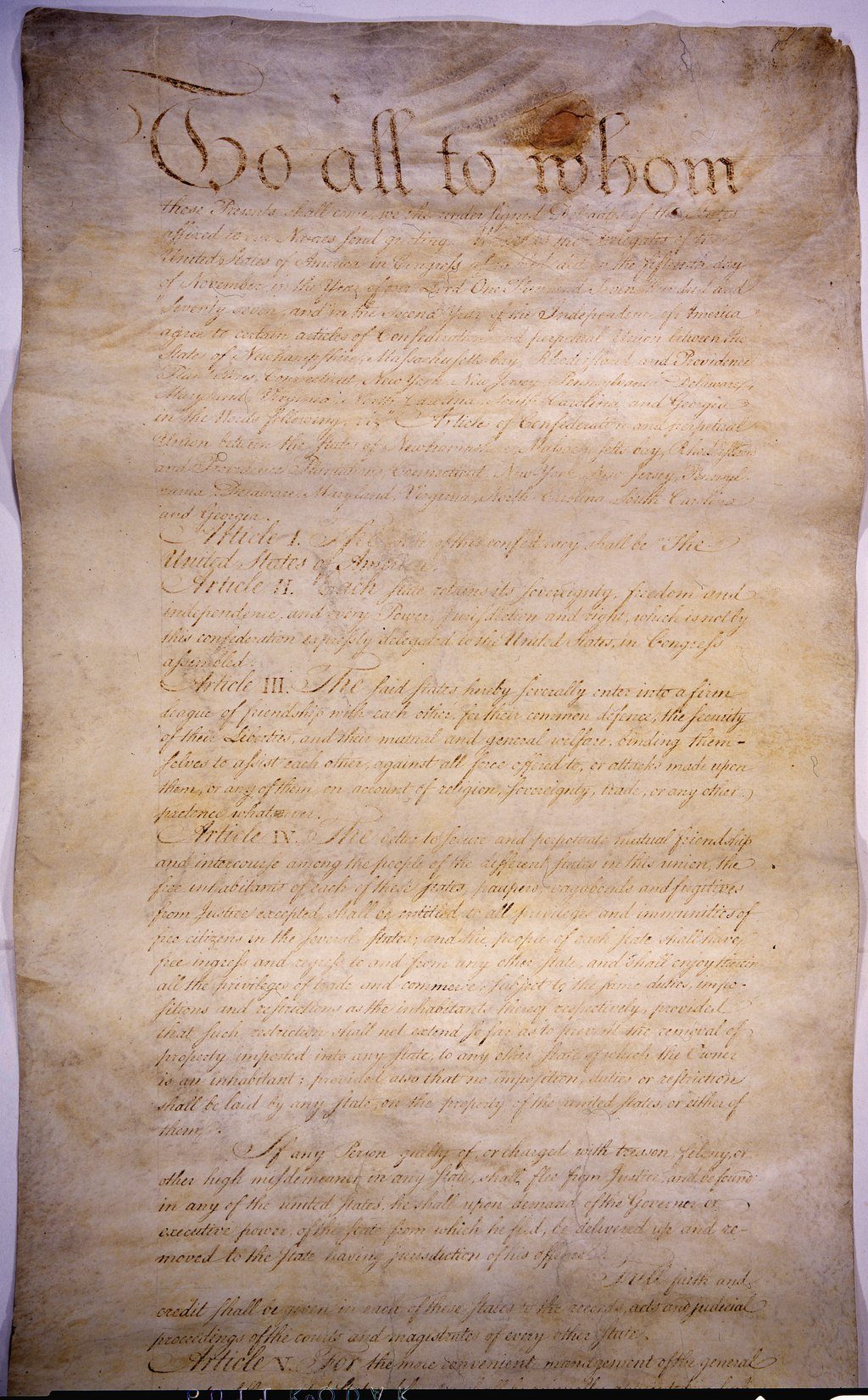
On this day in 1777, the Second Continental Congress adopted the Articles of Confederation, the country’s first written frame of government. Most Americans skip straight from the Declaration to the Constitution. The decade in between is worth knowing, because it shows why the Constitution was built the way it was.
What the Articles created
The National Archives calls the Articles “the United States’ first constitution.” John Dickinson of Delaware was the principal writer. The document gave the country its name. Article I reads: “The Stile of this confederacy shall be, ‘The United States of America.’”
- A league, not a nation: Article III called the arrangement “a firm league of friendship” among the states for their common defense and liberty.
- States kept the power: Article II said each state “retains its sovereignty, freedom and independence,” along with every power not “expressly delegated” to Congress.
- One state, one vote: Each state had one vote in Congress, whatever its population.
- Supermajorities: Major decisions, such as making war, coining or borrowing money, or raising an army, required nine of the thirteen states.
A slow start
Ratification required all thirteen states. Disputes over representation, voting and western land claims delayed it. The Articles finally took effect when Maryland ratified on March 1, 1781, months before the victory at Yorktown.
Why it failed
The National Archives sums up the problem plainly. Congress could not tax. It could not regulate commerce. It could not effectively support a war. With an empty treasury and paper money flooding the country, inflation soared, and Congress had little power to settle quarrels between states.
The amendment rule made reform nearly impossible. Article XIII required that any change be agreed to in Congress “and be afterwards confirmed by the legislatures of every state.” One state could block everything.
The fix
In May 1787 delegates met in Philadelphia to revise the Articles. By mid-June they had decided to replace them. The new Constitution was signed on September 17, 1787, and went into effect in 1789. Several of its features answer the Articles’ failures directly:
| Problem under the Articles | Answer in the Constitution |
|---|---|
| Congress could not tax | Congress may “lay and collect Taxes” (Article I, Section 8) |
| No power over trade between states | Congress may “regulate Commerce… among the several States” |
| One state, one vote | A House based on population and a Senate with two members per state |
| Unanimous consent to amend | Amendments ratified by three-fourths of the states (Article V) |
| Unanimous ratification | Nine state conventions sufficient (Article VII) |
Our view: The Articles were not a failure of principle. Their love of local self-government and fear of distant power were right, and the Tenth Amendment carries that idea forward. They failed in mechanics. The Founders kept the principle and fixed the machinery, which is a good lesson for anyone who wants to reform government today.
Related: A Primer on America’s Founding Documents and the Founding Timeline.
Sources
- National Archives, Articles of Confederation (1777), with transcript
- National Archives, The Constitution of the United States: A Transcription
- National Archives, The Bill of Rights: A Transcription
Featured image: Articles of Confederation WDL2717, by Dickinson, John (1732-1808). Public domain, via Wikimedia Commons. See all image credits.