

← Back to the timeline The American Founding1787
The National Archives calls three documents the “Charters of Freedom”: the Declaration of Independence, the Constitution and the Bill of Rights. All three are on display in its Rotunda in Washington. With the often-forgotten Articles of Confederation, they tell the story of how the United States was founded and then rebuilt.
The Declaration of Independence (1776)
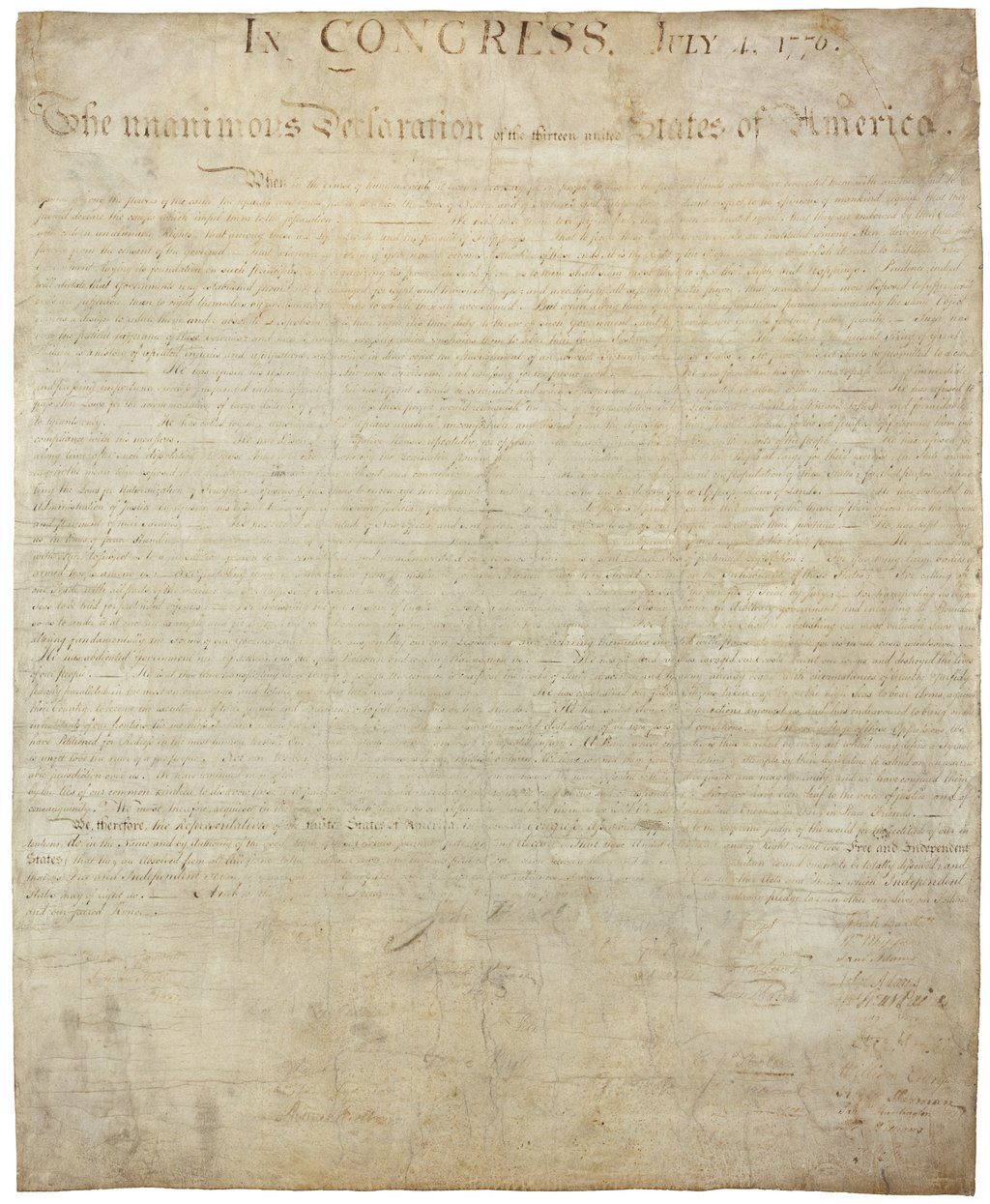
The Declaration announced that the colonies were separating from Britain, and it said why: people are endowed by their Creator with unalienable rights, and governments exist to secure them. The Archives notes that the reverse of the engrossed parchment carries the docket “Original Declaration of Independence dated 4th July 1776.”
The Articles of Confederation (1777-1789)
The Continental Congress adopted the Articles on November 15, 1777. They took effect on March 1, 1781, and served as the nation’s first constitution until 1789. The Articles created a weak league of states: no executive, no national courts, and no reliable way to raise revenue. Their failures led to the Constitutional Convention.
The Constitution (1787)
Delegates met in Philadelphia and signed the Constitution on September 17, 1787. The National Archives’ history recounts how New Hampshire became the ninth state to ratify in June 1788, which put the new government into effect. Its design included separated powers, checks and balances, and a federal system of enumerated powers.
The Bill of Rights (1791)
Proposed by the First Congress in 1789 and ratified December 15, 1791, the first ten amendments put key liberties in writing. Read our amendment-by-amendment guide.
Quick timeline
| Date | Event |
|---|---|
| July 4, 1776 | Declaration of Independence adopted |
| November 15, 1777 | Articles of Confederation adopted by Congress |
| March 1, 1781 | Articles take effect |
| September 17, 1787 | Constitution signed in Philadelphia |
| June 1788 | New Hampshire becomes the ninth state to ratify |
| September 25, 1789 | Congress proposes 12 amendments |
| December 15, 1791 | Ten amendments ratified as the Bill of Rights |
Go to the source: The National Archives posts full transcriptions of all three Charters. Yale’s Avalon Project hosts the Federalist Papers, the best explanation of the Constitution, written by the men who defended it.
Sources
- National Archives, America’s Founding Documents
- National Archives, Declaration of Independence
- National Archives, Declaration of Independence: A Transcription
- National Archives, Articles of Confederation (1777)
- National Archives, “A More Perfect Union”: The Creation of the U.S. Constitution
- National Archives, The Constitution: A Transcription
- The Avalon Project, The Federalist Papers
Featured image: Engrossed Declaration of Independence WDL2705, by Jefferson, Thomas (1743-1826). Public domain, via Wikimedia Commons. See all image credits.
Related on Candid Dragon
- The Articles of Confederation: America’s First Constitution, and Why It Failed
- The Bill of Rights Explained, Amendment by Amendment
- The Mayflower Compact: 41 Men, a “Civil Body Politic,” and What It Was (and Wasn’t)
Further reading: Go deeper with our plain-English guides to the Federalist Papers, the Anti-Federalist Papers, Locke and Magna Carta, part of Books That Shaped Humanity.