

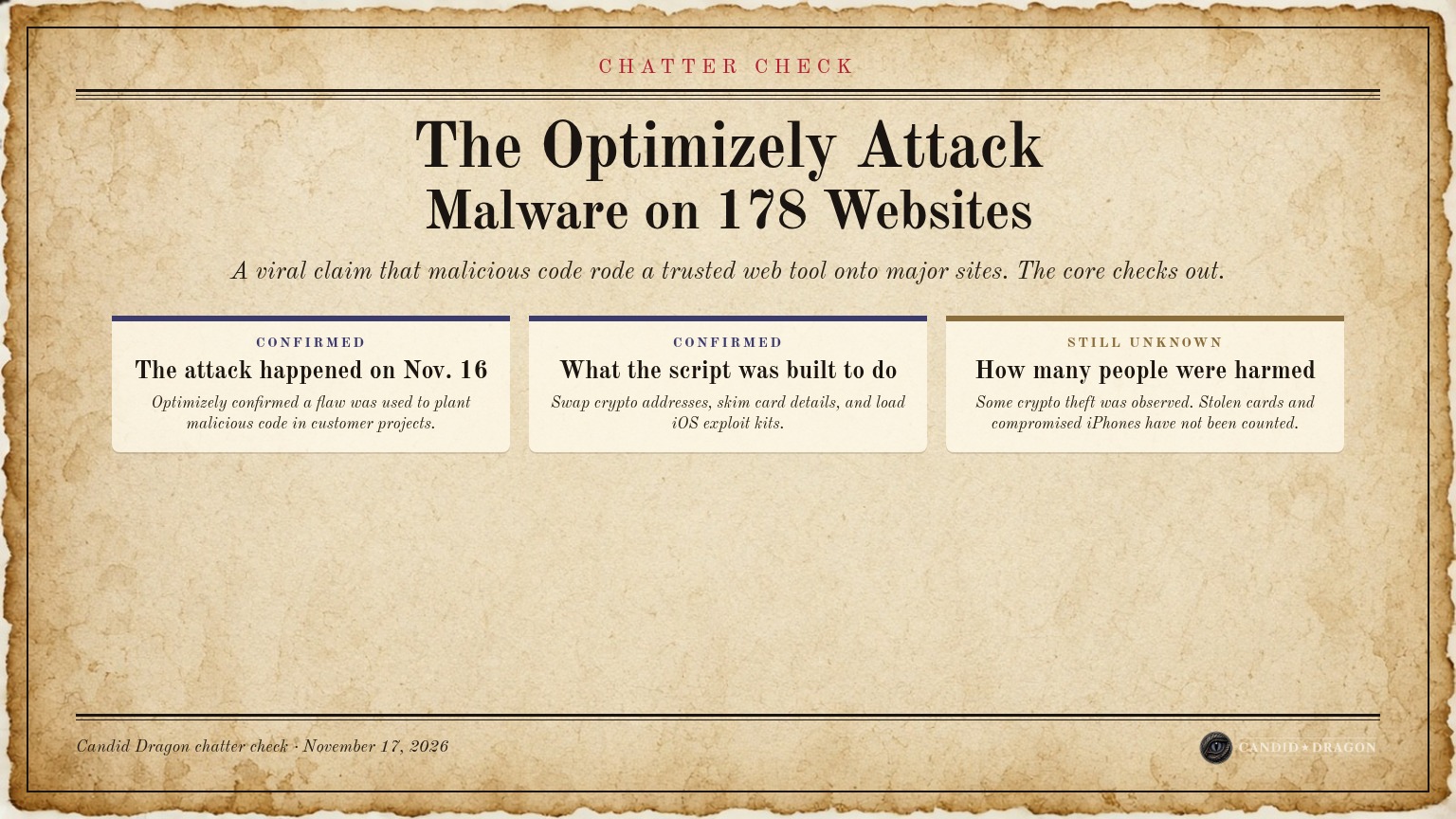
Chatter watch identified chatter developing on X (about 3,070 original posts since Monday) after Report URI published its findings.
Quick take
- The core claim is true. On November 16, malicious JavaScript was served through the Optimizely Web platform to visitors of 178 organizations, including Zoom, CNN, BBC, Fox News, HSBC, Ledger, Equifax, Salesforce, IKEA and Air France-KLM.
- Optimizely confirmed that an attacker exploited a vulnerability in its Experimentation signup flow, added malicious code to some customer projects, and said it has fixed the flaw and removed the injected code.
- The script was built to swap cryptocurrency wallet addresses, skim payment-card details typed into a site’s own forms, steal cookies and screenshots, and load iOS exploit kits. Some crypto theft was observed. How many cards were stolen, and whether any iPhone was actually compromised, is not known.
- New: Equifax says it stopped using Optimizely and found no evidence its systems were compromised. HSBC says unauthorized scripts were not active on its websites. Salesforce and IKEA say they are investigating.
- The infected Optimizely files were cleaned by 11:11 p.m. UTC on November 16. Visiting those sites today is not the same as having been exposed on Monday.
Our rating: ✅ Confirmed  Factual
Last updated November 17, 2026, 12:35 p.m. CT.
✅ Confirmed Factual Lean note: The viral post accurately restates findings from Report URI, which Optimizely has confirmed and which BleepingComputer independently checked on multiple sites. What remains unknown is how many visitors actually had cards stolen or devices exploited.
What happened
Late on November 16, a claim spread widely on X that a cyberattack had hit 178 major organizations by loading malware on the Optimizely Web platform, “exposing visitors to scripts built to steal payment data and exploit iOS devices, per security firm Report URI.” It also said banking and finance was the hardest-hit sector, with 32 organizations affected, including HSBC sites in the United States, Hong Kong, Mexico, Singapore, Australia and the UAE. By late morning on November 17 the most-shared version had millions of views. We counted about 3,070 original X posts on the Optimizely malware story since Monday, excluding reposts.
That account of the incident holds up. Scott Helme of Report URI reported that his team checked 1,611 Optimizely JavaScript snippets and found malicious code in 188 of them, belonging to 178 organizations. The real number may be higher, he wrote, because the team could only check the snippets it found in time. The attacker wrote a loader into each project’s “Project JavaScript,” a custom-code field that runs on every page. The rest of each file was untouched, and it was still served from Optimizely’s own content-delivery network, so sites treated it as trusted. BleepingComputer independently confirmed that the malicious script loaded, or tried to load, on sites including Zoom, CNN, the BBC, Salesforce, GitLab and KLM.
Optimizely confirmed the incident. On its status page, and in a statement to BleepingComputer, it said an unauthorized party exploited a vulnerability in the Experimentation account signup flow and used it to add malicious JavaScript to some customer projects. The company said it blocked the vulnerable path, deployed a fix, removed the injected code, ended sessions, revoked tokens, reset access for affected accounts, and notified affected customers. Report URI found the first injection at 4:21 a.m. UTC on November 16 and said all of the infected files it was watching were clean by 11:11 p.m. UTC the same day.
Company responses so far, as reported by Reuters: Salesforce and IKEA said they were investigating, and Salesforce disabled Optimizely scripts as a precaution. Equifax said it stopped using the platform and has “not identified evidence of any compromise to our systems.” HSBC said unauthorized scripts were not active on its websites. Apple, Zoom and CNN had not commented. Reuters said it could not determine whether the code succeeded in each case.
The payload, a file called track.js, was a multi-purpose kit:
- Crypto address swapping. It replaced valid wallet addresses on the page, in forms, and on the clipboard with addresses controlled by the attacker. Report URI said the attacker’s wallets had received about $7,000 as of Monday evening. Some of those wallets were already in use before this campaign, so not every transfer can be tied to this attack.
- Payment-card skimming. Starting at 1:43 p.m. UTC, the script watched for a card number, expiration date and security code entered in a site’s own forms and tried to send them to the attacker. Cards entered in a payment company’s hosted iframe, such as Stripe or Adyen, were out of its reach. Researchers say they cannot see how many cards were actually stolen.
- Cookies and screenshots. After some crypto swaps, the script could send non-HttpOnly cookies, the page address, and a screenshot of the page to the attacker.
- iOS exploit kits. On iPhones and iPads, Report URI says the script loaded the Coruna and DarkSword exploit kits, which target older iOS versions. SecurityWeek, citing Hudson Rock, reported a connection to that exploit-kit infrastructure but said successful device exploitation has not been demonstrated.
The sector counts in the viral post also check out. In Report URI’s list, banking and finance was the largest group, with 32 organizations. The HSBC markets it named are on that list. Report URI also listed HSBC sites in Malaysia, Taiwan, Vietnam, Egypt and the Philippines. The post’s phrase “178 major organizations” is a slight stretch: Report URI counted 178 organizations, some of them among the world’s most-visited sites, but not all 178 are household names.
What you should do
The malicious code is no longer being served from the Optimizely files Report URI was watching, and the attacker’s main payload domain was later taken down. If you only visited an affected site after Monday, this incident is not a reason to assume your information was taken. If you were on one of those sites on November 16:
- If you typed a payment card into the site’s own checkout form, watch your statements and consider asking your card issuer for a new card. Cards entered in a bank or payment company’s own boxed-off payment field were less exposed.
- If you sent cryptocurrency that day, compare the destination address with the one you meant to pay. If they differ, the address may have been swapped.
- Update iPhones and iPads to the latest available software. Report URI says the kits’ own notes mark iOS 18.7.3 and later, and iOS 26.3 and later, as patched.
- Watch for unusual activity on accounts you were logged into while visiting an affected site, especially if you keep session information in cookies that are not marked HttpOnly.
Latest updates
🔄 November 17, 2026, 12:35 p.m. CT: Added company responses: Equifax stopped using Optimizely and found no sign of compromise; HSBC says the scripts were not active on its sites; Salesforce and IKEA are investigating. Optimizely’s incident is still listed as “Monitoring.” Verdict unchanged.
🔄 November 17, 2026, 11:55 a.m. CT: First published.
Label key
- ✅ Confirmed An official record, or two or more independent outlets, agree.
- ❓ Unconfirmed Reported or claimed, but not yet independently verified.
- ⚠️ Disputed Contradicted by the evidence or by credible sources, or actively contested.
- Factual Straight reporting that holds up across outlets on different sides.
 Leans Left The facts hold, but the coverage tilts left: one-sided, loaded language, missing context or a single anonymous source.
 Leans Right The facts hold, but the coverage tilts right: one-sided, loaded language, missing context or a single anonymous source.
 Likely Propaganda State-run or state-aligned media, a militant press office, a partisan campaign or group, or unverifiable spin.
Each story gets one confidence tag and one source-lean label, plus a one-line Lean note explaining the call. Every side is held to the same standard. More on how we cover the news.
Sources
- Scott Helme, Report URI, “World’s Largest Brands Infected With Malware Via Optimizely,” November 16, 2026, updated November 17, 2026, 9:17 a.m. UTC
- Optimizely Service Status, “Web Experimentation Security Incident,” November 17, 2026, 1:02 a.m. UTC
- Lawrence Abrams, BleepingComputer, “Optimizely hack infected CNN, Fox News, BBC, Salesforce sites with malware,” November 16, 2026, updated with Optimizely’s statement
- Eduard Kovacs, SecurityWeek, “Optimizely Vulnerability Exploited to Serve Malware on Major Websites,” November 17, 2026
- Swati Khandelwal, The Hacker News, “Hijacked Optimizely Scripts Served Card Skimmer and iOS Exploit Kits to CNN, BBC and Zoom Visitors,” November 17, 2026
- Reuters, “Popular websites compromised in bid to steal crypto, target iPhone users,” November 16, 2026
Featured image: Candid Dragon almanac graphic, November 17, 2026. See all image credits.