

Quick take
- In a big storm, cell towers can run out of backup power within hours, and networks jam. A written plan costs nothing and is the most important part of staying in touch.
- Build in priority order: a free family plan first, then a weather radio, power bank and walkie-talkies, then licensed GMRS or ham radio, satellite and Starlink if your budget allows.
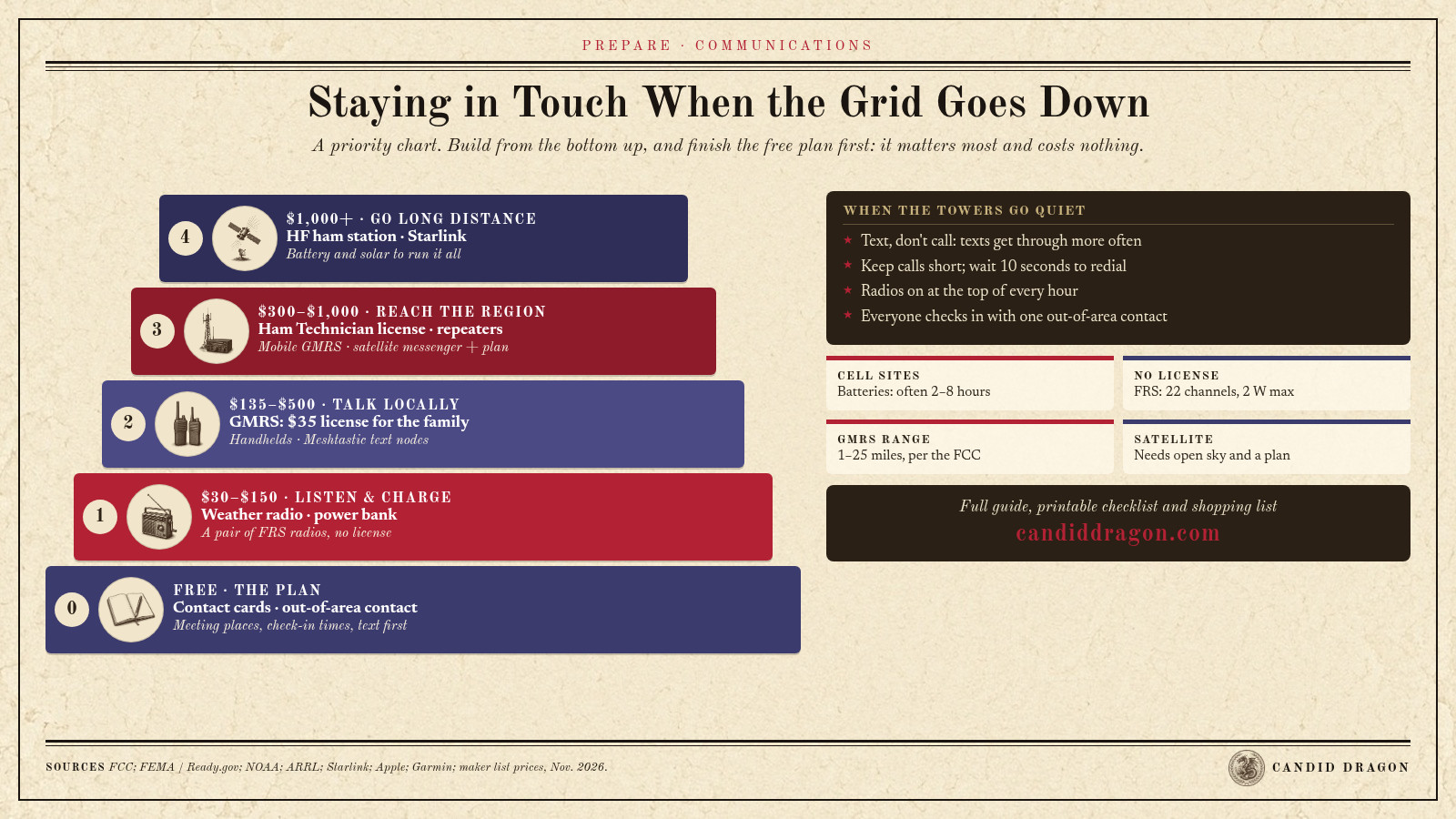
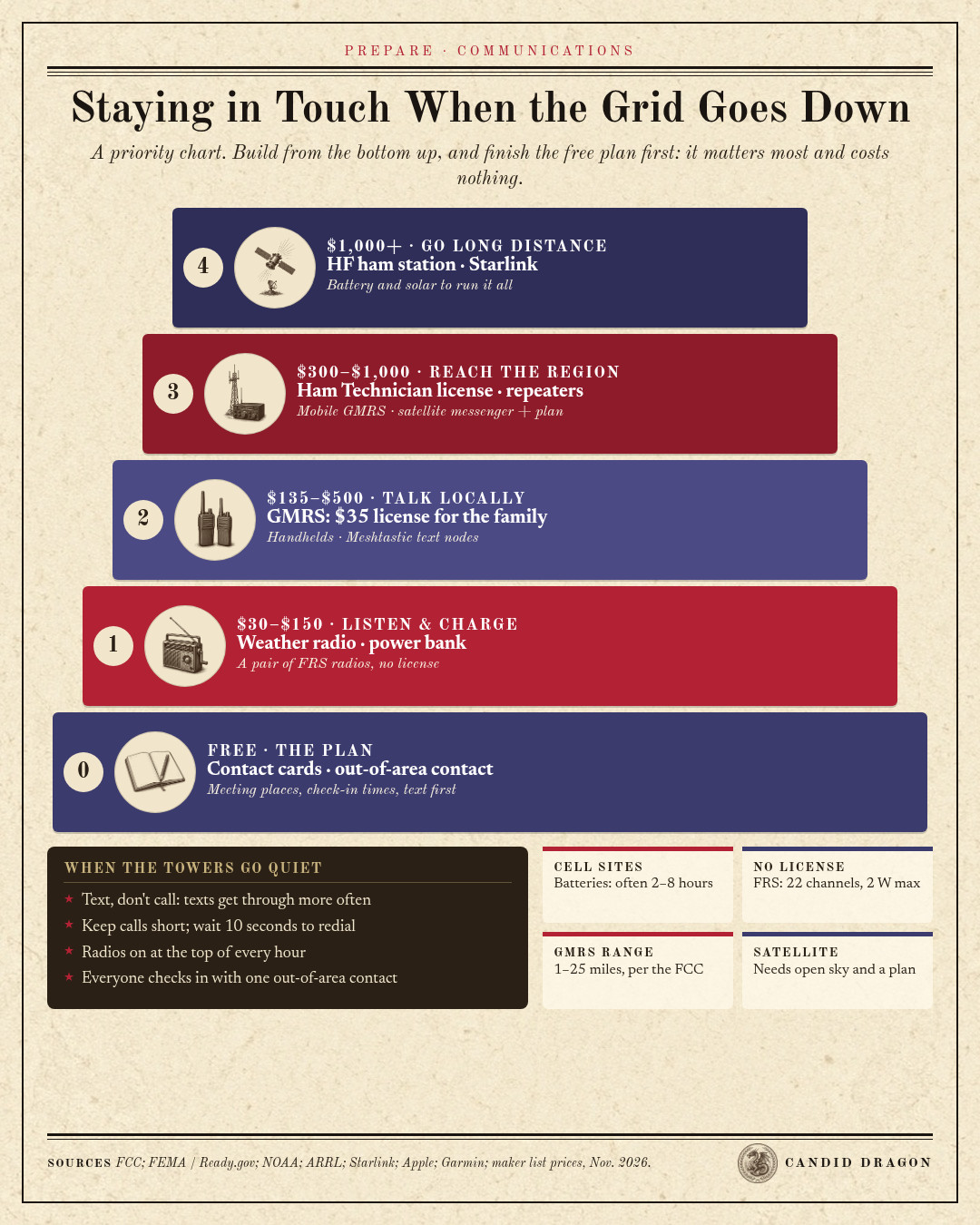
- Our priority chart below shows what each tier buys you, what it costs, including license and subscription fees, and who it is for.
When the power goes out, most of us reach for a phone. But phones need towers, towers need power, and the internet needs both. After a hurricane, an ice storm or a wildfire, families can be cut off from each other for days. A plan, a few batteries and the right radio change that. Here is how to stay in touch, starting with what is free.
The priority chart: what to do first, by budget
Each tier builds on the one below it. You do not need everything. Pick the tier that fits your budget and your situation, and work up over time.
| Tier and cost | What it buys you | Ongoing fees | Who it’s for |
|---|---|---|---|
| Tier 0 Free | A written family plan with contact cards, one out-of-area contact, four meeting places and set check-in times. Texting instead of calling. Battery-saving habits. Free alerts: Wireless Emergency Alerts and the FEMA app. Satellite texting if your phone already has it. | None | Everyone. Do this first. |
| Tier 1 $30–$150 | A power bank ($30 and up), a NOAA weather radio ($40) or a hand-crank weather radio that also charges a phone ($65), and a pair of license-free FRS walkie-talkies ($40). | None | Every household. Covers news, alerts and talking across the yard or block. |
| Tier 2 $135–$500 | A GMRS license ($35, good for 10 years, covers your family) plus a pair of GMRS handhelds ($100 a pair and up). Meshtastic text nodes ($40 each). A small folding solar panel ($100–$150). | GMRS: $35 every 10 years | Families who are spread across town, at school or work, or on rural property. |
| Tier 3 $300–$1,000 | A ham Technician license ($35 FCC fee plus a $0–$15 exam) and a handheld ($120). A 15- to 50-watt mobile GMRS radio for the car or house ($300–$515 with antenna). Or a satellite messenger ($300–$400). | Ham: $35 every 10 years. Satellite messenger: $7.99–$49.99 a month plus a $39.99 activation fee. | People who want regional reach, join local emergency nets, or travel and live beyond cell coverage. |
| Tier 4 $1,000 and up | An HF ham station that reaches hundreds to thousands of miles ($466–$1,000 for the radio, plus antenna and power). Starlink internet (Mini kit $149). A battery and solar setup to run it all. | Starlink Roam: $55 a month and up. Ham General: no extra fee beyond the exam. | Rural homes, long grid-down planning, and anyone who wants to be the neighborhood’s link to the outside. |
Finish the free tier first. It matters most and costs nothing. A $1,000 radio does not help if nobody knows when to turn it on or whom to call.
Prices are list prices we checked in November 2026 from makers, the FCC and service providers; they change. Each one is linked in the shopping list and sources below.
Why phones and the internet fail in a disaster
- Cell towers run on batteries when the grid goes down. An FCC advisory council found that cell-site batteries are generally sized for two to eight hours, and some only for 15 minutes, just long enough for a generator to start. Sites without a generator, or whose generator runs out of fuel, go dark.
- It happens at scale. Five days after Hurricane Helene came ashore, the FCC reported that 48.7% of cell sites in the affected North Carolina counties were still out of service, and 90.9% in Yancey County (Oct. 1, 2024).
- Networks jam. When everyone calls at once, calls fail. The FCC and FEMA ask people to limit non-emergency calls, keep them short, and wait 10 seconds before redialing.
- Many home phones need power too. Phone service delivered over broadband or VoIP will not work in an outage without a battery backup. A traditional copper landline may still work, but only with a corded phone.
Step 1: Write a family communication plan (free)
Ready.gov’s advice is to plan for the day your family is not together: know how you will contact one another and how you will reconnect. Put it on paper, because a dead phone takes its contact list with it.
- Contact cards. Every person, including kids, carries a wallet card with key phone numbers, the out-of-area contact, the meeting places and medical notes. FEMA’s free Family Emergency Communication Plan form has a fill-in card.
- One out-of-area contact. Pick a relative or friend in another region. A long-distance call or text can be easier to complete than one across town, and everyone reports to the same person. Make sure that person knows how to text.
- Four meeting places. FEMA’s form asks for an indoor spot (for a tornado), one in the neighborhood, one outside the neighborhood if you cannot get home, and one out of town.
- Check-in times. Our suggestion: agree on a schedule, such as turning radios on for five minutes at the top of every hour, and texting the out-of-area contact at 8 a.m. and 8 p.m. A schedule saves batteries and stops the guessing.
- An “ICE” contact in every phone. The FCC suggests storing at least one contact under “In Case of Emergency” and a group list of the people you would need to reach.
- Paper numbers. Write down numbers for doctors, schools, workplaces, utilities, insurance and the vet. Schools and employers have their own emergency plans; note their pick-up rules.
- A family radio channel. If you own radios, write your channel and privacy code on the card, plus a backup channel.
Print our one-page plan below, fill it in at the kitchen table, and give everyone a copy.
Text first, call second
- The FCC says a text message may go through when a call will not, though it may be delayed when networks are busy.
- Keep calls short and only for vital information. That frees up the network for emergencies and saves your battery.
- Call 911 only for emergencies. Text-to-911 works in some areas; check whether yours has it before you need it.
- If there are no bars at all, the FCC suggests turning the phone off for a while, since searching for a signal drains the battery fast.
Keep phones charged
- Charge everything when a storm is coming. Phones, laptops, tablets, power banks and radios.
- Power banks: a 10,000 mAh bank lists for about $30. Anker, for example, rates one of its 10,000 mAh banks at up to 1.8 charges for an iPhone 15 Pro. Keep one per adult and top them up every few months.
- Solar and crank: a small folding panel or a hand-crank radio with a USB port can top up a phone slowly. Check the manual first, as the FCC advises.
- The car: a car charger works, but run the engine only outdoors, never in a garage, because of carbon monoxide.
- Stretch the battery: turn on low-power mode, dim the screen, and close apps you do not need.
Listen: news and alerts without the internet
- NOAA Weather Radio All Hazards broadcasts official warnings and forecasts 24 hours a day from more than 1,000 transmitters covering all 50 states, on seven frequencies between 162.400 and 162.550 MHz. It also carries non-weather emergencies such as chemical spills, AMBER alerts and 911 outages. Buy one with a tone alert so it can wake you up.
- AM/FM radio. Broadcasters carry Emergency Alert System messages and local news. After Hurricane Helene, while two-thirds of North Carolina’s cell sites in the disaster area were down on Sept. 29, 2024, only three TV stations and two radio stations in the state reported being off the air, according to broadcasters’ filing with the FCC.
- Wireless Emergency Alerts come to your phone free whenever it has a signal. Also sign up for your county’s alerts and the FEMA app.
- Going further: a shortwave receiver picks up world news from far away when local stations are off the air. A digital police scanner hears local public-safety traffic; many agencies now use digital systems that cheap analog radios cannot receive. Both are listen-only and need no federal license, though a few states limit scanner use in vehicles.
Two-way radio: which one, and what is legal
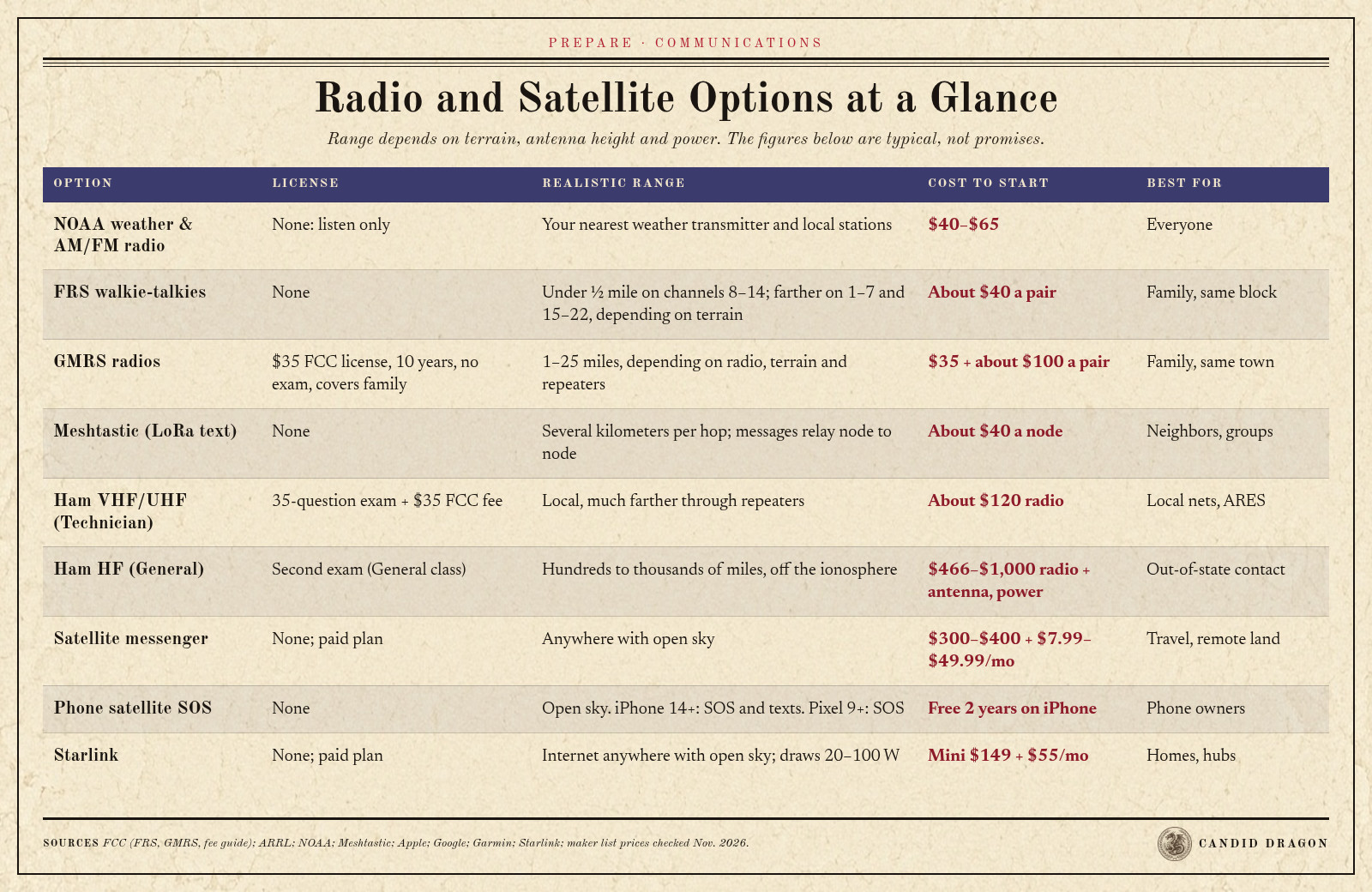
Radios work without towers, the internet or the grid, as long as their batteries last. Here is how the options compare.
FRS: walkie-talkies, no license
- The Family Radio Service has 22 channels, shared with GMRS. Anyone of any age can use an FCC-certified FRS radio without a license.
- Power is capped at 2 watts on channels 1–7 and 15–22, and half a watt on 8–14. The FCC says range on channels 8–14 is usually under half a mile; the other channels reach farther depending on conditions.
- Ignore the “36-mile” claims on the box. Those are best-case numbers from a mountaintop. Plan on the yard, the block or a campground.
GMRS: more power, one license for the family
- GMRS uses the same 462 and 467 MHz channels as FRS but allows more power, roof antennas and repeaters. The FCC puts typical range at one to 25 miles, depending on the radio, terrain and repeater use.
- A license costs $35, lasts 10 years, requires no exam, and lets any family member of any age use radios on your system. You must be 18 to apply. Apply through the FCC’s licensing system after you get a free FCC Registration Number (FRN).
- Repeaters, often run by local clubs, can stretch your range across a county. Ask the owner before using one.
- Many prepper and travel groups listen on channel 20 (462.675 MHz) by custom. It is not an official FCC emergency channel, and no GMRS channel belongs to anyone, so set your own family channel too.
- Use certified radios. The FCC has warned that radios such as low-cost Baofeng-style handhelds may not be used on FRS or GMRS unless they are certified for those services. A licensed ham can use them on ham bands; otherwise use them for listening only.
Ham (amateur) radio: the long-range backbone
- Technician license: pass a 35-question multiple-choice exam (26 correct to pass) and pay the FCC’s $35 fee. It gives you all ham bands above 30 MHz, including the popular 2-meter band, plus limited HF privileges. The license lasts 10 years.
- Fastest path, about a week: get a free FRN in the FCC’s CORES system, study the current question pool with free practice tests at HamStudy.org (10 to 15 hours is typical), then test online from home or at a local session. Volunteer exam teams charge from nothing to about $15. Your call sign usually shows up within days of paying the FCC fee.
- Repeaters on hilltops and towers relay a handheld’s signal across a wide area, many with emergency power. Local clubs run regular “nets,” scheduled on-air check-ins that are good practice.
- ARES and RACES. The Amateur Radio Emergency Service, organized by the ARRL, is made up of licensed volunteers who handle communications when disasters knock out cell towers and the internet. RACES does similar work for government emergency management. Joining is the best training there is.
- HF for long distance: the General license, a second exam you can take the same day, opens most of the HF bands. HF signals bounce off the ionosphere and can reach hundreds or thousands of miles with no infrastructure in between. This is how you reach the out-of-area contact when everything else is down.
Meshtastic: text messages over a homemade mesh
- Meshtastic is free, open-source software for small, inexpensive LoRa radios that pair with your phone by Bluetooth. No license is needed. You type a text, and the radios relay it node to node across a “mesh,” with no cell or internet service.
- Messages are encrypted, battery life is long, and GPS location sharing is optional. Range is typically several kilometers per hop; the project’s record is 331 km, under ideal conditions.
- It works best when neighbors or a local group run nodes too. Check whether a mesh already exists near you, and put a node up high at home.
Satellite: when there is no ground network at all
- iPhone 14 and later: Emergency SOS via satellite texts 911 from places with no cell or Wi-Fi service, and Messages via satellite (iOS 18 and later in the U.S.) lets you text family. Both are free for two years after activation. You need a clear view of the sky; a message can take 30 seconds or more. Try the demo in Settings before you need it.
- Google Pixel 9 and later (except the 9a) offer Satellite SOS to reach emergency services. Some carriers also sell satellite texting plans; check yours.
- Satellite messengers such as Garmin inReach send two-way texts and an interactive SOS over the Iridium network anywhere with open sky. They need a paid plan: Garmin lists plans from $7.99 to $49.99 a month plus a $39.99 activation fee, and you can suspend a plan for free between uses.
- Starlink gives you full internet, including calls and video, anywhere with open sky. The Mini kit lists for $149 with Roam service from $55 a month; the standard kit is $349. The catch is power: Starlink lists average draw at 20–40 watts for the Mini and 75–100 watts for the standard kit, so plan a battery and solar system to match. Its Standby Mode keeps emergency messaging for a small monthly fee.
Practice: run a drill
Ready.gov’s last step is to practice the plan. Our suggestion: twice a year, when you change smoke-alarm batteries, run a 30-minute drill.
- Phones down. Everyone texts the out-of-area contact from wherever they are, and the contact replies to all.
- Radios on at the agreed time and channel. Check that every radio is charged and can reach the others from school, work or the far end of the property.
- Walk or drive to the neighborhood meeting place. Make sure the kids know the way and the backup.
- Listen to the weather radio’s weekly test, and check its batteries.
- Licensed hams: check into a local net. GMRS users: try a local repeater.
- Update the cards: new phone numbers, new schools, new jobs.
Printable one-page plan
Print this section, fill in the blanks and keep copies in wallets, backpacks, the car and your kit.
| ✔ | Item | Write it here |
|---|---|---|
| ☐ | Out-of-area contact (name, phone) | _____________________ |
| ☐ | In Case of Emergency (ICE) contact | _____________________ |
| ☐ | Indoor safe spot | _____________________ |
| ☐ | Neighborhood meeting place | _____________________ |
| ☐ | Meeting place outside the neighborhood | _____________________ |
| ☐ | Out-of-town meeting place | _____________________ |
| ☐ | Check-in times (text the out-of-area contact) | _____ a.m. _____ p.m. |
| ☐ | Radio schedule | Top of every hour, 5 minutes |
| ☐ | Family radio channel / privacy code | Ch ___ Code ___ |
| ☐ | Backup channel | Ch ___ Code ___ |
| ☐ | Local weather radio frequency | 162.____ MHz |
| ☐ | Local AM/FM news station | _____________________ |
| ☐ | School and work emergency plans and pick-up rules | _____________________ |
| ☐ | Doctor, pharmacy, vet phone numbers | _____________________ |
| ☐ | Utilities and insurance phone numbers | _____________________ |
| ☐ | Ham or GMRS call signs, local repeater | _____________________ |
Kit checklist
- Paper copies of the plan and contact cards for everyone
- A power bank per adult, kept charged, plus cables
- Car charger
- NOAA weather radio with tone alert, or a crank radio
- Spare batteries for every radio
- Two-way radios, charged, with the channel written on them
- Paper maps of your area
- Satellite SOS demo tried on every phone that has it
Shopping list by tier
Examples, not endorsements. List prices checked November 2026 on the maker’s or seller’s own site.
| ✔ | Tier | Item | Price | Where |
|---|---|---|---|---|
| ☐ | 0 | Family Emergency Communication Plan form (FEMA) | Free | Ready.gov |
| ☐ | 0 | FEMA app | Free | FEMA |
| ☐ | 1 | Anker Zolo 10,000 mAh power bank | $29.99 | Anker |
| ☐ | 1 | Midland ER10VP compact weather alert radio (AA batteries) | $39.99 | Midland |
| ☐ | 1 | Midland ER50 crank, solar and battery weather radio | $64.99 | Midland |
| ☐ | 1 | Midland T10 FRS walkie-talkie 2-pack | $39.99 | Midland |
| ☐ | 2 | GMRS license (FCC, 10 years) | $35 | FCC |
| ☐ | 2 | Midland GXT1000 GMRS 2-pack | $99.99 | Midland |
| ☐ | 2 | BTECH GMRS-PRO handheld (each) | $166.89 | BTECH |
| ☐ | 2 | Seeed SenseCAP T1000-E Meshtastic node (each) | $39.90 | DigiKey |
| ☐ | 2 | Goal Zero Nomad 10 folding solar panel | $99.95 | Goal Zero |
| ☐ | 3 | Ham Technician license (FCC fee) plus exam | $35 + $0–$15 | HamStudy sessions |
| ☐ | 3 | Yaesu FT-65R dual-band ham handheld | $119.95 | GigaParts |
| ☐ | 3 | Midland MXT295 PRO 15W mobile GMRS | $299.99 | Midland |
| ☐ | 3 | Midland MXT575 50W mobile GMRS + MXTA26 antenna | $439.99 + $74.99 | Midland |
| ☐ | 3 | Garmin inReach Messenger Plus | $299.99–$399.99, plus plan | Garmin |
| ☐ | 4 | Xiegu G90 HF radio (budget) | $466 | Radioddity |
| ☐ | 4 | Icom IC-7300 HF radio | $999.95 | HRO |
| ☐ | 4 | MyAntennas EFHW-8010 wire antenna | $214.99 | MyAntennas |
| ☐ | 4 | LiTime 12V 100Ah LiFePO4 battery | $302.39 | LiTime |
| ☐ | 4 | Victron SmartSolar MPPT 100/30 charge controller | $135.15 | Powerwerx |
| ☐ | 4 | Renogy 200W 12V solar panel (each) | $168.99 | FactoryPure |
| ☐ | 4 | Starlink Mini kit, plus Roam service | $149 + $55/mo and up | Starlink |
| ☐ | Listen | Uniden SDS100 digital scanner (listen only) | $699.99 | Bearcat Warehouse |
| ☐ | Listen | C.Crane Skywave SSB 2 shortwave and weather radio | $189.99 | C.Crane |
A full home station with a scanner, GMRS, HF ham radio, antennas and solar power runs about $3,200 on a budget and about $5,000 fully built, before coax, masts and mounts.
About these links: We get nothing for them. No sponsors, no affiliate codes, no kickbacks. Prices and stock change; check before you buy.
Sources
- FCC/FEMA, Emergency Communications Tips
- FCC CSRIC IV Working Group 9, Backup Power Recommendations (2014)
- FCC, Communications Status Report for Areas Impacted by Hurricane Helene, Oct. 1, 2024
- National Association of Broadcasters, comments to the FCC on alerting (2025)
- Ready.gov, Make a Plan
- Ready.gov, Family Communication Plan
- NOAA National Weather Service, NOAA Weather Radio All Hazards
- FCC, Family Radio Service (FRS)
- FCC, General Mobile Radio Service (GMRS)
- FCC, Personal Service and Amateur Application Fees
- FCC Enforcement Advisory on unauthorized VHF/UHF radios (DA 18-980)
- ARRL, Getting Your Technician License
- 47 CFR 97.503, Element standards
- HamStudy.org, practice exams and exam sessions
- FCC CORES registration (FRN)
- ARRL, Amateur Radio Emergency Service (ARES)
- ARRL, Ham Radio Licenses
- Meshtastic, Introduction
- Apple, Use Emergency SOS via satellite
- Apple, About Messages via satellite
- Google, Satellite SOS on Pixel
- Garmin, Overview of inReach subscription plans
- The Subscription Guide, Garmin inReach plan prices (checked Oct. 27, 2026)
- Starlink, Service Plans
- Starlink, Standard kit specifications
- Starlink, Mini specifications
- Which Starlink, kit and plan price log (read Nov. 16, 2026)