

Quick take
- On November 18, 2026, House Democrats nominated Rep. Hakeem Jeffries of New York for speaker in a closed-door secret-ballot vote, 251–11, with two members not voting. If the full House elects him on January 3, 2027, he would be the first Black speaker of the House.
- The Democratic National Committee did not pick him. The House Democratic Caucus — the members-elect — did. He ran unopposed.
- Seven incoming members publicly said they voted no, or that they had intended to. They cited Medicare for All, Immigration and Customs Enforcement, money in politics, and the war in Gaza, and said talks with Jeffries are still going. One of the seven, Frederick Haynes of Texas, later said through his office that he missed the ballot because of illness but that his intended vote was no.
- The backlash started right after the midterms, when Jeffries said no caucus member had raised impeaching President Donald Trump with him and that voters “don’t want us to get even.” Online petitions grew from more than 300,000 signatures, as reported by HuffPost on November 4, to more than 1 million, as reported by The Hill on November 17. A separate petition to draft Rep. Ayanna Pressley had more than 140,000 to 150,000 signatures. Pressley did not run, and later said she voted for Jeffries.
- Jeffries’s numbers among all adults and registered voters are net negative. Among Democrats they are net positive. A large share of the public has not heard of him. Republicans account for a substantial part of the overall disapproval.
- He remains the heavy favorite for the January 3 floor vote, which is public and televised. Democrats are projected to hold at least 257 House seats, with some races still uncalled. He needs 218 if all members vote and none vote present. No nominated majority-party candidate has lost the speakership since after the Civil War, according to UMass Lowell political scientist John Cluverius.
Our rating: ✅ Confirmed  Factual
✅ Confirmed Factual Lean note: The vote tally, the dissenters’ statement, and the main polling figures are confirmed across outlets on the left, the right, and the center. Whether Jeffries is the right speaker is a live political argument, not a dispute about those facts.
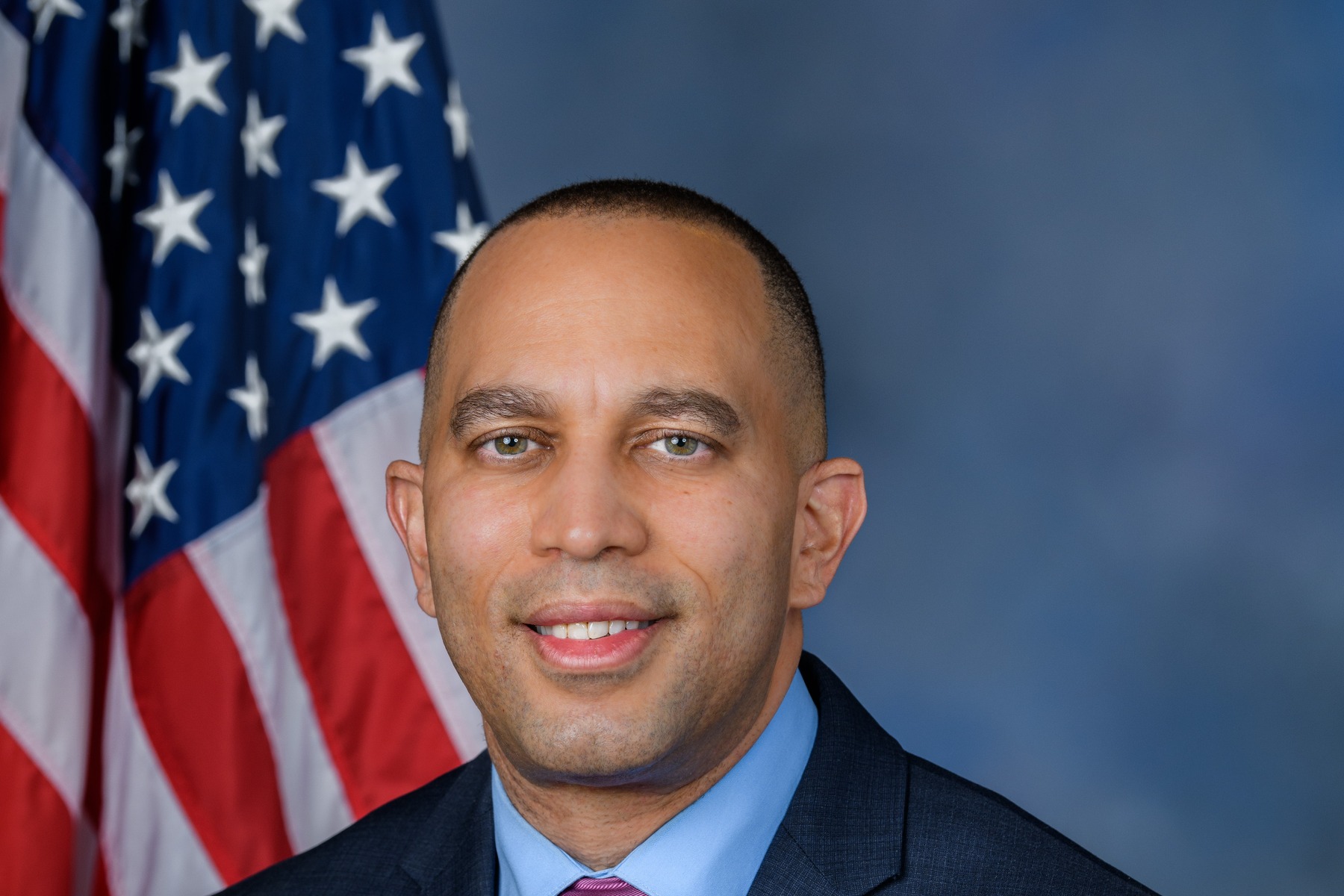
House Democrats formally nominated Hakeem Jeffries to be speaker of the House on Wednesday, November 18, putting him one public vote away from becoming the first Black lawmaker to hold the gavel. The nomination itself is not in dispute. The fight is over how he got there, who was left out of the choice, and whether a leader with weak public ratings can speak for a party that just won a midterm rout.
What the caucus actually decided
The vote was a closed-door, secret-ballot yes-or-no on Jeffries. There was no opposing candidate. Reuters reported the result as 251 votes for Jeffries and 11 against. [S1] The New York Post and Axios later reported that two members did not vote. Axios put the universe at 264 Democratic House members and non-voting delegates — which is why the caucus total is larger than the number of Democratic House seats. [S7] [S8]
The speaker still has to be elected by the full House when the 120th Congress convenes on January 3, 2027. That vote requires a majority of members present and voting, usually 218 if everyone is there and no one votes present. Reuters, writing on November 18, said Democrats will hold at least 257 seats, with several competitive races still uncalled. [S1] NPR used the same floor. [S21] Axios, a day later, said Democrats are expected to have at least 260 seats and that Jeffries could lose 42 Democrats and still win, assuming the rest stay with him. [S8] If he simply holds the 251 votes he already received, that is 33 more than 218.
Jeffries told a press conference it was “a high honor and a distinct privilege to stand before the American people today as the Democratic nominee to be the next speaker of the United States House of Representatives.” He said the “overwhelming majority” of Democrats had spoken “clearly and decisively from all corners,” and that the party’s job is to fight “MAGA extremism,” not each other, so they can “get big things done for the American people.” [S1] The New York Post quoted him saying, “The results of today’s election speak for themselves.” [S7]
The progressive critics’ case
Seven incoming members put their names on a joint statement saying their caucus vote “was no”: Reps.-elect Darializa Avila Chevalier and Claire Valdez of New York, Chris Rabb of Pennsylvania, Adam Hamawy of New Jersey, Melat Kiros of Colorado, Donavan McKinney of Michigan, and Frederick Haynes of Texas. [S2] [S3]
Fox News later quoted Haynes’s office saying he woke up ill, “narrowly missed the vote,” and that “his intended vote was no, as per the released statement.” [S6] That would make him one of the two who did not vote, if the office account is accurate, rather than one of the 11 recorded no votes. The statement still presented him as part of the public opposition.
The seven wrote: “Whether on Medicare for All, stopping ICE terror, getting money out of politics, or ending the genocide in Gaza, our constituents sent us to Congress with a mandate on these issues.” They said they had “worked to secure commitments from Leader Jeffries in good-faith conversations,” had seen “meaningful progress,” and that “there is still work to be done” so the next Congress “reflects what our constituents are demanding of leadership. Those conversations are ongoing.” [S3] [S6] [S7]
NBC News, in an analysis, said all of the seven except Hamawy and Haynes are members of the Democratic Socialists of America, and that critics had argued Jeffries was “too moderate, too sympathetic to Israel, too accommodating” to lead the House Democratic Caucus. [S2] Fox, Axios, Newsweek, and The New Republic have all reported the same sore points from the left: Jeffries’s record on Israel, his ties to corporate political action committees, and, in some accounts, pro-Israel donor groups. [S6] [S10] [S13] [S16]
The public fight started immediately after Election Day. At a November 4 press conference, Jeffries said, “I haven’t had a single member of the House Democratic caucus talk to me about impeachment. We’ve been relentlessly focused on affordability and accountability.” On MS NOW’s “Morning Joe,” he said “the American people don’t want us to get even; they want us to get things done on their behalf.” [S4] Progressive commentators and activists treated those remarks as a refusal to use a new majority for accountability. HuffPost reported that a Change.org petition urging House Democrats to pick someone else, started months before the election, had already topped 300,000 signatures as of November 4. [S4]
Those petition figures rose quickly, and they are not all the same petition. Newsweek reported on November 6 that a petition titled “House Democrats: CHOOSE A NEW SPEAKER,” started in September by author and TikTok creator Nicole Whitted, had 762,343 verified signatures by the night of November 5. The petition itself disclosed that Whitted is a compensated Change.org ambassador. Actor Mark Ruffalo also promoted a call for a new speaker. [S13] Axios, the same day, put the signature count at nearly 900,000 as of that Friday. [S10] The Hill, on November 17, said a Change.org petition demanding that House Democrats choose a new speaker candidate had received more than 1 million signatures. [S12] A separate petition to draft Pressley was smaller: The Hill put it at more than 140,000 signatures on November 17; GBH News, updating the same week, said more than 150,000. [S12] [S11]
Some incoming members went further than a caucus no. Rep.-elect Don Leonard of Ohio, who flipped a Republican-held seat, said in a video that Jeffries would not have his vote “unless Speaker Jeffries is willing to commit to enforcing our nation’s laws like the Leahy Law against Israeli genocide in Gaza” and to “get to the heart of this crisis which is Citizens United.” [S5] The New York Post reported Leonard’s claim that senior Democrats had threatened to make his life “a living hell” if he did not support Jeffries. That account comes from Leonard, as reported by the Post; Jeffries’s office has not been independently quoted on it here. [S7] Axios reported after the caucus vote that Leonard and Rep.-elect Angela Gonzales-Torres of California have said they plan to oppose Jeffries as speaker, a reference to the coming floor vote. [S8]
The leadership case
Jeffries and his allies have treated the 251–11 result as the caucus settling the question. Asked about the dissenters, he said the election results “speak for themselves” and declined to say whether he would adopt the left’s policy demands, which Fox summarized as including abolishing ICE and ending military aid to Israel. [S6] He told reporters it was “an honor to be serving with a majority of 260 members from all across the country, people who have different perspectives, and we embrace that,” but that Democrats would “work together to find the highest common denominator in order to make life better for the American people,” beginning January 3. [S6]
The argument from leadership is straightforward: Jeffries led House Democrats through the midterms, the party flipped more than 40 House seats, and the people who actually vote for speaker — sitting and incoming members — stayed with him in overwhelming numbers. [S13] Several Democrats celebrated the historic nature of the nomination. Rep. Jim Clyburn of South Carolina called Wednesday’s vote “very historic.” Rep. Joe Morelle of New York said Jeffries was “going to be a great speaker” and that there was broad consensus on an “affordability and accountability” agenda. [S1]
Other Democrats downplayed the 11 no votes. Rep. Rosa DeLauro told reporters there will always be naysayers. Rep. Jonathan Jackson said Democrats “can have a majority without being a monopoly.” Rep. Emanuel Cleaver told Reuters, “Rarely are great people able to reach their ultimate goal without somebody saying no.” [S1]
Importantly, the Congressional Progressive Caucus did not join the revolt. Its leaders congratulated Jeffries and pledged to work with him to pass “the first year of Medicare For All, an end to for-profit immigrant detention centers, and so much more.” [S1] Rep. Pramila Jayapal, a former chair of the group who voted for Jeffries, said it is legitimate for new members to “want to respond to the anger of the moment that’s out there,” and that Jeffries “understands that.” [S1] After the vote she told Axios she “felt very, very good both about the public direction he’s moved in and his commitments to us” on Medicare for All and immigration. [S22] Axios also reported that Pressley told the Boston Globe she voted for him, and that Reps. Alexandria Ocasio-Cortez of New York, Greg Casar of Texas, and Ilhan Omar of Minnesota did as well. [S22]
Ocasio-Cortez had already endorsed Jeffries in June. [S12] Before the vote, she defended the newcomers’ right to ask questions, telling The Hill: “I think it is completely normal for someone to show up and say, ‘What’s the agenda?’” She added, “I don’t think everyday people send and elect new members of Congress to come in and immediately take orders,” and “You can’t make villains of people who just showed up two days ago and are asking good faith questions.” [S12] After the nomination, in an Instagram Live video quoted by Axios, she was blunter about the math: “You can stand up and vote ‘no’ on this if you’d like. If we have a massive majority, which we do right now, it likely will not change the outcome.” She also said, “There’s no opposition. … There’s no alternative.” [S8]
Jeffries also changed the rules of the fight. Allies had hoped for a vote by acclamation, which would have produced no official no count. Instead, he forced a recorded vote, a shift first reported by Punchbowl News. He told reporters it was the same method Democrats used when they won the House in 2018. [S5] The effect was to put holdouts on the record without giving them a rival to rally around.
How the right has framed it
Right-leaning coverage has generally treated Jeffries’s nomination as a sure thing and the dissent as a far-left revolt that failed. Fox’s headline said he “brushed off opposition from far-left Dems.” The story emphasized that he would not commit to abolishing ICE or ending military aid to Israel, and it was the outlet that reported Haynes missed the ballot. [S6] The New York Post stressed the lopsided tally, the two non-votes, and the fact that Jeffries can “afford to lose almost 40 of his own members and still reach the magic number of 218.” [S7]
House Republicans, for their part, have already nominated Rep. Jim Jordan of Ohio to lead them in the minority. Reuters reported that Jordan won that post over Rep. Steve Scalise after Speaker Mike Johnson said he would not seek to lead Republicans in the minority. [S1] Jordan will be Jeffries’s counterpart in the January 3 speaker election, which is a floor fight between party nominees, not an intra-Democratic ballot.
Why he was picked despite weak public ratings
A common complaint, especially online, is that “the DNC” hand-picked a badly polling leader over the objections of Democratic voters. That is not what happened. The Democratic National Committee does not elect the speaker. House Democrats do, first in their caucus and then on the House floor. The caucus vote was 251–11, with two abstentions, and no one ran against him. [S1] [S8]
The polling complaint is still real, and it should be stated carefully.
The final pre-election Economist/YouGov poll, conducted October 23–26 among 1,440 registered voters, with a margin of error of about 3 percentage points, found that 26 percent approved of the job Jeffries was doing and 47 percent disapproved. Speaker Mike Johnson stood at 32 percent approval and 45 percent disapproval. Senate Minority Leader Chuck Schumer was at 24 percent approval and 54 percent disapproval. Newsweek reported those figures on November 6 and noted that the poll closed a week before the midterms, so it does not capture any bounce from the results. [S13]
Pew Research Center, in a survey of 10,247 adults conducted November 9–15 and released November 19, found Jeffries at 23 percent favorable, 37 percent unfavorable, and 37 percent who had not heard of him. Among Democrats, he was 38 percent favorable, 26 percent unfavorable, and 35 percent who had not heard of him. A majority of Republicans, 52 percent, viewed him negatively, and only about one in 10 viewed him positively. Schumer’s numbers were worse, including among Democrats (33 percent favorable, 40 percent unfavorable). [S14]
A Reuters/Ipsos poll conducted November 13–16 among 1,521 adults found that Democrats viewed Jeffries more favorably (40 percent) than unfavorably (29 percent), with 29 percent saying they had not heard of him. Schumer, among Democrats, was at 34 percent favorable and 43 percent unfavorable. [S15]
Put simply: Jeffries is not popular with the country as a whole, and he is not a household name. Among Democrats he is in net-positive territory, not beloved. His overall net-negative numbers are pulled down in part by Republicans, which is normal for a partisan congressional leader. The New Republic, in a November 19 piece on the gap between the caucus and the rank and file, made that disconnect its central point: House Democrats “love” Jeffries, or at least voted for him, while “a decent chunk of the party rank and file wanted someone else.” It also noted that at least one person was paid to gather petition names, while still acknowledging that hundreds of thousands of people did sign. [S16]
Why, then, did the caucus stick with him?
- No one else ran. Pressley, the most visible draft prospect, declined to mount a challenge. Rep. Jamie Raskin of Maryland, the name most often floated, said he was “not a candidate for speaker in any way” and is “supporting Hakeem.” Rep. Ro Khanna of California said, “I’m supporting Hakeem Jeffries.” [S9] [S11]
- He led a midterm rout. Democrats flipped more than 40 House seats. Members who just won, including many in newly competitive districts, had little incentive to dump the leader associated with that result. [S13]
- The speaker’s powers discourage a protest that cannot win. The speaker influences committee assignments and other internal rewards. NBC’s analysis argued that because Jeffries does not need the seven votes, a public no can cost the dissenters more than it costs him. [S2]
- The recorded vote removed a quiet veto. By forcing members to go on record, and with no alternative on the ballot, Jeffries stripped holdouts of the leverage that a threat of a messy floor fight might have had in a narrower majority. [S5]
That is a gap between insiders and some voters, not a secret DNC coronation. The people in the room were choosing a speaker who can hold a large, ideologically mixed caucus. The people signing petitions were trying to force a different choice from outside that room.
Who else was floated — and why none of them are running
Whether any of these people would be “better” than Jeffries is a matter of opinion. The fact is that none of them is a candidate. Here is the case their backers have made, and the drawbacks, as the record stands.
Ayanna Pressley (Massachusetts). She was the subject of a draft petition with more than 140,000 to 150,000 signatures. Backers present her as a progressive with a national profile who would push the majority to fight harder on immigration, economic policy, and accountability. Before the caucus vote she declined to simply rule it out. A spokesperson said she was “in active conversations with Leader Jeffries about how to leverage this majority, meet the moment, and deliver for the people,” and that she “appreciates the groundswell of support.” At an East Boston town hall she said she was “very humbled to even be in conversation” for the job, was “making no declarations or announcements here,” and added: “I do not need to be the speaker of the House to speak for the people.” [S11] Axios reported that she had privately told colleagues she did not want the role. [S9] By November 17 she had publicly dismissed the idea of a challenge, and after the vote Axios reported that she told the Boston Globe she voted for Jeffries. [S5] [S22] The drawback, even in sympathetic coverage, is the job itself. UMass Boston political scientist Erin O’Brien told GBH that the speakership, which requires constant compromise across a large caucus, would be “a bit of a mismatch” for the “policy purist” identity Pressley has built — and that the draft talk itself can still increase her leverage. [S11]
Jamie Raskin (Maryland). He was the name most often floated by callers and activists, in part because of his role as the top Democrat on the Judiciary Committee and his work on the January 6 committee. Axios reported that some offices were told, “make Jamie Raskin speaker.” [S10] Raskin’s own answer was unambiguous: “I am not a candidate for speaker in any way. … I am supporting Hakeem and voting for Hakeem.” He told Axios his “dream job” is to chair the Judiciary Committee. [S9] The drawback for anyone hoping he would be a vehicle is that he took himself out of the race and aligned with Jeffries.
Ro Khanna (California). He was mentioned as a possible progressive alternative and ruled it out. Asked about a challenge, he said, “I’m supporting Hakeem Jeffries.” [S11]
Alexandria Ocasio-Cortez (New York). She has the highest name recognition on the left of anyone in the House, which is why her name comes up. She has not run, she endorsed Jeffries months ago, and after the nomination she said there was “no opposition” and “no alternative.” [S8] [S12] Her public role in this fight has been to defend the freshmen’s questions while accepting the caucus result.
Other names have appeared in opinion commentary rather than as declared campaigns. In an August 26 Substack post, former Rep. Marie Newman listed “highly experienced members who would be excellent candidates,” among them Ted Lieu, Robert Garcia, Joe Neguse, and Pramila Jayapal, along with Ocasio-Cortez, Khanna, and Raskin. That was her opinion, and it was written before the midterms. [S17] None of those members ran. Jayapal and Lieu are now part of the incoming leadership or the vote that confirmed Jeffries: Democrats also elected Rep. Katherine Clark of Massachusetts as majority leader, Rep. Pete Aguilar of California as majority whip, Neguse as assistant speaker, and Lieu as caucus chair. [S7] Jayapal voted for Jeffries. [S22]
What still has to happen on January 3
The January 3 vote is different from Wednesday’s ballot. It is public and televised. Members can, in theory, nominate someone else, including someone who is not in Congress. Cluverius, the UMass Lowell political scientist, told GBH: “There is always time to run for speaker until the speaker is selected by the House in January.” He also said, “No nominated candidate from a particular party has lost the speakership since the consolidation of the two-party system after the American Civil War.” If Jeffries comes out of the caucus as the Democratic nominee, Cluverius said, “he is very likely to win.” [S11]
A handful of no votes on the floor would not, on the present math, stop him. A much larger break, or a decision by many members to vote present, would be a different story. That is the remaining point of leverage, and it is a narrow one.
History echo (analysis): The tactic is an intra-party holdout on a speaker vote: a faction withholds support from the party’s unopposed or front-running nominee in order to extract concessions, or at least to go on record. House Democrats did a version of this in November 2018, when Nancy Pelosi won the caucus nomination 203–32, with three blank ballots and one member absent, as reported by Roll Call and CNN. She then had to work the floor because Democrats held only about 235 seats and she could lose only around 17 votes. [S18] [S19] House Republicans did a harder version in January 2023, when Kevin McCarthy needed 15 ballots to become speaker and won 216–212 after six holdouts voted present, lowering the threshold. [S20] Where it matches: a minority inside the majority uses the gavel vote as leverage, and the nominee’s allies try to isolate the holdouts. Where it breaks down: McCarthy had a razor-thin majority and could not win without almost every Republican; the fight happened in public, on the floor, over several days. Pelosi’s 2018 floor math was also tight. Jeffries, after a midterm gain of more than 40 seats, can lose three dozen Democrats and still reach 218. That is why the 11 no votes are politically loud and, so far, mathematically weak.
Our view (opinion)
Two things can be true at once. Some Democratic voters are genuinely unhappy with Jeffries, and they have said so in large petition numbers, phone calls, and a public bloc of incoming members. And the people who actually had a vote chose him in a landslide, without a rival, after he led them to a rare midterm blowout in a president’s second term.
It is a mistake to call that a DNC hand-picking. It is also a mistake to pretend a 251–11 caucus vote is the same thing as enthusiasm among the party’s base. Insiders rewarded the leader they know, the one associated with winning, and the one who will decide their committee assignments. Petitioners were trying to force a contest that no senior Democrat was willing to start. That is a representation gap, not a conspiracy.
The poll numbers need the same care. Jeffries is not well liked by the country, but a great many people have not heard of him, and Republicans are a large part of the disapproval. Among Democrats he is net positive. That is a weak personal brand, not a collapse. Schumer’s numbers are worse, which is why the Senate fight looks different.
As for who would be “better,” that depends on what you want a speaker to do. A Pressley or Raskin might have come closer to what the petitioners asked for on Gaza, ICE, and Medicare for All. They also declined to run, and a speaker has to hold a caucus that now includes many members from newly flipped districts who did not campaign as democratic socialists. There is no test of whether a more progressive nominee could have gotten to 218, because no one offered that test. On the evidence in front of the caucus — a large majority, no opponent, and a midterm win — the members did the predictable thing. The January 3 roll call will show whether the dissent stays in the 11-vote range or grows once the cameras are on.
Label key
- ✅ Confirmed An official record, or two or more independent outlets, agree.
- ❓ Unconfirmed Reported or claimed, but not yet independently verified.
- ⚠️ Disputed Contradicted by the evidence or by credible sources, or actively contested.
- Factual Straight reporting that holds up across outlets on different sides.
 Leans Left The facts hold, but the coverage tilts left: one-sided, loaded language, missing context or a single anonymous source.
 Leans Right The facts hold, but the coverage tilts right: one-sided, loaded language, missing context or a single anonymous source.
 Likely Propaganda State-run or state-aligned media, a militant press office, a partisan campaign or group, or unverifiable spin.
Each story gets one confidence tag and one source-lean label, plus a one-line Lean note explaining the call. Every side is held to the same standard. More on how we cover the news.
Sources
- [S1] Reuters, “Democrats nominate Hakeem Jeffries for next US House speaker,” November 18, 2026 (Factual)
- [S2] NBC News, “Hakeem Jeffries’ progressive defectors reveal the limits of their power,” November 18, 2026 (Leans Left; analysis)
- [S3] Democracy Now, “Democrats Nominate Hakeem Jeffries for Speaker as Progressives Dissent on Healthcare, Gaza and ICE,” November 19, 2026 (Leans Left)
- [S4] HuffPost, “Hakeem Jeffries Faces Backlash After 1 Telling Comment On Possible Trump Impeachment,” November 4, 2026 (Leans Left)
- [S5] Al Jazeera, “Jeffries shifts strategy amid growing Democratic divisions in US House,” November 17, 2026 (Factual; recorded-vote shift first reported by Punchbowl News)
- [S6] Fox News, “Jeffries brushes off opposition from far-left Dems who voted no: ‘We’re going to work together,’” November 18, 2026 (Leans Right)
- [S7] New York Post, “House Democrats nominate Hakeem Jeffries for speaker,” November 18, 2026 (Leans Right)
- [S8] Axios, “Why Hakeem Jeffries is so hard to challenge for speaker,” November 19, 2026 (Factual)
- [S9] Axios, “Nobody wants to run against Hakeem Jeffries for speaker,” November 13, 2026 (Factual)
- [S10] Axios, “House Democrats ‘inundated’ with demands not to elect Jeffries speaker,” November 6, 2026 (Factual)
- [S11] GBH News, “There’s a push for Ayanna Pressley to be Speaker of the House. But what does Ayanna Pressley think?,” November 16, 2026, updated November 17, 2026 (Factual)
- [S12] The Hill, “Hakeem Jeffries confronts hurdles on glide path to House Speakership,” November 17, 2026 (Factual)
- [S13] Newsweek, “Jeffries Approval Rating Worse Than Mike Johnson as Democratic Voters Rebel,” November 6, 2026, citing the Economist/YouGov poll of October 23–26, 2026 (Factual for the poll figures)
- [S14] Pew Research Center, “How Americans View Trump, Key Administration Officials and Democratic Congressional Leaders,” November 19, 2026, survey conducted November 9–15, 2026 (Factual)
- [S15] Ipsos, “Democrats optimistic, Republicans discouraged after 2026 midterms,” November 16, 2026, Reuters/Ipsos poll conducted November 13–16, 2026 (Factual)
- [S16] The New Republic, “House Democrats Love Hakeem Jeffries. But Does the Rank and File?,” November 19, 2026 (Leans Left)
- [S17] Marie Newman, “The Speaker’s Throne Is Already Spoken For — Unless Democrats Dare to Challenge It,” Substack, August 26, 2026 (Opinion; Leans Left)
- [S18] Roll Call, “Pelosi Wins Democratic Caucus Nomination for Speaker,” November 28, 2018 (Factual)
- [S19] CNN, “Democrats vote to nominate Nancy Pelosi for House speaker,” November 28, 2018 (Factual)
- [S20] Axios, “Kevin McCarthy elected speaker of the House in 15th ballot,” January 7, 2023 (Factual)
- [S21] NPR, “Democrats formally nominate Hakeem Jeffries for speaker of the House,” November 18, 2026 (Leans Left)
- [S22] Axios, “House Democrats’ anti-Jeffries rebellion fails to materialize,” November 19, 2026 (Factual)