

Quick take
- Texas did not turn uniformly blue on November 3, 2026, but it did flip every statewide office on the ballot, the Texas House, the State Board of Education, and the statewide courts, according to unofficial returns from the Texas secretary of state. Republicans held the Texas Senate, 19–12, and a majority of the state’s U.S. House seats, a net loss of one seat after the 2025 mid-decade map.
- Those statewide results are unofficial until the state canvass, which must be held no earlier than November 21 and no later than December 7, 2026.
- The oddity, and the reason the result is being questioned, is the raw-vote pattern versus 2024. Democratic votes for governor rose 8.2% over Kamala Harris’s 2024 total, while Republican votes fell 29.2% from Donald Trump’s. In a typical midterm, both parties’ raw votes fall from the prior presidential year.
- That pattern is a confirmed fact in the unofficial returns. It does not, by itself, prove fraud. Rural skeptics point to low visible enthusiasm in red counties, registration that exceeds Census estimates in some counties, an incomplete official method-of-voting file, and a seven-vote Texas House recount. Those are reasons to keep asking questions. They are not evidence that the statewide winners were reversed by stuffed ballots.
- Viral claims that 20 million “found votes” flipped Texas, or that the FBI raided a Houston warehouse of fraudulent Democratic ballots, are false.
The statewide result flipped: ✅ Confirmed (unofficial)  Factual
The turnout pattern is unusual (Democratic raw votes up, Republican raw votes down versus 2024): ✅ Confirmed as a data fact Factual
Viral “20 million found votes” and Houston FBI-raid claims: ❌ False Factual
The pattern proves fraud: ❓ Unproven / no evidence yet Factual
Lean note: The unofficial vote totals, the official registration tables, the Census CVAP figures, and the fact-checks of the viral claims hold up across official records and outlets on different sides. Whether the unusual midterm pattern is fully explained by stay-at-home Republicans, a national backlash, a weak Senate nominee, and a Hispanic realignment is a live argument. That argument is about interpretation, not about whether the raw-vote oddity exists.
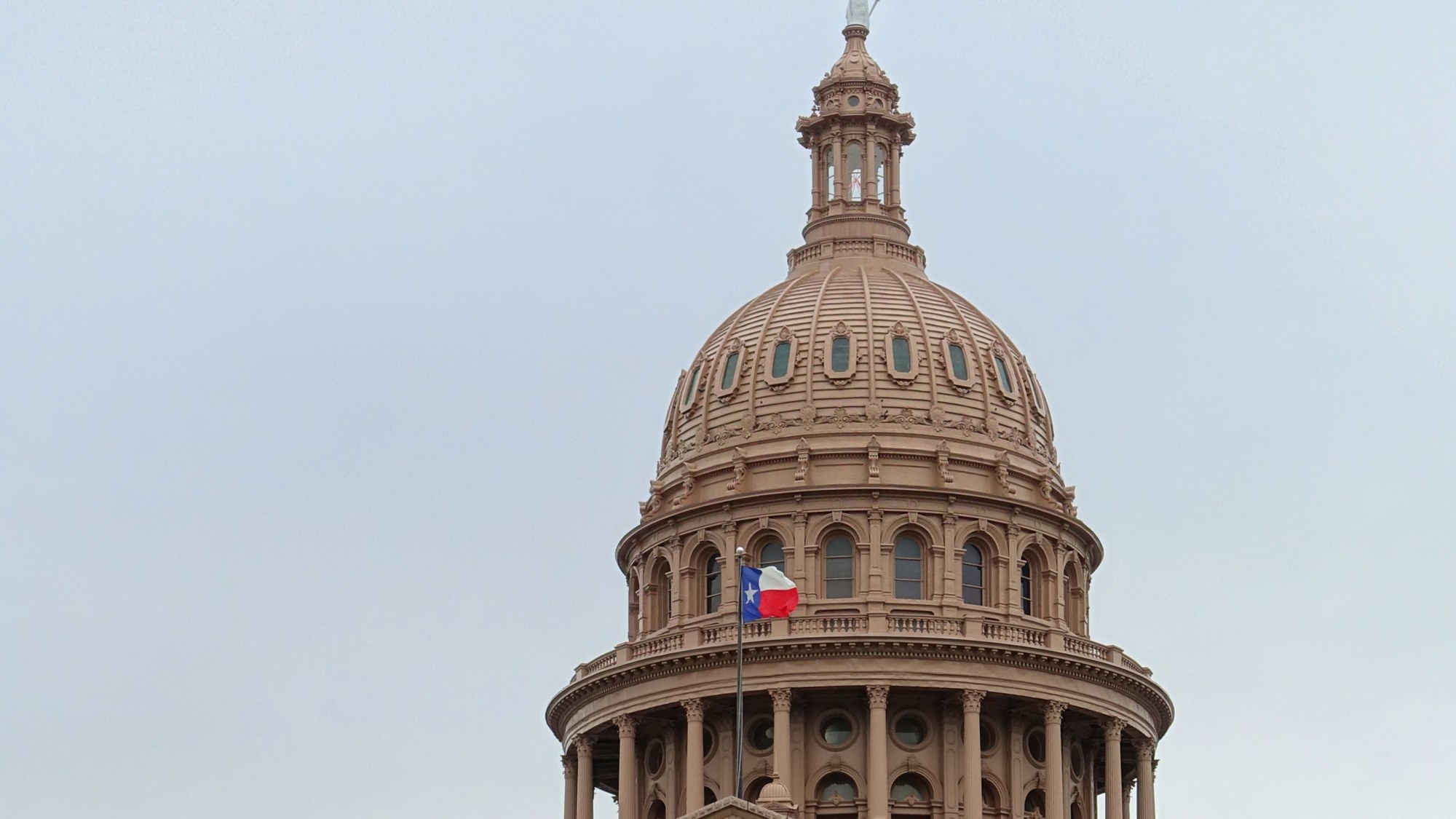
Texas Republicans did not lose a close election on November 3. In unofficial returns from the Texas secretary of state, Democrats unseated Gov. Greg Abbott, defeated Attorney General Ken Paxton in the U.S. Senate race, swept the other statewide offices, and took the Texas House for the first time since the 2002 election. [S1] [S3] [S4] [S5] [S6] [S7] The question that will not go away — and the one this article takes seriously — is not whether that happened on the unofficial tally sheets. It is whether the way the votes added up makes sense.
The oddity: Democratic votes rose in a midterm, Republican votes fell
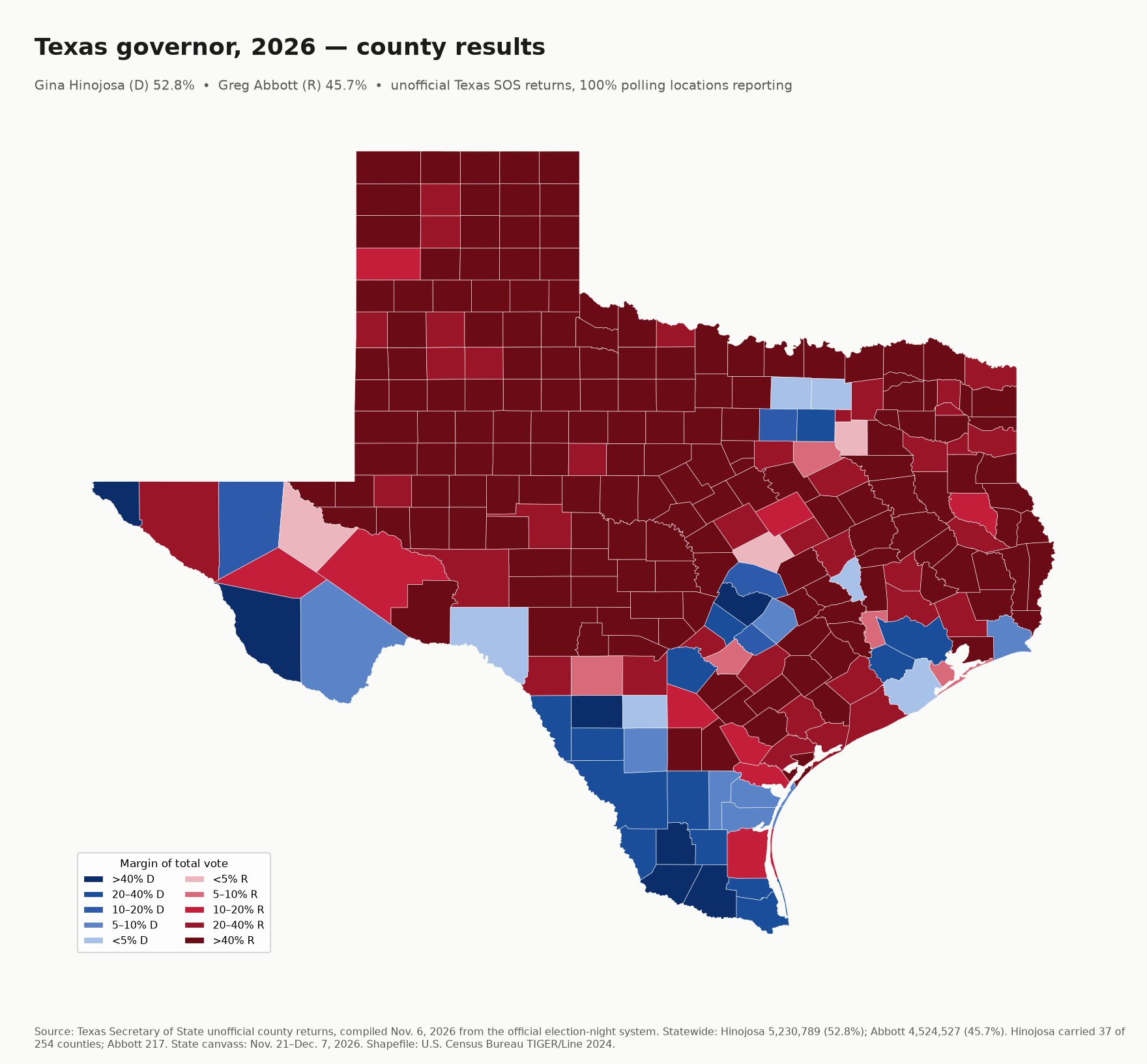
Compare the unofficial 2026 governor’s race with the official 2024 presidential totals. Gina Hinojosa received 5,230,789 votes, 395,539 more than Harris’s 4,835,250 — an increase of 8.2%. Abbott received 4,524,527, which is 1,869,070 fewer than Trump’s 6,393,597 — a drop of 29.2%. Hinojosa’s unofficial margin is 706,262 votes, or 7.1 points (52.8% to 45.7%). [S1] [S8]
That is not how midterms usually look. Turnout almost always falls from a presidential year, and both parties’ raw totals usually fall with it. Here, one party’s raw vote went up. That is why people who have watched Texas elections for decades are asking whether the numbers “math,” especially in rural red counties where they did not see a surge of Democratic enthusiasm.
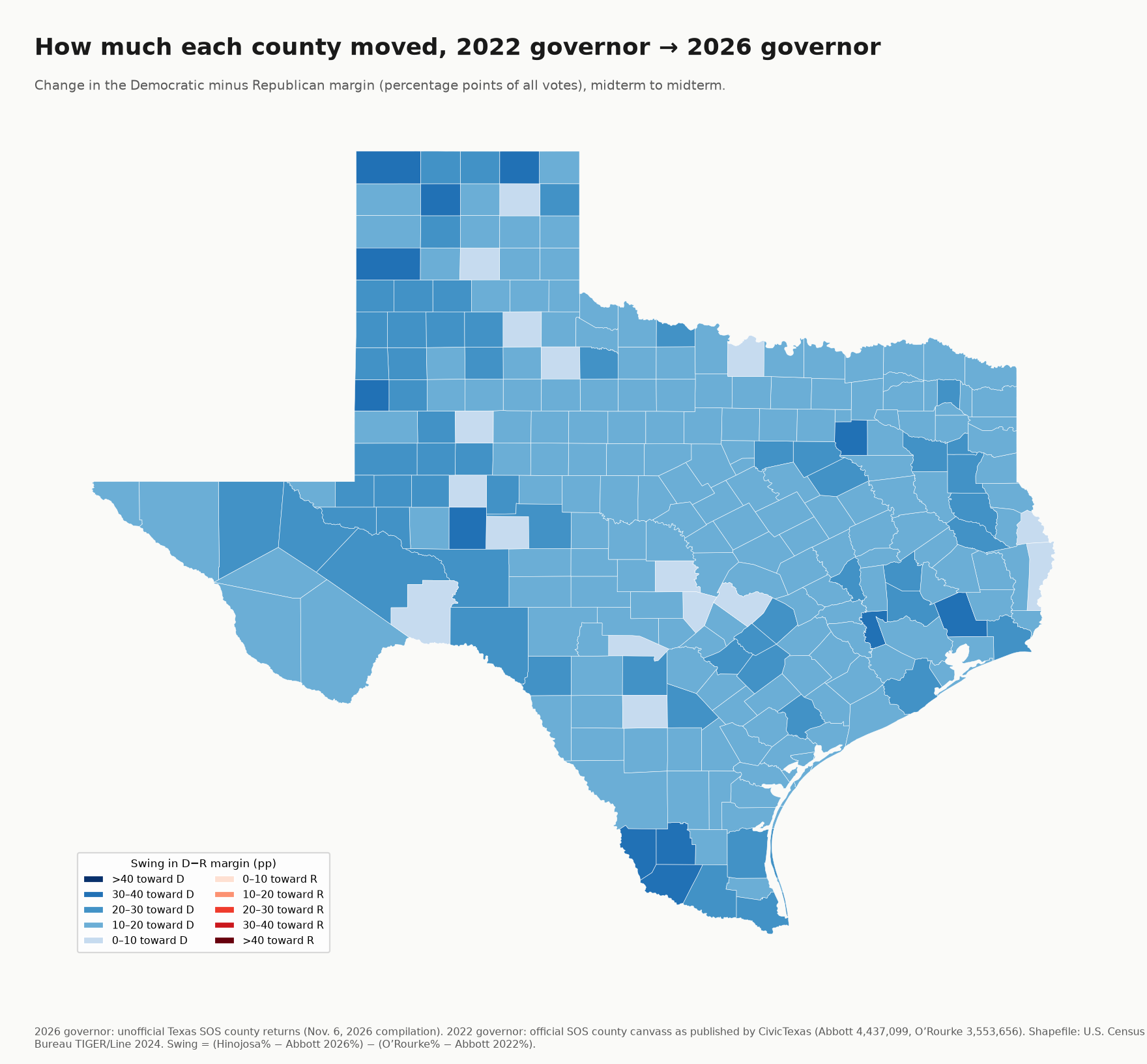
The comparison with 2022, the last midterm, is different and also important. Abbott’s unofficial 2026 total is actually up 87,428 votes, or 2.0%, from his official 2022 canvass of 4,437,099. Hinojosa is up 1,677,133 votes, or 47.2%, from Beto O’Rourke’s 3,553,656. [S1] [S9] Republicans did not collapse versus their last midterm. Democrats built a much larger raw-vote coalition than they had in 2022, and they also exceeded their 2024 presidential raw vote — which is the unusual part.
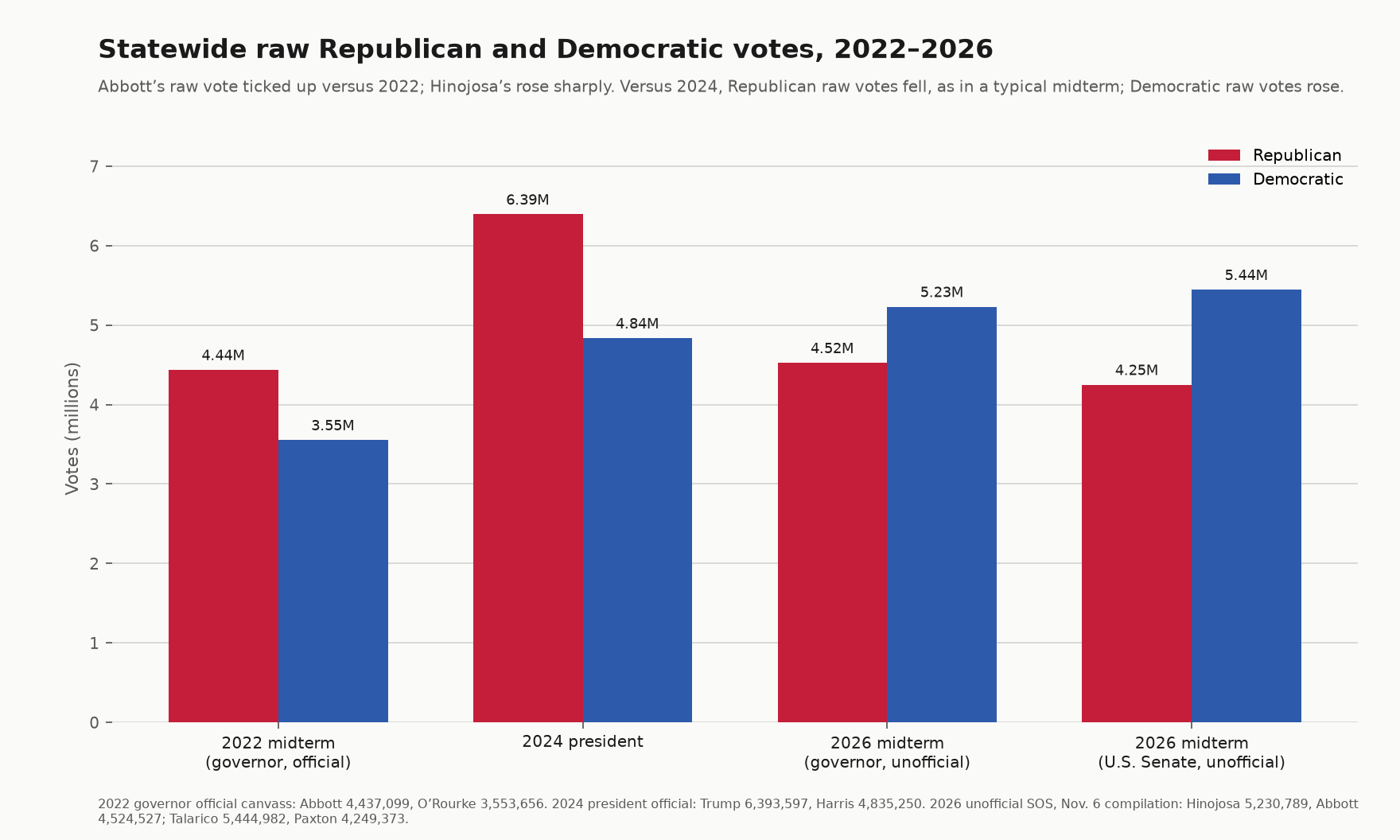
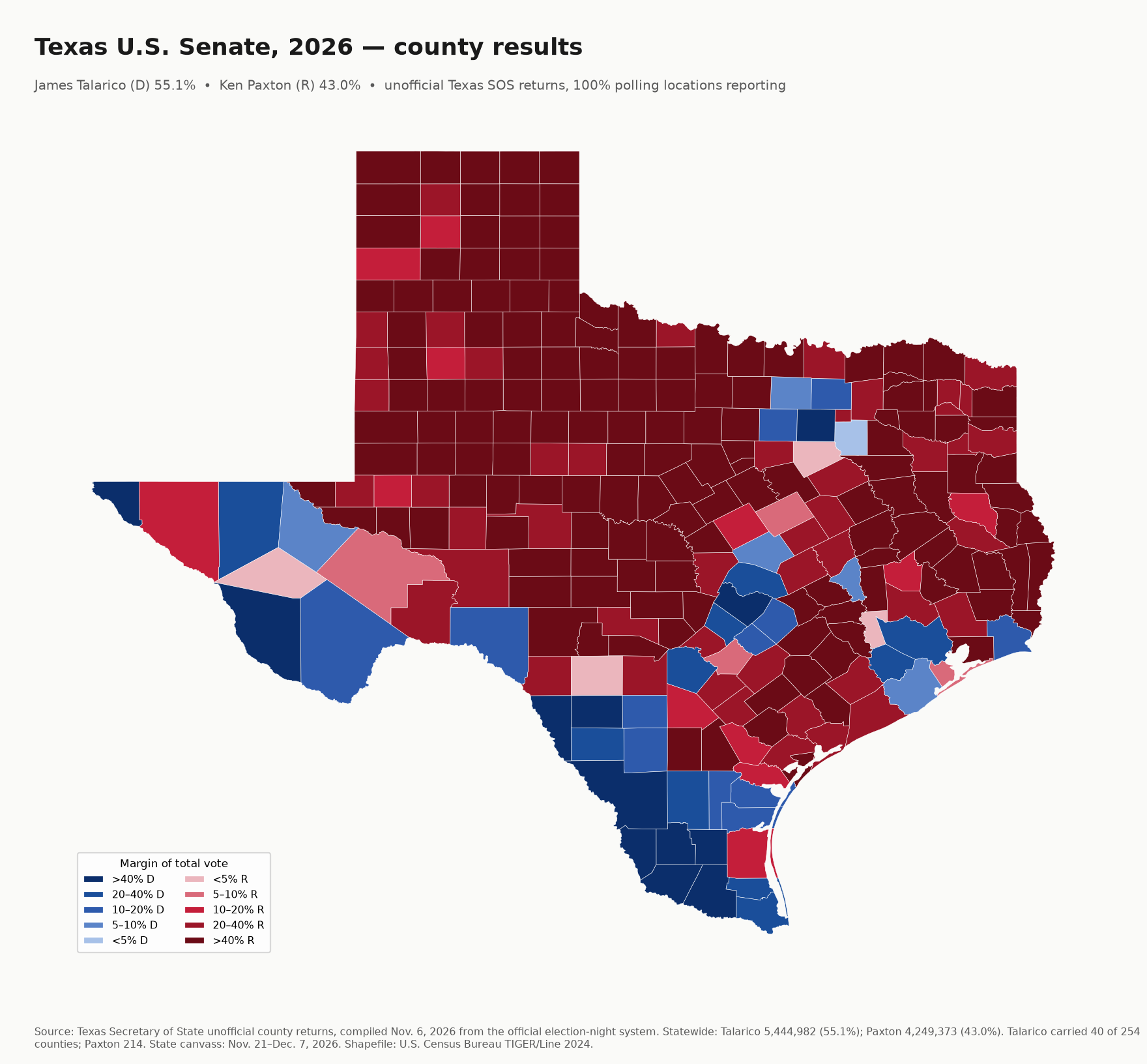
The U.S. Senate numbers move in the same direction, with a weaker Republican nominee. In unofficial returns, James Talarico has 5,444,982 votes (55.1%) to Paxton’s 4,249,373 (43.0%), a margin of 1,195,609 votes, or 12.1 points. Paxton trails Abbott by 275,154 votes and trails the strongest unofficial Republican statewide total in the set we tabulated — Republican Supreme Court candidate Brett Busby — by 327,510. [S1] [S3]
Why the pattern is being questioned
The questions are not coming only from viral posts. They come from a rural and conservative instinct that the visible campaign did not look like a Democratic surge in red Texas, from official registration and Census figures that raise flags in some counties, from an official vote-method file that does not yet add up, and from at least one painfully close legislative recount. Those points deserve to be stated plainly, then tested against the numbers.
The rural skeptic view: “the numbers do not math”
The core objection is simple. Texas has been a Republican state for a generation. In many rural counties, people who live there say they did not see long lines, a burst of Democratic yard signs, or a late wave of new faces that would explain a historic shift. If enthusiasm looked flat, they ask, how did Democratic raw vote totals rise — including in places that voted overwhelmingly for Trump two years ago?
The county returns do not show a rural Democratic takeover. They do show a real Democratic raw-vote increase from a small base, and a Republican drop from 2024 that looks like a normal midterm falloff from a presidential year.
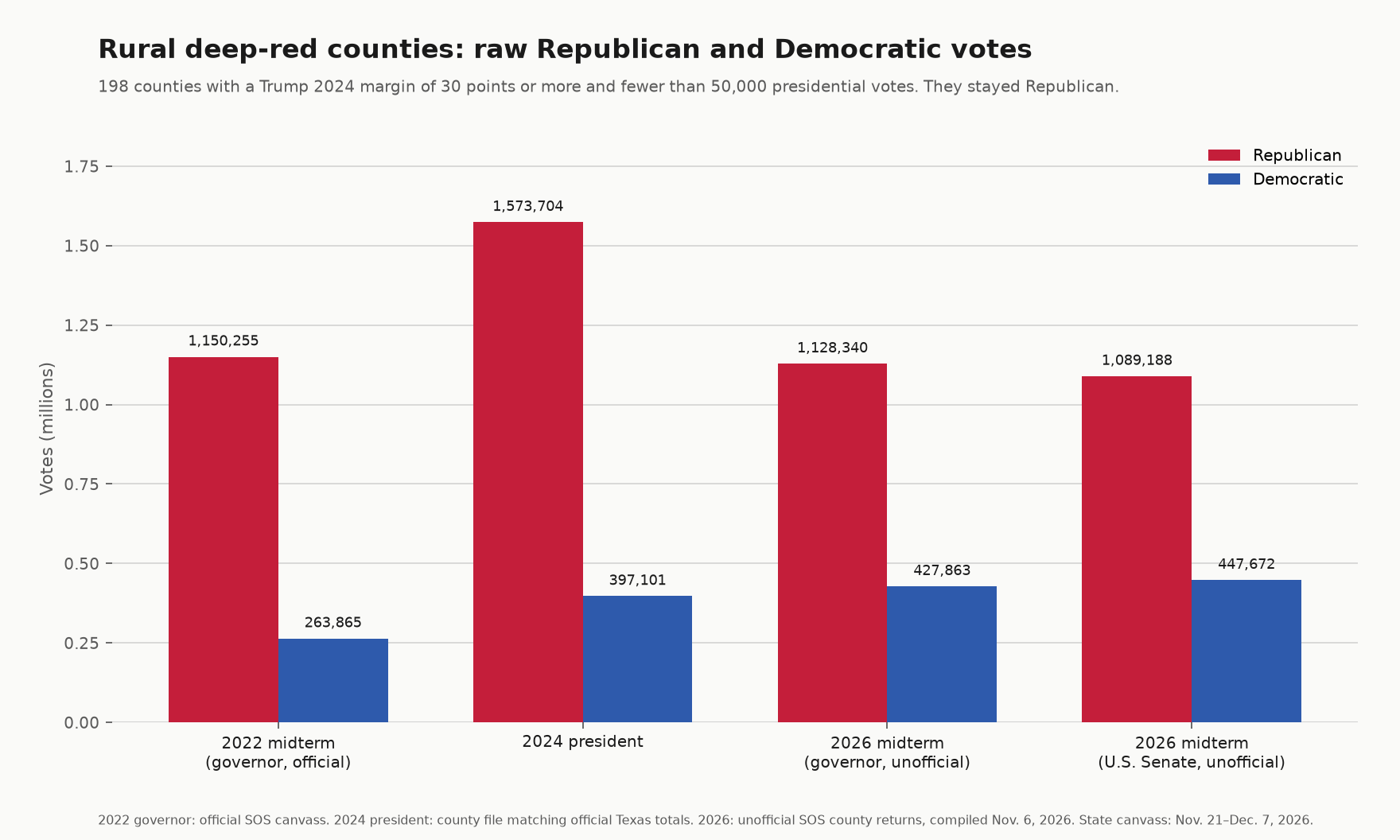
Define “rural deep-red” as the 198 counties where Trump’s 2024 margin was at least 30 points and the county had fewer than 50,000 presidential votes. In those counties:
- Versus 2022, Republican governor votes fell 21,915, or 1.9%, to 1,128,340. Democratic votes rose 163,998, or 62.2%, to 427,863. The counties still voted Republican by 44.3 points (71.3% to 27.0%).
- Versus 2024, Republican votes fell 445,364, or 28.3%. Democratic votes rose 30,762, or 7.7%.
- Republican raw votes were down versus 2022 in 157 of the 198 counties and up in 41. Democratic raw votes were up in 197; only Terrell County was down, 94 to 90.
- Hinojosa exceeded Harris’s 2024 raw vote in 157 of those 198 counties, and in 209 of 254 counties statewide.
Paxton also underperformed Abbott in those same counties, 1,089,188 to 1,128,340, a gap of 39,152 votes. [S1] [S8] [S9]
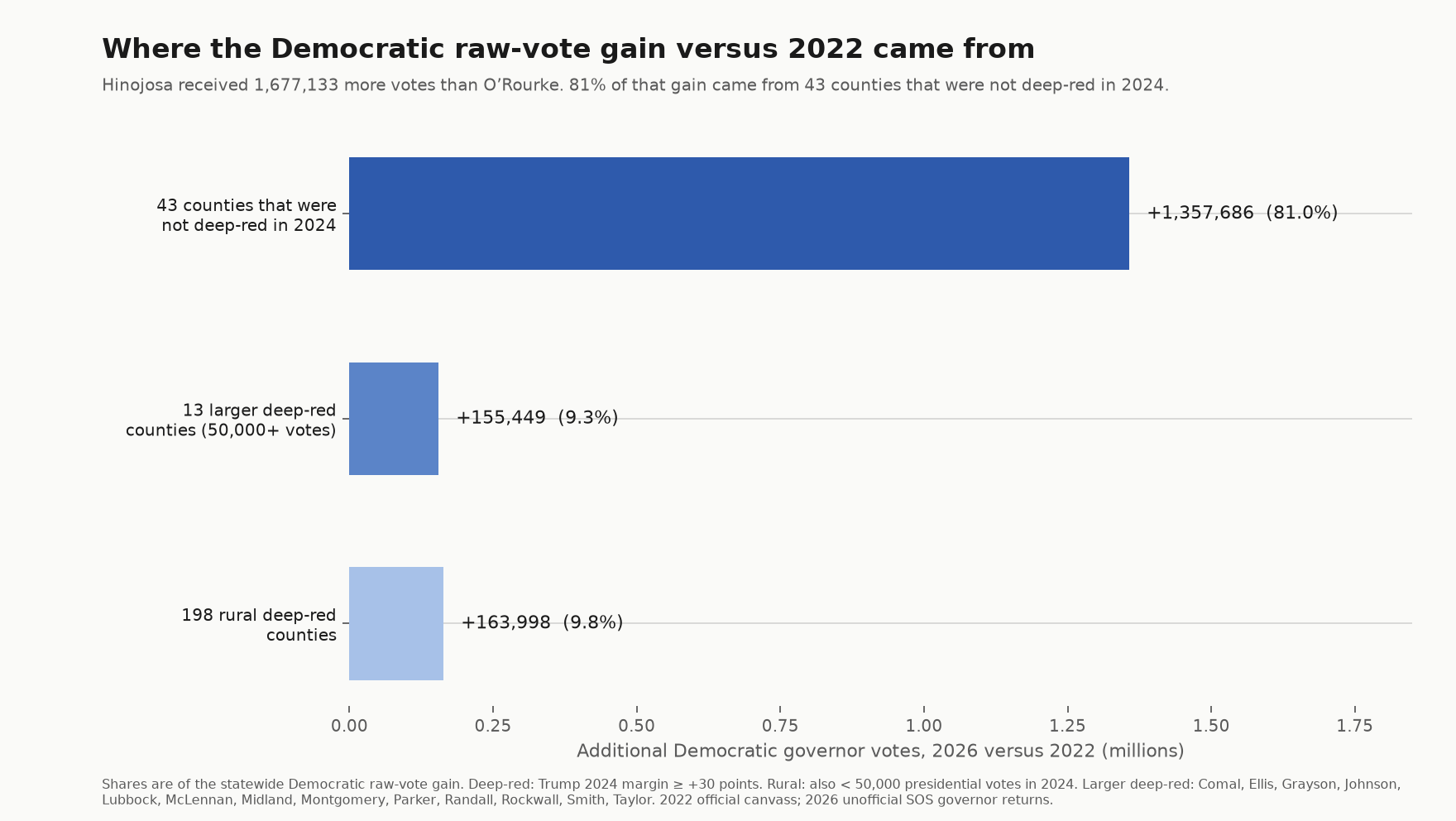
The statewide Democratic raw-vote gain versus 2022 did not come mostly from those rural counties. About 81.0% of Hinojosa’s raw-vote gain versus O’Rourke came from 43 counties that were not deep-red in 2024. Another 9.3% came from 13 larger deep-red counties, and 9.8% from the 198 rural ones. The largest rural Democratic raw gains versus 2022 were in Gregg, Ector, Liberty, Hunt, and Tom Green counties. The largest rural Republican raw drops versus 2022 were in Bowie, Wichita, and Ector. [S1] [S9]
That does not close the question. It locates it. Rural red Texas stayed Republican, but Democratic raw votes rose there too, including above 2024 in most of those counties, in a midterm, without a visible enthusiasm boom that many residents say they would have noticed. The burden is on the official files that still have not been completed — who voted, when, and how — to show whether those added Democratic votes were switches, new turnout, or something the current files cannot yet explain.
Registration versus Census: 97 counties over CVAP, and a handful of harder flags
Statewide, Texas is not registered above its citizen voting-age population. Official November 2026 registration is 19,041,684. The Census Bureau’s 2020–2024 ACS CVAP special tabulation, the latest available, is 19,865,984, plus or minus 24,077 at a 90% confidence level. Registration is 95.85% of that CVAP point estimate. Active (non-suspense) registration is 17,277,954, or 86.97% of CVAP. [S10] [S11]
Using unofficial governor votes of 9,907,381, statewide turnout is 52.03% of official registration and 49.87% of CVAP. Official SOS turnout reports use total registration, including voters on the suspense list. No Texas county reached 75% turnout of official registration in these unofficial figures. [S1] [S10]
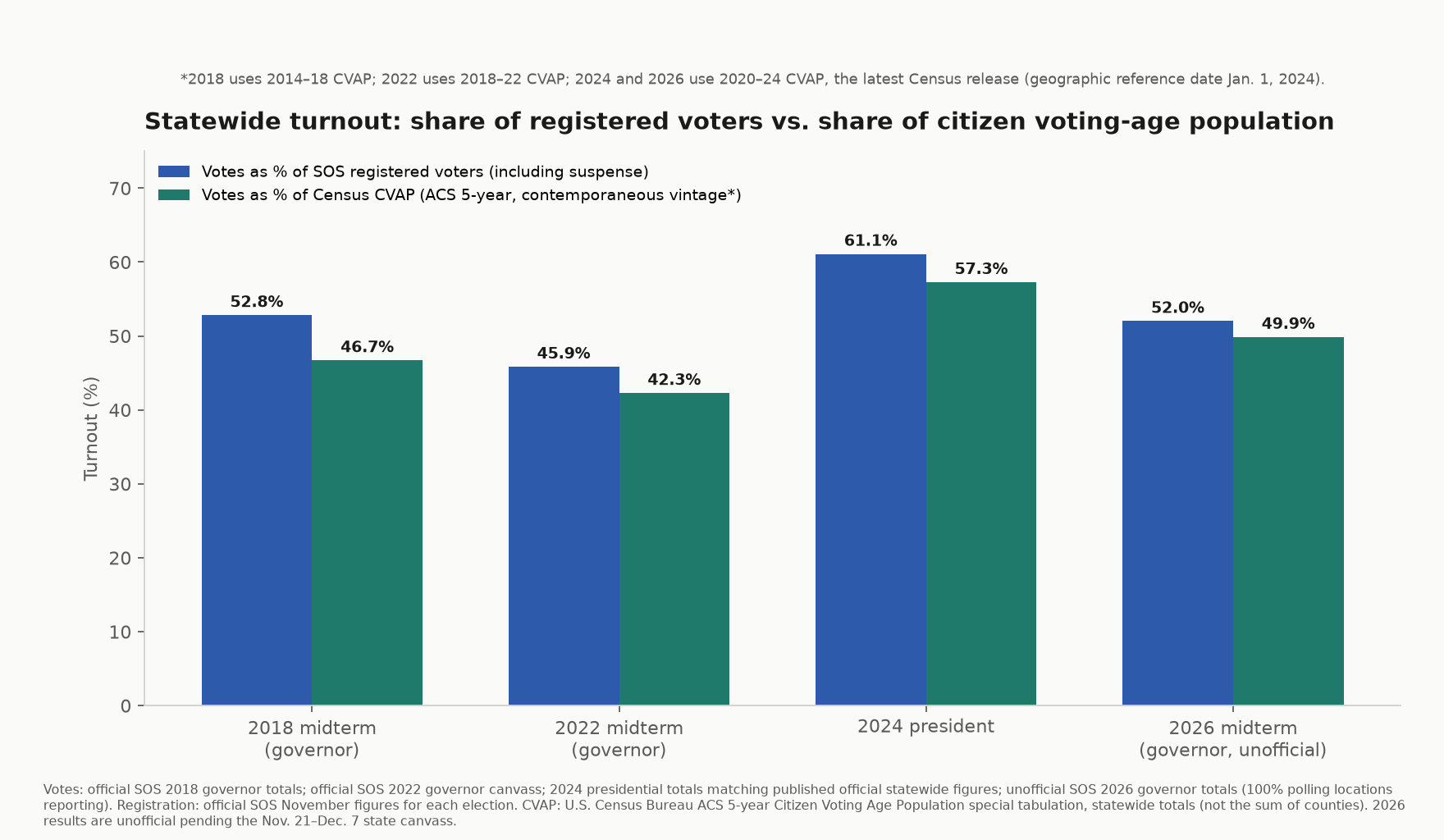
The flags appear at the county level. In 97 of 254 counties, total registration exceeds the CVAP point estimate. In 68 counties, total registration remains above CVAP even after adding the Census 90% margin of error. In 36 counties, active registration exceeds the CVAP point estimate. In 22 counties, active registration exceeds CVAP plus the margin of error. Those 22 counties account for 318,034 unofficial governor votes, or 3.2% of the statewide total. [S1] [S10] [S11]
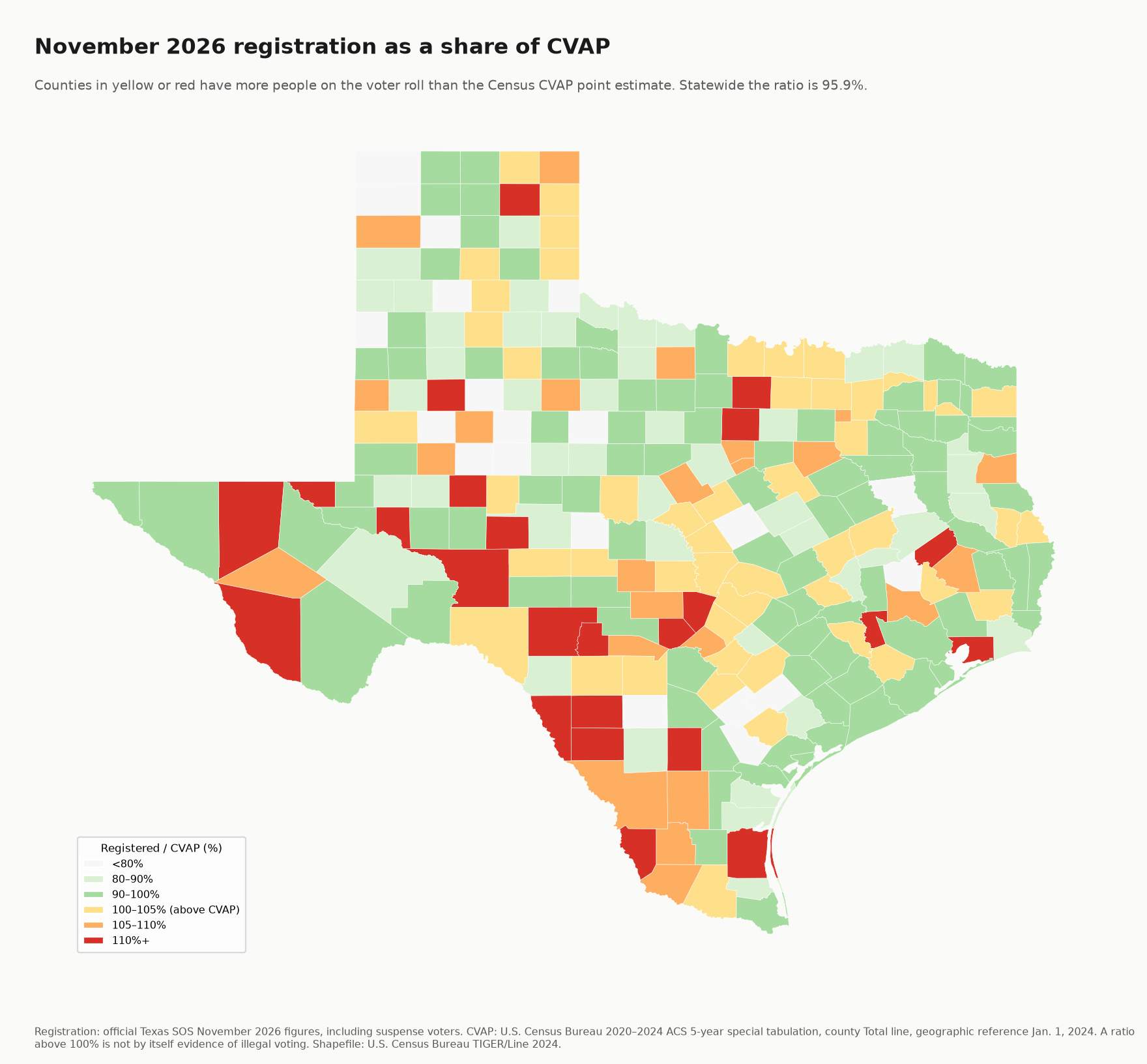
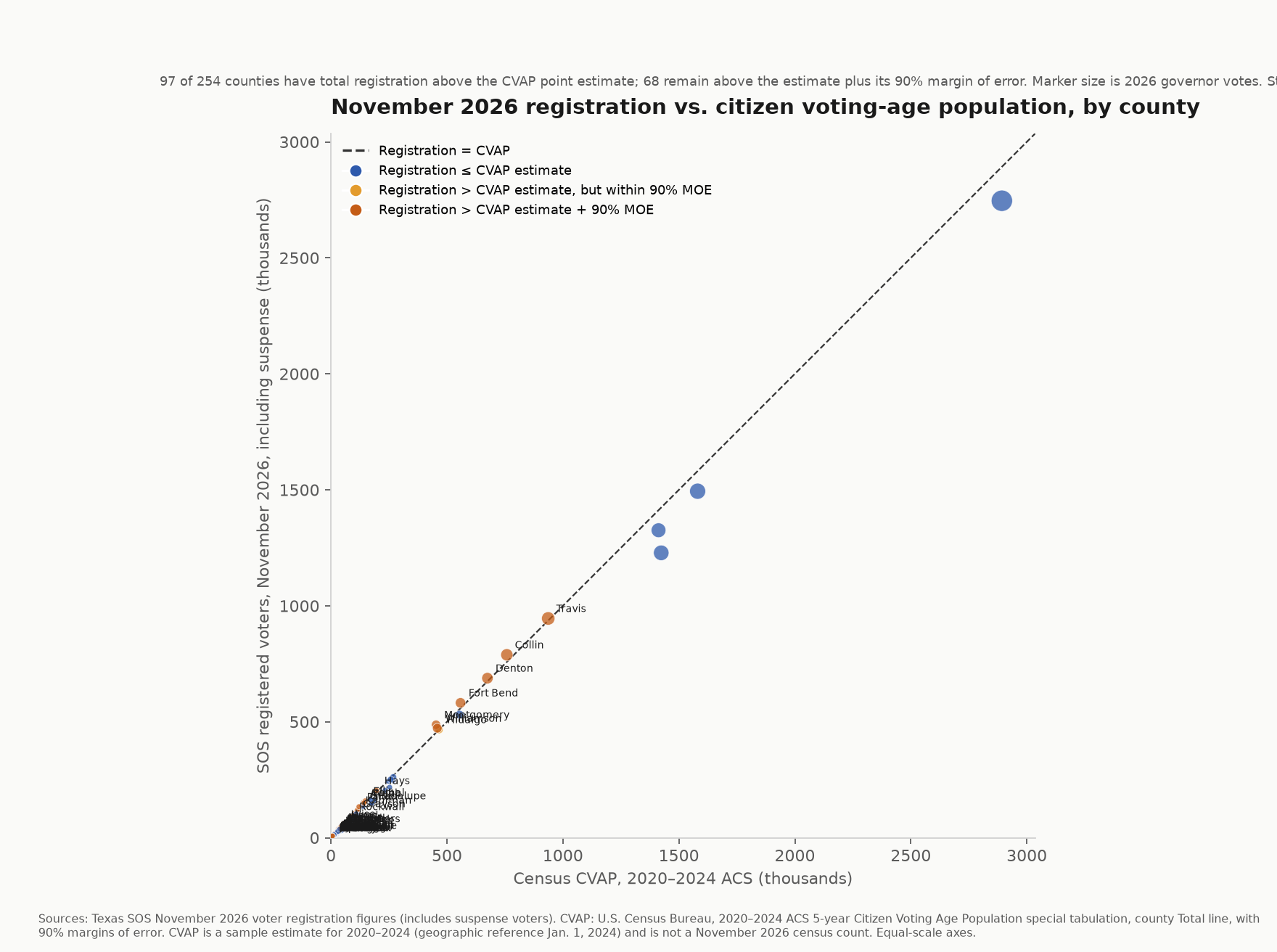
Two tiny counties also have unofficial votes above CVAP plus the margin of error: Loving County, with 68 votes and a CVAP of 32 plus or minus 30, and Kenedy County, with 159 votes and a CVAP of 91 plus or minus 52. Together that is 227 votes, a rounding error on a statewide margin of more than 700,000. Loving County’s 2026 turnout of its official roll was 45.9%, lower than in 2022 and 2024. Both counties have very large relative Census margins of error because the populations are so small. That is a data limitation, not proof of 227 illegal votes. It is still a flag, and it is reasonable to want the next CVAP vintage and the certified canvass before treating those two cells as closed. [S1] [S10] [S11]
Several ordinary explanations already account for a large share of “registration over CVAP” maps, and they should be stated in the same breath as the flags. The official roll includes suspense voters, people the county has not been able to confirm at the listed address; Votebeat (Factual) has described how Texas’s suspense process works and how cancellations lag. [S26] The CVAP file is a five-year American Community Survey estimate with a 22-month lag — the 2020–2024 vintage has a geographic reference date of January 1, 2024 — so a growing county can look “over CVAP” simply because the Census estimate is behind the roll. National Voter Registration Act list-maintenance rules also delay removals. In Travis, Collin, and some other large counties, total registration sits slightly above CVAP and is largely explained by suspense names. Tarrant County is the opposite of a mass add: official registration there fell 81,089, or 6.2%, from November 2024 to November 2026, with suspense down 51,584 and active registration down 29,505. Statewide, the roll grew 417,753, or 2.24%; without Tarrant, the rest of the state added 498,842. [S10] [S26]
Those explanations shrink the mystery. They do not erase the 22 counties where even the non-suspense roll sits above CVAP plus the Census margin of error, or the two tiny counties where recorded votes exceed that band. Until voter-history files and a newer CVAP vintage are in, those remain open questions, not a statewide proof of anything.
The method-of-voting file is still incomplete — 38,346 ballots short
The official secretary of state Election Day turnout file, election ID 53815, updated November 18, 2026, reports 7,463,198 early in-person ballots, 254,227 mail ballots, and 2,151,610 Election Day in-person ballots. The three methods sum to 9,869,035 — 38,346 below the unofficial governor total of 9,907,381. The file’s registered-voter total matches the official November figure of 19,041,684. Early in-person plus mail equals 7,717,425, which is consistent with The Texas Tribune’s report (Leans Left), citing preliminary SOS figures as of November 1, that more than 7.7 million people had already voted, 40.5% of registered voters. [S27] [S13]
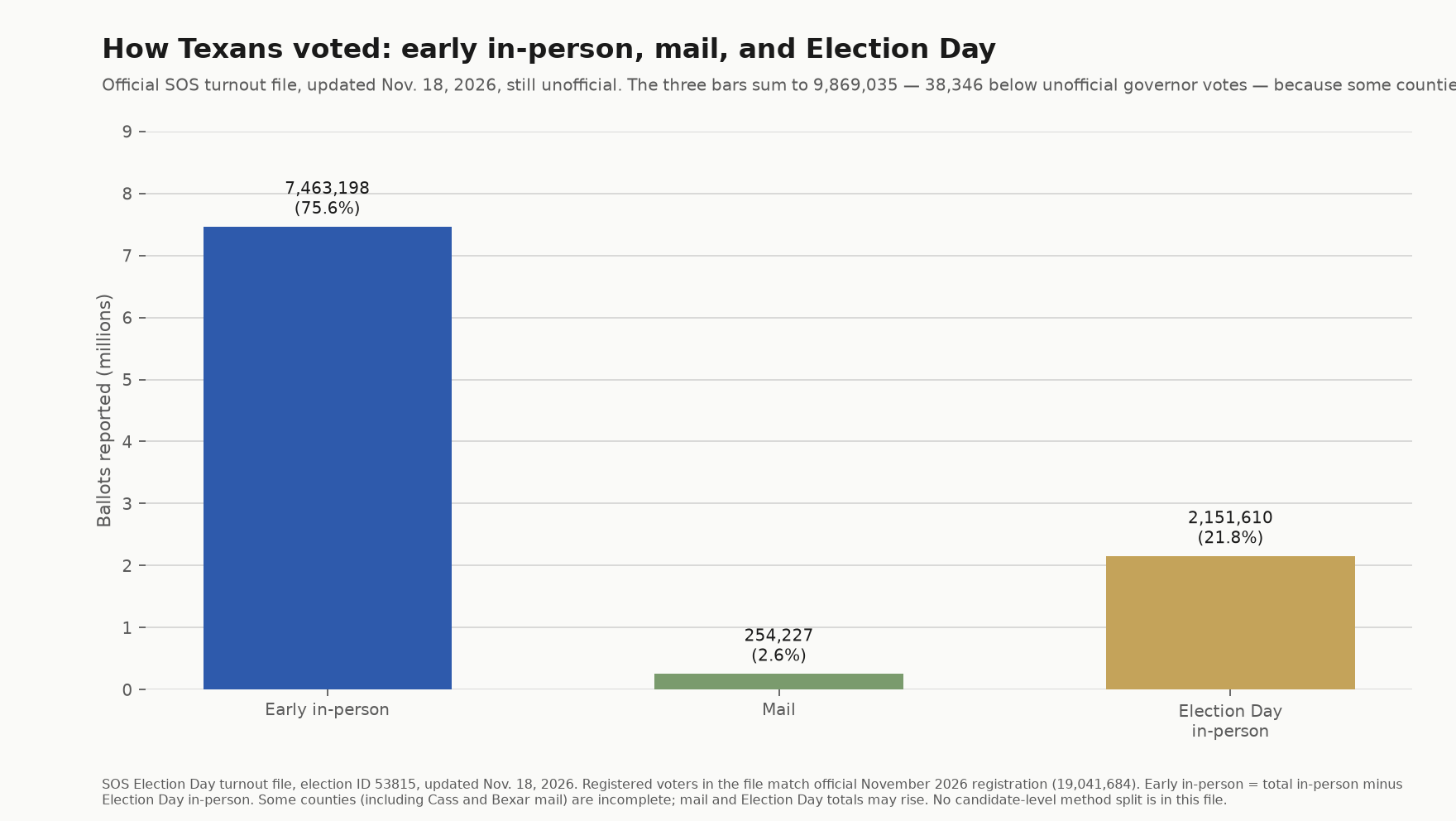
Some counties in that file are clearly incomplete. Cass County shows zero in-person ballots against 10,873 unofficial governor votes. Bexar County’s mail figure of 159 is implausibly low for a county of that size. There is still no complete official statewide, candidate-level split of votes by method. The canvass window of November 21 to December 7 is when those files are supposed to be finished. A short, patchy method file is a reason to withhold judgment, not a substitute for a completed count, and not evidence of a 700,000-vote statewide fraud. [S1] [S2] [S27]
A seven-vote House race is headed to a recount
One legislative race is close enough that a recount is already in motion, and it should be reported without being inflated into a statewide problem. Texas House District 61 in Collin County was certified on November 16: Republican Keresa Richardson 44,936, Democrat Tonya Black 44,929, a margin of seven votes out of 91,569. CBS Texas (Factual) reported the certified margin. The Dallas Morning News reported that a recount had been requested; the article is paywalled, and this newsroom is citing that headline fact, not a fuller account we cannot read. [S24] [S25] A seven-vote certified margin is exactly the kind of race that should be recounted. It does not move the unofficial statewide margins of 706,262 and 1,195,609 votes, and it does not, on its own, impeach the rest of the ballot.
What Republican critics themselves have said
A large share of the right-leaning argument after Election Day has been about candidates and message, not about a stolen count. That record belongs in this section because it is part of why some Republicans accept the defeat and others do not.
Sen. John Cornyn, writing in The Wall Street Journal on November 4 (opinion, Leans Right), said Republicans had nominated candidates who forced voters “to choose between policy and personal character,” calling that a “suicidal” proposition. “Here in Texas, traditional conservatives and independents were asked to swallow an almost comical list of personal scandals and improprieties,” he wrote. Figures like Paxton, he argued, “shrank the tent, obsessing over ‘RINOs’ and political theater.” [S16]
Derrick Wilson, chairman of the Texas Young Republican Federation, wrote that Paxton “was a terrible candidate,” and that long-time primary voters had told canvassers they “couldn’t vote for him.” The Texas Tribune (Leans Left) reported the post. [S15] Matt Mackowiak, a senior adviser to Cornyn’s campaign, told the Tribune the party had been “catering to and focusing on a more narrow and narrow sliver of the electorate, believing the only election they could lose is a primary.” U.S. Rep. Chip Roy told the Tribune that Republicans had made redistricting, political process, and then “the Iran War” their battle cry “when inflation’s up and they’re having their own personal issues.” [S15]
Those are Republican explanations for a political defeat. They are relevant, and they are not the same thing as a finding that the count is clean. Critics who still do not believe the raw-vote pattern can accept that Paxton was a weak nominee and still ask why Democratic governor votes exceeded 2024.
The explanations analysts offer — and why they do not fully close the question yet
Republicans stayed home. This is the most common political explanation, and it is partly right. Versus 2024, Republican governor votes fell 29.2% statewide and 28.3% in the 198 rural deep-red counties, a drop that looks like ordinary midterm falloff from a presidential year. Versus 2022, though, the stay-home story weakens. Statewide, Abbott’s unofficial raw vote is up 87,428 from his last midterm. In the rural deep-red counties, Republican raw votes were down only 1.9%. Stay-home Republican voters can explain a drop from Trump 2024. They cannot, by themselves, explain why Democratic raw votes rose above Harris 2024 in a midterm. [S1] [S8] [S9]
A national midterm backlash against the president. The Economist/YouGov poll of November 9–11, 2026 (Factual) found 32% of U.S. adults approved of President Trump’s job performance and 63% disapproved. [S17] [S36] That is a brutal midterm environment for the president’s party, and it helps explain why Republicans lost ground in Texas and elsewhere. It still runs into the same problem: midterm backlashes usually cut turnout from the presidential year on both sides. They do not usually produce a larger Democratic raw vote than the presidential election itself.
Paxton’s underperformance. This explains the Senate margin better than it explains the governor’s race. Paxton trails Abbott by about 275,000 unofficial votes and was the weakest Republican on the statewide ballot in the set tabulated here. Ticket-splitting of that size is consistent with a nominee many Republican operatives themselves called a drag. It does not explain Hinojosa beating Abbott, and it does not explain Democratic raw votes exceeding 2024. [S1] [S15]
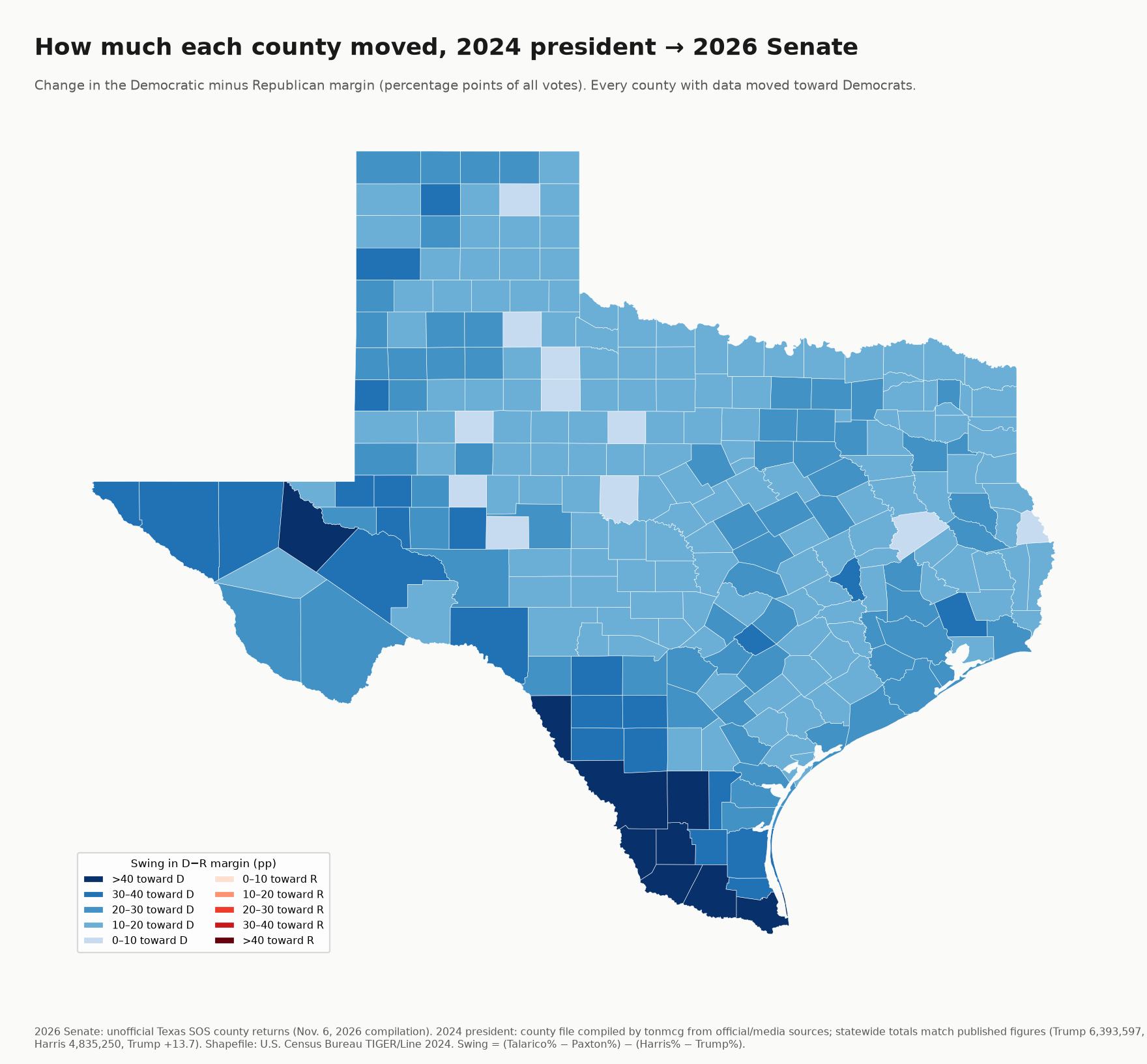
A Hispanic and South Texas reversal. This one is real in the unofficial county returns. Every one of the 254 counties moved toward Democrats versus the 2024 presidential race, with a median Senate swing of 17.7 points. The largest swings include Starr County, plus 71.8 points; Zapata, plus 63.1; Maverick, plus 59.5; Webb, plus 49.5; and Hidalgo, plus 49.3. Twenty-eight counties that backed Trump in 2024 flipped to Talarico; none flipped the other way. Versus 2022, every county also moved toward Democrats in the governor’s race, with a median swing of 16.6 points; 18 counties flipped from Abbott to Hinojosa, including Tarrant, Collin, Denton, and Williamson. [S1] [S8] [S9] Center Square (Leans Right) and other outlets have described Hispanic voters moving on pocketbook issues; that reporting is useful for the political why. [S18] A genuine South Texas reversal can account for a large part of the 81% of Democratic raw-vote gains that came from counties that were not deep-red. It does not, by itself, close the unusual midterm raw-vote question, the incomplete method file, the 22-county active-registration flags, or the HD 61 recount. That takes voter-history files — who switched, who newly turned out, and who stayed home.
What actually flipped — and what did not
The premise that “Texas turned blue” is too broad, and the unofficial returns are precise enough to say so. Democrats won the governor’s race, the U.S. Senate race, the other statewide executive offices, the statewide courts — including the Supreme Court chief justice race, Maggie Ellis over Jimmy Blacklock — and the State Board of Education, which unofficial returns show at 8 Democrats to 7 Republicans, flipped from 11–4 Republican. They took the Texas House, 83–67, a net gain of 21 seats from the outgoing 88–62 Republican House. The Associated Press (Factual), CBS Texas (Factual), and the Texas Association of School Boards (Factual) all reported the House flip; CBS and TASB give the 83–67 split, and TASB reports 21 seats flipped. [S3] [S4] [S5] [S6] [S7] Republicans kept the Texas Senate, 19–12, so there is no Democratic trifecta. [S6] They also kept a majority of Texas seats in the U.S. House, a net loss of one seat despite the 2025 mid-decade map, according to The Texas Tribune (Leans Left). [S14] Sen. Ted Cruz was not on this ballot. The state’s U.S. Senate delegation will be split.
In unofficial county returns, Talarico carried 40 of 254 counties and Paxton 214. Hinojosa carried 37 and Abbott 217. The color of the map is still mostly red. The margins inside those red counties, and the blue shift in the suburbs and along the border, are what changed the statewide result. [S1]
The “found vote” and early-flip stories, rated honestly
A separate set of claims circulated online in the days around the election: that late or “found” ballots had flipped Texas, or that a federal raid had uncovered a warehouse of fraudulent Democratic votes. Those claims should be rated one at a time. Some are false. Some describe real, smaller events that were then recast as something they were not.
“20 million found votes flipped Texas”
❌ False Factual
Official November 2026 registration is 19,041,684. Unofficial governor votes are 9,907,381. There were not 20 million votes to “find,” and the unofficial total is not larger than the roll. Snopes (Factual), in a November 13, 2026 fact-check, rated the claim false; The Wall Street Journal and Lead Stories traced the “20 million” figure to a poorly sourced national House-vote chart. Snopes also cited a slightly lower SOS turnout figure of 9,850,031, which does not change the rating. [S10] [S19] [S1]
A Houston FBI raid on 20,000 or more fraudulent Democratic ballots
❌ False Factual
The FBI said, “No election-related operation occurred.” Harris County Clerk Teneshia Hudspeth said the circulating information was false. The photos that traveled with the claim came from a January search in Fulton County, Georgia, and from ballots in San Francisco. PolitiFact (Factual) rated the claim Pants on Fire on November 3, 2026. Snopes, AFP (Factual), KHOU (Factual), and Lead Stories (Factual) reached the same conclusion. [S20] [S37] [S22] [S21] [S39]
A Tarrant County “ballot dump”
✅ Confirmed as a data fact that a large early-vote total was reported in a batch; ❌ False that this was evidence of stuffed ballots. Factual
Tarrant County’s official daily early-voting report shows 571,950 in-person early votes over 12 days at 47 locations, a figure also reported by KERA (Factual). The SOS method file implies 569,308 early in-person ballots in Tarrant, close to the county’s own daily total. Batch-reporting a large early-vote total after the polls close is a routine feature of Texas election night, not a late discovery of new ballots. [S23] [S27] [S28]
Lubbock County’s rescan of 5,681 paper ballots
✅ Confirmed as a local equipment failure and a lawful rescan; ❌ False as a cache of newly found ballots. Factual
After a scanner failure at the 82nd and Boston location, Lubbock County rescanned 5,681 paper ballots under Texas Election Code § 127.156. Unofficial results were delayed until early November 4. The Lubbock Chronicle (Factual) and local officials described it as an equipment failure, not newly discovered ballots. [S29]
Counties that “flipped early”
✅ Confirmed (unofficial) as partisan flips in the unofficial returns; ❓ Unproven / no evidence yet as mid-count discoveries of hidden votes. Factual
Twenty-eight Trump 2024 counties flipped to Talarico in the unofficial Senate returns. Tarrant, Collin, Denton, and Williamson flipped versus the 2022 governor’s race. Those are real changes in the unofficial county vote, visible once the returns were in, not evidence that a late batch reversed a statewide winner. As of November 19, there is no official finding that a late-reported batch changed the outcome of a statewide race. [S1] [S8] [S9]
A 30,000-case attorney general probe, and other unverified chatter
A viral claim that the attorney general’s office was sitting on some 30,000 election cases was denied by Paxton spokesperson Michelle Smith, according to Capitol Inside, a Texas political newsletter. Lead Stories (Factual) also found no evidence of such an investigation. [S32] [S38] Separate posts by Mike Lindell claiming a 15% “algorithm,” or that Paxton and Abbott actually won, or that a candidate ran 292,000 votes behind an “average Republican,” remain unverified chatter. They contradict the unofficial official returns. The 292,000 figure could not be independently reproduced from the nine statewide races tabulated for this article; ordinary ticket-splitting around a weak nominee is consistent with the Paxton-Abbott gap that does appear in those returns. This newsroom is not treating those posts as evidence.
How people voted, so far: method, roll-off, and the growth of the roll
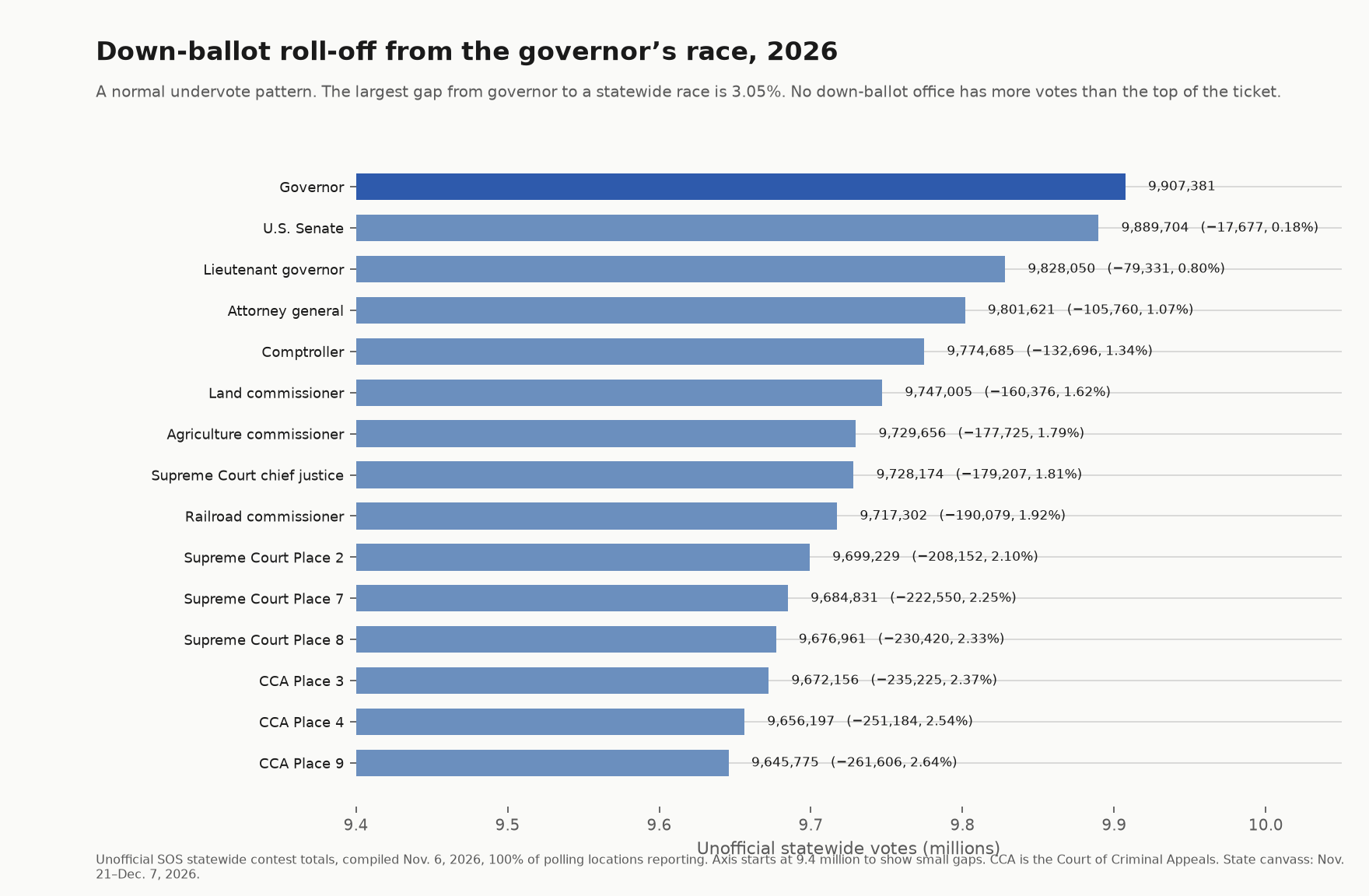
The method split is described above and remains incomplete. What the unofficial statewide contest totals do show is ordinary down-ballot roll-off, not a mysterious pile of extra votes appearing in one race and vanishing in the others. The governor’s race has the highest unofficial total, 9,907,381. The Senate race has 9,889,704, or 17,677 fewer (0.18%). Lieutenant governor has 9,828,050 (0.80% roll-off from governor). Attorney general has 9,801,621 (1.07%). Court of Criminal Appeals Place 9 has 9,645,775 (2.64%). 15th Court of Appeals Place 3 has 9,605,266 (3.05%). No down-ballot statewide office exceeds the governor’s total. [S1]
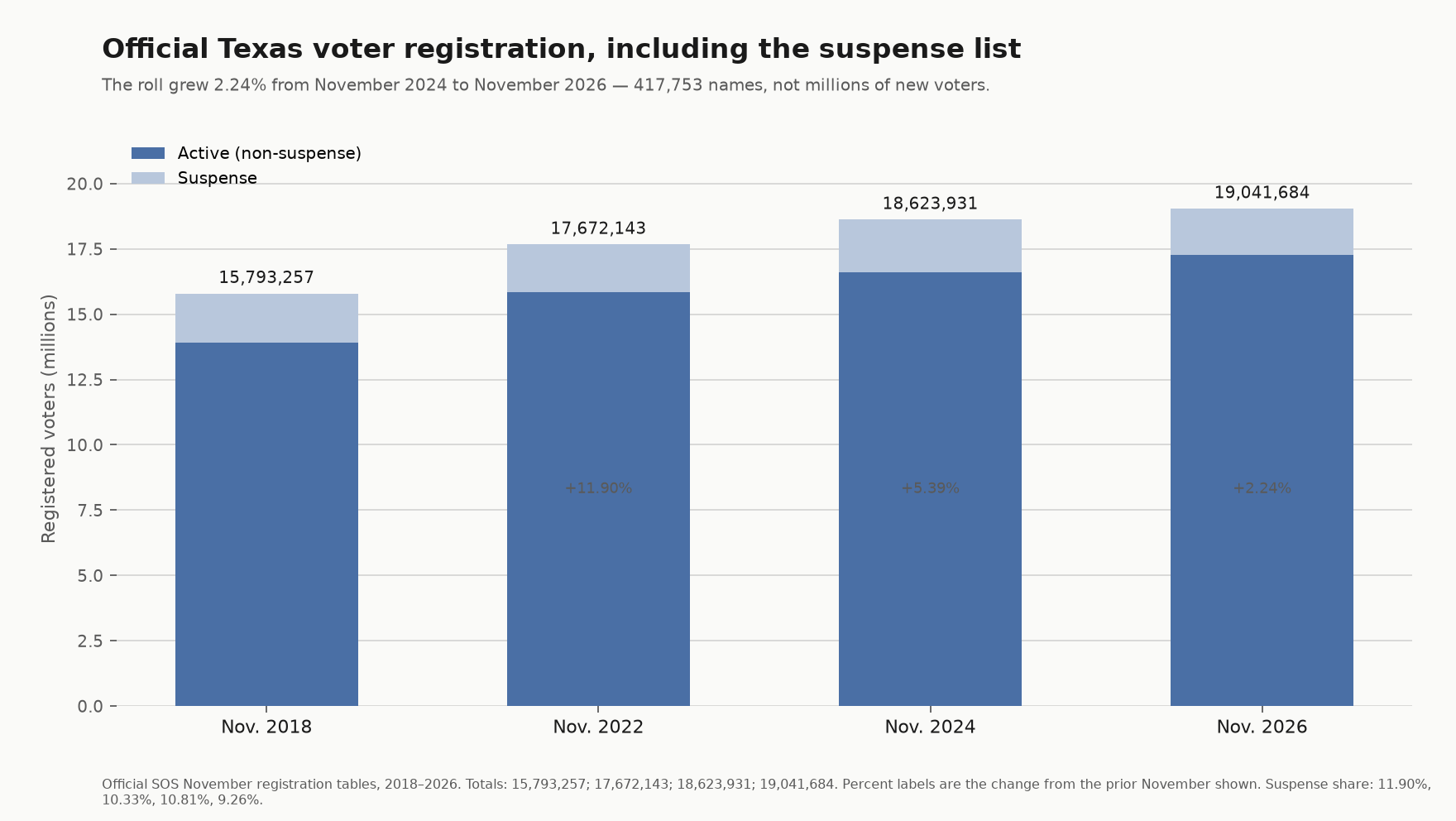
The official roll has grown, but not in a way that, by itself, invents a new electorate large enough to flip Texas overnight. Official November registration was 15,793,257 in 2018 (suspense 1,879,611, or 11.90%), 17,672,143 in 2022 (10.33% suspense), 18,623,931 in 2024 (10.81% suspense), and 19,041,684 in 2026 (1,763,730 suspense, or 9.26%). The suspense share is actually lower than in the last three comparable Novembers. [S10]
What official reviews exist — and what does not
As of November 19, 2026, this newsroom has not found an official contest, recount, or attorney general investigation aimed at overturning the statewide results. The secretary of state announced, on November 16, the first statewide risk-limiting audit of a November contest, covering the U.S. Senate race, under 2021’s Senate Bills 1 and 598. Dice were rolled on November 18. Secretary of State Robert Howden has described the audit as a routine statutory process, not a fraud investigation. Election lawyer Cris Feldman said he does not expect a 1.2 million-vote margin to change. Counties are also conducting routine sample hand counts. The results of the risk-limiting audit have not been released. [S30] [S31]
The state canvass must be held no earlier than November 21 and no later than December 7, 2026, under Election Advisory 2026-28. The deadline to request a recount of a statewide or district office is 5 p.m. on the third business day after that final state canvass. [S2] Until those dates pass, the statewide figures in this article remain unofficial. A seven-vote recount in House District 61 is a local, certified-margin recount, not a statewide contest.
What we know, and what we do not know yet
| What we know | What we do not know yet |
|---|---|
| Unofficial SOS returns, with 100% of polling locations in a Nov. 6 compilation, show Democrats winning every statewide office on the ballot and taking the Texas House, 83–67. Republicans held the Texas Senate, 19–12, and a U.S. House majority. | Certified statewide totals after the state canvass, which must be held Nov. 21–Dec. 7, 2026. |
| Versus 2024, unofficial Democratic governor votes rose 8.2% while Republican votes fell 29.2%. That midterm raw-vote pattern is unusual, and it is a fact in the unofficial returns. | Whether the pattern holds after certification, and whether the added Democratic votes were switches, new voters, or something the current files cannot yet show. That requires voter-history files. |
| Versus 2022, Abbott’s unofficial raw vote is up 2.0%. Hinojosa is up 47.2%. About 81% of that Democratic raw-vote gain came from 43 counties that were not deep-red in 2024. Rural deep-red counties stayed Republican by 44 points. | A complete, county-by-county official account of who voted in those rural counties, and when. |
| Statewide registration, 19,041,684, is below Census CVAP. In 97 counties total registration exceeds the CVAP point estimate; in 22, even the non-suspense roll exceeds CVAP plus the margin of error. Loving and Kenedy counties have votes above that band, totaling 227 ballots. | Whether those county flags shrink once the next CVAP vintage is published and list maintenance is reflected, and how much is suspense lag versus a real over-registration problem. |
| The official method-of-voting file, updated Nov. 18, is 38,346 ballots short of the unofficial governor total. Some counties in the file are clearly incomplete. | A finished official statewide method-of-voting file, and any official candidate-level split by early, mail, and Election Day votes. |
| House District 61 was certified Nov. 16 at a seven-vote margin. A recount has been requested. It does not change the statewide races. | The recount result, and the date it will be conducted. |
| Claims of 20 million “found votes,” and of an FBI raid on a Houston warehouse of fraudulent Democratic ballots, are false. The Tarrant early-vote total was a real, batch-reported early-vote figure. The Lubbock rescan was a documented equipment failure. | — |
| As of Nov. 19, there is no official contest or attorney general probe aimed at overturning the statewide result. A statutory risk-limiting audit of the Senate race is underway. Dice were rolled Nov. 18. | The risk-limiting audit results; any recount or contest filed after the state canvass (the statewide recount deadline is 5 p.m. on the third business day after that canvass). |
History echo (analysis): After surprising or close counts, claims of “found ballots” and late “dumps” recur. Florida’s 2000 recount turned on how late, overseas, and disputed ballots were treated. In 2020, batch-reporting of large early-vote or mail totals — especially after Election Day in-person counts had already been posted — was widely recast online as evidence of stuffing. The shared tactic is to treat a later-reported batch as if it were a newly invented pile of votes, rather than a delayed report of ballots already cast. Where it matches: the same claim appeared in Texas within hours of the 2026 count, attached to Tarrant County’s early-vote report, to a Lubbock rescan, and to invented statewide “found vote” totals. Where it breaks down: the unofficial statewide margins here are 706,262 votes for governor and 1,195,609 for Senate, not a few hundred hanging chads or a few thousand late mail ballots. As of November 19, there is no official contest of the statewide result. A historical rhyme in the rhetoric is not evidence that the 2026 count is a replay of 2000 or 2020, and it is not a reason to ignore the real open items in the table above.
Our view (opinion)
Two facts can be held at the same time. The unofficial returns show a real Democratic sweep of Texas statewide offices. And the raw-vote pattern versus 2024 is genuinely strange for a midterm. People who live in red counties and say they did not see the enthusiasm that would explain a Democratic raw-vote increase are not crazy for wanting a better explanation than a shrug.
The viral stories do not provide that explanation. There were not 20 million found votes. There was no Houston FBI warehouse raid. A large Tarrant early-vote total reported in a batch is how Texas election night works. A Lubbock rescan after a scanner failed is in the Election Code. Inflating those episodes into a statewide steal is a way to avoid the harder work of reading the returns.
The ordinary political explanations do a lot of work, and they should be credited. Republicans had a president at 32% approval, a Senate nominee their own operatives called a drag, a South Texas coalition that moved sharply, and a midterm electorate that punished the party in power. Those are sufficient reasons for a bad Republican night. They are not yet a complete accounting of why Democratic raw votes rose above 2024, why the official method file is still 38,346 short, or why 22 counties show active registration above Census CVAP plus the margin of error.
The honest position on November 19 is therefore narrower than either camp wants. The result should be treated as a real, unofficial defeat for the Republican statewide ticket. The oddity should stay on the table until the canvass, the risk-limiting audit, the completed method file, the HD 61 recount, and the voter-history files are in. Asking those questions is not the same thing as claiming the election was stolen. Declaring it stolen without that evidence is not analysis. It is a guess.
Label key
- ✅ Confirmed An official record, or two or more independent outlets, agree. “Confirmed (unofficial)” means the unofficial official returns agree, pending the canvass.
- ❓ Unconfirmed Reported or claimed, but not yet independently verified. “Unproven / no evidence yet” is used when a serious claim has been tested and no supporting evidence has been found.
- ⚠️ Disputed Contradicted by the evidence or by credible sources, or actively contested. ❌ False is used when the claim is contradicted by official records or by multiple fact-checks.
- Factual Straight reporting that holds up across outlets on different sides.
 Leans Left The facts hold, but the coverage tilts left: one-sided, loaded language, missing context or a single anonymous source.
 Leans Right The facts hold, but the coverage tilts right: one-sided, loaded language, missing context or a single anonymous source.
Each major claim in this article gets its own confidence tag. Lean labels describe the outlet being cited, not the conclusion. More on how we cover the news.
Sources
- [S1] Texas Secretary of State unofficial November 3, 2026 election-night returns, official Election Night Returns portal; county compilation used in this article dated November 6, 2026, with 100% of polling locations reporting (the prior public results page had been updated November 4, 2026, 4:59 p.m. CT) (Factual; official unofficial returns)
- [S2] Texas Secretary of State, Election Advisory No. 2026-28, “Canvass and Recount Deadlines for the November 3, 2026 General Election for Federal, State, and County Officers” (Factual; official)
- [S3] Associated Press, “Democrat James Talarico flips a US Senate seat in Texas and sends a shock through the GOP,” November 4, 2026 (Factual)
- [S4] Associated Press, “Democrat Gina Hinojosa defeats Greg Abbott in Texas governor race,” November 2026 (Factual)
- [S5] Associated Press, “Democrats deliver a stunning rout in Texas to retake power for the first time in decades,” November 2026 (Factual)
- [S6] CBS Texas, “Democrats win control of the Texas House from Republicans after remaining ‘cautiously optimistic,’” updated November 15, 2026 (Factual)
- [S7] Texas Association of School Boards, “2026 Midterm Election Recap,” November 12, 2026 (Factual)
- [S8] Official 2024 Texas presidential canvass totals used in this article: Donald Trump 6,393,597, Kamala Harris 4,835,250, total 11,380,105. County figures used for maps and swings come from a county file whose statewide totals match that official canvass. Official historical results are posted by the Texas secretary of state (Factual; official)
- [S9] Official 2022 Texas governor canvass: Greg Abbott 4,437,099, Beto O’Rourke 3,553,656, total 8,102,908, from the official SOS county canvass report (Factual; official)
- [S10] Texas Secretary of State, official November voter registration figures for 2018, 2022, 2024, and 2026 (November 2026: 19,041,684 registered, including 1,763,730 suspense) (Factual; official)
- [S11] U.S. Census Bureau, Citizen Voting Age Population (CVAP) special tabulation from the 2020–2024 American Community Survey 5-year estimates, Total line, 90% margin of error; statewide CVAP 19,865,984 ± 24,077; geographic reference date January 1, 2024 (Factual; official)
- [S12] Texas Secretary of State, official 2018 historical election results; official governor turnout 8,343,443 of 15,793,257 registered, or 52.83% (Factual; official)
- [S13] The Texas Tribune, early-voting turnout report citing preliminary secretary of state figures as of November 1, 2026, of more than 7.7 million early votes, 40.5% of registered voters, October 31–November 2026 (Leans Left)
- [S14] The Texas Tribune, “Democrats seize power in Texas, ending decades of GOP dominance,” November 4, 2026, including the report that Republicans lost one U.S. House seat overall after the 2025 map (Leans Left)
- [S15] The Texas Tribune, “Texas Republicans point fingers after Democratic midterm sweep,” November 4, 2026, quoting Derrick Wilson, Matt Mackowiak, and Rep. Chip Roy (Leans Left)
- [S16] Sen. John Cornyn, “Republicans Forgot How to Win Elections,” The Wall Street Journal, November 4, 2026 (Opinion; Leans Right)
- [S17] Economist/YouGov poll, November 9–11, 2026, 1,685 U.S. adult citizens, margin of error approximately 3 points; 32% approve / 63% disapprove of President Trump’s job performance, as reported from that survey by The Hill (Factual)
- [S18] The Center Square, Texas 2026 midterm analysis of Hispanic and pocketbook voting. This article does not use Center Square’s count of U.S. House seats, which conflicts with The Texas Tribune and CBS reporting of a net loss of one Republican seat (Leans Right)
- [S19] Snopes, fact-check of the claim that 20 million votes were “found” in the Texas midterms, November 13, 2026 (Factual)
- [S20] PolitiFact, “Houston FBI raid on a warehouse of fraudulent ballots? That’s false,” November 3, 2026, Pants on Fire (Factual)
- [S21] KHOU, “FBI: Social media claim that 20,000 fraudulent ballots were uncovered in Houston is false,” November 2026 (Factual)
- [S22] AFP Fact Check, “Claims of FBI raid uncovering ‘fraudulent ballots’ in Texas are fabricated,” November 2026 (Factual)
- [S23] KERA, “As North Texas voters break early voting records, Tarrant County becomes an election battleground,” November 2, 2026 (Factual)
- [S24] CBS Texas, “State lawmaker in North Texas wins reelection by just 7 votes,” November 2026, on the certified House District 61 result: Keresa Richardson 44,936, Tonya Black 44,929, certified November 16 (Factual)
- [S25] The Dallas Morning News, headline report that a recount was requested in the House District 61 race Keresa Richardson won by seven votes. The article is paywalled; this newsroom is citing the reported request, not a fuller account it cannot read (Factual for the headline fact)
- [S26] Votebeat, “What Texas’s voter suspense list means, and how registrations get canceled,” August 31, 2026 (Factual)
- [S27] Texas Secretary of State official Election Day turnout file (EVR), election ID 53815, election date November 3, 2026, updated November 18, 2026, still unofficial and incomplete in some counties (Factual; official, incomplete)
- [S28] Tarrant County Elections, official early-voting daily totals for the November 3, 2026 general election, 571,950 in-person early votes (Factual; official)
- [S29] Lubbock Chronicle, “Lubbock County rescanned 5,681 ballots after scanner failure, delaying unofficial results,” November 4, 2026 (Factual)
- [S30] Texas Secretary of State, “Texas Secretary of State Initiates Two Audits of the Nov. 3 Election as Prescribed by Law,” November 16, 2026 (Factual; official)
- [S31] Houston Public Media, “Texas Secretary of State launches first-of-its-kind audit of U.S. Senate election, newly required by state law,” November 18, 2026, quoting Secretary Robert Howden and election lawyer Cris Feldman (Factual)
- [S32] Capitol Inside, November 2026 bulletin, quoting Paxton spokesperson Michelle Smith responding to unsubstantiated reports of a 30,000-case election investigation: “Who has opened it??,” “Not the OAG?” (Texas political newsletter)
- [S33] The Texas Tribune, “Texas blue wave” turnout coverage, November 4, 2026 (Leans Left)
- [S34] Texas Secretary of State, early-voting news release, October 26, 2026 (Factual; official)
- [S35] Daderot, photograph of the Texas State Capitol, Austin, CC0 public domain, via Wikimedia Commons (Public domain image credit)
- [S36] The Hill, “Trump hits second-term low in Economist/YouGov poll,” reporting 32% approve / 63% disapprove in the November 9–11, 2026 survey of 1,685 U.S. citizens (Factual)
- [S37] Snopes, “FBI didn’t find more than 20K fraudulent Democratic ballots in Houston raid” (Factual)
- [S38] Lead Stories, “Fact Check: NO Evidence Texas Opened Major Investigation Into 30,000 Cases Of Voter Fraud After Midterms,” November 2026 (Factual)
- [S39] Lead Stories, “FBI Did NOT Find More Than 20,000 Fraudulent Ballots in Houston Storage Locker, ‘All For Democrats,’” November 2026 (Factual)