

← Back to the timeline Middle Ages & Reformation1095–1291
Quick take
- Between 1096 and 1291, Western European expeditions fought for Jerusalem and the lands around it; later ages called those wars the Crusades.
- This history traces causes backward from Clermont in 1095 — through the life of Jesus, the rise of Islam, and centuries of frontier war — and then forward through the campaigns and their aftermath.
- Facts are sourced and linked. The one section of opinion is labeled “Our view (opinion),” and an interactive timeline follows cause and effect.
- Every side massacred. Crusaders killed Jews in the Rhineland (at least 800 at Worms and about 1,100 at Mainz), Muslims and Jews at Ma’arra and Jerusalem, Muslim prisoners at Acre (about 2,700), Catholics and Cathars at Béziers, and Orthodox Christians at Constantinople. Saladin had about 200 captured Templars and Hospitallers beheaded after Hattin, and the Mamluks put Antioch to the sword in 1268. Most medieval tolls are inflated; we give the ranges and who reported them.
Content warning: this post describes massacres, mass executions, rape, enslavement, cannibalism and the killing of children in plain terms.
History, cause and effect. The Crusades did not come out of nowhere. This piece traces the chain backward, from the life of Jesus and the rise of Christianity, through the Islamic conquests and four centuries of frontier war, to the speech at Clermont in 1095, and then forward through two centuries of crusading and the long shadow it cast. Facts are sourced and linked. The one section of opinion is labeled Our view (opinion). The interactive timeline lets you follow each cause to its effects.
Between 1096 and 1291, tens of thousands of Western Europeans marched or sailed to the eastern Mediterranean to take and hold Jerusalem and the lands around it. They called themselves pilgrims. The Muslims they fought called them Franks. Only centuries later did both sides settle on the word “Crusades.” The wars left a Christian kingdom in Jerusalem for 88 years, a sacked Constantinople, massacred Jewish communities on the Rhine, new military orders like the Templars, and a memory that politicians and militants on several sides still reach for today.
To understand why they happened, you have to start much earlier.
At a glance
- Jerusalem mattered to everyone. It was where Jesus was crucified and, Christians believe, rose from the dead; it was the site of the Jewish Temple; and from the late 7th century it held the Dome of the Rock and al-Aqsa Mosque, making it Islam’s third holiest city.
- The long background was conquest and counter-conquest. Between the 630s and 711, Arab Muslim armies took the Christian Levant, Egypt, North Africa and most of Spain. Byzantium and the caliphates then fought along shifting frontiers for four centuries.
- The trigger was the Seljuk Turks. After Manzikert (1071), Turks overran most of Byzantine Asia Minor. In 1095 Emperor Alexios I asked the pope for troops.
- Urban II turned a request for mercenaries into a mass movement. At Clermont he offered warriors spiritual reward for an armed pilgrimage to free eastern Christians and Jerusalem.
- The First Crusade succeeded; most later ones did not. Jerusalem fell in 1099 and was lost to Saladin in 1187. The last major Crusader city, Acre, fell in 1291.
- The effects reached far beyond the Holy Land. Byzantium never recovered from the crusader sack of 1204. Jewish communities suffered recurring massacres. Italian trading cities grew rich. The Muslim world was pushed toward unity under Saladin and the Mamluks.
- Historians still argue about motives, especially how much was faith and how much was land, loot or politics. We lay out the debate below.
Interactive cause-and-effect timeline
Each event lists what led to it and what it led to. Open one, then follow the links. On a phone the timeline runs top to bottom; on a wide screen it scrolls sideways, with details below.
Interactive timeline
The Crusades: cause and effect
Tap any event to open it. ← Led here shows what caused it, and Led to → shows what it set in motion. Tap a link to follow the chain.
- Roots: Christianity and Jerusalemc. AD 30–630
Jesus of Nazareth is executed by crucifixion in Jerusalem under the Roman prefect Pontius Pilate. His followers proclaim his resurrection, making Jerusalem, and the place of his death and burial, the holiest ground in Christianity.
Led to → c. AD 30–60s The Jerusalem church and Paul's missions AD 70–135 Rome destroys the Temple and renames JerusalemRead this part of the story ↓The first Christian community forms in Jerusalem. Paul of Tarsus carries the faith across the eastern Mediterranean on missionary journeys (about AD 46–57), planting churches among non-Jews from Asia Minor to Greece and Rome.
← Led here c. AD 30–33 Jesus is crucified in JerusalemRead this part of the story ↓Christians face periodic persecution: under Nero after Rome's great fire (64), Decius (250) and the Great Persecution begun under Diocletian (303), which ends with Galerius's edict of toleration in 311.
Read this part of the story ↓Roman forces destroy Jerusalem and its Temple in AD 70. After the Bar Kokhba revolt, Hadrian refounds the city as Aelia Capitolina (about 135). A pagan temple is built over the site Christians later identify as Jesus's tomb.
← Led here c. AD 30–33 Jesus is crucified in JerusalemRead this part of the story ↓After his victory at the Milvian Bridge (312), Constantine and his co-emperor Licinius agree at Milan to tolerate Christianity and return confiscated church property. Christianity moves from persecuted sect to imperial favor.
← Led here 64–311 Persecutions, from Nero to DiocletianLed to → 326–335 The Church of the Holy Sepulchre is built 380 Christianity becomes Rome's state religionRead this part of the story ↓Constantine orders the pagan temple over the traditional tomb of Jesus removed and a great church built. His mother Helena visits the Holy Land around this time. The church is dedicated in 335 and becomes the focal point of Christian pilgrimage.
← Led here 313 Constantine and the Edict of Milan AD 70–135 Rome destroys the Temple and renames JerusalemLed to → 333–c. 384 Pilgrimage to the Holy Land grows 1009 The Fatimid caliph destroys the Holy SepulchreRead this part of the story ↓The anonymous Bordeaux Pilgrim (333) and the pilgrim Egeria (about 381–384) leave written accounts of journeys to Jerusalem's holy sites. Pilgrimage becomes a lasting act of Christian devotion, and later a penance.
← Led here 326–335 The Church of the Holy Sepulchre is built 380 Christianity becomes Rome's state religionLed to → 1064–1065 The Great German Pilgrimage is attacked November 27, 1095 Urban II preaches at ClermontRead this part of the story ↓The Edict of Thessalonica, issued by Theodosius I with his co-emperors, makes Nicene Christianity the official faith of the Roman Empire. The eastern half, ruled from Constantinople, becomes the Christian empire later called Byzantine.
← Led here 313 Constantine and the Edict of MilanLed to → 333–c. 384 Pilgrimage to the Holy Land grows 614–630 Persia sacks Jerusalem; Heraclius wins it back 1054 The Great SchismRead this part of the story ↓The Persian Sasanian empire takes Jerusalem in 614 and carries off the relic of the True Cross. Emperor Heraclius defeats Persia and returns the relic in 630. The long war leaves both empires exhausted on the eve of the Arab conquests.
Read this part of the story ↓- The Islamic conquests610–750
Muhammad begins preaching in Mecca around 610, migrates to Medina in 622 and by his death in 632 has united much of Arabia under Islam. Jerusalem is honored in Islam as the first direction of prayer and is linked to Muhammad's Night Journey.
Led to → 636–638 Yarmuk, and Jerusalem surrenders to Caliph Umar 639–698 Egypt and North Africa are conqueredRead this part of the story ↓Arab Muslim armies defeat the Byzantines at the Yarmuk River (636). Jerusalem surrenders to Caliph Umar around 637–638. Christians and Jews may keep worshipping under Muslim rule as protected, tax-paying communities.
Read this part of the story ↓Arab armies take Byzantine Egypt (about 639–642) and push west across North Africa, capturing Carthage in 698. Some of the oldest Christian lands in the world come under Muslim rule.
← Led here 610–632 The rise of IslamLed to → 711 Muslim forces cross into SpainRead this part of the story ↓The Umayyad caliph Abd al-Malik completes the Dome of the Rock on the Temple Mount (Haram al-Sharif). Jerusalem is now a holy city to Jews, Christians and Muslims alike, which is part of why it will be fought over.
Read this part of the story ↓Forces under Tariq ibn Ziyad cross from North Africa and overthrow the Visigothic kingdom within a few years. Most of the Iberian Peninsula becomes al-Andalus.
← Led here 639–698 Egypt and North Africa are conqueredRead this part of the story ↓Charles Martel's Franks defeat a Muslim raiding army near Tours and Poitiers. How decisive the battle was is debated, but Muslim expansion into Francia stops.
← Led here 711 Muslim forces cross into SpainRead this part of the story ↓- Four centuries of frontier674–1085
Arab forces attack Constantinople around 674–678 (the scale and dating of this first siege are debated) and again in 717–718. The city holds. Byzantium and the caliphates settle into centuries of border war.
Led to → 961–969 Byzantium strikes backRead this part of the story ↓Byzantine armies retake Crete (961) and Antioch (969). The frontier with the Muslim world swings back and forth, and Byzantium again thinks of itself as the shield of eastern Christians.
← Led here 674–718 Arab sieges of ConstantinopleLed to → 1071 The Battle of ManzikertRead this part of the story ↓French church councils, starting at Le Puy (975), try to curb violence by knights against clergy, the poor and pilgrims. The Truce of God (from 1027) bans fighting on certain days. Both help the church to channel warrior violence toward "holy" ends.
Led to → 1049–1122 Papal reform and the Investiture Controversy November 27, 1095 Urban II preaches at ClermontRead this part of the story ↓The Fatimid caliph al-Hakim orders the Church of the Holy Sepulchre destroyed. His successors allow it to be rebuilt with Byzantine help by about 1048, but the shock is remembered in the West.
Read this part of the story ↓Christian kingdoms in Spain push south. Alfonso VI of Castile takes Toledo in 1085. Popes start treating war against Muslims in Spain as meritorious, an idea that feeds directly into crusading.
← Led here 711 Muslim forces cross into SpainRead this part of the story ↓- The spark: Seljuks, popes and Clermont1049–1095
Reforming popes, above all Gregory VII, claim new authority over kings and clergy. In 1074 Gregory even proposes leading an army to help eastern Christians. Urban II inherits this ambition.
Read this part of the story ↓A papal legate and the patriarch of Constantinople excommunicate each other. The split between Latin and Greek Christianity deepens, coloring every later meeting of crusaders and Byzantines.
Read this part of the story ↓Seljuk Turks from Central Asia, recent converts to Sunni Islam, enter Baghdad under Tughril Beg and become the power behind the Abbasid caliph. They push west against both Byzantium and the Shiite Fatimids.
Led to → 1071 The Battle of ManzikertRead this part of the story ↓A large German pilgrim band led by bishops is attacked by Bedouin raiders near Ramla on its way to Jerusalem. The danger to pilgrims predated the Seljuks, but stories like this fed Western alarm.
← Led here 333–c. 384 Pilgrimage to the Holy Land growsRead this part of the story ↓The Seljuk sultan Alp Arslan defeats and captures Emperor Romanos IV Diogenes in eastern Anatolia. The Byzantine civil wars that follow open Asia Minor to Turkish settlement.
Led to → c. 1073–1098 Turks take Jerusalem; the city changes hands 1095 (March) Alexios I asks the West for helpRead this part of the story ↓A Turkish commander, Atsiz, takes Jerusalem from the Fatimids around 1073. The city passes between Turkish rulers and the Fatimids, who retake it in 1098, a year before the crusaders arrive.
← Led here 1071 The Battle of ManzikertRead this part of the story ↓With Turks holding most of Asia Minor, envoys of Emperor Alexios I Komnenos ask Pope Urban II for military help at the Council of Piacenza.
Read this part of the story ↓Urban II calls on Western knights to aid eastern Christians and free Jerusalem, offering remission of penance for those who go. Thousands take the cross.
← Led here 1095 (March) Alexios I asks the West for help 1049–1122 Papal reform and the Investiture Controversy 975–1027 The Peace of God and the Truce of God 333–c. 384 Pilgrimage to the Holy Land grows 1064–1085 The Reconquista gathers pace 1009 The Fatimid caliph destroys the Holy Sepulchre 1064–1065 The Great German Pilgrimage is attackedLed to → May–June 1096 Massacres of Rhineland Jews 1096 The People's Crusade is destroyed 1097–1098 Nicaea, Dorylaeum and the siege of Antioch 1209–1229 The Albigensian Crusade 1147–1410 The Northern CrusadesRead this part of the story ↓- The Crusades1096–1291
Crusader bands, notably under Count Emicho, attack Jewish communities at Speyer, Worms, Mainz and Cologne. Some bishops try to protect them; many Jews are killed or choose death over forced baptism.
Read this part of the story ↓Popular armies following Peter the Hermit cross into Asia Minor ahead of the knights and are wiped out by the Seljuks near Civetot in October 1096.
Read this part of the story ↓The princes' armies take Nicaea (returned to Byzantium), win at Dorylaeum and capture Antioch after an eight-month siege, then defeat a Muslim relief army. Baldwin of Boulogne takes Edessa.
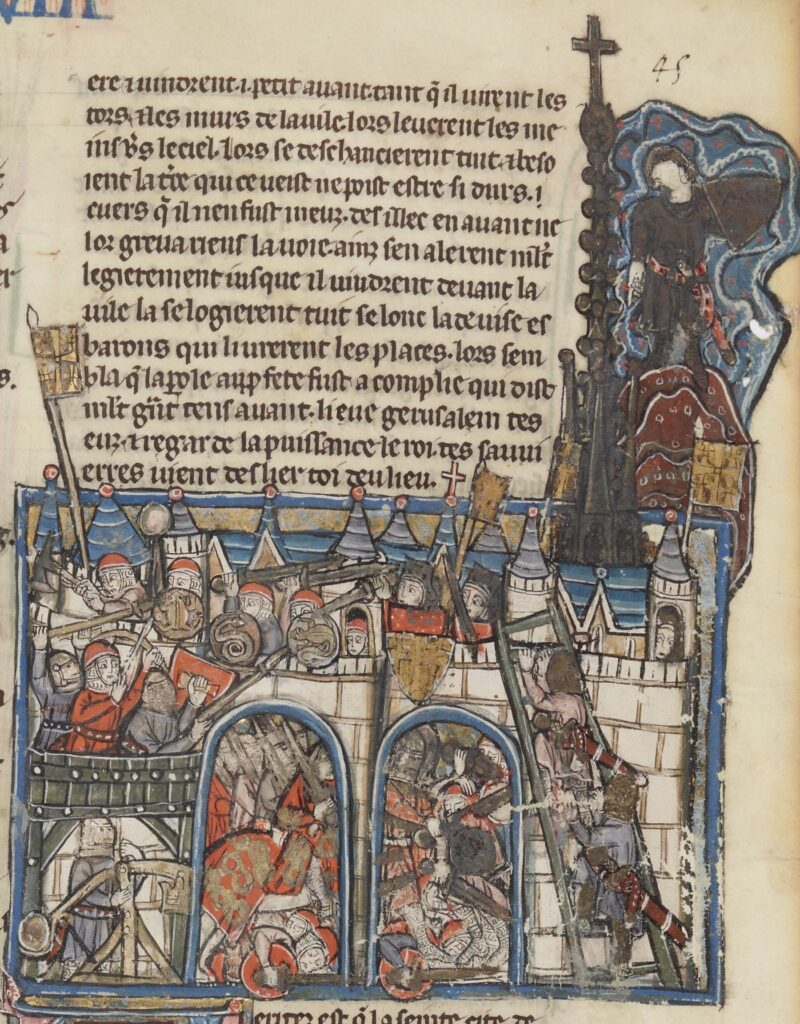
Read this part of the story ↓After a five-week siege the crusaders storm Jerusalem and massacre many of its Muslim and Jewish inhabitants. Death tolls in the sources range widely and are disputed.
Read this part of the story ↓Four Latin states take shape: Edessa, Antioch, the Kingdom of Jerusalem and Tripoli. Italian fleets help take the coast in exchange for trading quarters.
← Led here July 15, 1099 Crusaders take Jerusalem 1097–1098 Nicaea, Dorylaeum and the siege of AntiochRead this part of the story ↓The Hospitallers win papal recognition (1113), and the Templars form around 1120 to protect pilgrims, gaining papal approval at the Council of Troyes in 1129. Monks who fight become the backbone of Crusader defense.
← Led here 1098–1109 The Crusader statesRead this part of the story ↓Zengi, the Turkish ruler of Mosul and Aleppo, captures Edessa, the first Crusader state to fall. Muslim writers celebrate it as the start of a counter-crusade.
← Led here 1098–1109 The Crusader statesLed to → 1147–1149 The Second Crusade failsRead this part of the story ↓Preached by Bernard of Clairvaux and led by Louis VII of France and Conrad III of Germany, the crusade is mauled in Anatolia and abandons a four-day siege of Damascus in 1148.
← Led here 1144 Zengi takes EdessaRead this part of the story ↓Nur al-Din takes Damascus (1154). His Kurdish officer Saladin becomes vizier of Egypt (1169), ends the Fatimid caliphate (1171) and unites Egypt and Syria, surrounding the Kingdom of Jerusalem.
← Led here 1147–1149 The Second Crusade failsRead this part of the story ↓Saladin destroys the Crusader field army at Hattin on July 4, 1187. Jerusalem surrenders on October 2 after negotiations, with ransoms instead of a massacre.
← Led here 1169–1186 Saladin unites Egypt and SyriaLed to → 1189–1192 The Third CrusadeRead this part of the story ↓Frederick Barbarossa drowns on the way. Richard I of England and Philip II of France retake Acre (1191). Richard wins at Arsuf but never takes Jerusalem; the Treaty of Jaffa (1192) leaves the coast to the Franks and lets pilgrims visit Jerusalem.
← Led here 1187 Hattin, and Jerusalem falls to SaladinRead this part of the story ↓Deep in debt to Venice, the crusaders attack Christian Zara (1202), then Constantinople. They sack the city in April 1204 and set up a Latin Empire that lasts until 1261.
Led to → 1212 The "Children's Crusade" 1453 Constantinople falls to the Ottomans 1898–2001 Modern memory and rhetoricRead this part of the story ↓Bands of young people and the poor in France and Germany set out to free Jerusalem. They never reach the East. Most of the famous details come from later legend.
Read this part of the story ↓The Fifth Crusade takes the Egyptian port of Damietta (1219) but loses it in 1221. Emperor Frederick II then wins Jerusalem back by treaty in 1229, without a battle.
← Led here 1189–1192 The Third CrusadeLed to → 1244 Jerusalem is lost for goodRead this part of the story ↓Khwarazmian troops allied to Egypt sack Jerusalem in 1244. Months later a Crusader-Syrian army is crushed at La Forbie. Jerusalem stays in Muslim hands until 1917.
← Led here 1217–1229 The Fifth and Sixth CrusadesLed to → 1248–1270 Louis IX's crusadesRead this part of the story ↓King Louis IX of France is captured in Egypt (1250) and ransomed. He dies at Tunis in 1270 on a second crusade.
← Led here 1244 Jerusalem is lost for goodLed to → 1250–1268 The Mamluks riseRead this part of the story ↓Slave-soldiers seize power in Egypt (1250), defeat the Mongols at Ayn Jalut (1260) and under Sultan Baybars take Antioch (1268).
← Led here 1248–1270 Louis IX's crusadesLed to → May 18, 1291 The fall of AcreRead this part of the story ↓The Mamluk sultan al-Ashraf Khalil takes Acre, the last major Crusader city. The remaining coastal towns are abandoned within months. The Crusader states are gone.
← Led here 1250–1268 The Mamluks riseLed to → 1898–2001 Modern memory and rhetoricRead this part of the story ↓- Other crusades1147–1410
Crusades against pagan Wends, Livonians, Prussians and Lithuanians build a state for the Teutonic Order on the Baltic. Lithuania's ruler accepts Christianity in 1386; the order is defeated at Grunwald in 1410.
Read this part of the story ↓Innocent III proclaims a crusade against the Cathar heretics of southern France. It turns into a long war of conquest, beginning with the massacre at Béziers (1209).
Read this part of the story ↓- Aftermath and memory1291–today
Weakened since 1204, Byzantium falls when the Ottoman sultan Mehmed II takes Constantinople on May 29, 1453.
Read this part of the story ↓Ferdinand and Isabella take Granada, the last Muslim state in Spain. Crusade bulls and taxes had helped pay for the war.
← Led here 1064–1085 The Reconquista gathers paceRead this part of the story ↓Kaiser Wilhelm II honors Saladin's tomb in Damascus (1898). Arab writers revive the term "the Crusader wars." In 2001 Pope John Paul II voices regret for the 1204 sack, and the word "crusade" becomes a charged term in modern politics.
← Led here May 18, 1291 The fall of Acre 1202–1204 The Fourth Crusade sacks Constantinople July 15, 1099 Crusaders take JerusalemRead this part of the story ↓
51 events. Dates follow standard scholarship; “c.” means approximate.
Roots: Jesus, the early church and Jerusalem
The story begins with a death in Jerusalem. Jesus of Nazareth was crucified there around AD 30–33 on the orders of the Roman prefect Pontius Pilate. His followers proclaimed that he had risen from the dead, and the first Christian community formed in the city under his disciples (Britannica, Jesus). From then on, Jerusalem was not just a city to Christians. It was the place where, in their belief, God had entered history.
- The faith spreads. Paul of Tarsus, a convert, made missionary journeys around the eastern Mediterranean from about AD 46 to 57, founding churches among non-Jews in Asia Minor and Greece. His letters are the oldest Christian writings (Britannica, Saint Paul).
- Jerusalem is destroyed and renamed. Rome crushed a Jewish revolt and destroyed the Temple in AD 70. After a second revolt, Emperor Hadrian refounded the city as Aelia Capitolina around 135. According to the historian Eusebius, a pagan temple was built over the spot Christians remembered as Jesus’s tomb (Britannica, Jerusalem).
- Persecution. Christians faced waves of persecution: Nero blamed them for Rome’s great fire in 64, Emperor Decius demanded empire-wide sacrifice in 250, and the Great Persecution began under Diocletian in 303. It ended with an edict of toleration in 311.
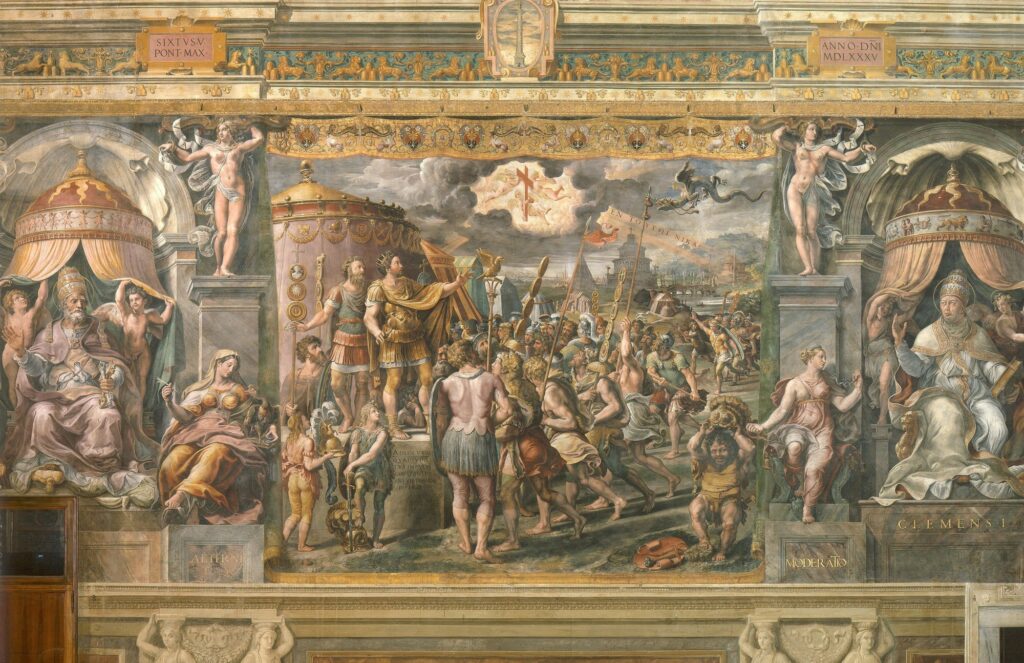
- Constantine changes everything. After winning the Battle of the Milvian Bridge in 312, Constantine agreed with his co-emperor Licinius in 313 on a policy, known as the Edict of Milan, that granted Christians freedom of worship and returned confiscated property (text of the Edict of Milan, via Lactantius; Britannica, Edict of Milan).
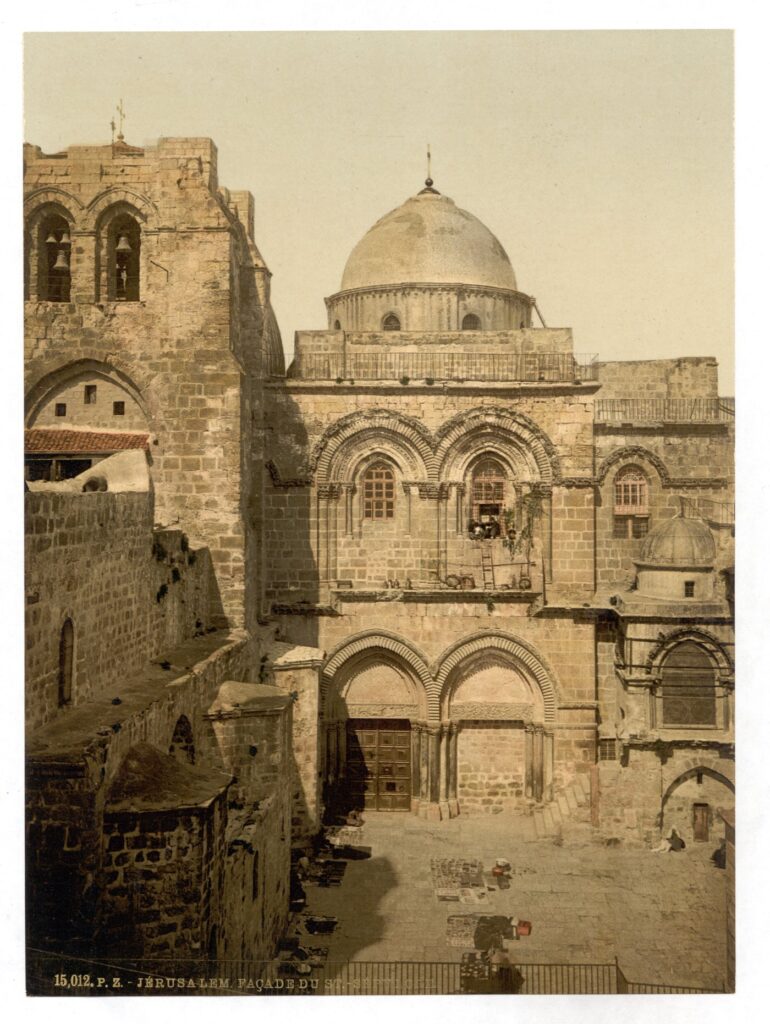
- The Holy Sepulchre. Constantine had the pagan temple in Jerusalem torn down and a great church built over the traditional site of the crucifixion and tomb. His mother Helena traveled to the Holy Land in the same years. The Church of the Holy Sepulchre was dedicated in 335 (Britannica, Church of the Holy Sepulchre).
- A Christian empire. In 380 the Edict of Thessalonica, issued under Theodosius I, made Nicene Christianity the official religion of the Roman Empire (Theodosian Code, Book 16; Britannica, Theodosius I). The eastern half of that empire, ruled from Constantinople, is what historians later called the Byzantine Empire. Its people called themselves Romans.
- Pilgrimage takes root. A traveler known as the Bordeaux Pilgrim left a record of a journey to Jerusalem in 333, and a woman named Egeria described the city’s churches and liturgy around 381–384. Pilgrimage to the places of Jesus’s life became one of the central devotions of Christianity, and later a recognized way of doing penance for sin.
- The first great loss. In 614 the Persian Sasanian empire captured Jerusalem and carried off the relic believed to be the True Cross. Emperor Heraclius defeated Persia and returned the relic to Jerusalem in 630 (Britannica, Heraclius). The decades-long war left both empires drained, just before a new power appeared from Arabia.
✅ Confirmed  Factual Lean note: Dates from Britannica and the primary texts linked. The resurrection is a matter of faith; the crucifixion under Pilate is accepted by historians across the spectrum.
The rise of Islam and the great conquests
Muhammad began preaching in Mecca around 610, moved with his followers to Medina in 622 and, by his death in 632, had united much of Arabia under Islam (Britannica, Muhammad). Jerusalem had a place in the new faith too: it was the first direction of Muslim prayer and is associated with Muhammad’s Night Journey.
What followed was one of the fastest expansions in history. Arab armies defeated the Byzantines at the Yarmuk River in 636, and Jerusalem surrendered to Caliph Umar around 637–638. Byzantine Egypt fell by about 642, Carthage in 698, and in 711 a force under Tariq ibn Ziyad crossed into Spain and brought down the Visigothic kingdom. A Frankish army under Charles Martel stopped a Muslim raid near Tours in 732. In the space of about a century, much of the old Christian heartland, including Jerusalem, Antioch, Alexandria and Carthage, had come under Muslim rule (Britannica, Crusades).
Life under the new rulers was not uniform persecution. Christians and Jews were generally allowed to keep their faith as dhimmi, protected communities that paid a special tax and lived under legal restrictions. Many churches kept operating for centuries, and Christian pilgrims kept coming. In 691–692 the Umayyad caliph Abd al-Malik completed the Dome of the Rock on the Temple Mount, which Muslims call the Haram al-Sharif. From then on, the same few acres of Jerusalem were holy to three faiths.
✅ Confirmed Factual Lean note: Conquest dates are standard across Britannica and the scholarship listed below. The terms of Jerusalem’s surrender to Umar survive only in later versions whose wording historians debate.
Four centuries of frontier
For the next 400 years, the line between Christian and Muslim powers moved back and forth.
- Constantinople holds. Arab forces besieged the Byzantine capital around 674–678 (historians debate how large and continuous that first siege was) and again in 717–718. Both failed. Byzantium became a frontier state fighting almost every year along its eastern border (Britannica, Byzantine Empire).
- Byzantium strikes back. In the 10th century the empire went on the offensive, retaking Crete in 961 and Antioch in 969.
- Spain. Small Christian kingdoms in the north of the Iberian Peninsula slowly pushed south in what Spaniards call the Reconquista. When Alfonso VI of Castile took Toledo in 1085, the old Visigothic capital, the advance looked unstoppable (Britannica, Reconquista). Popes had begun to treat fighting Muslims in Spain as spiritually meritorious, an idea that fed directly into crusading. Urban II later told Spanish knights to stay and fight at home rather than go east.
- 1009: the Holy Sepulchre destroyed. The Fatimid caliph al-Hakim, who ruled Egypt and Palestine and persecuted Christians and Jews in his later years, ordered the Church of the Holy Sepulchre demolished (Britannica, al-Hakim). His successors allowed rebuilding with Byzantine money, finished around 1048. Western chroniclers remembered the outrage. Historians debate how much it still weighed on minds 86 years later, at Clermont.
✅ Confirmed Factual Lean note: Britannica entries linked. Muslim rulers varied widely; al-Hakim’s persecution was an exception even by Fatimid standards, which Muslim historians also note.
Inside Europe: schism, reform and the Peace of God
At the same time, the Latin West was changing in ways that made a crusade possible.
- The Great Schism of 1054. A papal legate, Cardinal Humbert, and the patriarch of Constantinople, Michael Cerularius, excommunicated each other. Disputes over papal authority, the creed and church practice split Latin and Greek Christianity (Britannica, Schism of 1054). The break was not yet total in everyday life, and Urban II hoped helping Byzantium might heal it. Instead, mistrust between crusaders and Greeks grew with every expedition.
- Papal reform. A line of reforming popes, above all Gregory VII (1073–1085), claimed the right to discipline kings and appoint bishops, triggering the Investiture Controversy with the German emperor. In 1074 Gregory even proposed leading an army east himself to aid Christians against the Turks. It never happened, but the idea of a papal war was in place before Urban II (Britannica, Gregorian Reform).
- The Peace of God and the Truce of God. In a Europe with weak kings and many castle-holding knights, churchmen in France called councils from 975 onward to protect clergy, peasants, merchants and pilgrims from violence. The Truce of God, from 1027, banned fighting on certain days of the week and holy seasons. Britannica notes that the Peace movement also contributed to a “sacred militancy” that prepared the way for the Crusades (Britannica, Peace of God; Truce of God). At Clermont, Urban renewed the Truce of God before making his appeal.
- A warrior class looking for salvation. Knights lived by violence that the church taught was sinful. Penance, including long pilgrimages, was the remedy. A war that counted as penance offered a way to fight and be saved at once.
The spark: the Seljuks and the Byzantine appeal
The immediate trigger came from Central Asia. The Seljuk Turks, recent converts to Sunni Islam, entered Baghdad in 1055 and became the real power behind the Abbasid caliph (Britannica, Seljuq). They pressed west against both the Byzantines and the Shiite Fatimids of Egypt.
On August 26, 1071, the Seljuk sultan Alp Arslan defeated the Byzantine army at Manzikert in eastern Anatolia and captured Emperor Romanos IV Diogenes (Britannica, Battle of Manzikert). Many historians stress that the Byzantine civil wars after the battle did more damage than the battle itself: rival generals even hired Turkish troops, and within a decade Turkish rulers held Nicaea, less than 100 miles from Constantinople. Antioch fell in 1084–1085.
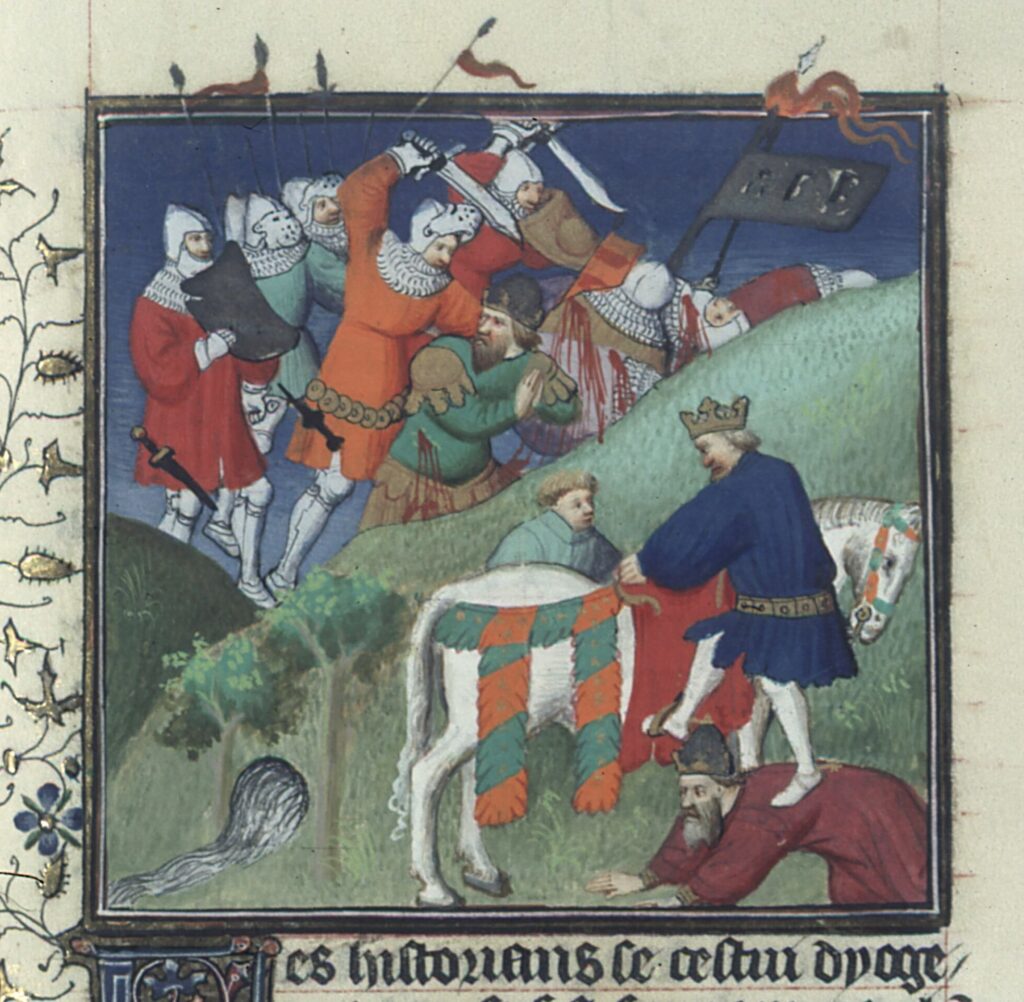
Jerusalem changed hands too. A Turkish commander, Atsiz, took it from the Fatimids around 1073, and the city passed among Turkish rulers until the Fatimids retook it in 1098, just a year before the crusaders arrived. Pilgrim routes became more dangerous and less predictable, though the dangers did not start with the Turks: in 1065 a large German pilgrimage led by bishops was attacked by Bedouin raiders near Ramla. How badly the Seljuks actually harassed pilgrims is debated. Western preachers, at any rate, told the story in the darkest terms.
In March 1095, envoys of Emperor Alexios I Komnenos appeared at Pope Urban II’s Council of Piacenza asking for help against the Turks (Britannica, Alexius I Comnenus). Alexios most likely wanted disciplined mercenary troops under his command to win back Asia Minor. What he got was very different. His daughter, Anna Komnene, later described the crusader armies with alarm in her history, the Alexiad (Fordham Medieval Sourcebook).
✅ Confirmed Factual Lean note: Britannica and primary sources. The scale of pilgrim harassment in the 1070s–1090s is debated among historians.
Clermont, 1095
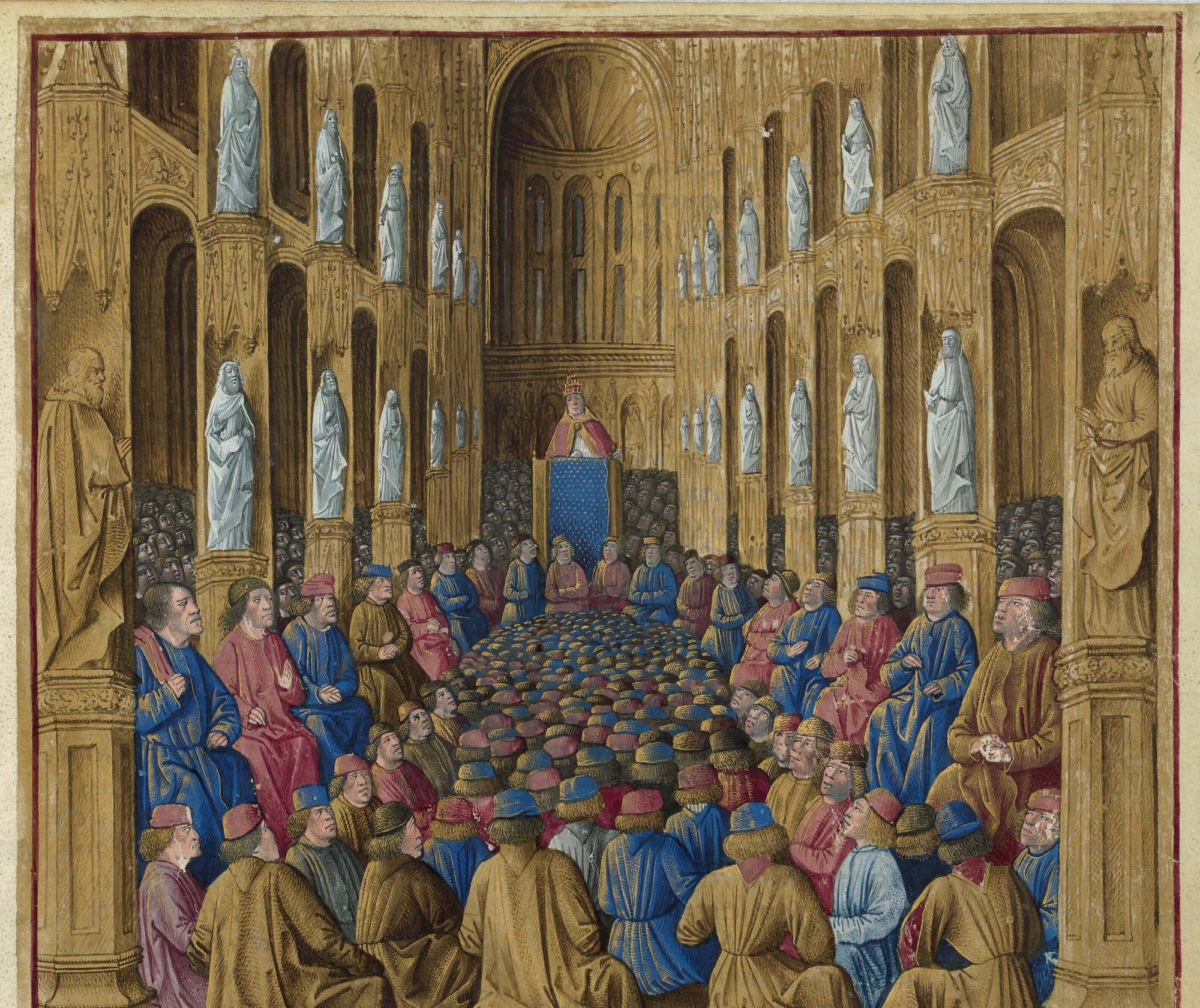
On November 27, 1095, at the end of a church council at Clermont in central France, Urban II preached in an open field to a crowd of clergy and knights (Britannica, Urban II). No transcript survives. We have five accounts written years later, after the crusade had succeeded, by chroniclers including Fulcher of Chartres, Robert the Monk, Baldric of Dol and Guibert of Nogent, and they differ in emphasis (Fordham, Urban II at Clermont: the versions).
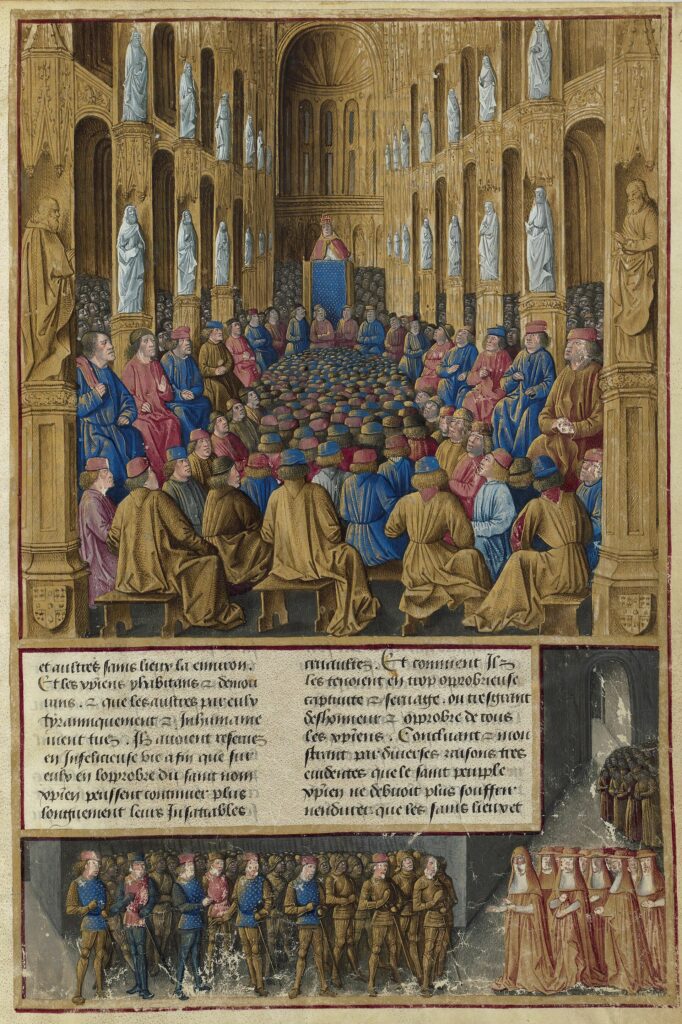
In Fulcher’s version, Urban urges Western Christians to help their brothers in the East and promises: “All who die by the way, whether by land or by sea, or in battle against the pagans, shall have immediate remission of sins.” Robert the Monk, writing about a decade later, adds that the crowd cried out, “It is the will of God! It is the will of God!” Urban’s own letters from the months after Clermont, which are closer to his actual words, talk of liberating the churches of the East and Jerusalem. The council itself decreed that going to Jerusalem out of devotion, not for honor or money, would count in place of all penance.
The response stunned everyone, possibly including Urban. Preachers carried the call across France, the Rhineland and Italy. Men sewed cloth crosses on their clothes and swore vows. Within a year, armies were moving.
✅ Confirmed Factual Lean note: Quotations from the Fordham Medieval Sourcebook translations. All versions of the speech were written after the fact, so its exact wording is unknown.
Why they went: motives and the debate
Why would thousands of people sell land, borrow money and walk 2,000 miles to fight? Historians have argued about it for two centuries. The main explanations:
| Motive | The evidence for it | The pushback |
|---|---|---|
| Religious: penance, pilgrimage, defending fellow Christians and the holy places | Charters written as crusaders left often state pious reasons. The indulgence was central to recruitment. Jonathan Riley-Smith’s studies of crusader families stress devotion, and Thomas Madden frames the Crusades as a response to centuries of Muslim conquest. | Piety and violence sat together uneasily. Critics note the massacres of Jews and civilians, and that “defense” is a stretch for wars fought 2,000 miles from home. |
| Political: papal power, Byzantine strategy, princes’ ambitions | Urban II gained prestige as leader of Western Christendom while a rival “antipope” claimed his office. Some leaders, such as Bohemond of Taranto and Baldwin of Boulogne, carved out principalities and stayed. Christopher Tyerman emphasizes the institutions and persuasion that built crusading. | Most leaders went home after 1099. Political gain alone does not explain why ordinary people joined. |
| Economic: land, loot, trade | Italian cities such as Venice, Genoa and Pisa won rich trading privileges. Some crusaders got wealthy. The older view held that landless younger sons went looking for estates. | Riley-Smith showed that crusading usually cost several times a knight’s yearly income, and families sold or mortgaged land to pay for it. Many crusaders were eldest sons and lords. Most came home poorer, if they came home at all. |
| Social: kinship, lordship, adventure, the warrior ethos | Crusading ran in families and followed lords: when a lord took the cross, his vassals often did too. The Peace of God movement had already tried to redirect knightly violence. | These explain how recruitment spread more than why the idea caught fire in the first place. |
Most current scholarship treats these as overlapping rather than competing: genuine religious conviction was the core for many participants, carried along by family ties, lordship and, for some, opportunity. Carole Hillenbrand adds an important corrective: in the Muslim world, the Franks were at first seen as one more invader among many, and the Crusades only became central to Muslim memory much later.
✅ Confirmed Factual Lean note: Summarized from Riley-Smith, Tyerman, Madden and Hillenbrand (see Further reading). Where scholars disagree, we show both views.
The First Crusade, 1096–1099
The first to leave were not the knights but popular bands following preachers like Peter the Hermit. This “People’s Crusade” reached Constantinople in 1096, was ferried across to Asia Minor and was wiped out by the Seljuks near Civetot in October 1096.
The main armies, led by princes including Godfrey of Bouillon, Raymond of Toulouse, Bohemond of Taranto and Robert of Normandy, gathered at Constantinople over the winter of 1096–1097 and swore oaths, with varying sincerity, to return former Byzantine lands to Alexios (Britannica, First Crusade).
- June 1097: Nicaea surrenders, to the Byzantines rather than the crusaders.
- July 1, 1097: The crusaders beat the Seljuk sultan Kilij Arslan at Dorylaeum.
- March 1098: Baldwin of Boulogne takes over Edessa, founding the first Crusader state.
- October 1097 to June 1098: The siege of Antioch. The city falls on June 3, 1098. Days later the crusaders are themselves besieged by a Muslim relief army under Kerbogha of Mosul, then break out and defeat it on June 28. Bohemond keeps Antioch for himself instead of returning it to Byzantium, a lasting grievance.
- July 15, 1099: After a five-week siege, Jerusalem falls.
What followed was a massacre. Fulcher of Chartres, who was not at Jerusalem but wrote from participants’ accounts, says of the Temple area: “In this temple almost ten thousand were killed. Indeed, if you had been there you would have seen our feet colored to our ankles with the blood of the slain” (Fordham, The Siege and Capture of Jerusalem: Collected Accounts). The Muslim historian Ibn al-Athir, writing more than a century later, put the dead at the al-Aqsa Mosque at more than 70,000. Modern historians treat both figures as exaggerations. Letters preserved in the Cairo Geniza show that some Jews and Muslims were taken captive and later ransomed rather than killed. Either way, the killing was on a scale that shocked contemporaries, and it became a defining memory in the Muslim world.
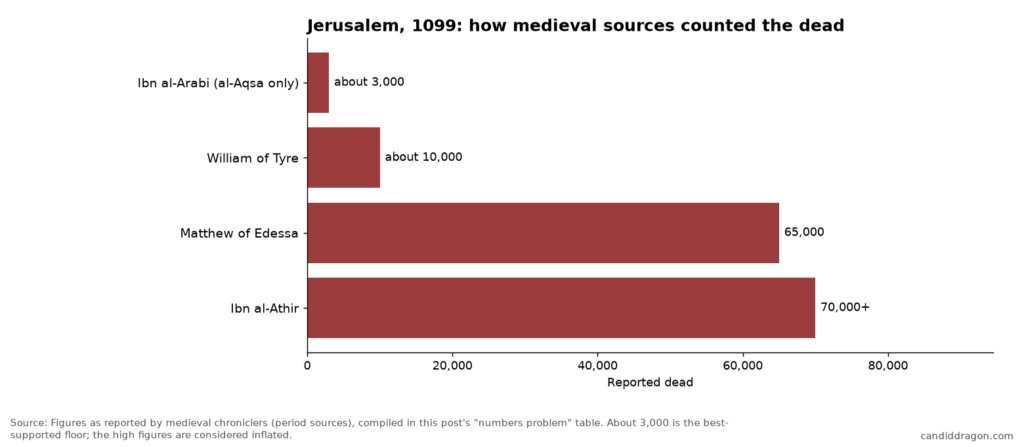
How many died at Jerusalem? The figures in the sources run from about 3,000 to more than 70,000, and every one is contested. William of Tyre, a Latin chronicler writing decades later, gives about 10,000; Matthew of Edessa, an Armenian chronicler, 65,000; Ibn al-Athir, a Muslim historian writing more than a century later, over 70,000 at al-Aqsa (World History Encyclopedia, The Capture of Jerusalem). The historian Benjamin Kedar drew attention to Ibn al-Arabi, a Spanish Muslim scholar who had been in Jerusalem shortly before the massacre and gave about 3,000 men and women killed in the al-Aqsa Mosque; Kedar argued that this source had no reason to play the toll down (Kedar, Crusades 3, 2004; discussed in Revista Chilena de Estudios Medievales). Other scholars warn that no source here rests on a count, and that even the 3,000 may be borrowed from another massacre (Sophia Historica). Military and civilian deaths cannot be separated: the crusaders killed defenders and townspeople alike.
The Jewish community. A letter written about nine months later by the Karaite Jewish elders of Ascalon, found in the Cairo Geniza, describes raising money to ransom Jewish captives from the Franks, captives dying of hunger and plague after release, and others who “were killed with all manner of torture out of sheer lust to murder before the eyes of others who were spared” (Goitein’s translation, transcribed at Historum; a victim community’s own account).
⚠️ Disputed Factual Lean note: The fact of the massacre is confirmed by Christian, Muslim and Jewish sources. The death toll is disputed, and every figure in the sources is likely inflated.
Ma’arra, December 1098: massacre and cannibalism
Seven months before Jerusalem, the crusaders under Raymond of Toulouse and Bohemond of Taranto stormed the Syrian town of Ma’arrat al-Nu’man on December 11, 1098, after a siege of about two weeks. Muslims who negotiated a surrender with Bohemond were killed anyway, and their women and children were sold as slaves (Wikipedia summary of the sources). The army was starving, and nearly a dozen Christian chronicles written within 20 years say crusaders ate the bodies of the dead. Fulcher of Chartres, a crusader chaplain, wrote that many “cut off pieces from the buttocks of the Saracens already dead there, which they cooked and chewed” (Medievalists.net). Ralph of Caen, who said he heard it from the men who did it, wrote that adults were boiled in pots and children roasted on spits (source).
- The toll: Ibn al-Athir, the Muslim chronicler writing a century later, claims more than 100,000 killed (not credible for a town this size); modern writers often give about 20,000, but there is no count (contested) (Wikipedia).
⚠️ Disputed Factual Lean note: The cannibalism is reported by Christian chroniclers themselves and one Arab source; the death toll is unknown.
The Rhineland massacres of 1096
The first mass killing of the crusade happened not in the East but in Germany. In May and June 1096, crusader bands, most notoriously one led by Count Emicho, attacked the Jewish communities of Speyer, Worms, Mainz and Cologne. The bishop of Speyer protected most of his city’s Jews; at Mainz, the archbishop’s protection collapsed. Faced with a choice between baptism and death, many Jews killed their own families and themselves rather than convert. The Hebrew chronicle of Solomon bar Samson, written about 1140, records these events as martyrdom (Fordham, Solomon bar Samson: The Crusaders in Mainz; Emicho and the Slaughter of the Rhineland Jews).
- Speyer, May 3, 1096: the bishop sheltered most of the Jews; 12 were killed (Wikipedia summary).
- Worms, May 18: crusaders and townspeople broke into the bishop’s palace where Jews had taken refuge. At least 800 Jews were killed for refusing baptism (Wikipedia summary).
- Mainz, May 27: Emicho’s men broke into the archbishop’s hall. The Christian chronicler Albert of Aachen (Albert of Aix) wrote that they attacked with arrows and lances, killed about 700 Jews, “killed the women, also, and with their swords pierced tender children of whatever age and sex,” and that mothers cut their own infants’ throats rather than see them taken (Fordham, Albert of Aachen). The Hebrew chronicle of Solomon bar Samson counts about 1,100 dead (Fordham, Solomon bar Samson; a Jewish chronicle written about 1140 as a martyrology).
- Cologne and Neuss: Albert writes that about 200 Jews who fled Cologne by boat were caught at Neuss and killed, “leaving not even one alive” (Fordham, Albert of Aachen).
- Who did it: crusader bands under Count Emicho and others, often joined by townspeople; the killers took the Jews’ money as plunder. All victims were civilians.
The church did not authorize the attacks, and later preachers condemned them. When a monk named Radulf stirred up anti-Jewish violence during the Second Crusade, Bernard of Clairvaux traveled to the Rhineland to stop him. But the pattern of crusade preaching turning into attacks on Jews repeated itself in 1146, in England in 1189–1190 and later. For European Jews, 1096 was a turning point.
✅ Confirmed Factual Lean note: Christian and Jewish chronicles agree on the attacks. Totals are uncertain: the Hebrew chronicles give about 1,100 dead at Mainz alone.
The Crusader states and the military orders
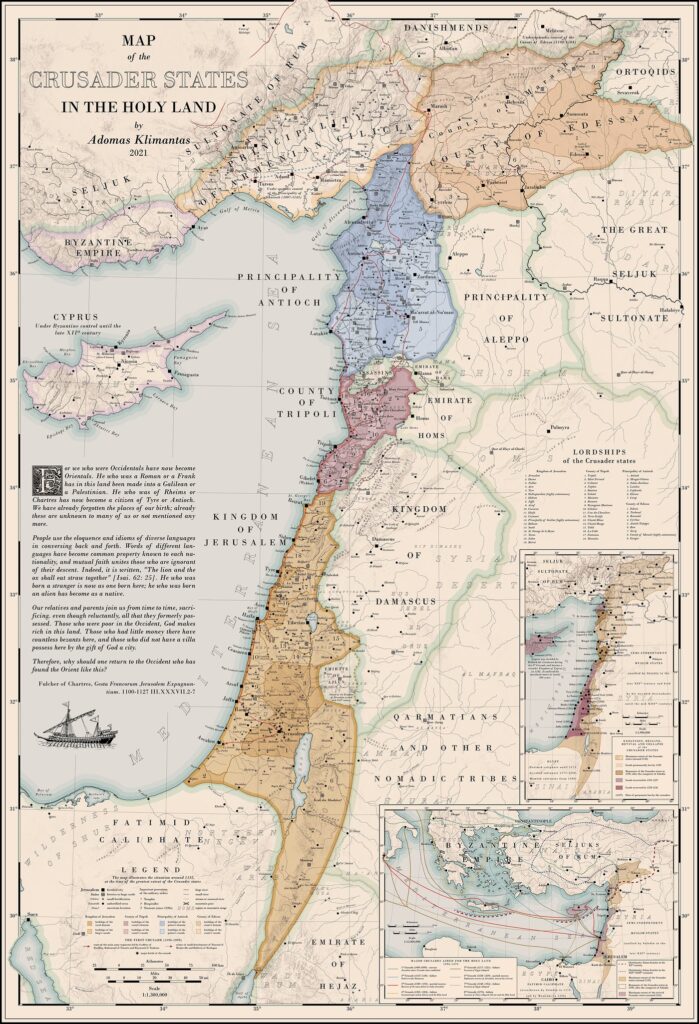
The victors set up four states, which Europeans called Outremer, “overseas”: the County of Edessa (1098), the Principality of Antioch (1098), the Kingdom of Jerusalem (1099) and the County of Tripoli (1109). Godfrey of Bouillon took the title Advocate of the Holy Sepulchre; his brother Baldwin became the first king of Jerusalem in 1100. Italian fleets helped take the coastal cities in exchange for their own quarters, courts and tax breaks in the ports.
The Franks were always a small minority ruling over a majority of local Christians, Muslims and Jews. Many native Christians, such as Syrian Orthodox and Armenians, lived under Frankish lords much as they had under Muslim ones. Usama ibn Munqidh, a Syrian Muslim nobleman, left a vivid memoir of Frankish neighbors, some of whom he found boorish and some of whom he befriended (Fordham, Usama ibn Munqidh).
Defending these states with so few settlers led to a new invention: monks who fought. The Hospitallers, originally a hospital for pilgrims, gained papal recognition in 1113. The Knights Templar formed around 1120 to protect pilgrims on the roads and won papal approval at the Council of Troyes in 1129 (Britannica, Templars). The military orders came to garrison many of the great castles and became rich landowners across Europe. For what happened to the Templars, see our separate piece, The Knights Templar: What Is Documented, and What Is Myth.
Edessa and the Second Crusade
The Muslim response was slow at first; the region was divided among rival Turkish lords, Arab dynasties and the Fatimids. But in 1105 a Damascus scholar, Ali ibn Tahir al-Sulami, was already preaching that the Franks must be met with jihad, according to Hillenbrand’s study of Muslim sources. In 1144, Zengi, the Turkish ruler of Mosul and Aleppo, captured Edessa, the first Crusader state to fall (Fordham, William of Tyre: The Fall of Edessa).
Bernard of Clairvaux preached a new crusade. Kings Louis VII of France and Conrad III of Germany led it, and both armies were badly mauled crossing Anatolia. In July 1148 the survivors besieged Damascus, a Muslim city that had sometimes allied with Jerusalem, and gave up after about four days (Britannica, Second Crusade). The failure discredited crusading for a generation. Zengi’s son Nur al-Din took Damascus in 1154, uniting Muslim Syria.
Saladin and Hattin
Saladin, a Kurdish officer in Nur al-Din’s service, became vizier of Egypt in 1169, ended the Shiite Fatimid caliphate in 1171 and, after Nur al-Din’s death, brought Damascus and Aleppo under his rule. For the first time, the Kingdom of Jerusalem faced a united Egypt and Syria (Britannica, Saladin).
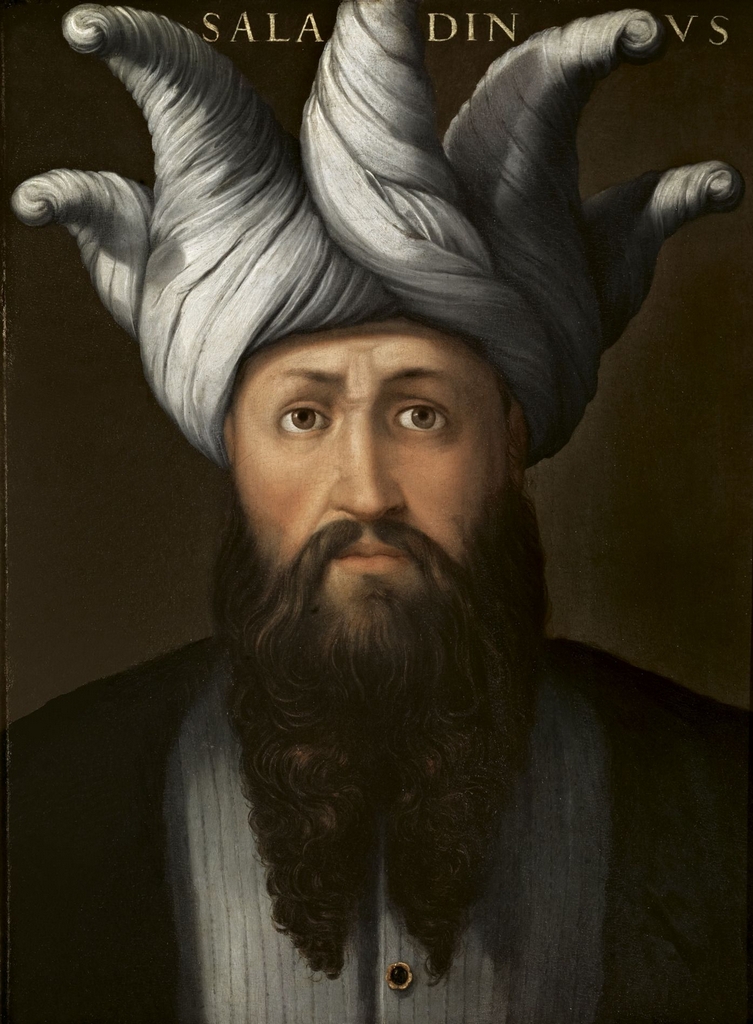
The kingdom, meanwhile, was divided by a succession crisis. A Frankish lord, Reynald of Châtillon, raided Muslim caravans in violation of truces. On July 4, 1187, Saladin trapped and destroyed the kingdom’s field army near the Horns of Hattin, west of the Sea of Galilee. King Guy was captured; Saladin personally killed Reynald and ordered the execution of the captured Templars and Hospitallers (Britannica, Battle of Hattin; Fordham, The Battle of Hattin).
The executions after Hattin. Saladin paid fifty dinars for each captured Templar and Hospitaller and had them beheaded, about 200 men in all, sparing only the Templar grand master (Wikipedia summary). His secretary, Imad al-Din, an eyewitness writing in praise of the sultan, described the scene: scholars, Sufis and ascetics each begged to kill one, “drew his sword and rolled back his sleeve,” while Saladin sat “his face joyful” on his dais; some cut cleanly, some refused, and some botched it and were replaced (translation quoted in BYU Studies). A Latin account records simply that the Templars and Hospitallers “were ransomed from the other Turks and were killed” (Fordham, The Battle of Hattin). Military deaths in the battle itself are unrecorded.
Jerusalem surrendered on October 2, 1187, after its defender, Balian of Ibelin, negotiated terms. Unlike 1099, there was no massacre: inhabitants could leave if they paid a ransom, and those who could not pay were enslaved (Fordham, The Capture of Jerusalem by Saladin). The contrast with 1099 is a big part of why Saladin was admired even by his enemies, and still is in the West as well as the Muslim world.
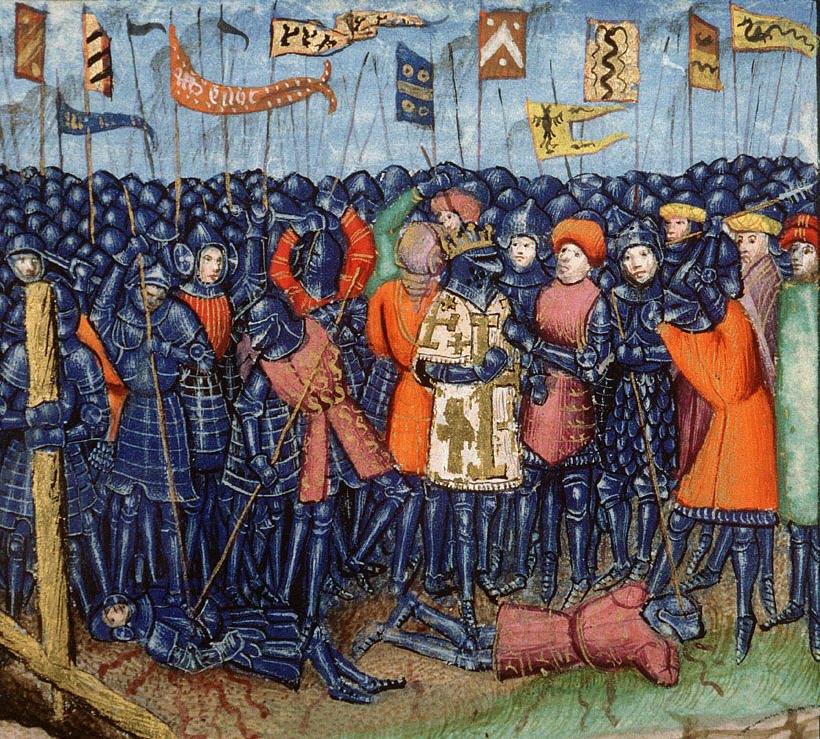
The Third Crusade: Richard and Saladin
The loss of Jerusalem launched the largest crusade yet. Emperor Frederick Barbarossa drowned crossing a river in Anatolia in 1190, and most of his army went home. Richard I of England and Philip II of France joined the long siege of Acre, which fell in July 1191 (Britannica, Third Crusade; Britannica, Richard I).
When ransom negotiations with Saladin stalled, Richard had his Muslim prisoners killed outside Acre on August 20, 1191. The English chronicle known as the Itinerarium gives the number as 2,700 (Fordham, Muslim Hostages Slain at Acre); Saladin’s biographer Baha al-Din gives a somewhat higher figure. Richard then defeated Saladin at Arsuf in September 1191 and twice advanced to within about 12 miles of Jerusalem, but judged that he could take it and not hold it. The Treaty of Jaffa in September 1192 left the coast from Tyre to Jaffa to the Franks and allowed Christian pilgrims to visit Jerusalem (Fordham, Richard Makes Peace with Saladin). Saladin died the next year. Richard never saw Jerusalem.
How it was done. The prisoners, the surrendered garrison of Acre, were led out bound to a hill called Ayyadieh, in sight of Saladin’s army, and beheaded. The Itinerarium says Richard’s men carried out the order “without delay” and “gave heartfelt thanks” for “taking vengeance in kind” (Fordham, Itinerarium; a Christian chronicle sympathetic to Richard). Baha al-Din, Saladin’s biographer, who was in the Muslim camp, gives a somewhat higher figure and says many crusaders themselves disapproved. Saladin answered by having Christian prisoners killed; in the following weeks, crusaders captured on the march to Jaffa were questioned and executed (Runciman, cited in Wikipedia). Range: about 2,700 to 3,000 killed; these were prisoners of war, not civilians.
✅ Confirmed Factual Lean note: Primary sources on both sides confirm the Acre executions; the exact number varies by source.
The Fourth Crusade and the sack of Constantinople
Pope Innocent III called a new crusade in 1198, aimed at Egypt. The crusaders contracted with Venice for a fleet sized for an army far larger than the one that showed up, and could not pay. To work off the debt, they attacked Zara on the Adriatic in 1202, a Christian city, and were excommunicated by the pope for it (Britannica, Fourth Crusade).
A Byzantine prince, Alexios Angelos, then offered money and troops if they would put him and his father on the throne in Constantinople. They did, in 1203. When he was overthrown and killed early in 1204 and the money never came, the crusaders stormed the city. For three days in April 1204, they looted the greatest Christian city in the world, stripping churches, killing civilians and carrying off relics and treasures, including the bronze horses now kept in St. Mark’s Basilica in Venice. The Byzantine historian Niketas Choniates, an eyewitness, described the sack in bitter detail (Fordham, Niketas Choniates on the sack).
What Choniates saw. Niketas Choniates, a senior Byzantine official who lived through the sack, describes the altar of Hagia Sophia broken to pieces and shared out among the soldiers, mules led into the sanctuary to carry off the loot and stabbed when they slipped on the pavement, a prostitute dancing on the patriarch’s throne, and in the streets “the groaning of men, the shrieks of women, wounds, rape, captivity.” He asks whether men who did this to God “could have spared the honorable matrons and maidens or the virgins consecrated to God” (Fordham, Choniates; an eyewitness victim, writing in grief and anger). An estimate often cited for civilian dead is about 2,000 (contested; no contemporary count) (Wikipedia summary). The killers were the crusader army and its Venetian allies, fellow Christians.
The crusaders set up a Latin Empire that lasted until the Byzantines retook the city in 1261 (Britannica, Latin Empire of Constantinople). Innocent III condemned the sack. Eight centuries later, in 2001, Pope John Paul II told the Orthodox archbishop of Athens: “I am thinking of the disastrous sack of the imperial city of Constantinople, which was for so long the bastion of Christianity in the East. It is tragic that the assailants, who had set out to secure free access for Christians to the Holy Land, turned against their own brothers in the faith” (Vatican, May 4, 2001).
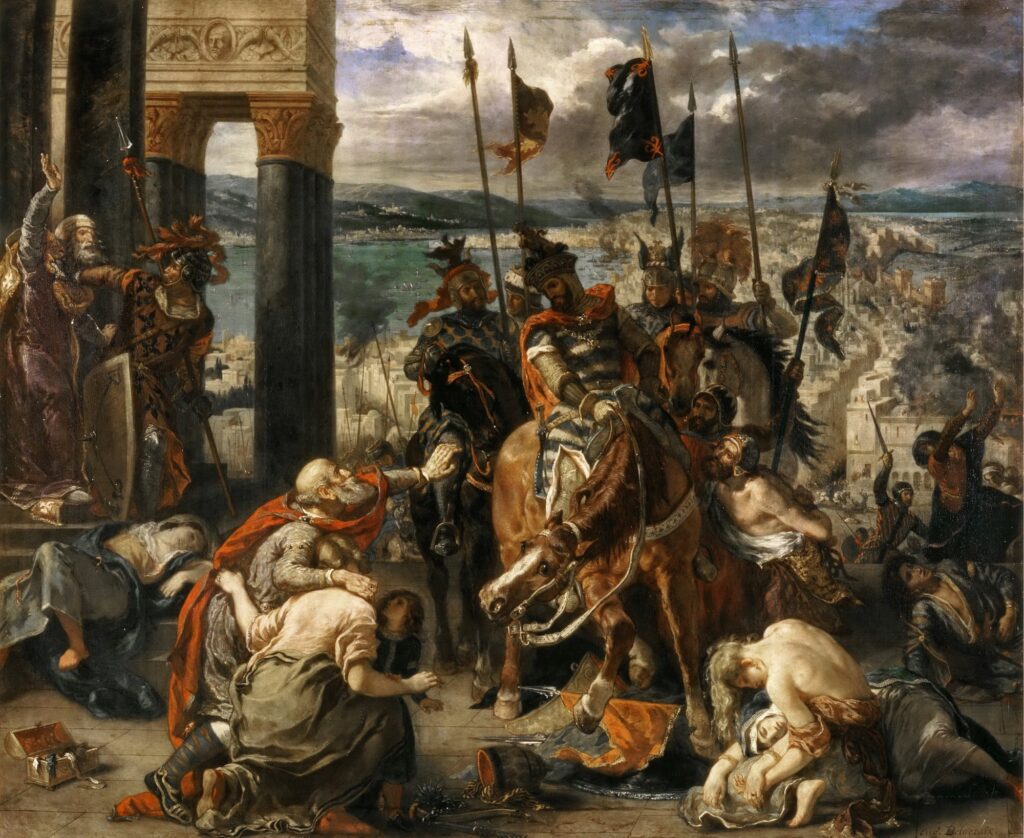
✅ Confirmed Factual Lean note: Britannica, an eyewitness Byzantine account and the Vatican’s published text of the 2001 address.
The “Children’s Crusade”: myth and record
Everyone has heard that in 1212 thousands of children marched off to free Jerusalem and were sold into slavery. The record is more modest. Two separate movements did start that year, one in the Rhineland led by a youth named Nicholas and one in northern France associated with a shepherd boy named Stephen. A Cologne chronicle describes “many thousands of boys, ranging in age from six years to full maturity” setting out “without anyone having preached or called for it” (Fordham, Cologne Chronicle).
Historians such as Peter Raedts and Gary Dickson point out that the Latin word the chroniclers used, pueri, could mean poor or low-status young people, not only children, and that many marchers were adolescents, adults and the rural poor. The German group crossed the Alps and broke up in Italy; the French one seems to have dispersed. The famous story of children shipped from Marseille and sold into slavery in Egypt comes from a chronicle written decades later and cannot be confirmed (Britannica, Children’s Crusade).
⚠️ Disputed Factual Lean note: The 1212 movements are documented. The popular version, with children sold as slaves, rests on later and unreliable accounts.
The later crusades
The numbering of the crusades is a later convention, and historians do not agree on it. After 1204, the main expeditions to the East were:
- Fifth Crusade (1217–1221): Aimed at Egypt, it took the port of Damietta in 1219, refused a sultan’s offer to trade it for Jerusalem, and lost it in 1221 (Britannica, Fifth Crusade).
- Sixth Crusade (1228–1229): Emperor Frederick II, under excommunication at the time, negotiated with Sultan al-Kamil and got Jerusalem back by treaty in 1229 without a battle, with the Temple Mount left in Muslim hands (Britannica, Sixth Crusade). Critics on both sides were furious.
- 1244: Khwarazmian troops allied to Egypt sacked Jerusalem. Months later the Franks and their Syrian Muslim allies were crushed at La Forbie. Jerusalem stayed under Muslim rule until British forces entered it in 1917.
- Louis IX of France invaded Egypt in 1248, was captured in 1250 and ransomed. He died at Tunis in 1270 on a second expedition.
- The Mamluks. In 1250 slave-soldiers seized power in Egypt. In 1260 they defeated the Mongols at Ayn Jalut, and under Sultan Baybars they took Crusader castles and cities one after another, including Antioch in 1268 (Britannica, Mamluk). Antioch, May 1268: Baybars’s troops climbed the walls on May 18 and sacked the city for days. A letter to Bohemond VI, written for Baybars by his secretary Ibn Abd al-Zahir to taunt the absent prince, boasts of “thy knights trampled under the feet of the horses,” “the wives of thy subjects put to public sale,” and monks, priests and deacons slaughtered in the sanctuary (Ballandalus; the victor’s own propaganda). The Muslim chronicler Ibn al-Furat says every man in the city was put to the sword, “more than a hundred thousand” (not credible). The figure most often repeated, from the 19th-century historian Joseph Michaud, is 17,000 killed and 100,000 taken as slaves, with captured boys selling for 12 dirhems and girls for 5 (Wikipedia summary). Contested: specialists treat the sources’ numbers as very high and probably exaggerated (Crusades Research Atlas). Antioch’s churches were burned and the city never recovered.
The fall of Acre, 1291
In April 1291 the Mamluk sultan al-Ashraf Khalil besieged Acre, the capital of what remained of the Kingdom of Jerusalem. The city fell on May 18. Templars held out in their fortress for some days more. Tyre, Sidon and Beirut were given up within months, and the Crusader states on the mainland ceased to exist (Fordham, Ludolph of Suchem: The Fall of Acre; Britannica, Acre).
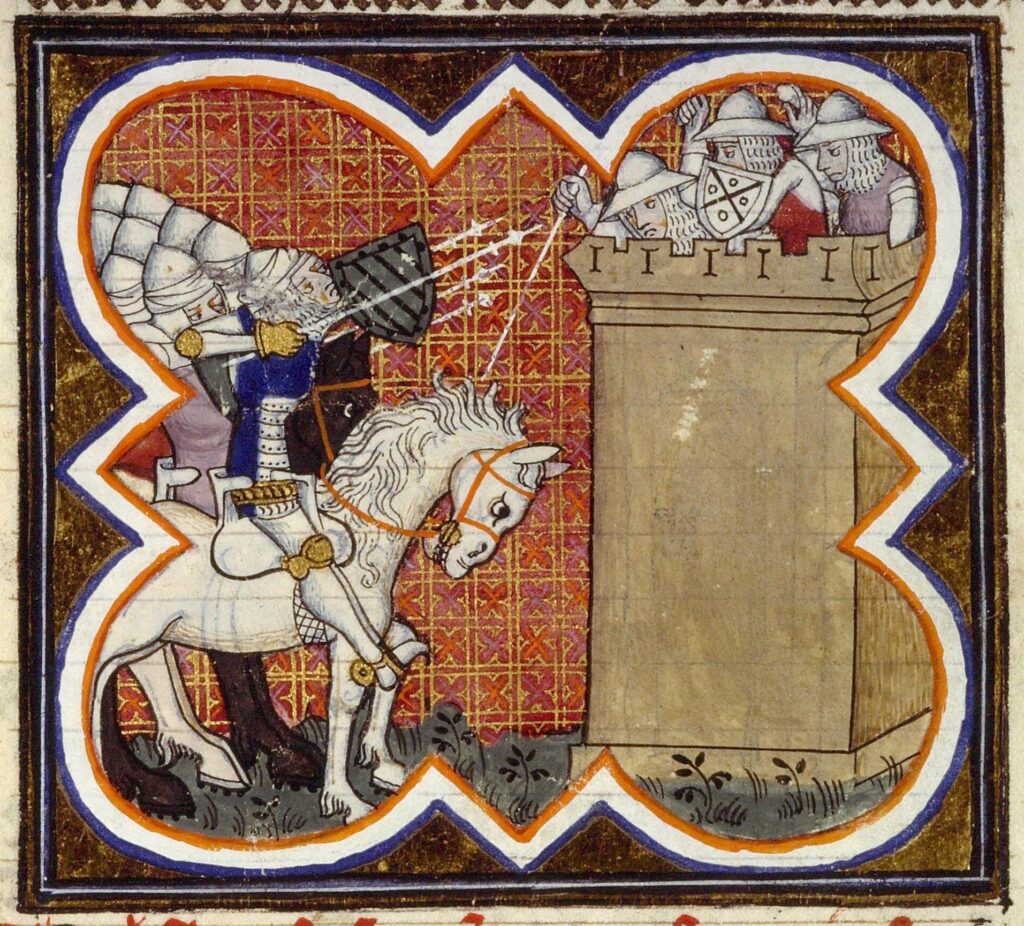
Crusades beyond the Holy Land
Once the church had created the idea of a holy war with spiritual rewards, it used it elsewhere.
- The Northern Crusades (from 1147): Crusades against the pagan Wends, Livonians, Prussians and Lithuanians around the Baltic. The Teutonic Order, founded in the Holy Land, built a powerful state in Prussia and Livonia. Lithuania’s ruler accepted Christianity in 1386, and the order’s defeat at Grunwald (Tannenberg) in 1410 ended its expansion (Britannica, Teutonic Order).
- The Albigensian Crusade (1209–1229): Innocent III proclaimed a crusade against the Cathars, a dualist Christian sect in southern France, after the murder of a papal legate. It opened with the sack and massacre of Béziers in 1209 and became a war of conquest by northern French lords. The famous line “Kill them all; God will know his own” was attributed to a papal legate by a German monk writing years later and may never have been said (Britannica, Albigensian Crusade). The war helped give rise to the medieval Inquisition. Béziers, July 22, 1209: when the townspeople refused to hand over some 222 named heretics, a sortie went wrong, camp followers broke in, and the town was taken in hours. Catholics and Cathars were killed together in the streets and in the churches where they sheltered, and the town was burned. The legates Arnaud Amalric and Milo wrote to the pope that “our men,” sparing no rank, sex or age, put almost 20,000 to the sword (the victors’ own boast); the chronicler Peter of Vaux-de-Cernay, a crusade partisan, says 7,000 were killed in the church of the Madeleine alone. The town probably had no more than about 14,500 people, and modern historians’ estimates of the dead run from several hundred to at most about half the population (contested) (French Wikipedia, citing Roquebert and Berlioz).
- Spain and beyond: Crusade privileges supported the Reconquista until Granada fell in 1492. Later crusades fought the Ottoman Turks in the Balkans and at sea, as at Nicopolis (1396) and Lepanto (1571).
Two sides, in their own words
The Christian view at the time. To the crusaders, they were armed pilgrims recovering land that had been Christian before the Muslim conquests, defending fellow Christians and doing penance. Contemporary writers like Fulcher of Chartres saw the capture of Jerusalem as a miracle. The violence was celebrated as righteous, which modern readers find disturbing, but which shows how the participants understood it.
The Muslim view at the time. Arab chroniclers such as Ibn al-Qalanisi of Damascus and later Ibn al-Athir called the invaders al-Ifranj, the Franks, and treated them as one enemy among several. Ibn al-Athir placed the Frankish attack within a wider pattern of Christian advances in Spain and Sicily. Carole Hillenbrand’s The Crusades: Islamic Perspectives shows how Muslim leaders from Zengi to Saladin and Baybars revived jihad as a rallying cry and how the recovery of Jerusalem became a sacred goal. To most Muslims of the time, the Mongol invasions, which destroyed Baghdad in 1258, were the greater catastrophe.
The Eastern Christian view. Byzantines like Anna Komnene saw the crusaders as useful but dangerous and uncouth. After 1204, they saw them as plunderers. Many eastern Christians, including Armenians, Syriacs and Maronites, cooperated with the Franks at different times, and others preferred Muslim rule to Latin rule.
The Jewish view. For Jewish communities in Europe and in Jerusalem, both the 1096 massacres and the 1099 sack were catastrophes, remembered in Hebrew chronicles and liturgy.
What the Crusades changed
On Byzantium
The crusaders did help Alexios recover western Asia Minor in 1097. But the long result was ruin. The sack of 1204 broke the empire into rival successor states, emptied its treasury and deepened the Greek-Latin split far beyond what 1054 had done. The restored empire after 1261 was a shadow of its former self, and the Ottoman Turks took Constantinople on May 29, 1453.
On Europe
- Trade and the Italian cities. Venice, Genoa and Pisa gained quarters and privileges in Levantine ports and grew rich on Mediterranean trade. Historians caution against crediting the Crusades with “opening” Europe to the East: much exchange of goods and learning ran through Spain, Sicily and Byzantium regardless.
- Military orders. The Templars, Hospitallers and Teutonic Knights became international institutions with land, castles and banking operations. The Templars were destroyed by the French crown in 1307–1314; the Hospitallers survive today as the Order of Malta.
- Money and the state. Paying for crusades drove new taxes, such as the Saladin Tithe of 1188 in England and France, and new ways of moving money across borders.
- Church power and the indulgence. Crusading strengthened papal leadership for a time and developed the system of indulgences that Martin Luther would attack in 1517.
- Holy war as a tool. The crusade model was turned against heretics, pagans and the popes’ political enemies, as in the Albigensian Crusade.
On the Islamic world
The Crusades helped push the Muslim Near East from fragmentation toward unity, first under Zengi, Nur al-Din and Saladin, then under the Mamluk sultans, who ruled Egypt and Syria until 1517. Revived jihad ideology and anti-Frankish feeling hardened attitudes toward local Christians in some places. Hillenbrand notes that medieval Muslim writers did not see the Crusades as a single unified episode at all. The Arabic term for “the Crusader wars,” al-hurub al-salibiyya, became common only in the 19th century.
On Jewish communities
Beginning with the Rhineland massacres of 1096, crusade preaching was repeatedly followed by violence against Jews in Europe. The killings of 1096 were remembered as a turning point in Jewish memory, and in Jerusalem in 1099 the Jewish community was killed or taken captive along with the Muslims.
Memory and modern rhetoric
The Crusades are still used as political shorthand, often with little connection to the history.
- In 1898 Kaiser Wilhelm II of Germany visited Saladin’s tomb in Damascus and paid for a new marble sarcophagus, part of a 19th-century revival of Saladin’s reputation in both Europe and the Arab world.
- Arab nationalist and Islamist writers in the 20th century often described European colonialism, and later Israel, as a new crusade. Osama bin Laden’s 1998 declaration was issued in the name of a “World Islamic Front for Jihad Against Jews and Crusaders” (text via Federation of American Scientists).
- On September 16, 2001, President George W. Bush said, “This crusade, this war on terrorism is going to take a while” (White House archive). The remark drew wide criticism, especially in the Muslim world, for echoing the medieval wars, and the word largely disappeared from administration statements.
- In the West, the Crusades have been portrayed in turn as noble chivalry, as greed in religious clothing and as an early case of Western imperialism. Each of those portraits picks some facts and drops others.
✅ Confirmed Factual Lean note: Quoted words come from the official White House archive and the published text of the 1998 statement.
The numbers problem
Medieval chroniclers used numbers to impress, not to count. Treat every army size and death toll from the period with caution.
| Event | What the sources say | Who died | How historians treat it |
|---|---|---|---|
| Rhineland, 1096 (crusaders vs. Jews) | Albert of Aachen: ~700 at Mainz. Hebrew chronicle: ~1,100 at Mainz. At least 800 at Worms; 12 at Speyer; ~200 at Neuss. | Civilians | Plausible; regional totals uncertain. |
| Ma’arra, 1098 (crusaders vs. Muslims) | Ibn al-Athir: 100,000+. Modern writers: often ~20,000. | Mostly civilians | No count exists; Ibn al-Athir’s figure is not credible. |
| Jerusalem, 1099 (crusaders vs. Muslims and Jews) | Ibn al-Arabi: ~3,000 at al-Aqsa. William of Tyre: ~10,000. Matthew of Edessa: 65,000. Ibn al-Athir: 70,000+. | Defenders and civilians together | A large massacre is certain; ~3,000 is the best-supported floor; the high figures are inflated. |
| Hattin, 1187 (Saladin vs. military orders) | ~200 Templars and Hospitallers beheaded after the battle. | Prisoners of war | Confirmed by Muslim and Christian sources. |
| Acre, 1191 (Richard vs. Muslim prisoners) | Itinerarium: 2,700. Baha al-Din: ~3,000. | Prisoners of war | Confirmed by both sides; the count is close. |
| Constantinople, 1204 (crusaders vs. Byzantines) | Often-cited modern estimate: ~2,000 civilians. | Civilians | Contested; no contemporary count. Rape and plunder are attested by eyewitnesses. |
| Béziers, 1209 (crusaders vs. townspeople) | Legates: ~20,000. Peter of Vaux-de-Cernay: 7,000 in one church. | Civilians | Both inflated; town had ≤14,500 people. Modern range: several hundred to about half the town. |
| Antioch, 1268 (Mamluks vs. Christians) | Michaud: 17,000 killed, 100,000 enslaved. Ibn al-Furat: 100,000+ killed. | Mostly civilians | Probably exaggerated; tens of thousands killed or enslaved is the cautious reading. |
| Crusade armies | Chroniclers often claim hundreds of thousands for the First Crusade. | — | Modern estimates are far lower, and differ by historian. |
Why it matters
The Crusades are still argued over as if one side were the butcher and the other the victim. The record does not allow that. Crusaders slaughtered Jews in Germany, Muslims and Jews in Syria and Jerusalem, Catholics in southern France and Orthodox Christians in Constantinople. Saladin, admired for sparing Jerusalem, had captured knights beheaded as a spectacle, and the Mamluks emptied Antioch by the sword and the slave market. Knowing who killed whom, how, and how uncertain the numbers are is the only defense against anyone who borrows this history for a slogan.
Patterns to recognize (analysis)
Analysis and opinion. Tactics from the Crusades, on every side, that are worth recognizing anywhere:
- Sacred framing of violence: promising spiritual reward for killing.
- Turning on minorities at home on the way to fight an enemy abroad.
- Inflating the enemy’s dead to glorify victory or deepen grievance.
- Killing prisoners once they become an inconvenience.
- Mission drift: a force raised for one cause turned against allies for money or advantage.
- Atrocity stories used to recruit, whether true, exaggerated or invented.
These are general warning signs drawn from the history above. They describe tactics, not any modern party or person.
Our view (opinion)
Opinion. Everything above is sourced fact. This section is our judgment, and readers may weigh it differently.
Cause and effect is the right way to read the Crusades, because both of the popular versions cut the chain in half. One version starts the story in 1095, so the Crusades look like unprovoked aggression; it skips four centuries in which Christian lands from Syria to Spain were conquered, and the Seljuk advance that brought the Turks within sight of Constantinople. The other version stops the story at Clermont, so the Crusades look purely defensive; it skips the massacres of Jews in the Rhineland and civilians in Jerusalem, the sack of a Christian capital in 1204, and the use of crusading against fellow Europeans.
In our view, the participants were mostly sincere, the causes were real, and the results were often terrible, including for the people the Crusades were supposed to help. Byzantium, the empire that asked for help, was the biggest loser. That is a story about how wars escape the control of the people who start them, and it is worth knowing in full before anyone borrows the word “crusade” for an argument today.
What we could not verify
- The exact words of Urban II at Clermont. Every version was written after the fact.
- Reliable death tolls for almost any event in this story. See the numbers table above.
- The number of Christians enslaved when Saladin took Jerusalem in 1187, and the size of Saladin’s reprisal killings after Acre.
- The death toll at Constantinople in 1204 and at Antioch in 1268; the figures in circulation are later estimates or victors’ boasts.
- How serious the threat to pilgrims was in the 1070s–1090s. Western sources stress it; some historians think they exaggerated it to justify the crusade.
- The details of the 1212 “Children’s Crusade” beyond the basic outline.
Further reading
Books by the scholars whose work this piece draws on, for readers who want to go deeper:
- Jonathan Riley-Smith, The Crusades: A History (3rd ed., Bloomsbury, 2014) and The First Crusaders, 1095–1131 (Cambridge, 1997).
- Christopher Tyerman, God’s War: A New History of the Crusades (Harvard, 2006).
- Thomas F. Madden, The Concise History of the Crusades (3rd ed., Rowman & Littlefield, 2014).
- Carole Hillenbrand, The Crusades: Islamic Perspectives (Edinburgh, 1999).
- D. S. Richards, trans., The Chronicle of Ibn al-Athir for the Crusading Period (Ashgate, 2006–2008).
- Fulcher of Chartres, A History of the Expedition to Jerusalem, 1095–1127, trans. Frances Rita Ryan (Tennessee, 1969).
- Gary Dickson, The Children’s Crusade: Medieval History, Modern Mythistory (Palgrave, 2008).
Sources
- Britannica, Crusades (Factual)
- Britannica, First Crusade (Factual)
- Britannica, Second Crusade (Factual)
- Britannica, Third Crusade (Factual)
- Britannica, Fourth Crusade (Factual)
- Britannica, Children’s Crusade (Factual)
- Britannica, Albigensian Crusade (Factual)
- Britannica, Battle of Manzikert (Factual)
- Britannica, Battle of Hattin (Factual)
- Britannica, Schism of 1054 (Factual)
- Britannica, Edict of Milan (Factual)
- Britannica, Church of the Holy Sepulchre (Factual)
- Britannica, Peace of God (Factual)
- Britannica, Saladin (Factual)
- Britannica, Alexius I Comnenus (Factual)
- Britannica, al-Hakim (Factual)
- Fordham Medieval Sourcebook, Urban II: Speech at Clermont (versions by Fulcher of Chartres, Robert the Monk and others) (Factual)
- Fordham Medieval Sourcebook, The Siege and Capture of Jerusalem, 1099: Collected Accounts (Fulcher of Chartres, Raymond of Aguilers, Gesta Francorum) (Factual)
- Fordham Medieval Sourcebook, Solomon bar Samson: The Crusaders in Mainz, 1096 (Factual)
- Fordham Medieval Sourcebook, The Edict of Milan (Factual)
- Fordham Medieval Sourcebook, Theodosian Code, Book 16 (Factual)
- Fordham Medieval Sourcebook, The Capture of Jerusalem by Saladin, 1187 (Factual)
- Fordham Medieval Sourcebook, Muslim Hostages Slain at Acre, 1191 (Factual)
- Fordham Medieval Sourcebook, Niketas Choniates on the Sack of Constantinople (Factual)
- Fordham Medieval Sourcebook, The “Children’s Crusade”, 1212 (Factual)
- Fordham Medieval Sourcebook, The Fall of Acre, 1291 (Factual)
- Vatican, Address of John Paul II to Archbishop Christodoulos of Athens, May 4, 2001 (Factual)
- White House archive, Remarks by the President upon arrival, Sept. 16, 2001 (Factual)
- Federation of American Scientists, text of the 1998 “World Islamic Front” statement (Factual)
- Ibn al-Athir, The Chronicle of Ibn al-Athir for the Crusading Period, trans. D. S. Richards (Ashgate, 2006)
- Carole Hillenbrand, The Crusades: Islamic Perspectives (Edinburgh University Press, 1999)
- Jonathan Riley-Smith, The Crusades: A History (3rd ed., Bloomsbury, 2014)
- Wikipedia, Rhineland massacres (Factual)
- Fordham Medieval Sourcebook, Albert of Aachen: Emicho and the Slaughter of the Rhineland Jews (Factual)
- Wikipedia, Siege of Ma’arra (Factual)
- Medievalists.net, Did Cannibalism Take Place During the Crusades? (Factual)
- World History Encyclopedia, The Capture of Jerusalem, 1099 (Factual)
- Benjamin Z. Kedar, The Jerusalem Massacre of July 1099 in the Western Historiography of the Crusades, Crusades 3 (2004) (Factual)
- Rivers of Blood: An Analysis of One Aspect of the Crusader Conquest of Jerusalem in 1099, Revista Chilena de Estudios Medievales (Factual)
- Sophia Historica, Prise de Jérusalem en 1099 (Factual)
- Letter of the Karaite elders of Ascalon (Goitein translation), transcription on Historum (Factual)
- BYU Studies, Muslim Perspectives on the Military Orders during the Crusades (Factual)
- Wikipedia, Battle of Hattin (Factual)
- Wikipedia, Massacre at Ayyadieh (Factual)
- Wikipedia, Sack of Constantinople (1204) (Factual)
- Wikipédia (French), Siège de Béziers (Factual)
- Wikipedia, Siege of Antioch (1268) (Factual)
- Ballandalus, Letter of Baybars to Bohemond VI (Factual)
- Crusades Research Atlas, Baybars captures Antioch (Factual)
Images are public domain or openly licensed, credited in each caption. Featured image: Pope Urban II at the Council of Clermont, miniature by Jean Colombe from Sébastien Mamerot’s Les Passages d’outremer, about 1474, Bibliothèque nationale de France; public domain, via Wikimedia Commons. See all image credits.