

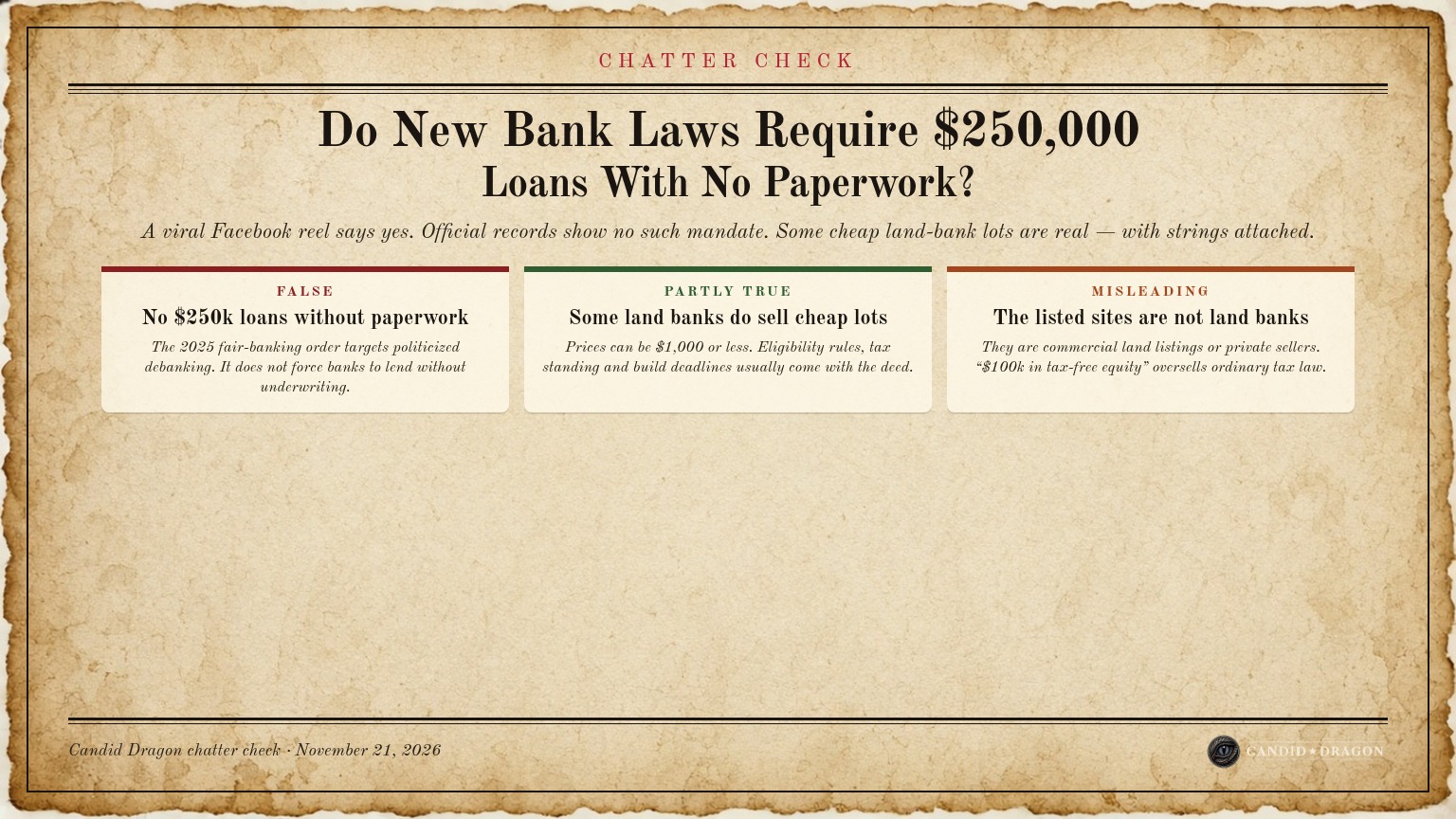
Chatter watch identified a viral Facebook reel claiming that “Trump’s new bank laws” now require banks to offer small businesses up to $250,000 with no documentation, that an LLC and an EIN mean easy approval, and that $1,000 land-bank lots can be turned into $100,000 in tax-free equity with a construction loan. When we reviewed the reel on November 21, 2026, it had more than 9,000 likes and 11,000 saves. Meta had placed a context note under it saying the video appears to be clickbait and that there is no law requiring banks to loan up to $250,000.
Quick take
- The reel says new bank laws require lenders to offer small businesses up to $250,000 with no documentation necessary, and that “LLC + EIN = Easy Approval.”
- No statute or executive order requires banks to make $250,000 loans without documentation. Banks still underwrite credit, cash flow and identity.
- What does exist is Executive Order 14331 of August 7, 2025, “Guaranteeing Fair Banking for All Americans,” which directs federal regulators to stop politicized or unlawful debanking. An OCC and FDIC rule that took effect June 9, 2026, bars those agencies from using “reputation risk” to push banks to close or deny accounts. Neither requires no-documentation lending.
- SBA loan rules were tightened in 2025, not loosened. Lenders must verify financial information, usually with IRS tax transcripts, and owners of 20% or more generally must give a personal guarantee. Forming an LLC does not, by itself, produce easy approval or erase that personal liability.
- Land banks are real. Some sell vacant lots for $1,000 or less, often to neighboring homeowners, with tax, eligibility and build-or-renovate conditions. The websites named in the reel are commercial land listings or private sellers, not land banks.
- Unrealized equity is not taxed because it is not a sale. That is ordinary tax law, not a special break. Construction loans still need a down payment or land equity, plans, a builder and an appraisal. A $1,000 lot is not, by itself, a 20% down payment on a new house.
Our rating: ⚠️ Disputed The headline legal claim is False. “LLC + EIN = Easy Approval” is False. The $1,000 land-bank lot claim is Partly True but Misleading as pitched. Naming commercial listing sites as land banks is False. The “$100,000 in equity that’s tax free” line is Misleading.  Factual
Last updated November 21, 2026, 10:20 p.m. CT.
⚠️ Disputed Factual Lean note: Official White House, Federal Register, SBA, IRS and land-bank records contradict the claim that banks must now make $250,000 loans with no paperwork. Keep the claims separate: the Trump administration did change banking policy on politicized debanking, and some land banks do sell cheap lots. Those are real. They are not a no-documentation lending mandate or a guaranteed $100,000 tax-free equity play.
What the reel says
The on-screen text in the reel, posted under the name Tyrell L Brown, presents a three-part pitch:
- “Trump’s NEW bank laws now REQUIRE banks to offer small businesses up to $250,000 with no documentation necessary. LLC + EIN = Easy Approval.”
- “Buy community lots from land banks for $1000,” followed by a list of websites: Land.com, Landsearch.com, Landwatch.com, Landflip.com, Landandfarm.com, Landhub.com and Landcentral.com.
- “Life hack instead of buying a brand new home, you can buy land from land banks for $1000 and qualify for a construction loan using your LLC to build the same house and have $100K in equity that’s tax free.”
The reel ends by telling viewers to comment and follow, a common way to build a sales list. We are not publishing any phone number from the video.
The $250,000 no-paperwork loan: False
Banking rules in the United States are made by Congress, by regulators such as the Federal Deposit Insurance Corporation, the Office of the Comptroller of the Currency and the Federal Reserve, and, for guaranteed small-business loans, by the Small Business Administration. We reviewed the official record of Trump administration banking actions in 2025 and 2026, including the White House presidential-actions page, the Federal Register, SBA loan rules and Congressional Research Service reporting. We found no statute or executive order that requires banks to offer small businesses loans of up to $250,000 with no documentation.
There is a real banking policy change, and it is not that mandate. On August 7, 2025, President Trump signed Executive Order 14331, “Guaranteeing Fair Banking for All Americans” (also in the Federal Register). The order says banking decisions “must instead be made on the basis of individualized, objective, and risk-based analyses.” It directs federal banking regulators, including the SBA, to remove “reputation risk” concepts that could be used for politicized or unlawful debanking, and it tells the SBA to have lenders identify and try to reinstate customers who were denied service for those reasons. It does not require any lender to approve a loan, set a $250,000 offer amount, or drop documentation.
On April 10, 2026, the OCC and the FDIC adopted a final rule, effective June 9, 2026, that prohibits those agencies from criticizing or taking adverse action against a bank on the basis of reputation risk, and from pressuring a bank to close or deny accounts because of political, religious or other protected views, or solely because of lawful but politically disfavored business. The rule constrains the regulators. It does not require banks to make undocumented loans. Bank Secrecy Act duties, including customer identification, remain in force.
In October 2026, the OCC released a report on its review of the nine largest national banks, conducted under that executive order. The agency said that between 2020 and September 2025, all nine had reputation-risk or industry-restriction policies. That report is about access to banking services. It is not a rule that banks must lend $250,000 without paperwork.
The $250,000 figure is a familiar one in banking for a different reason: it is the standard FDIC deposit-insurance limit of $250,000 per depositor, per insured bank, for each ownership category. That limit protects deposits if a bank fails. It is not a required small-business loan amount.
“LLC + EIN = Easy Approval”: False
An employer identification number is a tax ID. Forming a limited liability company and getting an EIN does not require a bank to approve a loan. Lenders still look at credit history, cash flow, tax returns and the business itself. A brand-new company with no revenue usually faces more questions, not fewer.
SBA-guaranteed loans go the other way. A Congressional Research Service insight dated April 28, 2025 (Factual) reviewed the SBA’s SOP 50 10 8, which took effect June 1, 2025. CRS described the changes as generally limiting eligibility in some cases, tightening underwriting and putting more responsibility on lenders. Among the changes: lenders must verify financial information, usually through IRS tax transcripts, for all loans; the collateral threshold fell to $50,000; and start-ups and changes of ownership must contribute an equity injection of 10% of project costs. Federal regulations still say the applicant must be creditworthy and the loan “so sound as to reasonably assure repayment” (13 CFR 120.150). Holders of at least a 20% ownership interest generally must give a personal guarantee (13 CFR 120.160(a)). A personal guarantee means the owner can be on the hook personally. The LLC does not, by itself, wall that off.
Recent policy on legal-entity customers has not moved toward “no documentation.” On November 19, 2026, the Treasury Department’s Financial Crimes Enforcement Network published a proposed rule that would strengthen customer due diligence for legal-entity customers, including beneficial-owner verification. It is a proposal, not a final rule, and it is the opposite of a no-paperwork mandate.
$1,000 land-bank lots: Partly True, Misleading as pitched
Land banks are real. The Center for Community Progress (Factual), which tracks them, describes land banks as public or quasi-public agencies that take in vacant, abandoned or tax-foreclosed property and transfer it to new owners under local rules, often in places with a history of disinvestment. The center said in March 2025 that 18 states and Puerto Rico have land-bank laws and that there are more than 350 land banks and land-banking programs in the country. Each has its own sales policies. Properties are commonly sold as-is. Many programs require an application, a plan for the property, and a deadline to renovate or build. If the work is not finished, the land bank may keep the title.
Some prices really are $1,000 or less, with limits:
- The Detroit Land Bank Authority sells “Side Lots” for $100, or $250 if there is a structure such as a garage, but only to the owner of an adjacent occupied home who is current on property taxes or a tax payment plan. “Neighborhood Lots” are $250 and are limited to residents of an occupied home within 500 feet who meet additional rules, including a cap on how many lots one buyer can purchase.
- The Cuyahoga Land Bank in Ohio sells some renovation homes through a deed-in-escrow program, in some cases for $5,000 or less. The land bank holds the deed until the buyer finishes agreed renovations, typically within about four to six months, and passes inspection. If the work is not completed on time, the land bank keeps the title and the buyer can lose the money already spent.
- The city of Ypsilanti, Michigan sells eligible city-owned vacant lots for $1,000 plus closing costs and legal fees, as-is, if the buyer meets the application requirements. That is a city lot program, not a national land-bank entitlement.
Those programs can be a legitimate way to put a vacant lot back to use. They are not a standing offer that anyone, anywhere, can buy a $1,000 lot and immediately qualify for a construction loan to build a new house with $100,000 in equity. The cheap lots are often in distressed neighborhoods, may not be buildable without extra cost, and frequently come with neighbor-only rules or construction deadlines.
The listed websites are not land banks: False
The reel lists Land.com, Landsearch.com, Landwatch.com, Landflip.com, Landandfarm.com, Landhub.com and Landcentral.com as if they were land banks. They are not. Those sites are commercial land-listing marketplaces or private land sellers. They advertise parcels at asking prices, the way a real-estate listing site advertises homes. A land bank is a public or special-purpose agency operating under local or state rules. Searching a commercial listing site is not the same as buying from a land bank.
The construction loan and “tax-free” $100,000 in equity: Misleading
Construction loans are real, and people do sometimes use land they already own as part of the down payment. The rest of the pitch leaves out the hard parts.
Fannie Mae’s Selling Guide, B5-3.1-02, updated May 6, 2026, is the rulebook many conventional construction-to-permanent loans follow. The loan-to-value ratio is based on the “as completed” appraised value of the lot and the finished house, or on a related cost measure set out in the guide. For a purchase, the borrower must make the minimum contribution from their own funds unless the loan-to-value ratios are 80% or less, or the borrower qualifies for gift, grant or employer-assistance rules on a one-unit principal residence. In plain terms, lenders generally expect substantial cash or land equity, often around 20%, plus plans, a construction contract and an appraisal. A $1,000 lot is not, by itself, 20% of the cost of a new house. If the finished house appraises below cost, the borrower has to bring more cash, not collect $100,000 in instant equity. In a weak market, a new house on a cheap lot may not be worth $100,000 more than it cost to build. Lenders also typically require a qualified builder. A loan in the name of an LLC commonly still comes with a personal guarantee.
The tax line mixes a true rule with a sales claim. You generally do not pay tax on paper equity while you still own the property, because gain is recognized when you sell. That is ordinary tax law, not a new break created by “bank laws.” The IRS, in Publication 523 (2025), explains the exclusion that can apply when you sell a principal residence: up to $250,000 of gain, or $500,000 for a married couple filing jointly, if you owned and used the home as your principal residence for at least two years in the five-year period ending on the sale. Treasury regulations say that if a home is owned by a single-owner entity that is disregarded for federal tax purposes, such as a typical single-member LLC, the owner is treated as owning it for that test (26 CFR 1.121-1(c)(3)(ii)). A multi-member LLC is a different story. The exclusion is not automatic, it is not $100,000 by magic, and it applies only if the sale qualifies. Calling the equity “tax free” as soon as the house is built oversells a rule that, at most, defers tax until a sale and then may exclude some of the gain if the home was really your principal residence.
What to watch
- Any actual statute, executive order or banking-agency rule that would require lenders to offer no-documentation small-business loans. None was on the official record as of November 21, 2026.
- Further SBA or federal banking-regulator changes to documentation, personal guarantees or debanking rules, including the pending FinCEN customer-due-diligence proposal.
- Sales pitches that follow videos like this one, especially any request for an upfront fee in exchange for “funding” or “easy approval.”
Latest updates
🔄 November 21, 2026, 10:20 p.m. CT: First published, based on the official texts of Executive Order 14331, the April 2026 OCC and FDIC reputation-risk rule, SBA lending regulations, IRS Publication 523, Fannie Mae Selling Guide B5-3.1-02, and published land-bank and city lot programs. We will update this page if Congress or a federal regulator adopts a small-business lending mandate that matches the reel, or if a named land-bank program changes its published prices or rules in a way that affects the ratings.
Label key
- ✅ Confirmed An official record, or two or more independent outlets, agree.
- ❓ Unconfirmed Reported or claimed, but not yet independently verified.
- ⚠️ Disputed Contradicted by the evidence or by credible sources, or actively contested.
- Factual Straight reporting that holds up across outlets on different sides.
 Leans Left The facts hold, but the coverage tilts left: one-sided, loaded language, missing context or a single anonymous source.
 Leans Right The facts hold, but the coverage tilts right: one-sided, loaded language, missing context or a single anonymous source.
 Likely Propaganda State-run or state-aligned media, a militant press office, a partisan campaign or group, or unverifiable spin.
Each story gets one confidence tag and one source-lean label, plus a one-line Lean note explaining the call. Every side is held to the same standard. More on how we cover the news.
Sources
- White House, Executive Order 14331, “Guaranteeing Fair Banking for All Americans,” August 7, 2025 (official record)
- Federal Register, Executive Order 14331, August 12, 2025 (official record)
- OCC and FDIC, “Prohibition on the Use of Reputation Risk by Regulators,” final rule, 91 FR 18279, April 10, 2026, effective June 9, 2026 (official record)
- OCC, “OCC Releases Report on Large Banks’ Debanking Activities,” news release 2026-90, October 14, 2026 (official record)
- Anthony A. Cilluffo, Congressional Research Service, “Changes to Small Business Administration (SBA) Business Loan Program Policies in Early 2025,” IN12549, April 28, 2025 (Factual)
- 13 CFR 120.150 and 120.160, SBA lending criteria and loan conditions, including personal guarantees (official record)
- FinCEN, “Customer Due Diligence Requirements for Covered Financial Institutions,” proposed rule, November 19, 2026 (official record)
- FDIC, “Understanding Deposit Insurance,” standard coverage of $250,000 per depositor, per insured bank, per ownership category (official record)
- Center for Community Progress, “How to Buy Property From a Land Bank,” March 10, 2025 (Factual)
- Detroit Land Bank Authority, Side Lot and Neighborhood Lot FAQ (official record)
- Cuyahoga Land Bank, about the deed-in-escrow program and renovation pricing (official record)
- City of Ypsilanti, Michigan, Residential Lot Program, $1,000 plus closing costs (official record)
- Fannie Mae Selling Guide, B5-3.1-02, Conversion of Construction-to-Permanent Financing: Single-Closing Transactions, May 6, 2026 (official record)
- IRS, Publication 523 (2025), Selling Your Home (official record)
- 26 CFR 1.121-1, exclusion of gain from the sale of a principal residence, including single-owner disregarded entities (official record)
Featured image: Candid Dragon almanac graphic, November 21, 2026. See all image credits.
Be informed. Be aware. Be prepared.