

Chatter watch identified a Facebook post dated November 21, 2026, headlined “TEXAS 2026 PRIMARIES EXPLODE IN MASSIVE FRAUD SCANDAL AS THOUSANDS OF VOTER IDS AND BALLOTS APPEAR VANISH AND GET INJECTED.” The post lists precise counts of vanished voter IDs and “injected” ballots in both party primaries, says the data is public, and calls for a full forensic audit.
Quick take
- The post claims the Texas 2026 primaries exploded in a massive fraud scandal. For Republicans it cites 87,336 voter IDs that vanished and then reappeared, with only 21,190 still having ballots by the end of early voting; 137,693 ballot additions or deletions; and 35,772 extra ballots “injected” for people who already voted. For Democrats it cites 37,039 “phantom” IDs, 26,481 of them still with ballots, 36,169 ballots injected after voting, and 80,903 additions and deletions.
- Those figures, except one typo, match a citizen analysis by Unite4Freedom (Leans Right) of successive unofficial snapshots of the Texas Secretary of State’s public early-voting roster files. They are not a court finding or an official audit conclusion.
- The Democratic “injected” count in the post is 36,169. Unite4Freedom’s reports, and a later notice it sent to the state, list 35,169.
- The Texas 2026 primaries were held March 3, 2026, with runoffs on May 26, 2026. The Secretary of State’s calendar and Election Advisory 2026-09 set the local canvass for the March primary on March 12, with the state canvass due March 15 or March 25, depending on the race. By the date of the post, those elections had already been canvassed, and the November general election had already been held.
- Texas law requires counties to update early-voting rosters every day and send them to the Secretary of State. The Secretary of State’s office tells the public that early-voting totals are unofficial, that it refreshes the public reports several times a day as county submissions arrive, and that the figures change as counties submit updates or corrections. Delayed county uploads can leave the statewide file temporarily incomplete.
- Legal, routine reasons a record can appear, disappear or change include those reporting lags, typo and duplicate corrections, a voter canceling a mail ballot in order to vote in person, and provisional ballots. Unite4Freedom labels some of those changes “oscillations” and “injected ballots.” That is an interpretation of file differences, not proof that extra votes were added to the official count.
- A real limit in the analysis is that it did not use county or precinct fields, because those were “not consistently available” in the downloaded files. Without the county, a delayed or missing county upload can look like thousands of voter IDs vanishing and then reappearing.
- The more specific figures that still deserve a close look are Unite4Freedom’s counts of voter IDs that appear with more than one ballot: 1,400 Republican and 9 Democratic at first appearance, and 1,549 Republican and 54 Democratic in its final early-voting snapshot. Those should be checked against poll books and the official final rosters. We found no public official finding that they changed the certified results.
- Texas did not leave the March primary unaudited. Election Advisory 2026-10 directed counties to conduct the post-election hand-count audit required by Election Code section 127.201. That is a sample hand count of paper ballots against electronic totals, not a “full forensic audit” of every roster change. We found no public Secretary of State or Attorney General finding that the March 2026 primaries were decided by injected or vanishing ballots matching these statewide figures.
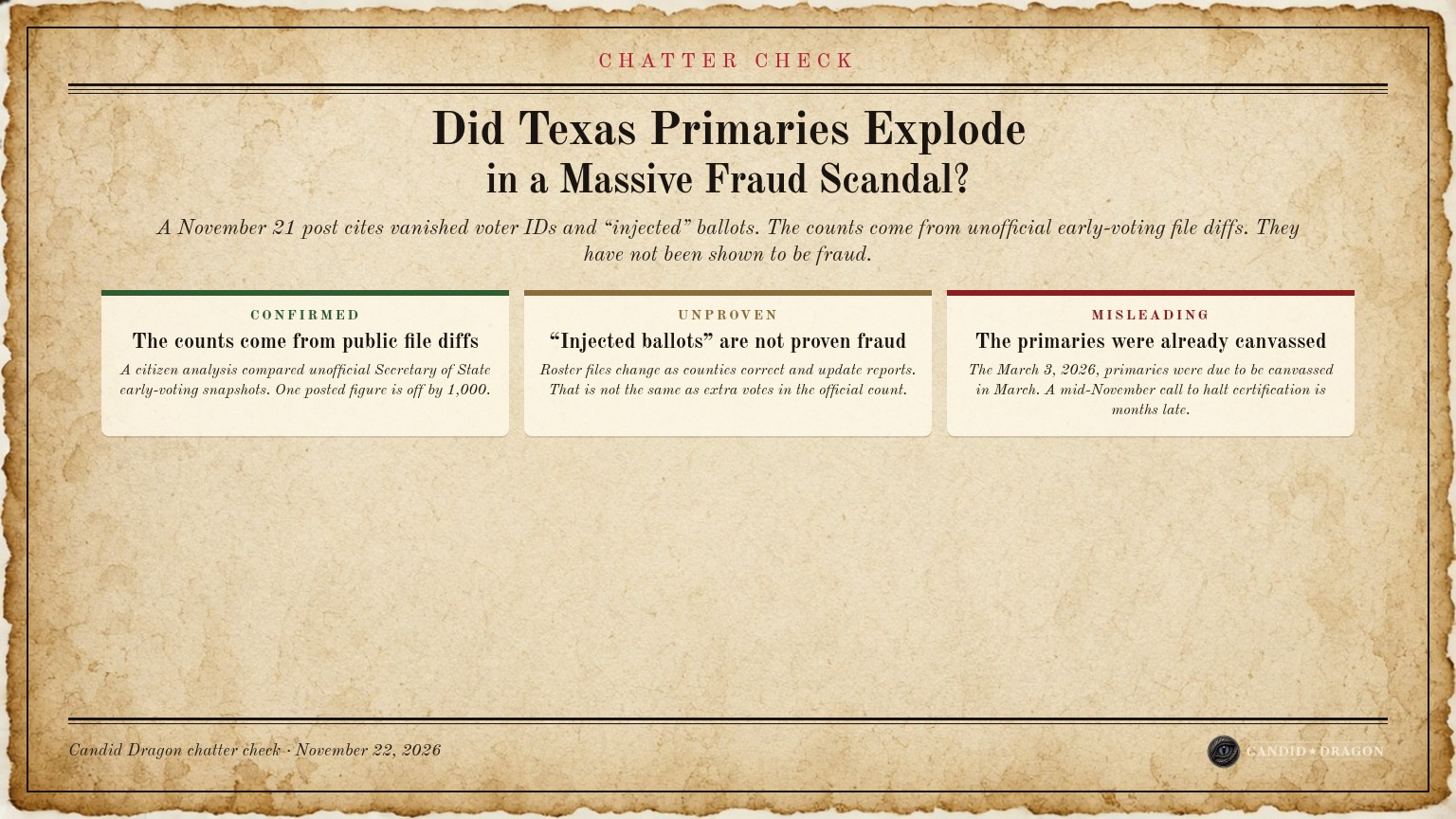
Our rating: ⚠️ Disputed The claim of a “massive fraud scandal” is Unproven. The specific counts, with one typo, are Confirmed as coming from the Unite4Freedom analysis of unofficial public files. Calling those changes “injected ballots,” or treating vanished IDs as proof of fraud, is Misleading. The suggestion that certification was still pending in mid-November is False.  Factual
Last updated November 22, 2026, late morning CT.
⚠️ Disputed Factual Lean note: Official Texas election law and the Secretary of State’s own warnings about unofficial, frequently updated early-voting reports explain a great deal of roster churn. Keep the claims separate: the file changes documented in the citizen analysis are real as file differences. They have not been shown to be fraud, and they are not a reason to treat the March primary as uncertified.
What the post says
The November 21 post presents the Texas 2026 primaries as a “massive fraud scandal” in which voter IDs and ballots “appear, vanish and get injected.” It gives these counts:
- Republicans: 87,336 voter IDs vanished, then reappeared, with only 21,190 still having ballots by the end of early voting; 137,693 ballots added or deleted; and 35,772 extra ballots “injected” for people who already voted.
- Democrats: 37,039 “phantom” IDs doing the same, with 26,481 still clinging to ballots; 36,169 more “injected after voting”; and 80,903 ballot additions and deletions.
The post says the data is public, that “the discrepancies remain,” and that Texas must “act immediately” and conduct a full forensic audit, with “pressure rising for answers before any final certification moves forward.”
Where the numbers come from
The counts are not a new official finding from November. They match, almost exactly, Unite4Freedom’s “Real-Time High Resolution Vote Tampering Reports” on early voting in the 2026 Republican and Democratic primaries. The group says it downloaded the Texas Secretary of State’s public early-voting datasets at regular intervals, including more than once a day, from the start of early voting through election day, March 3, 2026, and compared those snapshots to one another.
In the August 7, 2026, versions of those reports, Unite4Freedom listed a final Republican dataset of 1,265,564 records and a final Democratic dataset of 1,405,576 records. The Republican report lists 87,336 “voter oscillations” (IDs that appear, disappear and reappear), of which 21,190 still had a ballot at the end of early voting; 35,772 “injected” ballots, defined as additional ballots assigned to voter IDs that had already cast a ballot; 137,693 incremental additions or deletions; and 66,146 voter-history deletions from the evening file of February 27, the last day of early voting. The Democratic report lists 37,039 oscillations (26,481 still with a ballot at the end of early voting), 35,169 “injected” ballots, 80,903 incremental changes and 10,558 deletions. A September 2, 2026, notice Unite4Freedom later sent to the state repeats those same figures.
The Facebook post copies those numbers, with one error: it gives the Democratic “injected” count as 36,169, not 35,169. It also omits the deletion counts and the multiple-ballot counts, and it upgrades the group’s call for investigation into a “massive fraud scandal” and a warning about certification that was already months in the past.
Unite4Freedom itself is not of one voice on what the numbers prove. The reports are titled “Vote Tampering” and say the pattern “suggests intentional or automated manipulation, not normal reporting errors.” The group’s later notice to the state is more cautious: it says the figures identify changes “requiring investigation” and “do not independently establish that any particular change violated federal law.” Both things can be quoted. Neither is an official finding.
How Texas early-voting files actually work
The underlying files are real and public. Under Texas Election Code section 87.121 (official record), the early-voting clerk must keep a daily roster of people who vote early in person and of people who return a ballot by mail. For a primary, the clerk must submit that information to the Secretary of State for posting, generally by 11 a.m. the next day. The Secretary of State must post it in a downloadable format. Final rosters are due no later than the 20th day after the local canvass, which is later than the early-voting period itself.
The Secretary of State has also warned the public, in plain language, not to treat a mid-cycle download as a frozen official count. In an October 26, 2026, news release explaining the same early-voting reporting portal, the office said counties must enter the previous day’s totals by 11 a.m., but that those numbers “may take additional time to appear”; that the office “refreshes the publicly available reports several times throughout the day as county submissions are processed”; that “all early voting figures are unofficial and subject to change as counties submit updates or corrections”; and that some counties’ third-party election systems “may create additional delays.” “Because of these factors,” the office said, “statewide totals may not immediately reflect all ballots cast.”
That matters for the “vanished, then reappeared” claim. If a county’s file is late, incomplete, or temporarily missing from one statewide refresh and present in the next, thousands of voter IDs can disappear from one snapshot and come back in another without a single ballot having been added or removed from a ballot box. Unite4Freedom’s method makes that hard to test. The reports say the counts are based on records that match voter ID, name and voting method, and that the analysis “does not include County and Precinct details because they were not consistently available in the data downloaded from the Secretary of State’s website.” Without the county, a reporting lag and a statewide manipulation can look the same in the file.
What can look like a vanished ID or an “injected” ballot
Several lawful processes also change a voter’s early-voting history during the voting period:
- Mail ballots canceled so the voter can vote in person. Under Election Code section 84.032 (official record), a voter who was sent a ballot by mail can request that it be canceled and, if the ballot is surrendered or the required notice is presented, vote a regular ballot in person. If the mail ballot is not surrendered, the voter may be limited to a provisional ballot. In a file that tracks voting method, that can look like a history deletion and a new ballot, or like a second ballot assigned to the same ID.
- Corrections and duplicates. Counties are told to review the daily statewide extract so that no voter is listed more than once and so that local rosters match the state file. When they fix typographical errors in a voter ID, a name or a voting method, or remove a duplicate row, a later snapshot will not match an earlier one.
- Provisional and late-arriving records. A provisional ballot, a mail ballot received and added the next day, or a county upload that arrives after one of the Secretary of State’s intra-day refreshes can add, hold or later remove a row.
None of that proves that every change Unite4Freedom counted is innocent. It does mean that “appears, disappears and reappears” and “additional ballots assigned to a voter ID” are not, by themselves, the same thing as a ballot being stuffed or a lawful vote being erased from the certified count. The group’s own definition of an “injected” ballot is a change in the unofficial file, not a finding that an extra vote was tabulated.
The multiple-ballot records are the sharpest remaining question. Unite4Freedom counted 1,400 Republican and 9 Democratic voter IDs that first appeared with more than one ballot, and 1,549 Republican and 54 Democratic IDs with more than one ballot in the final early-voting snapshot it used. If those rows survived into the official final rosters and poll books as two counted ballots for one voter, that would be a serious problem and should be investigated. If they are duplicate rows, method changes, or snapshot artifacts that were cleaned up before the canvass, they would not support the “massive fraud” headline. We have not seen a public, record-by-record official reconciliation of those specific rows.
What official audits and investigations have said
The March 3 primary was not left without a required review. On March 4, 2026, Christina Adkins, the state’s director of elections, issued Election Advisory 2026-10, reminding officials that Election Code section 127.201 (official record) requires a post-election hand-count audit in elections that use an electronic voting system. The audit must cover at least three election-day locations and three early-voting locations, or 1% of each, whichever is greater, plus at least three precincts or 1% of the precincts in which a ballot by mail was cast, whichever is greater. That compares a hand count of paper ballots with the electronic totals at the sampled places. It is not a forensic review of every daily roster change in the statewide portal, and it would not automatically explain every file oscillation. It is, however, the audit Texas law required after this primary, and it is not the same thing as “no audit was done.”
A separate “forensic audit” of the 2020 general election was a one-time project under Texas election-integrity legislation, not a standing requirement that had to be repeated before the 2026 primary could be certified. Election Advisory 2026-09 set the local canvass for Thursday, March 12, 2026, and the state canvass for no later than March 15 for races with three or more candidates and March 25 for the remaining offices. The runoff was May 26. A mid-November post that speaks as if “final certification” of the primaries is still ahead is describing a deadline that had already passed, twice, and after the general election itself.
The Attorney General’s Election Integrity Unit has been active in 2026. On October 31, it announced arrests of convicted felons accused of illegally voting, after a citizen report about people who were incarcerated, on parole or on probation. That is a real enforcement action. It is also a different allegation, about voter eligibility, not a finding that tens of thousands of ballots were injected into the March primary through the early-voting roster files. We found no public Secretary of State or Attorney General statement concluding that the Unite4Freedom snapshot differences prove that the 2026 primaries were stolen or decided by injected ballots.
For context on the size of the election, The Texas Tribune (Leans Left), citing unofficial Secretary of State figures as of the morning of March 5, 2026, reported that nearly 4.5 million Texans voted in the two primaries, divided between about 2.3 million ballots in the Democratic primary and nearly 2.2 million in the Republican primary. Those are unofficial election-week totals, not a judgment on the fraud claim, and they include election day, not only the early-voting files Unite4Freedom studied.
What would settle the remaining questions
The honest split is this: the unofficial public files did change, a citizen group documented large numbers of those changes, and some of the more specific anomalies, especially the multiple-ballot rows, have not been publicly explained line by line. That is a fair reason to ask election officials for a reconciliation. It is not, on the evidence now public, proof of a massive fraud scandal, and it does not reopen a primary that was canvassed in March.
What would settle it is a county-level comparison of the snapshot differences with poll books and with the official final early-voting rosters due after the canvass; an official explanation of the 1,549 Republican and 54 Democratic multiple-ballot records in Unite4Freedom’s final snapshot; and a public Secretary of State or Attorney General review of this analysis. Unite4Freedom’s September 2026 notice asked the state for implementation records. We found no published reply.
What to watch
- Any public, county-level reconciliation of the early-voting snapshot differences with poll books and the official final rosters.
- An official explanation of the multiple-ballot records counted in the Unite4Freedom snapshots.
- A Secretary of State or Attorney General finding that directly addresses this analysis, or a published response to the September 2026 notice.
Latest updates
🔄 November 22, 2026, late morning CT: First published, based on Unite4Freedom’s August 7, 2026, Texas primary early-voting reports and its September 2, 2026, notice to the state; Texas Election Code sections 87.121, 84.032 and 127.201; Secretary of State Election Advisories 2026-09 and 2026-10 and the 2026 official election calendar; the Secretary of State’s October 26, 2026, explanation of early-voting reports; The Texas Tribune’s unofficial March 5 turnout report; and the Attorney General’s October 31, 2026, Election Integrity Unit announcement. We will update this page if the Secretary of State or the Attorney General issues a public finding on these snapshot differences, or if a county-level reconciliation of the multiple-ballot records is published.
Label key
- ✅ Confirmed An official record, or two or more independent outlets, agree.
- ❓ Unconfirmed Reported or claimed, but not yet independently verified.
- ⚠️ Disputed Contradicted by the evidence or by credible sources, or actively contested.
- Factual Straight reporting that holds up across outlets on different sides.
 Leans Left The facts hold, but the coverage tilts left: one-sided, loaded language, missing context or a single anonymous source.
 Leans Right The facts hold, but the coverage tilts right: one-sided, loaded language, missing context or a single anonymous source.
 Likely Propaganda State-run or state-aligned media, a militant press office, a partisan campaign or group, or unverifiable spin.
Each story gets one confidence tag and one source-lean label, plus a one-line Lean note explaining the call. Every side is held to the same standard. More on how we cover the news.
Sources
- Unite4Freedom, Real-Time High Resolution Vote Tampering Report, Texas Early Voting, 2026 Republican Primary Election, August 7, 2026 (Leans Right)
- Unite4Freedom, Real-Time High Resolution Vote Tampering Report, Texas Early Voting, 2026 Democrat Primary Election, August 7, 2026 (Leans Right)
- Unite4Freedom, “Who Hijacked the Texas 2026 Democrat and Republican Primary Elections?” (Leans Right)
- Unite4Freedom, Texas NVRA Notice of Violations and Demand for Corrective Action, September 2, 2026 (Leans Right)
- Texas Election Code section 87.121, Early Voting Rosters (official record)
- Texas Election Code section 84.032, Request for Cancellation of a ballot by mail (official record)
- Texas Election Code section 127.201, Hand Count Election Audit (official record)
- Texas Secretary of State, Important Dates for the Party Conventions, Primary Elections, and General Election, 2026 (official record)
- Texas Secretary of State, Election Advisory 2026-09, Canvass and Recount Deadlines for the March 3, 2026 Primary Elections, March 2, 2026 (official record)
- Texas Secretary of State, Election Advisory 2026-10, Post-Election Hand Count Audit after the March 3, 2026 Primary Election, March 4, 2026 (official record)
- Texas Secretary of State, “More Than 4.2 Million Texans Cast Ballots in First Half of Early Voting,” October 26, 2026, including “Understanding Early Voting Reports” (official record)
- Apurva Mahajan and Alejandro Serrano, The Texas Tribune, “Texas primary voters smash recent midterm turnout records,” March 4–5, 2026 (Leans Left)
- Texas Attorney General, “Attorney General Ken Paxton Announces Arrests of Convicted Felons for Illegally Voting in Texas,” October 31, 2026 (official record)
Featured image: Candid Dragon almanac graphic, November 22, 2026. See all image credits.
Be informed. Be aware. Be prepared.