

Quick take
- On September 9, President Trump said, “Right after the election, oil prices are going to be tumbling downward.” That call is Confirmed: U.S. crude futures fell 8.3% the day after the November 3 midterms, and the government’s spot price for U.S. crude is down about 10% since Election Day.
- The call was right because of a market mechanism, not a vague forecast. On October 8, Trump pledged not to attack Iran before the election, so traders priced a war-escalation risk for after the vote. When Democrats won Congress, that risk premium came out. Cheaper winter-blend gasoline and slower fall demand also pulled pump prices lower.
- Regular gasoline averaged $3.805 a gallon in the week of November 16 (EIA), down 34.8 cents from the week of November 2. The 19-cent drop in that latest week was the largest weekly fall since November 2008. AAA’s daily national average was $3.75 on November 18.
- Diesel fell less. U.S. on-highway diesel went from $6.292 on November 2 to $5.937 on November 16, down 35.5 cents, or 5.6%, compared with gasoline’s 8.4% drop. From the late-September peak, diesel is down 9.1% versus 15.0% for gasoline. Distillate inventories were tight going into winter, and the International Energy Agency said diesel tightness remains the market’s overriding concern.
- A separate question is whether prices were “held up” until after the vote. Trump’s November 17 line, “Notice that they waited until after the ‘Election?’,” and Democrats’ earlier “price gouging” claims are tested below with the same evidence standard. We found no proof either way. That implication is Unproven.
Our rating: ✅ Confirmed  Factual
Last updated November 18, 2026, 8:15 p.m. CT.
✅ Confirmed Factual Verdict: Trump’s September prediction is Confirmed. The separate implication that “they waited” until after the election, and Democratic claims of wartime price gouging, are Unproven. Strait of Hormuz developments are reported as context only and are not rated.
What Trump said, and what happened the next day
On September 9, speaking to reporters on his way to the Republican midterm convention in Dallas, Trump said Iran would try to end the war “immediately after the election,” prompting oil to tumble. “They can’t hold out any longer,” he said, according to CNN (Leans Left). NBC News (Leans Left) recorded the line that became the prediction: “Right after the election, oil prices are going to be tumbling downward.”
On October 8, he made the timing explicit. “We will not be attacking Iran at any time prior to the Midterm Elections,” he posted on Truth Social, while saying the naval blockade would stay in place. CNBC (Factual) wrote that the pledge was “explicitly tying the timing of potential further military action to Election Day.”
The midterms were Tuesday, November 3. Democrats won both the House and the Senate. On Wednesday, November 4, U.S. West Texas Intermediate crude futures lost 8.3% and settled at $88.12 a barrel. Brent, the international benchmark, fell 8.7% to $94.62, CNBC reported. Vice President JD Vance posted, “The reason we lost is the war.” Trump told the Financial Times he had no immediate plans to strike Iran.
−8.3%
✅ Confirmed
November 4, the day after the election
U.S. crude futures (WTI) settled at $88.12 a barrel, down 8.3%. Brent settled at $94.62, down 8.7%.
CNBC (Factual), futures settlements.
−10%
✅ Confirmed
Election Day through November 17
The government’s WTI spot price was $99.64 a barrel on November 3 and $89.53 on November 17, down 10.1%.
EIA (Factual) daily spot prices, downloaded November 18.
Why the call was right
Traders had already described the mechanism before Election Day. On November 2, oil sold off more than 7% after Trump said Iran wanted to “make a deal” and Iran’s president signaled a willingness to talk. CNBC wrote that day: “The oil market had priced in the risk of a major military escalation after the U.S. midterm elections, gaining more than 10% in October.” The same explanation was repeated on November 4, after the results: a Democratic Congress made a wider war less likely, so the risk premium came out.
That path was set up by the October 8 pledge. By saying the United States would not attack Iran before the midterms, the White House moved the escalation risk traders were pricing to the other side of Election Day. When the vote then reduced the odds of a larger war, crude fell sharply the next session. That is a political event moving a market through a publicly stated timeline, and it is why the September prediction held up.
Seasonal and supply factors added to the move at the pump. U.S. gasoline switches to a cheaper winter blend after mid-September, and driving demand typically eases in the fall. On November 13, the IEA (Factual) said global oil supply rose by 2.3 million barrels a day to 105.4 million in October, observed inventories increased by 52 million barrels (the first rise since June), and its balances pointed to a surplus in the fourth quarter of 2026. CNBC, citing the same report, said the market was shifting from a fear of shortage to a fear of surplus.
Hormuz context, not rated. The IEA said Gulf oil exports, excluding Oman, reached 18.4 million barrels a day in October, still 26% below pre-war levels, and that attacks on tankers continue. Those shipping developments are reported here as background only and are not rated.
What happened at the pump
Crude moves in a day. Pump prices move over days and weeks. The government’s weekly survey is the official record of what drivers paid.
$4.478
✅ Confirmed
Week of September 21, late-September high
U.S. regular gasoline, all formulations. The 2026 weekly high was slightly higher, $4.50 on May 11. AAA’s daily high this year was $4.56 on May 21, per NBC.
$4.153
✅ Confirmed
Week of November 2, the Monday before Election Day
Already down 32.5 cents, or 7.3%, from the late-September weekly high. Pump prices had been easing for several weeks before the vote.
$3.805
✅ Confirmed
Week of November 16
Down 34.8 cents, or 8.4%, from the week of November 2, and 67.3 cents, or 15.0%, from the late-September high. The 19.0-cent drop from the week of November 9 was the largest weekly fall since the week of November 3, 2008, when the average fell 25.6 cents.
All figures: EIA weekly retail gasoline, release dated November 17, 2026. AAA’s daily national average on November 18 was $3.750.
So both things are true, and they are not in conflict. Pump prices had already been coming down from a late-September peak, which is what a seasonal decline plus a cheaper winter blend looks like. And crude still posted a sharp, one-day break the day after the election, which is what Trump said would happen. The following week’s 19-cent drop at the pump was the steepest in 18 years on the weekly data, which is why the “biggest drop in 18 years” line in his November 17 post checks out on that measure.
Diesel fell, but not as much
Highway diesel is a different product from gasoline. It comes from the same distillate pool that supplies home heating oil, and it is the fuel for trucks, rail and much of the freight that stocks stores. Drivers who fill both tanks often notice gasoline moving first.
$6.529 → $5.937
✅ Confirmed
Diesel, late-September peak to November 16
U.S. on-highway diesel peaked at $6.529 in the week of September 21. It eased, then rose again to $6.352 in the week of October 26. On November 2, the week of the election, it was $6.292. On November 16 it was $5.937, down 35.5 cents, or 5.6%, from November 2, and 59.2 cents, or 9.1%, from the peak.
$4.478 → $3.805
✅ Confirmed
Gasoline, same window
Regular gasoline fell 15.0% from the late-September weekly high and 8.4% from the week of November 2. In cents, the post-election two-week drop was similar (34.8 cents for gasoline, 35.5 cents for diesel). Diesel fell less as a share of its price, it gave back less before the vote, and it actually rose in late October.
Source: EIA weekly U.S. No. 2 diesel retail prices and weekly regular gasoline, release dated November 17, 2026. AAA’s daily diesel average on November 18 was $5.959, still about $2.21 above regular gasoline and about $2.19 above diesel a year earlier.
The inventories and the IEA report explain why. U.S. distillate fuel oil stocks, which cover diesel and heating oil, fell to 99.3 million barrels in the week of October 30, then recovered only to 104.9 million by November 13, according to EIA weekly stocks. That October 30 reading was about 13% below the average for the comparable week in 2021–2025 (our calculation from the same EIA series). Winter heating demand was starting to compete for the same barrels, and freight demand does not fade after summer the way gasoline demand does. The IEA, in its November 13 report, said “the severe tightness in product supply, especially for diesel, remains the overriding concern of the broader market and consumers.”
Gasoline also gets a seasonal cost cut that diesel does not. After mid-September, U.S. refiners can make a cheaper winter-blend gasoline. Diesel does not get that same seasonal break, and it was still $2.07 a gallon above its year-earlier EIA weekly level on November 16, compared with 74 cents for regular gasoline.
Were prices held up until after the vote?
This is a different claim from the prediction, and it gets its own rating. On November 17, at 4:09 p.m. CT, Trump posted on Truth Social: “Biggest drop in gasoline in 18 years. Notice that they waited until after the ‘Election?’ President DJT.” The first sentence is accurate on the weekly EIA data, as noted above. The second sentence implies that someone held prices up until after the vote. He did not name a “they,” and he did not offer evidence.
Democrats have made a related, but not identical, claim: that oil companies used the war to gouge customers. On May 13, Sen. Ed Markey, Democrat of Massachusetts, wrote to Federal Trade Commission Chairman Andrew Ferguson asking for a formal investigation of “price gouging, market manipulation, or anti-competitive pricing practices.” That letter was about wartime profits and pricing, months before the election, not about a midterm-timed drop. Both claims are tested here with the same standard: a charge of manipulation needs evidence of an actor and a mechanism, not only a price chart that can be read in more than one way.
The strongest case that prices were held up
The case starts with what people saw. Crude’s sharpest break came the day after the election, and the largest weekly pump-price drop in 18 years landed in the next EIA survey week. Trump had publicly tied military timing to Election Day, which is a lever a president actually controls. If the market was forced to carry extra war risk until after the vote, prices were, in a real sense, held higher until then — by policy timing, even if not by a secret meeting.
There is also a retail-margin argument. Gulf Coast wholesale gasoline, a benchmark for what refiners charge, fell much faster than the national pump average in the weeks before the vote. From September 23 to October 27, that wholesale price fell $1.03 a gallon ($4.126 to $3.101). Over the closest survey weeks, the national pump average fell only about 21 cents ($4.478 on September 21 to $4.269 on October 26). The gap between the pump and that wholesale benchmark widened from about 53 cents in the week of September 21 to about $1.16 in the week of October 26, and to $1.30 in the week of November 2. (Our calculation from EIA weekly retail and daily Gulf Coast spot prices; part of the wholesale drop is the switch to cheaper winter-grade gasoline.) That is the “rockets and feathers” pattern Markey asked the FTC to examine: prices rise quickly with costs and come down slowly. A reader who thinks someone was slow-walking a price cut can point to that lag.
Markey’s May letter is the fullest version of the Democratic claim, and it should be stated at its strongest. He wrote that gasoline had risen more than 50% since the war began, from $2.98 to about $4.51, while companies reported record profits and “shipping American energy reserves abroad at historic volumes.” His test was straightforward: “If supply chain disruptions driven by the United States’ war with Iran were the only cause of the rising prices at the pump, it would stand to reason that oil companies would be seeing expenditures and losses rise at the same time as gasoline costs. We are not seeing a neutral effect on profits.” He asked the FTC to look at four things: possible coordination, including through branded franchise networks; whether companies were tightening domestic supply or prioritizing exports to keep U.S. prices high; whether “rockets and feathers” pricing is an unfair practice; and whether franchise contracts give refiners de facto pricing power. Those are specific allegations, and they are about conduct, not just about a war-driven shortage.
The strongest case that they were not
The same data also cut the other way, and they have to be counted. Pump prices were already falling for six weeks before Election Day. Diesel, which people often cite as the fuel that “didn’t come down,” had peaked in September too, even if it bounced in late October. A hold-until-the-vote story has to explain a decline that started in late September, not a cliff that began on November 4.
The sharp one-day crude drop has a dated, public explanation: CNBC reported, before and after the election, that traders had priced in post-election escalation risk, and that the risk came out when Democrats won Congress. That is the mechanism above. It is a political effect on prices. It is not evidence of a hidden hand propping up the pump until the polls closed.
The margin data, taken all the way through, does not show a release after the vote. If retailers or refiners had been sitting on an unusually wide gap and then let it go once the election passed, that gap should have narrowed after November 3. It did not. On the same EIA math, the pump-minus-wholesale gap was about $1.30 in the week of November 2, widened to about $1.44 in the week of November 9, and was still about $1.34 in the week of November 16 — wider than it was on Election week, not tighter.
High profits during a supply shock also are not, by themselves, proof of illegal gouging. When a chokepoint is disrupted, scarcity can lift both prices and profits without a conspiracy. Markey asked the right question about whether conduct went beyond that. Asking the question is not the same as answering it. We found no public FTC finding on his May request. A separate CFTC review of unusual oil trades in March and April — minutes before Trump’s Iran announcements, not around the midterms — remained open as of October 22, according to enforcement director David Miller, speaking to Reuters. That probe is about possible trading ahead of White House news. It is not a finding that anyone held pump prices until after the election. Miller declined to comment specifically on the November midterms in connection with prediction-market trading.
What would prove it, or disprove it
Volume of talking points is not proof. These are the kinds of facts that would settle each claim.
- To prove Trump’s “they waited” implication: evidence of an identifiable actor — a company group, a cartel, traders, or officials — deciding to keep crude or retail prices elevated until after November 3 and then let them fall. That could be internal communications, a regulator or court finding, or inventory and production data showing supply was withheld before the vote and released after. A sudden collapse in retail margins right after the election, after crude, wholesale costs, taxes and the winter-blend switch are accounted for, would also be hard to ignore.
- To disprove it: a complete path in which dated public news and seasonal factors explain the move, and in which inventories and margins do not show a pre-election hold and a post-election release. The dated war-risk selloff, the pre-election decline in pump prices, and the failure of the retail-wholesale gap to shrink after November 3 all cut against a hold-then-release story. Absence of a finding is not the same as a clean bill of health; it is a lack of proof.
- To prove the Democrats’ price-gouging claim: an FTC, Justice Department or court finding of coordination, unlawful price maintenance, or unfair practices; or evidence that companies withheld domestic supply or used exports to keep U.S. pump prices higher than crude, refining costs, taxes and seasonal factors can explain, in a way ordinary competition would not sustain.
- To disprove it: margins and prices that track those cost factors, plus a formal finding that the conduct Markey described did not occur. Record wartime profits, standing alone, do not decide the question either way.
We have not found that proof for either claim, and we have not found a regulator’s verdict that closes either one. The prediction is Confirmed. The “they waited” implication is Unproven. The May price-gouging allegations are also Unproven. Those are separate ratings, and they stay separate.
History echo (analysis). Fuel prices have been a midterm issue for both parties. In October 2022, three weeks before that year’s midterms, the Biden administration announced a sale of 15 million barrels from the Strategic Petroleum Reserve, the last slice of a larger release, as it tried to cool pump prices. Biden said the move was “not politically motivated at all,” NBC News reported at the time. In 2026, Trump tied the timing of possible further military action to Election Day and then pointed to a post-vote drop. The shared tactic is a president using the public levers he has — reserve releases in one case, war timing and public predictions in the other — in the weeks around a midterm. Where it breaks down: the 2022 release was a relatively small final sale after prices had already been falling for months. In 2026, the president’s own conflict was the main driver of prices, so his decisions on escalation moved markets more than any reserve action. Neither case, on the evidence we have, shows a market secretly fixed. Both show presidents using public tools that voters can judge. Same standard for both parties.
Label key
- ✅ Confirmed An official record, or two or more independent outlets, agree.
- ❓ Unproven Claimed or reasonably raised, but not established by the evidence we have.
- ⚠️ Disputed Contradicted by the evidence or by credible sources, or actively contested.
- Factual Straight reporting that holds up across outlets on different sides.
 Leans Left The facts hold, but the coverage tilts left: one-sided, loaded language, missing context or a single anonymous source.
 Leans Right The facts hold, but the coverage tilts right: one-sided, loaded language, missing context or a single anonymous source.
 Likely Propaganda State-run or state-aligned media, a militant press office, a partisan campaign or group, or unverifiable spin.
Each story gets one confidence tag and one source-lean label, plus a one-line Lean note explaining the call. Every side is held to the same standard. More on how we cover the news.
Sources
- U.S. Energy Information Administration, Gasoline and Diesel Fuel Update, November 17, 2026 (Factual)
- EIA, Cushing, OK WTI spot price, daily (Factual)
- EIA, weekly U.S. No. 2 diesel retail prices (Factual)
- EIA, weekly U.S. ending stocks of distillate fuel oil (Factual)
- EIA, U.S. Gulf Coast conventional gasoline regular spot price, daily (Factual)
- AAA Fuel Prices, national averages as of November 18, 2026 (Factual)
- International Energy Agency, Oil Market Report, November 13, 2026 (Factual)
- Adam Cancryn, CNN, “Trump says Iran war will end after the midterms and gas prices will fall,” September 9, 2026 (Leans Left)
- Steve Kopack and Jason Abbruzzese, NBC News, “Gas prices approach highest level this year with just weeks to go before midterms,” September 18, 2026 (Leans Left)
- Luke Fountain, CNBC, “Trump says U.S. will not attack Iran before midterm election,” October 8, 2026 (Factual)
- Spencer Kimball and Justina Lee, CNBC, “Crude oil prices sell off more than 7% on Iran peace talk hopes ahead of U.S. midterms,” November 2, 2026 (Factual)
- Spencer Kimball and Pippa Stevens, CNBC, “Crude oil prices fall below $90 a barrel as Vance blames GOP election defeat on Iran war,” November 4, 2026 (Factual)
- CNBC / Reuters, “Oil prices post second straight weekly drop on signs of growing supply surplus,” November 13, 2026 (Factual)
- Donald J. Trump, Truth Social post archived at trumpstruth.org, November 17, 2026, 4:09 p.m. CT (primary)
- Sen. Edward J. Markey, letter to FTC Chairman Andrew N. Ferguson, May 13, 2026 (official correspondence)
- Yun Li, CNBC, “Regulators are reportedly zeroing in on suspicious trades ahead of market-moving Trump post,” April 15, 2026 (Factual)
- Chris Prentice and Douglas Gillison, Reuters via BOE Report, “US regulator is probing suspicious Iran oil trading, official says,” October 22, 2026 (Factual)
- NBC News, “Biden announces sale of 15 million barrels of reserve oil,” October 19, 2022 (Leans Left), used only for the 2022 Strategic Petroleum Reserve announcement and Biden’s quoted remark.
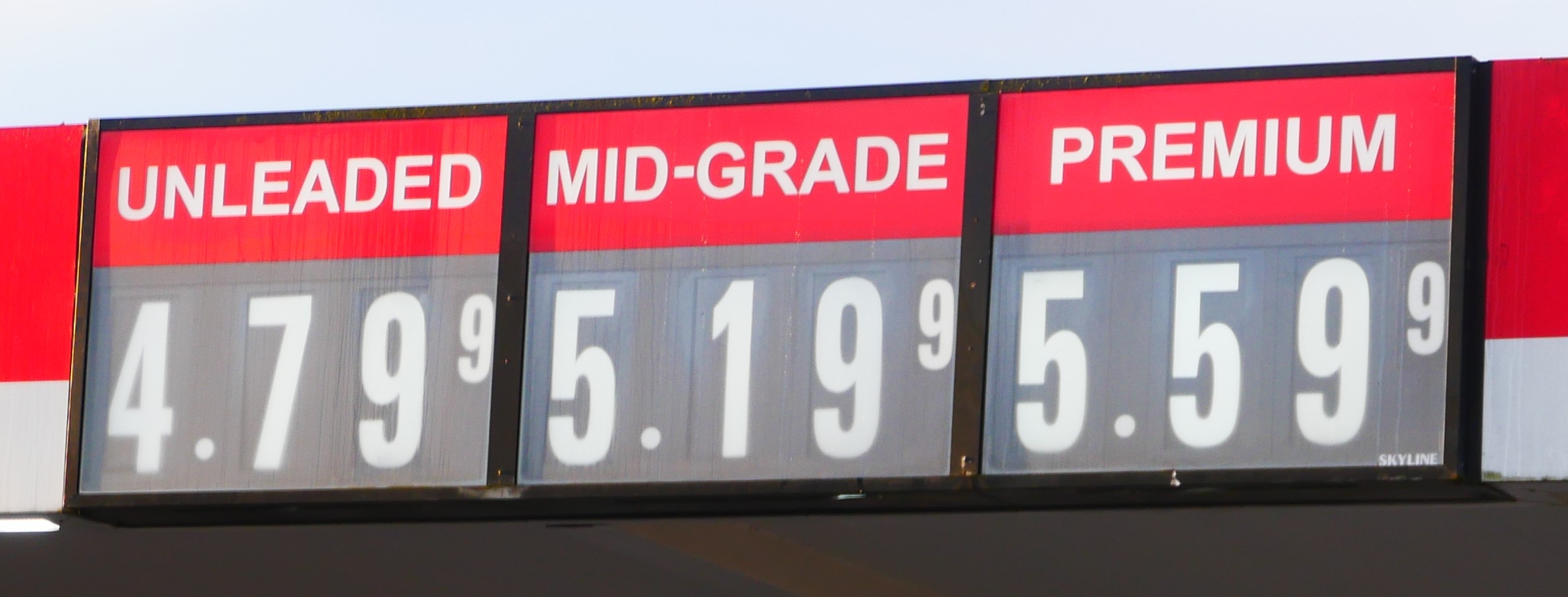
Featured image: a station sign on Easter Sunday, April 5, 2026, showing unleaded at $4.79 a gallon, by Rick Obst, CC BY 4.0, via Wikimedia Commons. The photo is from April, not from the midterms, and is used to illustrate 2026 pump prices. See all image credits.
Get Ready List
This story is about pump prices easing, so the fuel rule drops to No rush. A legal, ordinary reserve is enough.
 NO RUSH
Fuel cans and a normal reserve
Why. AAA national regular gasoline was $3.7212 a gallon on November 19, 2026, down 4.78 percent from November 12. Diesel was $5.9298, down 3.28 percent from November 11. EIA WTI spot was $89.53 on November 17, down 10.15 percent from November 3. There is no cited disruption that would justify a fuel run. (AAA and EIA, via the Candid Dragon oil desk, Factual.)
Buy before the rush: Fuel storage can and stabilizer kit (Coming soon — Candid Dragon store link).
This is a preparedness recommendation, not a claim that the whole country has run out. Ratings follow the Get Ready List key on PrepperCast. Orders are not open yet.