

Quick take
- On November 13, the FBI issued a FLASH advisory on ARTEX, an open-source penetration-testing framework that, the bureau said, malicious actors have used since at least August 2026 against financial, government, energy, telecommunications and other sectors.
- The U.S. Department of Agriculture internally disclosed a “security incident” this week and reset database passwords, taking farmer payment and loan tools offline or making them intermittent. Who was behind it, and whether any data was taken, is not known.
- JPMorgan Chase, Visa and Mastercard said a cyberattack on third-party vendors exposed some marketing data, including names and email addresses. The companies said payment services were not affected and that the incident was not connected to a separate bank-app outage earlier in the week.
- Researchers and vendors disclosed a set of critical flaws in the NGINX web server, collectively called NGINX2Root. Fixes are in NGINX Open Source 1.30.7 and 1.31.9. As of November 18–19, there were no reports of exploitation in the wild.
- Director of National Intelligence Jay Clayton said the week’s service outages were “not a cyberattack” and “not a coordinated effort by a nation-state.” That official line is on the record. A claim that those outages were one coordinated attack remains disputed. The USDA incident and the vendor breach are separate, confirmed facts and should not be collapsed into that argument.
- A household can keep running when a card network, bank app, government portal, flight system or the internet hiccups by locking down accounts, keeping some cash, storing offline copies of key documents, writing a family communications plan and packing a simple travel backup.
- This week’s flight cancellations are covered in a separate article.
Our rating: ✅ Confirmed  Factual for the advisories, company statements and official remarks below. Separate claims are rated separately.
FBI FLASH advisory on ARTEX (issued November 13): ✅ Confirmed Factual
USDA farmer payment and loan tools offline or intermittent this week: ✅ Confirmed Factual
USDA internal email describing a “security incident” and a department-wide database password reset: ✅ Confirmed as reported Factual (single-source: Nextgov/FCW and Government Executive, sister outlets that say they viewed the email; DTN independently confirmed the outages and official comments, and cited that report)
Who carried out the USDA intrusion, and whether data was taken: ❓ Unconfirmed Factual
Cyberattack on vendors serving JPMorgan Chase, Visa and Mastercard, exposing some marketing data; companies say payment services were unaffected: ✅ Confirmed Factual
How many records were exposed in that vendor breach: ❓ Unconfirmed Factual
NGINX “NGINX2Root” flaws, with fixes in 1.30.7 and 1.31.9, and no reported in-the-wild exploitation as of November 18–19: ✅ Confirmed Factual
DNI Clayton’s statement that the week’s service outages were not a cyberattack and not a coordinated nation-state effort: ✅ Confirmed that he said it Factual
A coordinated cyberattack tying this week’s service outages together: ⚠️ Disputed Factual
Lean note: These are separate events. Officials have said the week’s technical outages were not a coordinated cyberattack. That does not cancel a confirmed USDA security incident or a confirmed attack on payment-industry vendors. We keep those facts apart.
A household cannot patch a federal network or a card-company vendor from the kitchen table. What it can do is make sure a few days of ordinary life do not depend on a single login, card reader or app. Mid-November offered a clear reminder of how many everyday systems can fail at once, and for different reasons: the FBI warned that a widely available attack framework is being used against real targets; a security incident at USDA disrupted tools used for farmer payments and loans; a cyberattack on vendors serving Chase, Visa and Mastercard exposed some customer marketing data; and a critical flaw in a workhorse web server, NGINX, was disclosed and patched. At the same time, officials said a wave of service outages — banks, software, an internal NSA network — was not a coordinated cyberattack. Those facts can all be true at once. Here is what is confirmed, what is not, and a practical plan for when digital systems fail.
The FBI’s ARTEX warning
On November 13, the FBI released FLASH-20261113-001, a TLP:CLEAR advisory titled “Threat Overview of ARTEX Autonomous Penetration Testing Framework.” The bureau described ARTEX as an open-source, large language model-driven platform that threat actors have “weaponized to automate multiple phases of cyber intrusions at machine speed, from reconnaissance through data exfiltration.” [S1] The Record and BleepingComputer, which opened the same advisory, reported the same core findings. [S2] [S3]
According to the FBI, malicious actors have used ARTEX since at least August 2026 against organizations in financial services, government, technology, defense, semiconductors, energy, healthcare, manufacturing, telecommunications and legal work. The bureau said some intrusions have moved from initial targeting to privileged access in under three hours, and that the framework can let less-skilled operators run complex, multi-target operations. It said the original GitHub repository, posted in July 2026 by a developer known as Autumn-27, was taken down on October 8, 2026, after reports of abuse, but that the tool remains available through forks, archives, localized copies and a commercial version, ARTEX PRO. Researchers, the FBI said, had identified more than 1,600 publicly exposed ARTEX consoles as of early November, with the true number likely higher. [S1] [S2] [S3]
The advisory also cited earlier campaigns, including financially motivated attacks on South Korean financial institutions that, the FBI said, led to the theft of personal information from about 67,000 people, and a supply-chain compromise involving ConnectWise Cloud Backup in which attackers tried to sign in to more than 2,250 downstream customer tenants. Those figures come from the FBI’s own advisory and the reporting that followed it; they are not new U.S. incidents from this week. [S1] [S3]
Separately, the European Commission confirmed a cyber campaign against staff systems that used a publicly available tool. Commission spokesperson Thomas Regnier told reporters the investigation was ongoing, that the Commission had not detected evidence of a data breach affecting staff as a whole, and that there had been no ransomware demand. Euronews reported that the tool was ARTEX (single-source for the name of the tool). CERT-EU, the cybersecurity service for EU institutions, had already warned on November 5 that it had observed ARTEX being used in campaigns and that similar activity against EU bodies had “highly likely” involved the framework. [S4] [S5]
USDA: a confirmed security incident, with key questions still open
Nextgov/FCW and Government Executive reported on Thursday, November 19, that they had viewed an internal USDA email sent Monday by Chris Rottler, acting assistant chief information officer for the department’s Farm Production and Conservation Business Center. The email said the department’s Cybersecurity and Privacy Operations Center had “uncovered a security incident” that required the Information Services Division to “reset all database passwords in all environments, and this is requiring us to reset all applications causing outages.” A Thursday technical bulletin viewed by the same outlets warned that applications “may continue to experience intermittent outages throughout the week.” Citing people familiar with the matter, the outlets said the outages affected many financial tools used for payments between USDA and farmers, and that it is not clear who carried out the intrusion or whether any data was taken. USDA and CISA had been reached for comment. [S6]
That internal email is single-source reporting in the strict sense: Nextgov/FCW and Government Executive are sister outlets and say they viewed it together. DTN/Progressive Farmer independently confirmed the operational effects. It reported that software used by local Farm Service Agency and Natural Resources Conservation Service offices had had intermittent outages since Monday, disrupting some work on producer loans and payments. A county loan officer told DTN the problem was still present Thursday afternoon. FSA Administrator Bill Beam said he had heard of outages and that the IT department was working on them. Under Secretary of Agriculture for Farm Production and Conservation Richard Fordyce did not acknowledge a cybersecurity breach. He told DTN, “We will occasionally have outages sometimes because there’s updates.” DTN also cited the Nextgov report of the internal email. [S7]
A vendor breach at Chase, Visa and Mastercard — payments still up
On November 19, JPMorgan Chase said “third parties who provide services” to the bank “were the target of a cyberattack.” “Based on our investigation so far, we believe the attackers accessed certain marketing data held by those vendors, which may include some customer names and email addresses,” the bank said. It said there was “no disruption to our services,” that it would contact affected customers and offer support, including complimentary credit monitoring, and that it found “no connection to service disruptions some customers experienced earlier this week.” Chase had blamed that earlier outage on a software bug. [S8] [S9] [S10]
Visa said the incident involved “a third-party service provider in Asia Pacific,” that Visa’s own systems were not involved or impacted, and that “no payments data such as card numbers were affected.” Mastercard said it had been “informed of an incident at a third-party provider that resulted in the exposure of [a] limited amount of email addresses – non-payments information – from a small subset of cardholders enrolled in a specific benefit program.” It said there was “no impact to the Mastercard payment network or the ability for people to use their cards,” and that “the exposure has been contained.” [S8] [S9] [S10]
The companies did not publish a full count of affected records. Figures circulating from a private report about leaked datasets have not been confirmed by the companies or by a second independent count, and we are not treating them as established. If your bank or card brand contacts you, follow that notice. A credit freeze, discussed below, is a free step that can block someone from opening new credit in your name; it is not a substitute for watching accounts you already have.
NGINX “NGINX2Root”: a serious flaw, with patches out
On November 18–19, the Center for Internet Security and security reporters described a set of critical vulnerabilities in NGINX, a widely used web server, reverse proxy and load balancer. Researchers have collectively called the five flaws “NGINX2Root.” The most severe can allow remote code execution under some conditions, including where address-space layout randomization is disabled or bypassed. The Center for Internet Security listed the flaws as CVE-2026-123007, CVE-2026-123633, CVE-2026-123634, CVE-2026-121810 and CVE-2026-113425. [S11] [S12]
NGINX’s own security advisories, and Help Net Security’s reporting, say the Open Source releases that fix these flaws are 1.30.7 and 1.31.9. The Center for Internet Security said there were no reports of the vulnerabilities being exploited in the wild as of November 18. Help Net Security reported the same as of November 19, and said none of the flaws were listed in CISA’s Known Exploited Vulnerabilities catalog that day. A public proof-of-concept exists for CVE-2026-123007. The Center for Internet Security rated the risk to home users as low; this is mainly a problem for organizations that run NGINX, not for a household PC. It still matters to ordinary users because so many of the sites and services they depend on sit behind NGINX, and because emergency patching is one of the reasons systems sometimes go down for maintenance. [S11] [S12] [S13]
Connected building equipment is a target too. In the UK, the BBC (Factual) reported on November 20 that the National Cyber Security Centre, the Department for Environment, Food & Rural Affairs and the Food Standards Agency worked with researchers at Omega Solutions and Pen Test Partners to take thousands of vulnerable supermarket refrigeration controllers off the open internet after waves of fridge-controller hacks in Europe spoiled food at hundreds of stores. The controllers’ maker, RDM, said it saw no sign of malicious activity on them. [S23] [S24]
Officials say the outage wave was not a cyberattack
A separate argument has been running alongside these disclosures: that a cluster of service outages this week — including Microsoft 365, bank websites, and an internal National Security Agency network — was in fact a coordinated cyberattack. Director of National Intelligence Jay Clayton rejected that claim. In remarks the White House posted on November 17, and again in a November 18 written release, Clayton said: “This is not a cyberattack, and this is not a coordinated effort by a nation state. We’ve looked very closely.” He said institutions were patching and upgrading systems, and that some were “not coming back as expected.” [S14] [S15]
Secretary of State Marco Rubio, in the same White House release, said, “We have zero evidence or any reason to believe that any of these isolated or individual instances have anything to do with nefarious actors, with cyber hackers, with criminals, with another nation-state, with a malign actor of any kind.” He said the Microsoft incident was not connected to the FAA disruption, and that the FAA problem was not connected to the bank outages. CBS News quoted Clayton on Fox Business tying the NSA’s Tuesday network problem to patching after a PHP vulnerability was disclosed. The NSA, in a Tuesday statement, called it a “temporary degradation during scheduled routine maintenance” and said “mission-critical capabilities remain fully operational.” Accounts of when that internal network returned were not fully aligned: CBS, on Wednesday, cited sources saying it was back up, with staggered arrivals continuing; NBC News, on Thursday, cited sources saying it remained down that day and that some staff had been told to work from home a third day. Both reports said there was no sign of a cyberattack. [S15] [S16] [S17]
Keep the claims separate. Officials have given a clear public answer on the outage wave. That answer does not erase the FBI’s ARTEX advisory, the USDA security incident, or the confirmed attack on payment-industry vendors. Those are different events, with different evidence. A claim that the outages themselves were one coordinated attack remains disputed.
On November 20, PolitiFact (Factual) found no evidence that the outages were coordinated or connected. See our chatter check on the attack claim. [S22]
A household plan when systems go down
You do not need to predict the next outage, or settle an argument about what caused this week’s problems, to prepare for a few days without a bank app, a card reader, a government portal or a reliable internet connection. The same habits help whether the cause is a hack, a software bug or a maintenance mistake.
Lock down your accounts
CISA’s “Secure Our World” guidance is plain: use a long, random, unique password on every account, and store those passwords in a password manager so you only have to remember one strong master passphrase. CISA recommends passwords of at least 16 characters, and says a password manager can generate, store and fill them in. Then turn on multifactor authentication (MFA) — also called two-factor or two-step verification — on every account that offers it, especially email, banking and other financial accounts. CISA notes that even if someone steals a password, they still have to clear the second step. An authenticator app or another method your bank offers is worth setting up before you need it, not after an outage or a breach notice. [S18]
A credit freeze is a separate, free protection against someone opening new credit in your name if personal data is later exposed. USA.gov explains that a freeze restricts access to your credit report, and that you place or lift it for free at each of the three major credit reporting agencies: Equifax, Experian and TransUnion. Requests made online or by phone must be processed within one business day to freeze, and within one hour to lift; mailed requests have a three-business-day deadline. The Consumer Financial Protection Bureau notes that a freeze does not affect your credit scores, that you must contact each bureau separately, and that paid “credit locks” are no more effective than the free freeze. You will need to lift the freeze temporarily when you yourself apply for new credit. A freeze is aimed at new accounts; existing creditors can still see your file. For a closer look at cash and records when payment apps fail, see What to Have on Hand When Banks or Card Payments Go Down. [S19] [S20]
Keep some cash on hand
Ready.gov’s financial preparedness page says to keep a small amount of cash at home in a safe place, in small bills, “because ATMs and credit cards may not work during a disaster when you need to purchase necessary supplies, fuel or food.” The same advice appears in Ready.gov’s emergency kit list, which includes cash or traveler’s checks. Ready.gov does not set a dollar amount. A practical target is enough to cover a few days of groceries, fuel and other essentials for your household, stored securely. There is no need to empty a bank account or stand in a long ATM line. The point is not to live off cash; it is to have a backup when the card reader or the banking app does not work. [S21]
Keep offline copies of key documents
If the only copy of your insurance policy, ID or bank details lives in an email inbox or a portal, an outage can lock you out of the very records you need. Ready.gov’s kit guidance says to keep copies of insurance policies, identification and bank account records, saved electronically or in a waterproof, portable container. Its financial preparedness page adds that important documents can also be stored in a safe deposit box, on an external drive or in the cloud. For a systems-fail plan, do not rely on the cloud alone. Keep a paper set, or a copy on a drive you control, and store it safely. Be careful with Social Security numbers and account numbers. [S21]
Write a family communications plan
Ready.gov’s family plan starts with a simple fact: your family may not be together when something goes wrong. Agree how you will contact one another and reconnect if you are separated, and pick a meeting place that is familiar and easy to find. The agency also asks households to decide how they will receive emergency alerts, where they will shelter, and what their evacuation route is, then to write the plan down and practice it. Put key phone numbers on paper. A group text is useful when it works; it is not a plan by itself. For more on radios, meeting places and what to do when phones or the internet are down, see Staying in Touch When the Power or Internet Goes Down. [S21]
Have a travel backup
If you are away from home when booking apps, payment systems or other travel tools stall, a little paper and a little cash go a long way. Keep a written copy of your confirmation number, the airline’s phone number and your hotel address, not only a screenshot in an app. Ready.gov’s kit guidance includes a cell phone with chargers and a backup battery, local maps, and a small kit in the car in case you are stranded. Add medications for a few extra days, snacks, a refillable water bottle and a change of clothes in a carry-on. Know a ground route home; rental cars and trains can sell out quickly when a lot of people are stuck. Our earlier guide, When the Systems Fail, walks through that traveler’s kit in more detail. [S21]
If the outage lasts — or the power goes too
Some failures are only digital: the lights stay on, but the bank app, the card terminal or a government portal does not work. In that case, use the cash and paper records you already set aside, watch official notices from your bank or agency, and avoid panic buying. A longer outage can also take down power, and then the list gets longer. Ready.gov notes that an extended power outage can disrupt communications, water and transportation, and can close grocery stores, gas stations, ATMs and banks. It can also spoil food and interfere with medical devices. [S21]
- Inventory what in your home depends on electricity or the internet, especially medical devices and refrigerated medicines, and plan a backup for each.
- Keep the refrigerator and freezer closed. Ready.gov says a refrigerator keeps food cold about four hours, and a full freezer about 48 hours.
- Use a generator outdoors only, at least 20 feet from windows, doors and attached garages. Never heat a home with a gas stove or oven.
- Unplug appliances and electronics so a surge does not damage them when power returns.
- If heat or cold is extreme, go to a community location that has power.
- When in doubt, throw it out: discard food that has been at 40°F or higher for two hours or more. If power is out more than a day, discard refrigerated medicines unless the label says otherwise, and call your pharmacist.
A three-day supply of water, food, light and a way to hear official news covers most short failures and gives you a head start on a longer one. That is the purpose of our 72-Hour Kit checklist and the Lights Out power-outage plan. For water specifically, see Water Storage Basics.
Our view (opinion): You cannot patch USDA, a card-network vendor or a web server from home. You can make sure your household is not one frozen login or one dead card reader away from being stuck. Do the quiet work now — MFA, a password manager, a credit freeze, some cash, a folder of copies, a written comms plan — and this week’s headlines become a drill, not a crisis. Officials may be right that the outages were not a coordinated attack. Confirmed incidents still happened. Either way, the household job is the same.
Sources
- [S1] Federal Bureau of Investigation, FLASH-20261113-001, “Threat Overview of ARTEX Autonomous Penetration Testing Framework,” November 13, 2026. Factual (primary).
- [S2] Jonathan Greig, The Record, “FBI flash alert says Artex tool automating cyberattacks at ‘machine speed,’” November 13, 2026. Factual.
- [S3] Lawrence Abrams, BleepingComputer, “FBI warns ARTEX AI hacking tool is powering global cyberattacks,” November 15, 2026. Factual.
- [S4] Luca Bertuzzi, Euronews, “EU Commission hit by large-scale cyberattack with data leakage unknown,” November 19, 2026. Factual. Single-source for naming ARTEX as the tool used against the Commission.
- [S5] CERT-EU, “From Penetration Testing to Cyber Threat: Beware of ARTEX,” November 5, 2026. Factual.
- [S6] David DiMolfetta and Jory Heckman, Nextgov/FCW, “USDA grapples with security breach as IT staff take multiple systems offline,” November 19, 2026, 4:42 p.m. ET. Factual. Single-source, with sister outlet Government Executive, for the internal USDA email.
- [S7] Jake Zajkowski, DTN/Progressive Farmer, “USDA Loan Software Systems Face Outages Amid Cybersecurity Concerns,” November 19, 2026, 5:41 p.m. CST. Factual.
- [S8] Taylor Dunn and Bill Hutchinson, ABC News, “JPMorganChase, Mastercard, Visa report cyberattack on third-party service providers,” November 19, 2026. Factual.
- [S9] Emma Roth, The Verge, “JPMorgan Chase reveals data breach, but says it’s unrelated to this week’s banking outage,” November 19, 2026. Factual.
- [S10] Bloomberg, via Moneycontrol, “Visa, Mastercard, JPMorgan disclose customer data exposure in third-party vendor cyberattack,” November 19, 2026. Factual.
- [S11] Center for Internet Security, “Multiple Vulnerabilities in NGINX Could Allow for Remote Code Execution,” advisory 2026-136, November 19, 2026. Factual.
- [S12] Zeljka Zorz, Help Net Security, “NGINX2Root: F5 patches five critical NGINX vulnerabilities,” November 19, 2026. Factual.
- [S13] nginx.org, nginx security advisories (CVE-2026-123007, CVE-2026-123633, CVE-2026-123634, CVE-2026-121810 and CVE-2026-113425; not vulnerable: 1.31.9+, 1.30.7+). Factual (primary).
- [S14] The White House, “This is not a cyberattack and this is not a coordinated effort by a nation-state” – DNI Jay Clayton (video), November 17, 2026. Factual (primary official record).
- [S15] The White House, “No Indication of a Cyberattack”: DNI Clayton and Secretary Rubio on Recent Tech Outages, November 18, 2026. Factual (primary official record).
- [S16] Nicole Sganga and Laura Geller, CBS News, “National Security Agency network outage linked to software vulnerability,” November 18, 2026. Factual.
- [S17] Dan De Luce, Kevin Collier and Nicole Acevedo, NBC News, “Classified NSA network is still down, leaving some staff working from home,” November 19, 2026. Factual.
- [S18] CISA, “Use Strong Passwords” and “Turn On MFA.” Factual.
- [S19] USA.gov, “How to place or lift a security freeze on your credit report,” last updated November 13, 2025. Factual.
- [S20] Consumer Financial Protection Bureau, “What is a credit freeze or security freeze on my credit report?” Factual.
- [S21] Ready.gov (FEMA), Financial Preparedness, last updated March 13, 2026; Build A Kit, last updated July 1, 2026; Make A Plan, last updated September 1, 2026; Power Outages, last updated June 4, 2026. Factual.
- [S22] Madison Czopek, PolitiFact, “Two reasons people think recent tech failures must be connected: our brains and online platforms,” November 20, 2026. Factual.
- [S23] Joe Tidy, BBC News, “Tens of thousands of UK fridges secured from hackers in secret nationwide operation,” November 20, 2026. Factual.
- [S24] Ken Munro and Andrew Tierney, Pen Test Partners, “The fridge hack UK supermarkets narrowly avoided?” November 20, 2026. Factual (primary; the firm took part in the effort).
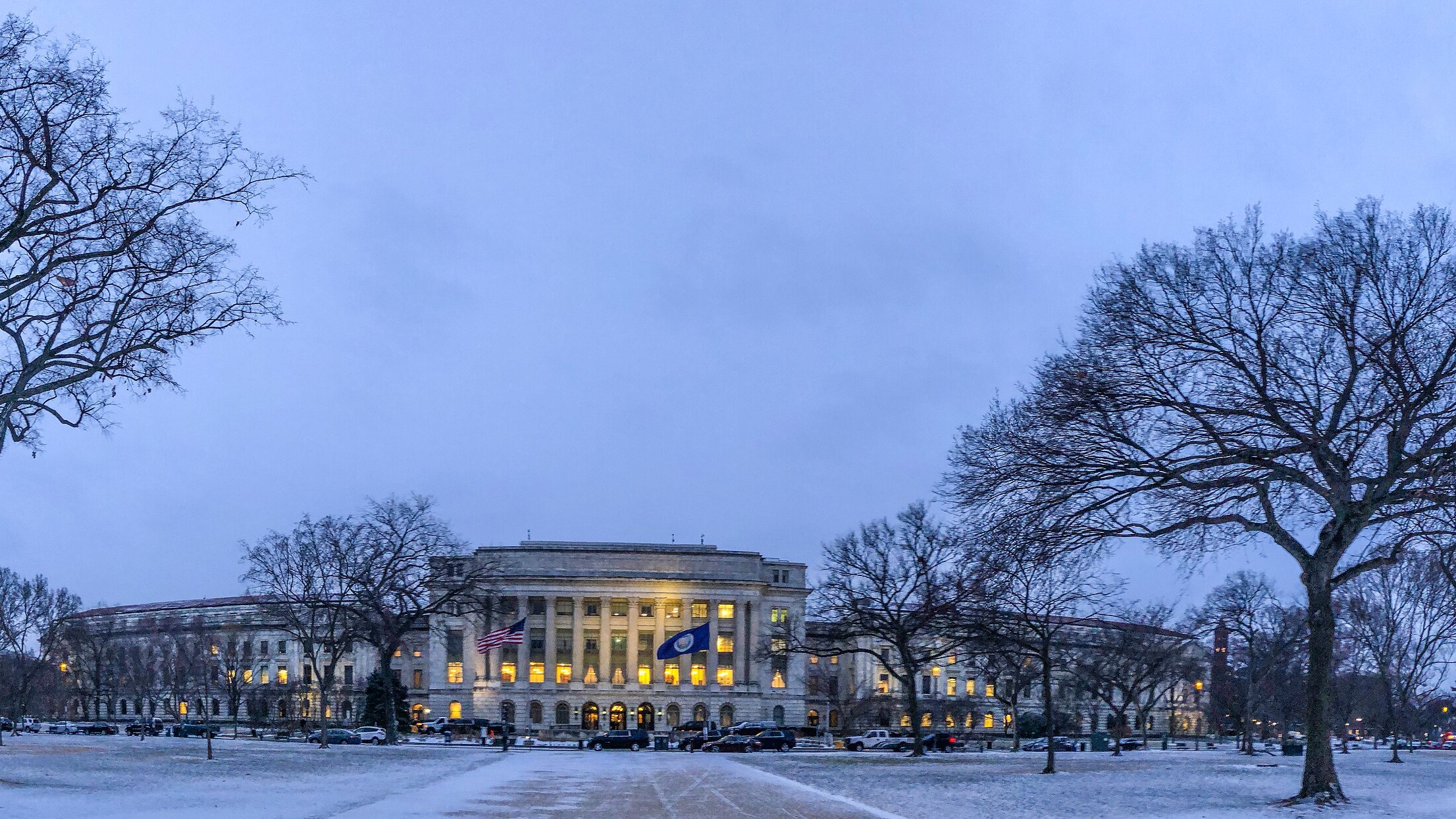
Featured image: USDA Whitten Building (39033221524), by Preston Keres, U.S. Department of Agriculture, Jan. 17, 2018. Public domain (U.S. government work), via Wikimedia Commons. Cropped to 16:9. See all image credits.
Related on Candid Dragon
- A Week of Flight Cancellations: What Caused Them and What It Means for Thanksgiving Travel
- The 72-Hour Kit: A Field-Ready Emergency Checklist
- Lights Out: A Power-Outage Plan That Also Covers a Solar Storm
- When the Systems Fail: Preparedness Lessons from the FAA Ground Stop
- What to Have on Hand When Banks or Card Payments Go Down
- Staying in Touch When the Power or Internet Goes Down
- Water Storage Basics: How Much, How to Store It, How to Make It Safe