

Quick take
- The FAA’s nationwide ground stop on November 13 caused one of the worst U.S. travel days of the year, and airlines needed until about Monday, November 16, to recover.
- Officials blame a router installed during a copper-to-fiber upgrade by FAA contractor L3Harris, which flooded the FAA’s telecom network with data. They have not yet said whether the router, the install or the configuration was at fault.
- Officials say there was no evidence of a cyberattack. United’s separate outage on November 16 was also not cyber-related, the airline says.
- Since then, delays have been routine and mostly weather-related.
- Thanksgiving air travel is forecast near last year’s level. AAA’s forecast was prepared before the ground stop.
Our rating: ✅ Confirmed  Factual for the ground stop, the multi-source cancellation counts, the officially stated cause and the Thanksgiving forecasts. Single-source and still-open claims are labeled separately below.
Nationwide ground stop on November 13, and airline recovery through about Monday, November 16: ✅ Confirmed Factual
Friday and Saturday cancellation counts: ✅ Confirmed Factual
The about-18,000 four-day cancellation total, the Sunday and Monday counts, and the per-airline totals from Cirium: ✅ Confirmed as reported Factual (single-source: CNBC)
Officials’ account of the cause — a data flood on the FAA telecom network tied to router work by contractor L3Harris: ✅ Confirmed that this is the official account Factual
The exact fault (a bad router, installer error or a configuration problem): ⚠️ Disputed / still under investigation Factual
AAA and TSA Thanksgiving travel forecasts: ✅ Confirmed Factual
Lean note: Straight reporting that agrees across Reuters, CBS, NBC, CNBC, CNN, ABC and the FAA’s own Q&A. Early accounts varied, and the official account narrowed over the weekend, as noted below. The New York Post item on the San Francisco weather stop is tagged Leans Right in the source list; the facts in that report are used only for that local delay.
What happened on November 13
On the afternoon of Friday, November 13, the FAA ordered a nationwide ground stop and halted departures at U.S. airports. The stop began just before 3 p.m. CT and lifted after 7 p.m. CT, according to CNBC. The FAA says the system “was made stable and air traffic resumed as of 8:15 p.m.” ET (7:15 p.m. CT). [S1] [S3] Reuters and CNBC both describe it as the longest nationwide halt to U.S. departures since Sept. 11, 2001. [S2] [S3]
According to NBC News, officials had detected disruptions at 17 of the FAA’s 22 centers that handle aircraft at high altitude by the time departures were halted. [S6] CBS News reported that about 3,100 aircraft were in the air bound for U.S. airports when the stop began. All of them landed safely, according to Homeland Security Secretary Markwayne Mullin. [S4]
How many flights were canceled
| Day | Cancellations (U.S.) | Source |
|---|---|---|
| Fri Nov 13 | 9,159 canceled, 7,190 delayed (FlightAware); “about 9,200” | CBS [S4]; Reuters [S2]; CNBC “more than 9,000” [S3] |
| Sat Nov 14 | more than 6,400 canceled and 8,000+ delayed as of 9:35 p.m. ET | Reuters [S2]; CNBC “roughly 6,500” [S3] |
| Sun Nov 15 | more than 2,000 canceled | CNBC [S3] (single-source) |
| Mon Nov 16 | nearly 300 canceled, close to 1,000 delayed | CNBC [S5] (single-source) |
| Fri–Mon morning total | about 18,000 canceled; “hundreds of thousands of travelers” stranded | CNBC, citing FlightAware [S5] (single-source) |
- Airlines: Over the four days, American Airlines canceled 5,367 flights (close to 22% of its schedule) and Delta canceled 3,434 (17%). Southwest and United each canceled more than 16% of their schedules, according to Cirium data reported by CNBC (single-source). [S5] On Saturday morning, CBS counted Delta at 640 cancellations, United at 530 and American at 488. [S4]
- Airports: CBS reported that cancellations on Saturday morning hit Atlanta Hartsfield-Jackson, Chicago O’Hare and New York JFK the hardest. It also reported delays building Friday at Boston, Atlanta, Miami, Pittsburgh, New York, Los Angeles and Baltimore. [S4]
- Weather: Weather was also a factor. CNBC notes that bad weather on Thursday and Friday contributed to disruptions before the ground stop. [S3] [S5]
- Scale: CBS and Cirium say Friday was the second-worst U.S. cancellation day of 2026, behind the Jan. 25 snowstorm (11,607 cancellations). [S3] [S4]
What officials say caused it
- The FAA’s account: In its Q&A, the FAA says its legacy equipment “became unstable when data began flooding the FAA FTI network, at a rate of 1,000 connection attempts every 4 to 5 seconds.” The FAA’s initial investigation points to two locations: a radar site in Amarillo, Texas, and a radio site in El Dorado, Arkansas. Contractor L3Harris “had been doing work at the El Dorado site, including deployment of a new router.” Both sites were blocked, and a broadcasting function was disabled on all the new routers. [S1]
- Transportation Secretary Sean Duffy: “We think it was the installation or the router that was the bad actor.” Duffy said both routers are at an L3Harris lab in Florida for examination. [S5] Reuters quotes him: “We’re working to determine whether we had incompetence, meaning was it user error or installer error from L3Harris, or did they install a faulty router? We haven’t determined what the fault was.” [S2]
- L3Harris: L3Harris says it is “supporting the FAA in its investigation.” It says it has completed more than 70% of the copper-to-fiber conversion. [S14]
- How the account changed: On Friday, CBS reported conflicting early explanations from its sources, including old Cisco routers and a network update. Mullin said at the time that new security patches “appeared to overwhelm” the routers. [S4] By Saturday and Sunday, the officials’ account had narrowed to the router installation. [S1] [S2] [S5]
- On a cyber cause: FAA Administrator Bryan Bedford said there was “zero evidence” the problem was caused by something “nefarious.” [S5] Duffy, asked whether a foreign nation attacked the network, said “we don’t believe so.” [S8] Reuters reports that federal agencies scrambled Friday to rule out a cyberattack before the problem was traced to the router installation. [S2]
Monday, November 16: a separate United outage
United Airlines had a separate technology outage on Monday afternoon that delayed departing flights. United said flights already in the air and United Express flights were not affected. [S8] [S9] Accounts of how long it lasted differ: United’s spokesperson told CNN about 30 minutes, with fewer than 150 flights affected. [S8] CNBC reported the pilots’ union said it affected “multiple pilot facing applications,” including final weight figures for departing flights. [S9] United said there was “no indication that this was a cybersecurity-related issue.” The FAA said “it’s not an FAA equipment issue.” [S8] [S9] CNBC reported no indication that United’s outage was related to Friday’s ground stop. [S9]
For this week’s separate cyber incidents, and a household plan for when everyday systems fail, see This Week’s U.S. Cyber Incidents — and What to Do When Everyday Systems Fail.
Since then: ordinary, weather-driven delays
- Wednesday, November 18, South Florida: Short ground stops hit Miami International (low visibility, lifted shortly after 10 a.m. ET) and Fort Lauderdale-Hollywood (thunderstorms, lifted shortly before 10 a.m. ET). By 2:30 p.m. ET, FlightAware showed 330 delayed flights at MIA and 131 at FLL. Flooding closed some roads near FLL. [S10]
- Wednesday, November 18, San Francisco: The FAA issued a ground stop at SFO for wind and weather as heavy rain hit the Bay Area. Departing flights were averaging delays of more than three hours at the time. [S11]
- We found no further mass-cancellation event from November 17 through November 19.
What’s ahead for Thanksgiving
- AAA: AAA projects 81.5 million Americans will travel at least 50 miles from Tuesday, November 24, through Monday, November 30, a 0.1% dip from last year. That includes 5.96 million domestic air travelers (down 0.2%). Round-trip domestic fares are up 17%, averaging $800. AAA’s forecast was prepared the week of Oct. 12, before the ground stop. [S12]
- TSA: “Early indicators show TSA has the potential to screen more than 3 million passengers nationwide on Sunday, Nov. 29.” TSA says it will release its official national projection later this week. Its advice is to arrive at least two hours early for domestic flights and three hours early for international flights. [S13]
- Roads: AAA and INRIX expect Tuesday, Wednesday, Sunday and Monday to be the busiest driving days. [S12]
- FAA: The FAA says it is continuing to investigate the root cause with L3Harris, and the broadcasting function remains disabled on the new routers. [S1] Officials have not announced a final report date.
What this means for travelers and households
- Before you go: Before heading to the airport, check your flight status with your airline and on the FAA’s National Airspace System status page (nasstatus.faa.gov). The FAA points travelers to that page. [S1]
- If plans slip: Keep a short “plans slip” kit in your carry-on: medications, a phone charger and power bank, snacks, a paper copy of your itinerary and key phone numbers. Our 72-Hour Kit checklist covers the basics.
- If systems fail: When a system you rely on goes down, simple backups help most: some cash, a written contact list and a plan to reach family. See When the Systems Fail: Preparedness Lessons from the FAA Ground Stop.
- At home: If you are hosting or staying home, our Lights Out power-outage plan covers lighting, food safety and staying in touch if the power goes out.
- Background: Our earlier report, The FAA Ground Stop: What First Reports Got Right, has the minute-by-minute timeline.
Sources
- [S1] FAA, “Nationwide Ground Stop: Questions and Answers” (November 15, 2026). Factual (official record).
- [S2] David Shepardson, Reuters, “US air travel disruptions to persist until late on Sunday, FAA head says” (November 14, updated November 15, 2026). Factual.
- [S3] CNBC, “Duffy ties router in southern Arkansas to nationwide ground stop” (November 14–15, 2026). Factual.
- [S4] CBS News, “FAA issues nationwide ground stop” (November 13–14, 2026). Factual.
- [S5] CNBC, “FAA ground stop: Flight delays linger, but schedule improves Monday” (November 15–16, 2026). Factual. Single-source for the about-18,000 four-day total, the Sunday and Monday cancellation counts, and the per-airline Cirium totals.
- [S6] Shayna Jacobs, Doha Madani and Jay Blackman, NBC News, “How a router problem at one FAA site led to a nationwide ground stop” (November 14, 2026). Factual.
- [S7] ABC News, “Transportation Secretary Duffy says ATC routers’ ability to broadcast data turned off, being investigated” (November 15, 2026). Factual.
- [S8] Danya Gainor, Pete Muntean and Alexandra Skores, CNN, “United Airlines says it resolved system outage that delayed flights” (November 16, 2026). Factual.
- [S9] Michele Luhn, CNBC, “United Airlines resolves system outage that affected departing flights” (November 16, 2026). Factual.
- [S10] Michelle Marchante and Vinod Sreeharsha, Miami Herald, “Flights resume at MIA, FLL — but there still could be issues at the airports” (November 18, 2026). Factual.
- [S11] Ross O’Keefe, New York Post, “San Francisco International Airport ground stop halts all flights” (November 18, 2026). Leans Right (outlet); straight report.
- [S12] AAA Newsroom, Thanksgiving holiday travel forecast (November 16, 2026). Factual.
- [S13] TSA, Harry Reid International Thanksgiving readiness press release, including the national early indicator (November 18, 2026). Factual (official).
- [S14] L3Harris, statement on the November 13 ground stop. Factual (company statement).
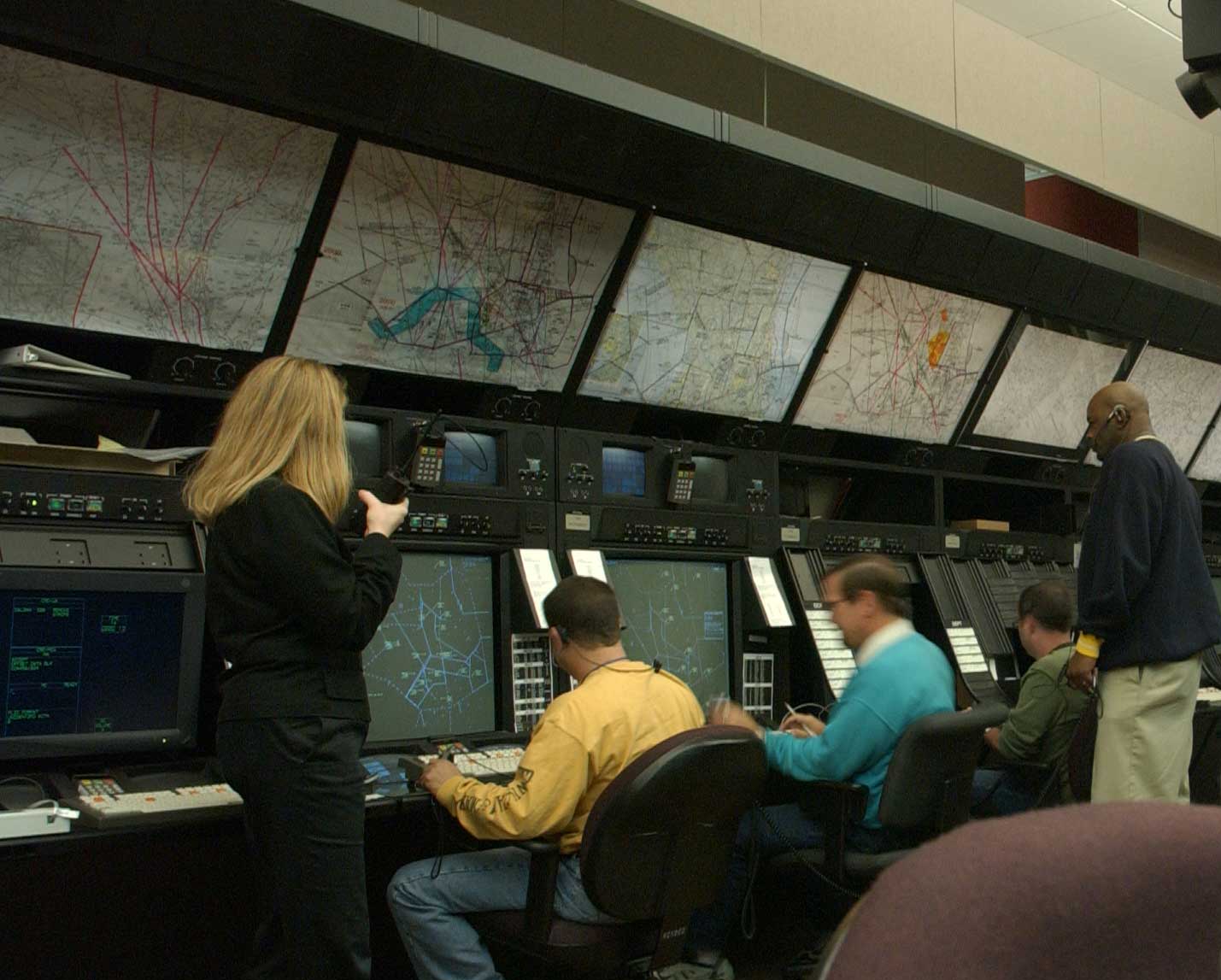
Featured image: Air traffic controllers at the Washington ARTCC, Federal Aviation Administration. Public domain (U.S. government work), via Wikimedia Commons. See all image credits.
Related on Candid Dragon
- This Week’s U.S. Cyber Incidents — and What to Do When Everyday Systems Fail
- The FAA Ground Stop: What First Reports Got Right
- When the Systems Fail: Preparedness Lessons from the FAA Ground Stop
- The 72-Hour Kit: A Field-Ready Emergency Checklist
- Lights Out: A Power-Outage Plan That Also Covers a Solar Storm