

Quick take
- Price: the White House announced the ballroom on July 31, 2025, at about $200 million. The contractor’s March 2026 estimate put it at $600 million.
- Split in that estimate: $293 million private, $155 million Secret Service, $149 million White House Military Office and $3 million Executive Residence. That makes about half of it public money. This split is Unconfirmed: the documents have been reported, but the White House has not confirmed them.
- Taxpayer money moved: in June 2026 the budget office released $351.6 million in Secret Service funds from the One Big Beautiful Bill Act for “White House Security Measures.”
- Private money: a leaked donor spreadsheet logs about $333 million. Apple and Nvidia gave $25 million each, and some donors asked to stay anonymous. Trump was not listed on the White House’s donor list.
- Order of events: the East Wing was demolished in October 2025. Design approvals came later (Fine Arts Commission, February 19, 2026; Planning Commission, April 2, 2026). The Supreme Court let work continue 5–4 on August 31, 2026, without ruling it legal.
- Before the ballroom: the East Room seated about 200 and the State Dining Room about 130–140. Bigger state dinners went into South Lawn tents. Obama’s 2009 India dinner (about 400 guests) cost the State Department $572,187, about $900,000 today.
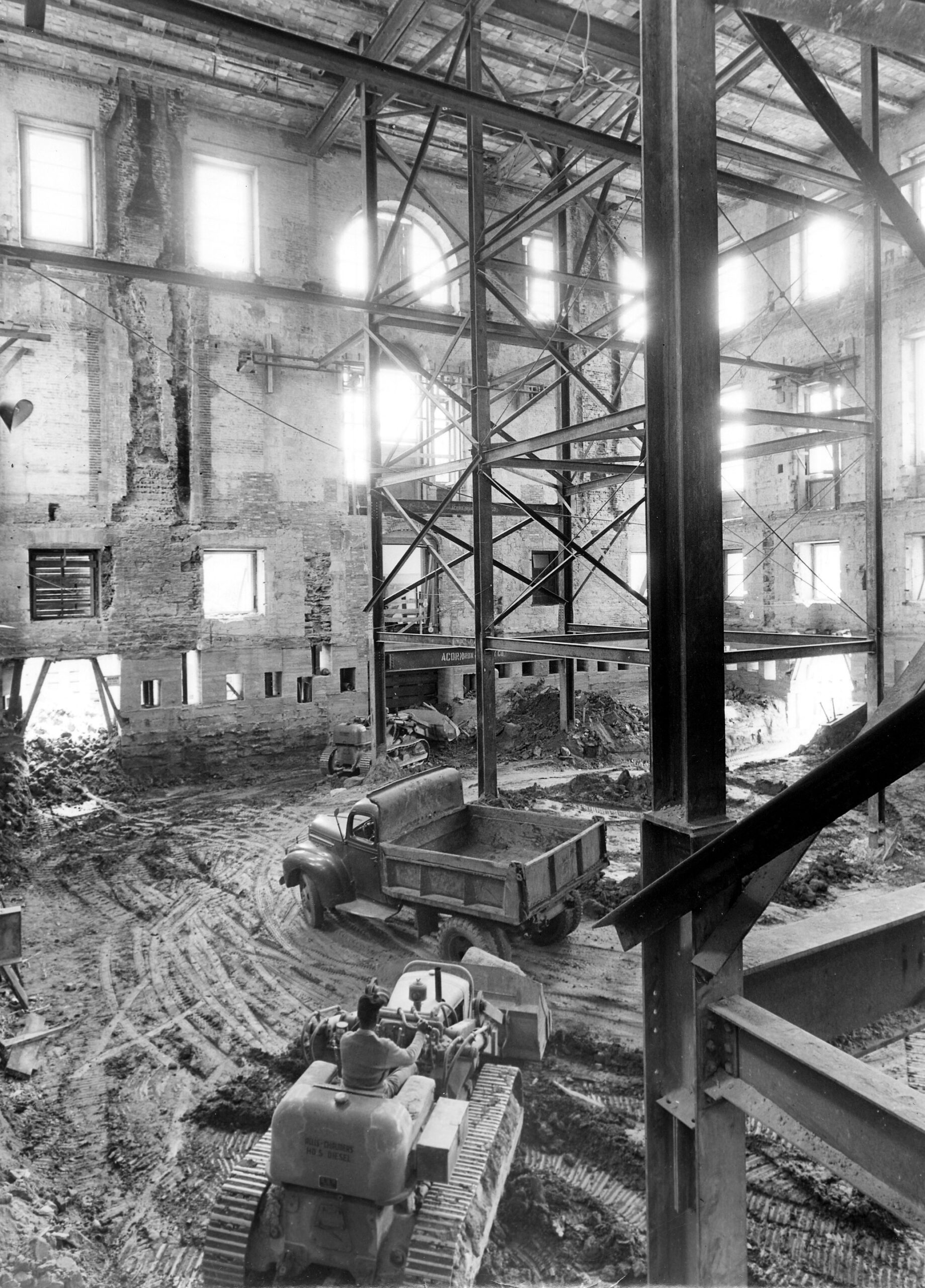
- Past presidents, today’s dollars: Truman’s 1949–52 rebuild cost about $81 million, from Congress. The East and West Wing systems overhaul (funded in 2008, built from 2010) cost about $582 million, from GSA. Ford’s pool (about $419,000) and Reagan’s 1981 redo (about $3.1 million) were paid with private donations.
- Myth check: Obama did not spend $376 million on a basketball court. That money was for wiring, HVAC and security systems; he only added hoops to the tennis court.
Our rating: ✅ Confirmed  Factual
✅ Confirmed Factual Lean note: The numbers come from official records (the White House, the Commission of Fine Arts, the National Capital Planning Commission, OMB apportionments, the National Park Service and the Congressional Research Service) and from reporting the administration has not refuted line by line. The true project total — $600 million in contractor documents versus the White House figure of about $400 million — and whether taxpayers are paying for the ballroom or only for security are disputed. Critics’ and the administration’s framings are both quoted and labeled.
The White House announced a new East Wing ballroom in July 2025 as a privately funded project. Since then the official price has gone up, contractor documents have put a higher figure on the work, and federal money has been moved for “White House Security Measures.” This analysis lays out the numbers that are on the record, who is paying, how that compares with earlier presidents in today’s dollars, and which claims about the project do not hold up.
1. Total cost, and how it changed
The public price has moved several times. The White House’s own figures are confirmed as official statements. The higher contractor totals come from documents first reported by the Washington Post and restated by other outlets; the White House has not confirmed those documents, and the $600 million figure is Disputed.
About $200 million
✅ Confirmed
July 31, 2025
About $200 million, with “President Trump, and other patriot donors” to fund it; “The United States Secret Service will provide the necessary security enhancements and modifications.”
White House statement; NPR [S1] [S17]
(official)
about $300 million
✅ Confirmed
October 2025 (demolition week)
Trump says about $300 million.
Widely reported; The Guardian notes the East Wing was destroyed in October. [S3]
(stated figure)
$478 million
❓ Unconfirmed
October 20, 2025
Contractor project summary: $478 million, with taxpayers funding nearly half.
Washington Post documents, as later summarized secondhand. [S2]
Single-origin documents, secondary summary.
$600 million
⚠️ Disputed
March 5, 2026
Contractor (Clark Construction) summary: $600 million.
Washington Post; restated by Roll Call, The Guardian and Axios. [S2] [S4] [S3] [S10] [S65]
The documents say $600 million; on June 18, 2026, the White House said donors are funding “approximately $400m.” [S3]
up to $400 million
✅ Confirmed
March 31, 2026
Trump: up to $400 million. “This is taxpayer-free. We have no taxpayer putting up 10 cents.”
Washington Post; The Guardian [S2] [S3]
(quote confirmed)
at least $900 million
❓ Unconfirmed
August 12, 2026
All White House-grounds construction (ballroom, helipad, visitor screening center, Lafayette Square and other work): at least $900 million, mostly taxpayer-funded, per the reporting.
Washington Post reporting, restated by Reuters and The Independent. [S19] [S20]
Single-origin documents; not refuted by the White House.
2. Cost breakdown
- No official public line-item breakdown exists. ✅ Confirmed The White House has released no itemized budget for construction, design (McCrery Architects), engineering (AECOM), demolition or the underground security and bunker work. [S1] [S3]
- The only breakdown on record is the contractor’s March 5, 2026, funding split: $293 million private / $155 million Secret Service / $149 million White House Military Office / $3 million Executive Residence = $600 million. [S2] [S3] ❓ Unconfirmed Unconfirmed. The documents are real as reported, but the White House has not confirmed them.
- Secret Service money was reportedly budgeted for parts of the job: $3.6 million for site preparation and more than $1.6 million for part of the demolition, according to emails and estimates obtained by the Washington Post and later summarized secondhand. ❓ Unconfirmed
- The underground bunker / security center: Trump has described the project as including “bomb shelters and major medical facilities.” [S2] Axios has called it “the ballroom and its underground bunker.” [S10] No official cost for the bunker or Presidential Emergency Operations Center work has been released. The National Capital Planning Commission does not review below-grade work. [S9] ✅ Confirmed No figure has been released.
Contractor funding split, March 5, 2026
$600 million ❓ Unconfirmed
[S2] [S3] The documents are real as reported, but the White House has not confirmed them.
3. Who is paying (private side)
- Total private: about $333 million, from an internal fundraising spreadsheet (67 gifts over $10,000 and 57 over $100,000, through late September 2026). ✅ Confirmed Washington Post, an NPR interview with a Washington Post reporter, and CNBC. [S5] [S6] [S7]
- Named donors (as reported): Apple $25 million and Nvidia $25 million (Nvidia confirmed the gift to CNBC); Cisco and ServiceNow $5 million each (both confirmed to CNBC). Amazon, Palantir, Meta, Microsoft, HP, Micron, Salesforce and Vast Space are listed in the millions; Microsoft and Meta declined to comment. Lockheed Martin is among the largest. [S6] [S7] ✅ Confirmed
- Anonymous money: the spreadsheet includes companies that asked to remain anonymous. ✅ Confirmed NPR The reported figure of at least $77 million from anonymous donors, Nvidia among them, comes from the Washington Post as relayed by Forbes. ❓ Unconfirmed Unconfirmed.
- Conduit: donations go through a nonprofit trust, the Trust for the National Mall, the National Park Service’s philanthropic partner. Donors received a pledge form for the “Donald J. Trump Ballroom.” [S7] ✅ Confirmed
- Quid pro quo? The Washington Post reporter told NPR: “We have no evidence of a quid pro quo,” but many donors have business before the government, and one donor’s father was pardoned after she made the first payment. [S6] ✅ Confirmed That is what was reported; no proven exchange.
- Trump paying personally: the White House says “President Trump, and other patriot donors” committed funds [S1], and in June 2026 it said “President Trump and generous American patriots are funding the ballroom.” [S3] No public record shows how much, if anything, Trump has personally given. Reports say he does not appear on the leaked donor list. ❓ Unconfirmed Unconfirmed.
4. Taxpayer share
- ✅ Confirmed Confirmed federal money: the Office of Management and Budget apportioned $351.6 million ($340.8 million for procurement and construction plus $10.75 million for operations) from the One Big Beautiful Bill Act’s $1.17 billion Secret Service appropriation for “White House Security Measures” (June 12, 2026). [S4] [S3] Axios reported: “About $352 million in taxpayer dollars was redirected to the project.” [S10]
- ✅ Confirmed Official acknowledgment of a security role: “The United States Secret Service will provide the necessary security enhancements and modifications” (White House, July 2025). [S1] A White House spokesperson said in June 2026 that the project is “inextricably tied to the security of the president” and includes “drone-proof structures and drone ports.” [S3]
- ❓ Unconfirmed Exact use: OMB and the White House did not specify what the $352 million pays for. [S4] [S19]
- ⚠️ Disputed Disputed framing: critics (Sen. Patty Murray called it “a corrupt disgrace”) say this is taxpayer money for the ballroom. The administration says private money covers the ballroom and federal money covers security. Sen. Susan Collins, a Republican, said Trump “should keep to” private-only funding. Sen. John Thune, a Republican, said security money “above and beyond the private money” is expected. [S4]
- ✅ Confirmed Congress refused a direct $1 billion: a $1 billion Secret Service add-on in a draft reconciliation bill, part of it for ballroom security, was stripped. [S4] [S3]
- ❓ Unconfirmed Broader campus spending: the Washington Post reported $875 million routed into the White House Repair and Restoration account (normally a few million dollars for upkeep): about $500 million from Secret Service and White House Military Office transfers, $305 million from private donations and $70 million from an unidentified source. [S20] The White House told Reuters the East Wing work is “inextricably tied to the security of the president” and that Trump and others are funding the ballroom “to the tune of approximately $400 million.” [S19]
- White House Military Office ($149 million in the contractor plan) and GSA and National Park Service roles in the ballroom budget: no official figures have been released. ✅ Confirmed Officials have not said.
5. Controversy, approvals and lawsuits
- ✅ Confirmed Demolition came before approvals. The East Wing, last rebuilt in 1942, was demolished in 2025. [S9] The Commission of Fine Arts gave final approval on February 19, 2026. [S8] The National Capital Planning Commission approved the project on April 2, 2026, by a vote of 8 for, 1 against and 2 abstaining, per the official minutes. [S11] CBS reported the vote as 9–1 [S21]; this article uses the official memo. The commission says it has no authority over demolitions or below-grade work. [S9]
- ✅ Confirmed Exemption: the White House is exempt from National Historic Preservation Act Section 106 review, according to the commission’s staff report. [S9]
- ✅ Confirmed Lawsuit: the National Trust for Historic Preservation sued. A federal judge ruled in March 2026 that work could not proceed without congressional approval. [S3] [S22] An appeals panel blocked above-ground work, and the Supreme Court stayed that 5–4 on August 31, 2026, on standing grounds only. Chief Justice John Roberts, dissenting, wrote that construction was “likely unlawful.” [S10]
- ✅ Confirmed Congress: objections came from Democrats, including Sens. Murray, Chris Murphy and Brian Schatz, and from some Republicans, including Sen. Collins and Sen. Thom Tillis, who said, “On its face it doesn’t sound right.” [S4] [S3]
- ✅ Confirmed Watchdogs: the Campaign Legal Center warned that corporate donations “create a substantial risk of corruption.” [S3]
- The White House has said it will pursue whoever leaked the donor list, as reported. ❓ Unconfirmed
6. What past presidents spent, in today’s dollars
Method: Bureau of Labor Statistics CPI-U, U.S. city average, not seasonally adjusted (series CUUR0000SA0). Each original figure is multiplied by the October 2026 CPI-U of 337.511, the latest available, divided by the annual-average CPI-U for the year the money was authorized or spent. Annual averages were computed from BLS monthly data. Results are rounded and labeled as our calculation.
about $13.5 million
✅ Confirmed
Truman repairs authorized
about $76.6 million
✅ Confirmed
Truman reconstruction, appropriation request
about $80.8 million (1949 base)
✅ Confirmed
Truman reconstruction, final total (after a $261,000 add)
about $12.4 million (1950 base)
❓ Unconfirmed
Truman-era bomb shelter (from a separate presidential fund)
single secondary source [S12]
about $565,000
✅ Confirmed
Kennedy restoration: the initial $50,000 budget was spent in two weeks; the rest was funded by private gifts and White House Historical Association guidebook sales, which the JFK Library says was meant to avoid a controversial use of public money
n/a
✅ Confirmed
Nixon: indoor pool covered over to create the Press Room
project confirmed; cost not found [S14]
about $419,000
✅ Confirmed
Ford outdoor pool: “Ford spent no federal money”
about $3.05 million
✅ Confirmed
about $582 million (2010 base)
✅ Confirmed
East and West Wing infrastructure replacement (HVAC, electrical, fire, security, IT), authorized in fiscal 2008–09, built from 2010
GSA fact sheet [S24]; Marketplace [S16]
n/a
✅ Confirmed
Trump first term: Tennis Pavilion (cost not disclosed)
about $1.9 million
✅ Confirmed
about $600 million
⚠️ Disputed
at least $900 million
❓ Unconfirmed
Sourced figures were not found in this review for Clinton, George W. Bush, a standalone Obama basketball-court cost, or Biden-era project costs. Those are left out rather than guessed.
7. D.C. monuments and parks, and how they were funded
The claim often attached to this work is that “previous presidents clearly left it in disarray.” ⚠️ Disputed Disputed / partly true. The disrepair is real and documented. The National Park Service backlog grew under presidents of both parties, and Congress largely sets the funding. The data does not pin it on any single administration.
Work listed since the March 28, 2025, executive order “Making the District of Columbia Safe and Beautiful” (EO 14252):
The Park Service cites more than $866 million in rehabilitation projects (official claim)
✅ Confirmed
about $60 million
✅ Confirmed
not itemized
✅ Confirmed
Nine working fountains upgraded: Dupont Circle, FDR, George Mason, Japanese American, Korean War, Law Enforcement Officers, Shevchenko, Navy Memorial and the World War II Memorial
$13.1 million total
❓ Unconfirmed
Lincoln Memorial Reflecting Pool renovation
New York Times, citing an internal document [S31]
$124.3 million in Phase I plus $38.6 million in Phase II
✅ Confirmed
$3.57 million
✅ Confirmed
Jefferson Memorial exterior marble
$45 million
✅ Confirmed
White House and President’s Park utilities
about $3 million
❓ Unconfirmed
Lafayette Square brick resetting
about $1.9 million
✅ Confirmed
The fee spending is legal under the 2004 Federal Lands Recreation Enhancement Act. Conservation groups criticized it for diverting money from backlogged parks elsewhere. [S31]
Earlier administrations’ D.C. monument repairs (today’s dollars)
- Lincoln Memorial Reflecting Pool rebuild, 2010–12, under Obama: $34 million from the 2009 stimulus (ARRA), about $52.6 million in 2026 dollars. It was the Park Service’s largest stimulus project. ✅ Confirmed Interior Department [S36]; NPR [S37]
- Arlington Memorial Bridge rehabilitation, 2018–2020 (funding secured in 2017): $227 million, including a $90 million FASTLANE grant and Federal Lands Transportation Program funds; about $305 million in 2026 dollars (2018 base). ✅ Confirmed National Park Service [S38]
What the deferred-maintenance data actually shows
- Total National Park Service backlog, from the Congressional Research Service, in 2025 dollars: fiscal 2016, $17.0 billion; 2017, $16.9 billion; 2018, $16.7 billion; 2019, $17.7 billion; 2020, $19.6 billion; 2021, $29.7 billion; 2022, $24.6 billion; 2023, $24.2 billion; 2024, $23.6 billion; 2025, $24.2 billion. In nominal dollars it went from $11.3 billion to $24.2 billion. ✅ Confirmed Congressional Research Service; National Park Service [S39] [S40]
- Caveat: CRS says the 60% jump from fiscal 2020 to 2021 was “due in part to changes in how the agency estimates deferred maintenance.” Long-term trends are not cleanly comparable. ✅ Confirmed [S39]
- National Mall and Memorial Parks: $968 million (fiscal 2023) to about $1.3 billion (fiscal 2025), now the highest of any Park Service unit. National Capital Region: $2.97 billion (fiscal 2023), $2.70 billion (fiscal 2024), $3.45 billion (fiscal 2025). ✅ Confirmed [S39] [S40] [S41]
- The backlog grew under Obama, Trump (first term), Biden and into fiscal 2025. It shrank in real terms from fiscal 2021 to 2024, when Great American Outdoors Act money was flowing, with the method change in mind. No single administration “left it in disarray”; the data shows decades of underfunding across administrations and Congresses. ✅ Confirmed (the data); the claim as worded: ⚠️ Disputed Disputed.
8. What the White House used before the ballroom
The framing often used for the project is that “the alternative to the ballroom was tents on the grass.” Verdict: Mostly True. For seated events over roughly 130 to 200 guests, a tent on the South Lawn or in the Rose Garden was the main workaround. It was not the only option: presidents also held smaller indoor dinners or used other venues.
Indoor capacity
✅ Confirmed Confirmed. The State Dining Room seats about 130 for a state dinner (Washington Post, 2009 [S43]; a former usher speaking to AP [S45]) and about 140 in other accounts (Los Angeles Times; USAFacts [S46] [S47]). The East Room seats about 200 (Washington Post; NPR [S43] [S17]); the White House has cited a “200-person seated capacity.” [S1] A former usher told AP it holds about 300 chairs, fewer with television cameras. [S45] The ballroom as announced seats 650. [S1] USAFacts, citing National Capital Planning Commission materials, says about 1,000; Trump has said 999. [S47] [S48]
Tent examples, cost and who paid (today’s dollars are our CPI-U calculation, October 2026 base; 2009 uses the BLS published annual average of 214.537):
n/a
✅ Confirmed
JFK state dinner for Pakistan’s president, July 11, 1961
n/a
✅ Confirmed
Clinton-era state dinner
n/a
❓ Unconfirmed
George W. Bush
one expert, a former Laura Bush chief of staff [S44]
about $900,000
✅ Confirmed
about $134,000
❓ Unconfirmed
about $872,000
✅ Confirmed
about $619,000
✅ Confirmed
Obama: China, January 19, 2011
about $324,000
✅ Confirmed
Obama: Germany, June 7, 2011
about $305,000
✅ Confirmed
Obama: South Korea, October 13, 2011
n/a
✅ Confirmed
Obama: France, February 11, 2014
n/a
✅ Confirmed
Trump: King Charles III, April 28, 2026 (East Wing already gone)
The CBS figures are total state-dinner costs, not tent-only costs. A former first-lady chief of staff said tenting the lawn is “an enormous expense,” because floors, heat and power all have to be brought in. [S44] ✅ Confirmed
The White House’s stated rationale ✅ Confirmed (that this is what officials said): the White House cannot host major functions “without having to install a large and unsightly tent approximately 100 yards away from the main building entrance.” [S1] The planning-commission submission also cites stakes damaging underground utilities, temporary floors damaging turf, and too few restrooms. [S9] The 2000 Comprehensive Design Plan did identify a need for expanded event space. But FactCheck.org‘s reading of that plan says it recommended underground meeting space for about 200 near the West Wing and an events plaza on the Ellipse, not a ballroom replacing the East Wing. [S55] ✅ Confirmed (per FactCheck.org’s review of the primary document)
Was there a secure location for heads of state or large gatherings?
- ✅ Confirmed A shelter, yes; a large hall, no. The Presidential Emergency Operations Center bunker under the East Wing dates to World War II. The 1942 East Wing was built partly to cover it, and it was used on September 11, 2001. [S55] [S56] [S57] It is a command shelter, not an event space.
- ✅ Confirmed Secure indoor rooms existed but were small. The East Room and State Dining Room are inside the residence and inside the security perimeter, but they seat only about 130 to 200. [S43] [S45]
- ✅ Confirmed Off-site federal option: the State Department’s Benjamin Franklin State Dining Room holds 375 and is used for receptions with world leaders. [S58]
- ✅ Confirmed The administration’s security case: the acting attorney general’s May 2026 filing calls the ballroom a “SAFE HAVEN,” unlike the tented structures used for state dinners. It lists a “drone proof roof,” “blast proof glass,” bomb shelters and “a state of the art hospital.” [S59] ABC News reports that a filing also describes the South Lawn tents as vulnerable canvas or plastic that cannot stop bullets. [S60] FactCheck.org reports that the Secret Service chief told lawmakers that $220 million of the proposed $1 billion would go to fortifying the ballroom. [S55]
- ❓ Unconfirmed No independent public Secret Service assessment comparing the risk of tents with a permanent hall was found. The “tents are unsafe” argument comes from administration court filings and officials.
- ✅ Confirmed The one notable tent-dinner breach was a checkpoint failure, not a tent failure. At the 2009 India tent dinner, two uninvited guests got through Secret Service checkpoints. The Secret Service director told Congress it was human error and that protocols were not followed; three officers were put on leave. [S61] [S62] [S51]
9. Rumor and claim check (both sides)
Volume and examples on X come from the X public search API, pulled November 18, 2026. Facebook spread is attributed to fact-checkers’ archived examples.
- 1. “Taxpayer-free… no taxpayer putting up 10 cents” / “not one dime of government money”
Where it circulated: Trump, March 29–31, 2026 [S2] [S55]; many replies on X, for example this post
Verdict: False for the project as a whole
The facts: $351.6 million in Secret Service funds was apportioned for “White House Security Measures.” [S4] The contractor plan has about $307 million in public money. [S2] [S3] The White House’s own 2025 release said the Secret Service would fund security. [S1] The narrower claim that the “ballroom section” is private is Unproven, because no public accounting exists. - 2. “Taxpayers are paying for all of it”
Where it circulated: Replies on X, for example this post
Verdict: False
The facts: About $333 million in private donations has been documented. [S5] [S6] [S7] - 3. “Trump is paying for it himself”
Where it circulated: Posts on X, for example this post and this one
Verdict: Unproven that he gave anything; False that he is paying for it all
The facts: The White House says he “committed” funds [S1], but Trump was not listed on the White House’s October donor list (FactCheck.org). [S55] No public record shows a personal payment. - 4. “Obama spent $376 million (of taxpayer money) on a basketball court”
Where it circulated: Posts on X, for example this post and this one; also Facebook and Instagram, per fact-checkers
Verdict: False
The facts: The $376 million was a GSA infrastructure overhaul of the East and West Wings (HVAC, electrical, fire, security, IT), funded starting in 2008 under George W. Bush. [S24] [S63] [S47] Obama only adapted the existing tennis court with hoops and lines. [S63] Snopes reached the same conclusion. - 5. “Obama’s $376 million renovation shows Democrats are hypocrites; it’s the same thing”
Where it circulated: A post on X cited by PolitiFact (October 22, 2025) [S63]
Verdict: Misleading
The facts: It was taxpayer-funded (true), but it was failing-systems repair that Congress approved in 2008, not a new addition. [S63] [S47] - 6. “The East Wing was the original, historic White House”
Where it circulated: Social posts after the demolition
Verdict: Misleading
The facts: The East Wing was built in 1902 and expanded with a second story in 1942; the residence dates to 1792–1800. [S1] [S64] [S9] The opposite claim, “nothing historic was lost,” is also Misleading: the wing was more than 80 years old and held the first lady’s offices and the public entrance. [S64] - 7. “The bunker is the real purpose” / “a six-story military bunker with a hospital”
Where it circulated: Posts on X, for example this post
Verdict: Unproven (the purpose is an opinion; “six-story” has no source)
The facts: Trump said “the military’s building a massive complex under the ballroom” and called the ballroom a “shed” over it. [S55] Justice Department filings cite bomb shelters, a hospital and “Top Secret military installations.” [S59] No official depth or floor count has been released. - 8. “There was never a bunker; this is new” / “Obama installed the bunker”
Where it circulated: Posts on X, for example this post
Verdict: False
The facts: The Presidential Emergency Operations Center under the East Wing dates to World War II and was used on September 11, 2001. [S55] [S56] - 9. “Donors are buying access” / “bribes”
Where it circulated: Posts on X, for example this post and this one
Verdict: Unproven
The facts: Many donors have business before the government. The Post reporter said: “We have no evidence of a quid pro quo.” [S6] Watchdogs call it a corruption risk. [S3] - 10. “Congress gave Trump $1 billion of taxpayer money for the ballroom”
Where it circulated: Lawmakers’ posts in May 2026 (Sens. Elizabeth Warren, Reps. Jamie Raskin and Marcy Kaptur), per FactCheck.org and PolitiFact
Verdict: False as passed
The facts: It was proposed for Secret Service “security” tied to the East Wing project, then stripped by June 10, 2026. [S55] [S4] The Secret Service chief reportedly said $220 million of it was for the ballroom. [S55] Separately, $351.6 million was moved administratively without a new vote. [S4] - 11. “The Supreme Court ruled the ballroom is legal”
Where it circulated: Supporters after August 31, 2026
Verdict: False
The facts: The 5–4 order was on standing; the court did “not pass upon the legality.” Roberts, dissenting, wrote that construction is “likely unlawful.” [S10] - 12. “It costs $200 million” / “$400 million”
Where it circulated: Older posts; the White House line
Verdict: Outdated / Disputed
The facts: Contractor documents show $600 million (March 2026). [S2] All White House-grounds work is at least $900 million, in single-origin reporting. [S19] - 13. “The only alternative was tents on the grass”
Where it circulated: Supporters, for example this post
Verdict: Mostly True
The facts: See section 8: tents were the main workaround for big events; smaller indoor dinners and off-site venues were also used.
History echo (analysis): Truman’s 1949–52 reconstruction is the closest documented parallel: a gut-level rebuild of the core of the White House, with a secret bomb shelter added, at a cost that rose from a $1 million estimate to $5.7 million (about $81 million today). Where it matches: cost growth, a security and bunker element, and arguments over keeping the historic fabric. Where it breaks down: Truman’s rebuild was triggered by documented structural failure, was requested from and appropriated by Congress up front, and was entirely public money. The current project was announced as privately funded and began demolition before design approvals, and its taxpayer share came through agency reprogramming rather than a dedicated appropriation. Truman himself complained it was “not worth” $5.5 million. [S12] [S13]
What we heard on X
From the X public search API, pulled November 18, 2026, at about 6:26 p.m. CT. Daily counts are UTC days. The search was for original posts matching “ballroom” and (“Trump” or “White House”).
- November 12: 2,039 · November 13: 1,924 · November 14: 3,279 (seven-day peak) · November 15: 1,836 · November 16: 1,825 · November 17: 1,312 · November 18 (to about 6:26 p.m. CT): 1,052. Seven-day total: 13,280. Trend status was not checked.
- The top relevant post found was from @BulwarkOnline, October 4, 2026, a taxpayer-funding critique, with 11,837 impressions, 173 likes and 81 reposts.
- Rumor posts sampled for the claim check above, from both sides, were mostly low-engagement replies (typically under 100 impressions). These claims spread through volume, not a few viral hits.
Label key
- ✅ Confirmed An official record, or two or more independent outlets, agree.
- ❓ Unconfirmed Reported or claimed, but not yet independently verified.
- ⚠️ Disputed Contradicted by the evidence or by credible sources, or actively contested.
- Factual Straight reporting that holds up across outlets on different sides.
 Leans Left The facts hold, but the coverage tilts left: one-sided, loaded language, missing context or a single anonymous source.
 Leans Right The facts hold, but the coverage tilts right: one-sided, loaded language, missing context or a single anonymous source.
 Likely Propaganda State-run or state-aligned media, a militant press office, a partisan campaign or group, or unverifiable spin.
Each story gets one confidence tag and one source-lean label, plus a one-line Lean note explaining the call. Every side is held to the same standard. More on how we cover the news.
Sources
- [S1] White House, “The White House Announces White House Ballroom Construction to Begin,” July 31, 2025 (official; Factual for quotes)
- [S2] Washington Post, “Trump said no taxpayer money would be spent on the ballroom. A contractor’s invoices show otherwise,” June 16, 2026 (Leans Left; paywalled; key passage confirmed via MS NOW)
- [S3] The Guardian, “Trump administration quietly shifts $352m in federal funds for White House ballroom,” June 18, 2026 (Leans Left)
- [S4] Roll Call, “Secret Service disbursements raise questions on ballroom funding,” June 16, 2026 (Factual)
- [S5] Washington Post, “See the full list of major donors to the White House ballroom,” October 15, 2026 (Leans Left; paywalled)
- [S6] NPR, “Investigation details who donated to the White House ballroom project,” October 16, 2026 (Leans Left)
- [S7] CNBC, “Nvidia and Cisco confirm multimillion-dollar donations to Trump’s White House ballroom,” October 15, 2026 (Factual)
- [S8] U.S. Commission of Fine Arts, CFA 19/FEB/26-1 approval letter (official)
- [S9] National Capital Planning Commission, East Wing Modernization Project staff report, April 2026, and project FAQ (official)
- [S10] Axios, “Supreme Court allows Trump’s ballroom construction to proceed,” August 31, 2026 (Factual)
- [S11] National Capital Planning Commission, Memorandum of Actions, April 2, 2026 (official)
- [S12] Wikipedia, “White House Reconstruction,” citing Robert Klara, The Hidden White House, and the 1952 Commission report (reference; Factual)
- [S13] Harry S. Truman Library, letter transmitting the $5.4 million appropriation estimate, February 17, 1949 (official)
- [S14] White House Historical Association, “A Pool for the President” (Factual)
- [S15] UPI Archives, November 18, 1981 (Reagan refurbishing, $822,640) (Factual)
- [S16] Marketplace, “White House to undergo renovations,” May 24, 2010 (Factual)
- [S17] NPR, July 31, 2025, on the ballroom announcement (Leans Left)
- [S19] Reuters, “Trump administration set to spend at least $900 million on White House construction, Washington Post reports,” August 12, 2026 (Factual)
- [S20] The Independent, “White House construction costs could soar to $900 million” (Leans Left)
- [S21] CBS News, “Planning commission approves Trump’s ballroom and East Wing design” (Factual)
- [S22] Reuters, “Planning commission approves Trump’s White House ballroom project,” April 2, 2026 (Factual)
- [S23] John F. Kennedy Presidential Library, “The White House Restoration” and “Jacqueline Kennedy in the White House” (official)
- [S24] General Services Administration, PBS fact sheet on the West and East Wing Infrastructure Systems Replacement (document copy) (official document copy)
- [S25] Trump White House archive, announcement of the Tennis Pavilion completion, December 7, 2020 (official)
- [S26] NPR, “Trump makes over the Rose Garden, Mar-a-Lago style,” August 23, 2025 (Leans Left)
- [S27] Axios, “Trump White House Rose Garden is now paved,” August 4, 2025 (Factual)
- [S28] National Park Service, “Making DC Safe and Beautiful” (official)
- [S29] U.S. Department of the Interior press release on implementing the executive order (official)
- [S30] National Park Service news release, January 8, 2026 (fountain list) (official)
- [S31] New York Times, via the Seattle Times, “National Park entrance fees are funding Trump’s D.C. projects,” May 27, 2026 (Leans Left)
- [S32] U.S. Department of the Interior, “Washington DC: Great American Outdoors Act” fact sheet, 2026 (official)
- [S33] National Park Service, Tidal Basin seawall contract (official)
- [S34] Washington Post, “Trump pushes more White House renovations in wake of GOP midterm loss,” November 17, 2026 (Leans Left; paywalled)
- [S35] The Telegraph, “Trump unveils new White House renovations,” November 17, 2026 (Leans Right)
- [S36] U.S. Department of the Interior, Reflecting Pool renovation announcement, August 7, 2012 (official)
- [S37] NPR, “Restoration Done, Iconic Reflecting Pool Reopens,” August 26, 2012 (Leans Left)
- [S38] National Park Service, Arlington Memorial Bridge Rehabilitation (official)
- [S39] Congressional Research Service, R48136, “National Park Service Deferred Maintenance,” October 15, 2026 (official; Factual)
- [S40] National Park Service, “By the Numbers – Infrastructure” (official)
- [S41] National Park Service, National Mall and Memorial Parks deferred-maintenance fact sheet (official)
- [S42] CBS News (Mark Knoller), “How much do state dinners cost? They ain’t cheap,” February 11, 2014, citing a State Department FOIA release (Factual)
- [S43] Washington Post, November 22, 2009, on Obama’s first state dinner (Leans Left)
- [S44] CBS Minnesota (WCCO), “Why Do White House State Dinners Cost So Much?” February 11, 2014 (Factual)
- [S45] AP, “Tight space at the White House has long been an issue, longtime usher says” (Factual)
- [S46] Los Angeles Times, November 23, 2009 (Leans Left)
- [S47] USAFacts, “How much have major White House renovations cost over the past 100 years?” January 27, 2026 (Factual)
- [S48] PolitiFact, October 31, 2025, on announced capacity and the Obama comparison (Factual)
- [S49] George Washington’s Mount Vernon, “Kennedy State Dinner” (Factual)
- [S50] New York Times, “Crashers Met Obama; Secret Service Apologizes,” November 28, 2009 (Leans Left)
- [S51] Reuters, “Gate crashers met Obama at state dinner with India,” November 2009 (Factual)
- [S52] BizBash, 2009, on vendors and the tent for the India state dinner (trade press)
- [S53] Eater, November 11, 2016, reporting an $85,000 tent cost (Leans Left)
- [S54] Washington Post, “How the East Wing demolition changes the state dinner for King Charles,” April 28, 2026 (Leans Left)
- [S55] FactCheck.org, “Who’s Paying for the White House Ballroom?” May 14, 2026, updated June 10, 2026 (Factual)
- [S56] NPR, “Timeline: Trump’s ballroom compared to past White House renovations,” October 23, 2025 (Leans Left)
- [S57] White House Historical Association, “An Ever-Changing White House” (Factual)
- [S58] U.S. Department of State, Benjamin Franklin State Dining Room (official)
- [S59] CBS News, “Attorney general files request to resume ballroom construction, citing latest White House shooting,” May 25, 2026 (Factual)
- [S60] ABC News, “DOJ filing invokes weekend White House shooting in ballroom case” (Factual)
- [S61] CNN, “Lawmaker: White House ‘stonewalling’ on security breach,” December 3, 2009 (Leans Left)
- [S62] NBC News, “Secret Service benches 3 over party crashing,” December 2009 (Factual)
- [S63] PolitiFact, October 31, 2025 (same article as S48), on the Obama $376 million claim and the basketball-court context (Factual)
- [S64] PBS NewsHour, “The East Wing of the White House has been demolished. Here’s a look at its history” (Factual)
- [S65] MS NOW, via Yahoo News, “Newly disclosed records reportedly show taxpayers on the hook for ballroom costs,” June 16, 2026 (Leans Left; quotes the Washington Post passage on the $600 million estimate)
- NCPC project FAQ: January 2026 FAQ PDF (official).
- Reuters’ August 12, 2026, $900 million report was also read in full via MarketScreener syndication: MarketScreener wire text.
- The Independent’s $900 million figures were also confirmed in Anadolu Agency, August 12, 2026 (a Turkish state-owned wire, used here only to confirm figures also reported by Reuters and The Independent).
- JFK Library, “Jacqueline Kennedy in the White House”: jfklibrary.org (official).
- Snopes reached the same finding as PolitiFact on the Obama renovation claim (attribution only): Snopes, October 23, 2025.
- Posts on X cited in the claim check were retrieved via the X API on November 18, 2026; links are given in that section.
- Inflation figures are our own calculation from the BLS CPI-U series CUUR0000SA0: BLS public API (official).