

Quick take
- World War II killed an estimated 70 to 85 million people, about 3 percent of the world’s population. Most of the dead were civilians.
- The Soviet Union lost about 24 million people and China about 20 million. Six million Jews were murdered in the Holocaust.
- Every major power killed civilians: Japan at Nanjing and in Unit 731’s germ attacks, the Soviets at Katyn and in mass rapes, the Allies in the firebombing of Dresden and Tokyo and the atomic bombs, and British wartime policy helped turn a food crisis into the Bengal famine.
Our rating: ✅ Confirmed  Factual
Content warning: this post describes genocide, mass rape, human experimentation, starvation and the bombing of cities in plain terms.
World War II was the deadliest war in human history. It was fought from China to the Atlantic, and it erased the line between soldiers and civilians. Some of the killing was deliberate extermination; some was the bombing of cities by democracies that believed it would shorten the war; some was starvation caused by blockade, occupation and neglect. This post sets out the numbers as honestly as the sources allow, including the uncomfortable ones on the winning side. For how the Nazi regime came to power, see our post on Hitler, propaganda and the Holocaust; for the war that set the stage, see World War I.
The global toll
The National Museum of the Pacific War puts total military and civilian deaths at 70 to 85 million, about 3 percent of the world’s population at the time (National Museum of the Pacific War). The National WWII Museum estimates about 15 million battle deaths, 25 million battle wounded and 45 million civilian deaths, and notes that estimates “vary widely”: civilian deaths in China alone “might well be more than 50,000,000” (National WWII Museum). All global totals are estimates; the range is contested.
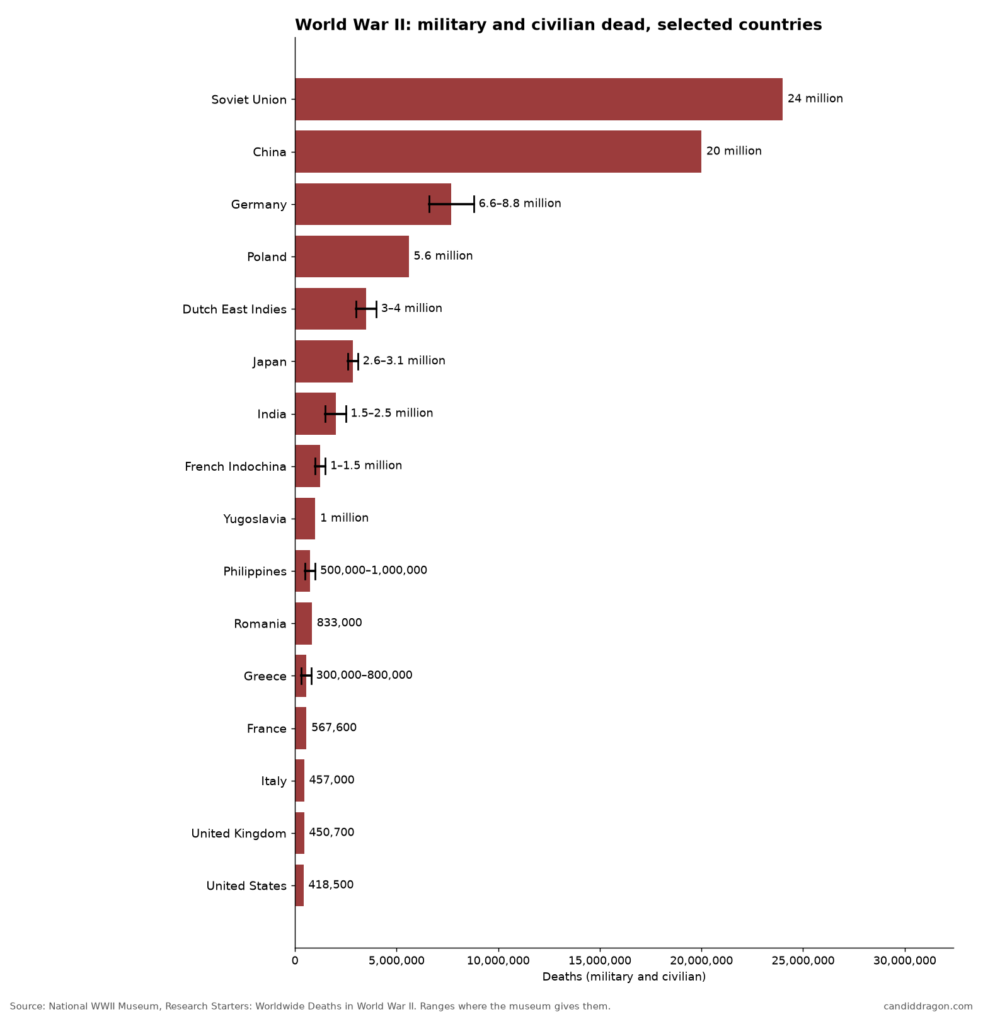
| Country | Military deaths | Total military and civilian deaths |
|---|---|---|
| Soviet Union | 8,800,000–10,700,000 | 24,000,000 |
| China | 3,000,000–4,000,000 | 20,000,000 |
| Germany | 5,533,000 | 6,600,000–8,800,000 |
| Poland | 240,000 | 5,600,000 |
| Dutch East Indies | – | 3,000,000–4,000,000 |
| Japan | 2,120,000 | 2,600,000–3,100,000 |
| India | 87,000 | 1,500,000–2,500,000 |
| French Indochina | – | 1,000,000–1,500,000 |
| Yugoslavia | 446,000 | 1,000,000 |
| Philippines | 57,000 | 500,000–1,000,000 |
| Romania | 300,000 | 833,000 |
| Greece | 20,000–35,000 | 300,000–800,000 |
| France | 217,600 | 567,600 |
| Italy | 301,400 | 457,000 |
| United Kingdom | 383,600 | 450,700 |
| United States | 416,800 | 418,500 |
Most of these civilians died in Europe’s east and in Asia. Poland lost about 5.4 million civilians against 240,000 soldiers; Britain and the United States lost almost all their dead in uniform.
The Eastern Front: a war of annihilation
The German invasion of the Soviet Union in June 1941 was fought as a racial war. Of about 5.7 million Soviet soldiers captured by the Germans, about 3.3 million, 57 percent, died in captivity (USHMM). Behind the lines, SS mobile killing squads shot Jews town by town; the Holocaust killed six million Jews in all (USHMM). The full story is in our Nazi regime post.
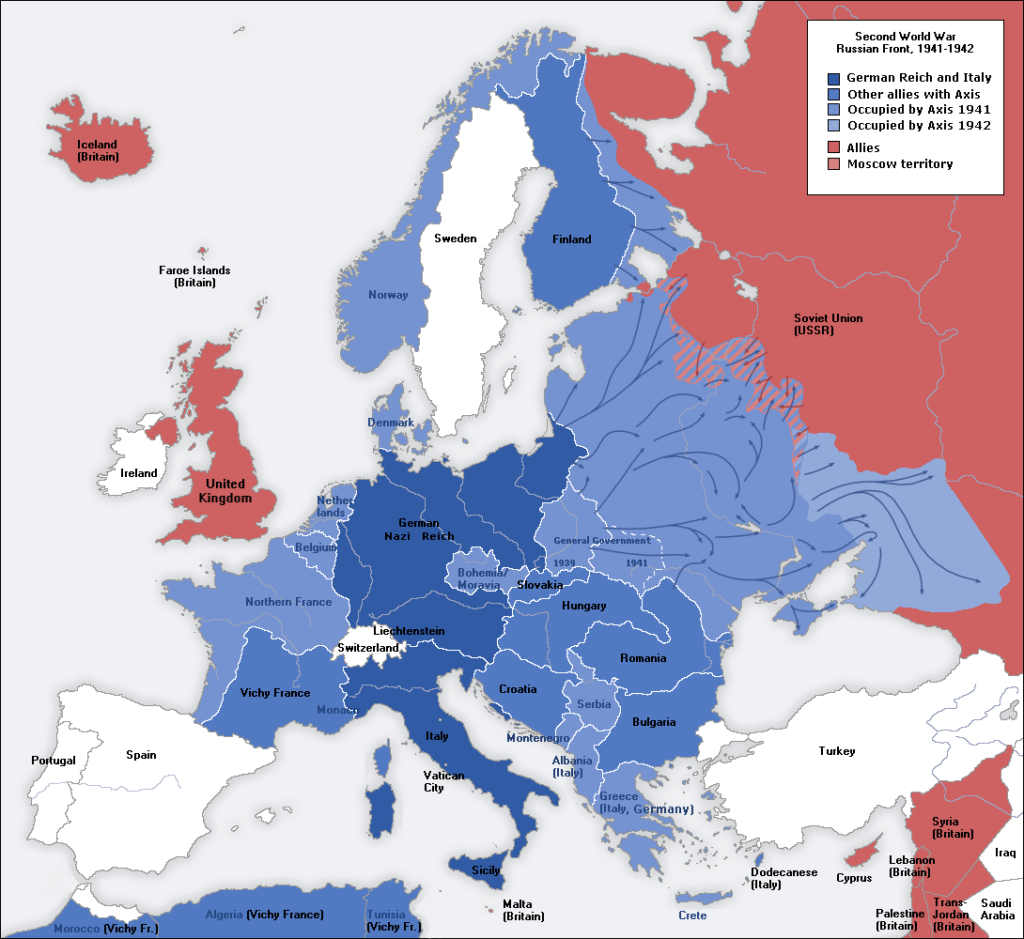
Leningrad: German and Finnish forces besieged the city for 872 days, from September 1941 to January 27, 1944. Rations fell to 125 grams of bread a day, about three small slices, for children, the elderly and the unemployed. In the winter of 1941–42 starvation killed as many as 100,000 people a month; people ate wallpaper glue, rats and pets, and authorities arrested more than 2,000 people for cannibalism. About 800,000 civilians died (History.com).
Japan’s war in Asia
Nanjing, December 1937–January 1938
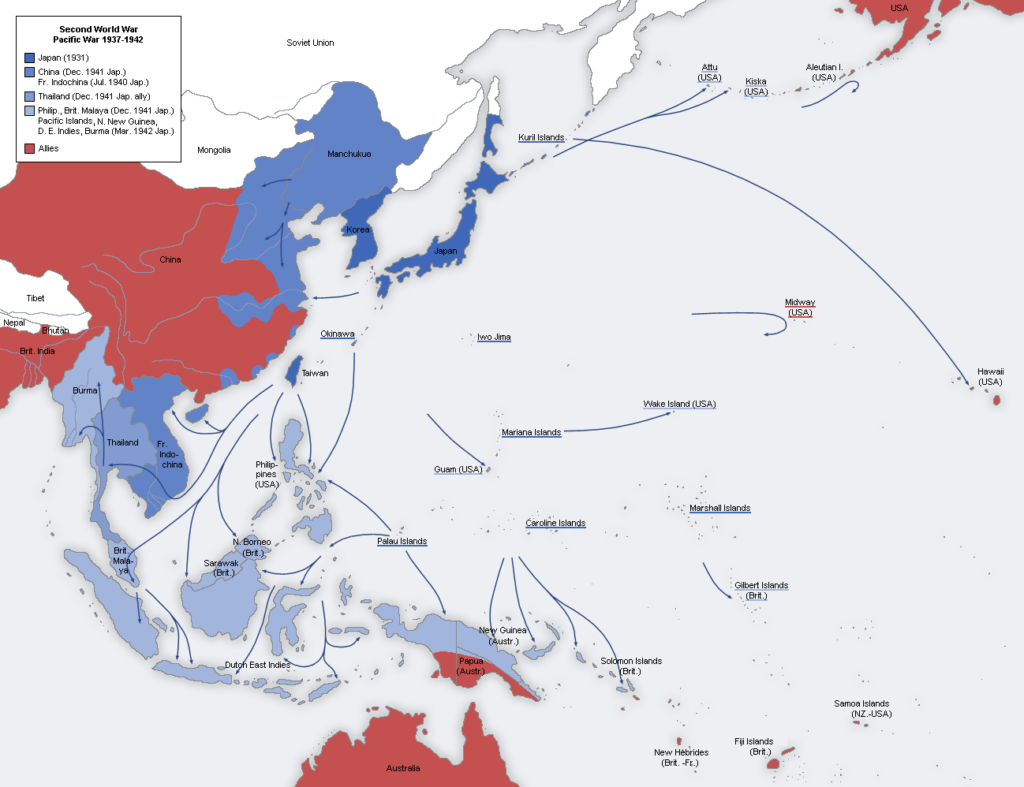
After the Japanese Imperial Army took the Chinese capital, Nanjing, on December 13, 1937, its soldiers spent about six weeks killing and raping civilians and prisoners who had surrendered. Estimates of the Chinese dead range from 100,000 to more than 300,000; the exact number “remains disputed,” partly because historians draw different boundaries in space and time and differ on whether to count executed prisoners of war. More than a third of the city’s buildings were destroyed. General Matsui Iwane was convicted by the Tokyo tribunal for failing to prevent the atrocities, and Lieutenant General Tani Hisao by a Chinese tribunal; both were executed in 1948 (Britannica). Japanese textbooks and some public figures have minimized the massacre.
Unit 731
Unit 731 was a secret Imperial Japanese Army biological and chemical warfare unit based near Harbin in occupied Manchuria from 1935 to 1945. It carried out lethal experiments on prisoners of war and civilians, including tests of chemical and biological agents and vivisection. After the war the United States granted its members immunity from prosecution in exchange for their research data (Britannica). The historian Sheldon H. Harris estimated that Shirō Ishii’s unit and related facilities killed 10,000 to 12,000 prisoners, and that 300,000 to 500,000 Chinese civilians died from germ attacks on more than 70 cities and towns (Los Angeles Times; City Journal). Harris’s figures are a single historian’s estimate; many records were destroyed and China has published no official count.
Soviet atrocities
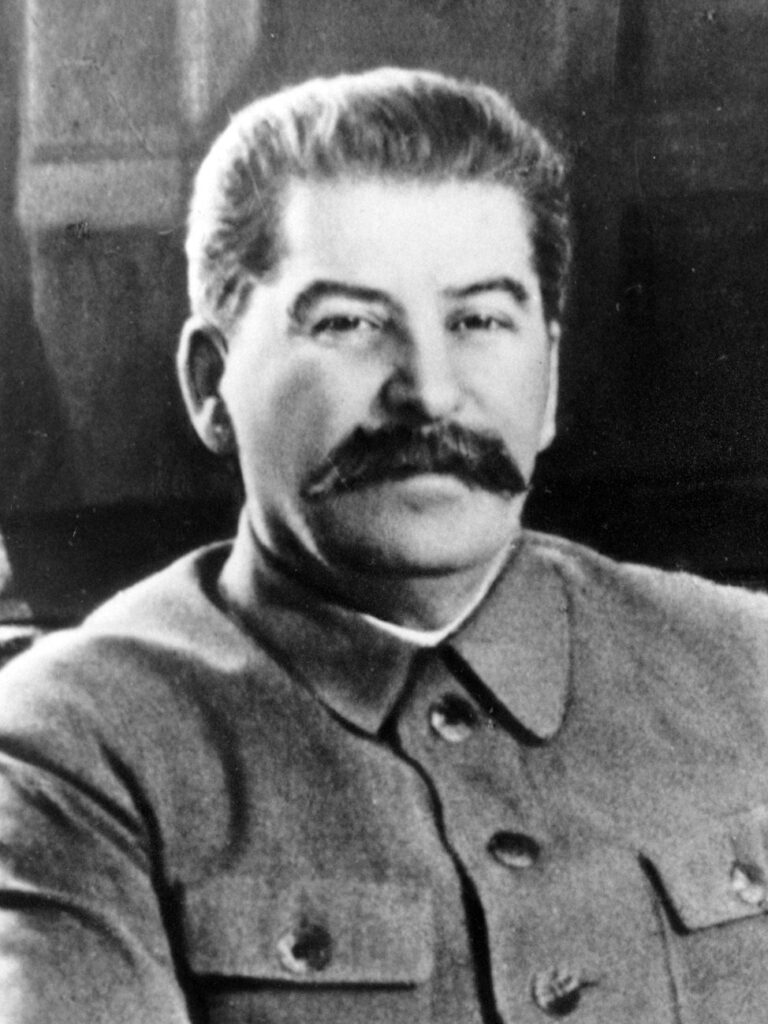
Katyn, 1940: the Soviet secret police shot 21,857 Polish prisoners, among them army officers, civil servants, landowners, policemen and ordinary soldiers, on Stalin’s personal order in a memorandum of March 5, 1940, to NKVD chief Lavrenti Beria. Soviet propaganda blamed the Germans, and in 1959 the KGB chief recommended destroying the records; the Kremlin admitted responsibility only in 1990 (Hoover Institution). The Hoover Institution leans right; the figure comes from Soviet archival documents.
Mass rape, 1945: as the Red Army advanced into Germany, its soldiers raped women on a massive scale. The historian Antony Beevor reports that estimates from Berlin’s two main hospitals ranged from 95,000 to 130,000 victims in the city, and cites an estimate of 1.4 million victims in East Prussia, Pomerania and Silesia (Antony Beevor in The Guardian). These are estimates, not counts, and they are contested.
The bombing of cities
By 1945, British and American bombers were destroying German and Japanese cities on an enormous scale.
- Dresden, February 13–14, 1945: a commission of historians set up by the city identified 18,000 dead and concluded that at most 25,000 people were killed. Claims in the literature had ranged up to 500,000 or more (Dresden Historians’ Commission, 2010). The commission found no evidence or reliable indications for the higher claims.
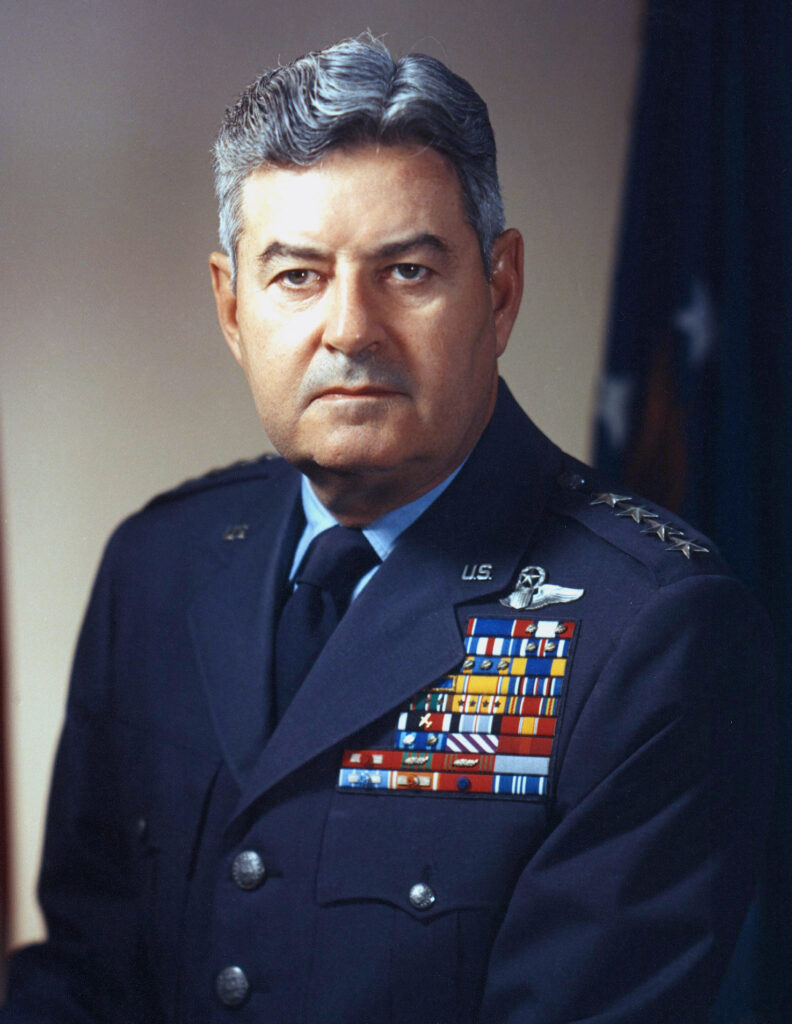
- Tokyo, March 9–10, 1945: U.S. B-29s dropped 1,665 tons of incendiary bombs, burned more than 16 square miles of the city, killed up to 100,000 civilians (the official figure was 83,793), injured more than 40,000 and left more than a million homeless (National Security Archive). General Curtis LeMay’s own report called it “the most destructive air raid in history.”
- Hiroshima, August 6, 1945: by the end of December 1945, when the acute effects of radiation had largely subsided, roughly 140,000 people were dead (City of Hiroshima; Atomic Heritage Foundation).
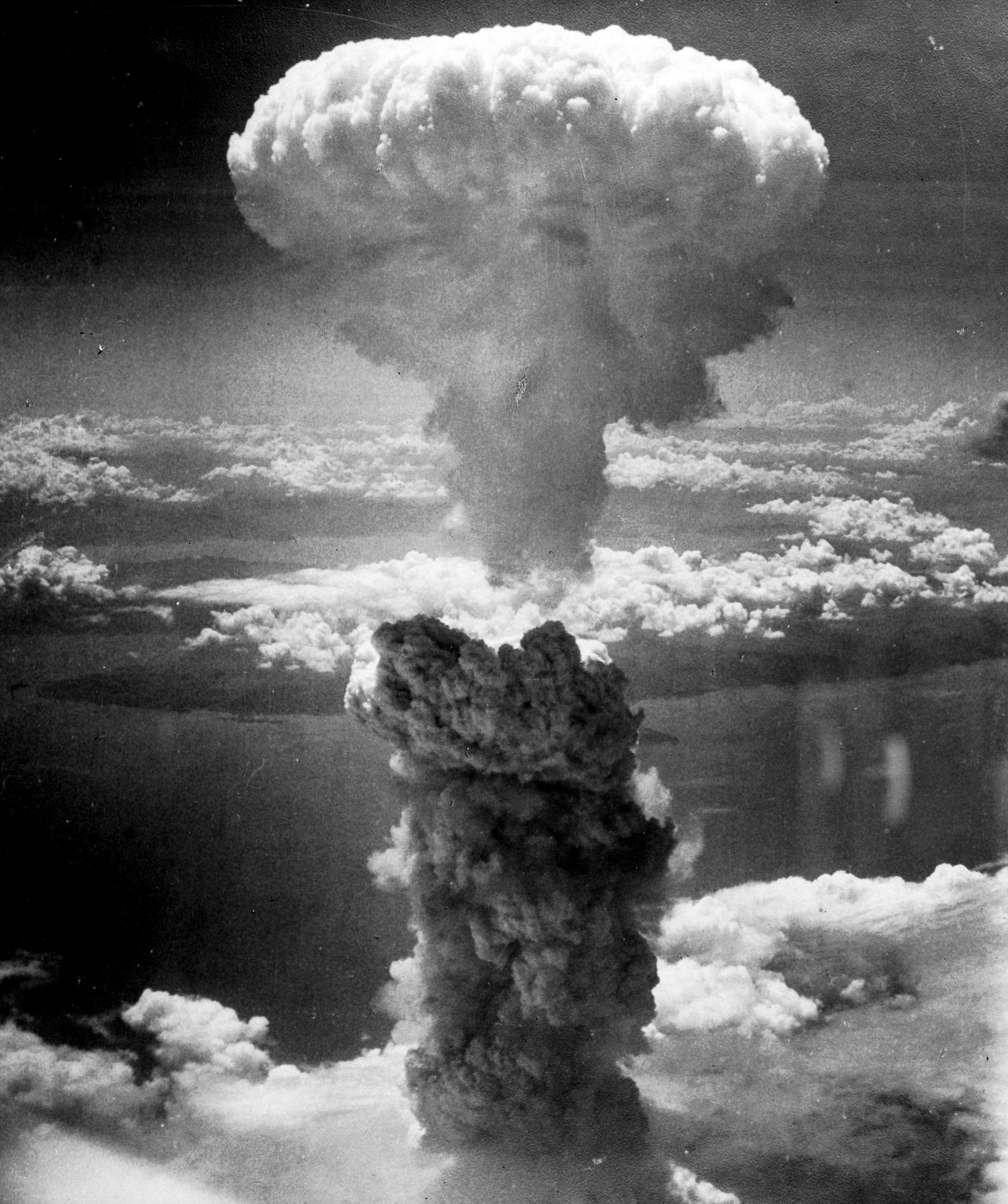
- Nagasaki, August 9, 1945: by the end of December 1945, 73,884 people had been killed and 74,909 injured. Many who seemed unhurt later died of radiation (Nagasaki Peace site).
Opinion: whether the atomic bombs and the firebombing of cities were necessary to end the war remains genuinely debated by historians. What is not debated is who died: overwhelmingly civilians.
The Bengal famine, 1943
About three million people in British-ruled Bengal died of malnutrition or disease in 1943. Food production had not collapsed; the 1943 crop was “actually sufficient.” Instead, fearing a Japanese invasion, British authorities stockpiled food for troops, exported considerable quantities to forces in the Middle East and confiscated boats and carts in the Chittagong region, cutting off fishermen and local trade. Hoarding and inflation followed, and the government failed to halt rice exports or seek relief supplies elsewhere (Britannica). The economist Amartya Sen, who saw the famine as a boy, called it an “entitlement failure”: people starved because they could not afford food, not because there was none.
Why it matters
World War II showed that every kind of state can kill civilians on an enormous scale once war makes them seem expendable: dictatorships by design, democracies by policy and neglect. The deliberate extermination of Jews, Roma and Soviet prisoners stands apart, but the bombing of cities and the Bengal famine are part of the record too. Honest history counts all of them.
Patterns to recognize (analysis)
Analysis and opinion. Recurring tactics and failures from the war, written as general warning signs:
- Dehumanizing a people as racially inferior, which made mass shooting, starvation and medical experiments thinkable.
- Treating whole populations as targets, on the theory that civilians are part of the enemy’s war machine.
- Secrecy and denial: hiding a massacre for decades, blaming it on someone else, or minimizing it in school textbooks.
- Trading justice for advantage, as when war criminals were shielded in exchange for their data.
- Inflating or shrinking death tolls to serve a political story, in either direction.
- Wartime priorities that write off civilians: food shipped away from a starving region, or a city starved by siege.
These are general warning signs drawn from the history above. They describe tactics, not any modern party or person.
Bottom line: World War II killed 70 to 85 million people, most of them civilians. The Axis powers committed the war’s deliberate genocides and its worst massacres, but no major power came out with clean hands. The record, with its contested ranges marked, is above.
Label key
- ✅ Confirmed An official record, or two or more independent outlets, agree.
- ❓ Unconfirmed Reported or claimed, but not yet independently verified.
- ⚠️ Disputed Contradicted by the evidence or by credible sources, or actively contested.
- Factual Straight reporting that holds up across outlets on different sides.
 Leans Left The facts hold, but the coverage tilts left: one-sided, loaded language, missing context or a single anonymous source.
 Leans Right The facts hold, but the coverage tilts right: one-sided, loaded language, missing context or a single anonymous source.
 Likely Propaganda State-run or state-aligned media, a militant press office, a partisan campaign or group, or unverifiable spin.
Each story gets one confidence tag and one source-lean label, plus a one-line Lean note explaining the call. Every side is held to the same standard. More on how we cover the news.
Sources
- National Museum of the Pacific War, The Enduring Impact of World War II (Factual)
- National WWII Museum, Research Starters: Worldwide Deaths in World War II (Factual)
- USHMM, Nazi Persecution of Soviet Prisoners of War (Factual)
- USHMM, Documenting Numbers of Victims of the Holocaust (Factual)
- History.com, The Siege of Leningrad: When Hitler Used Starvation as a Weapon (Factual)
- Britannica, Nanjing Massacre (Factual)
- Britannica, Unit 731 (Factual)
- Los Angeles Times, Faustian Deals, “Factories of Death” in WWII (1994) (Leans Left)
- City Journal, When Germ Warfare Happened (Leans Right)
- Hoover Institution, Remembering Katyn (Leans Right)
- Antony Beevor, “They raped every German female from eight to 80,” The Guardian (2002) (Leans Left)
- City of Dresden, Statement of the Historians’ Commission on the Dresden air raid death toll (2010, German) (Factual)
- National Security Archive, XXI Bomber Command Tactical Mission Report, Mission No. 40 (Tokyo) (Factual)
- City of Hiroshima, How many people died because of the atomic bombing? (Factual)
- Nagasaki Peace site, Damage Caused by the Atomic Bombing (Factual)
- Atomic Heritage Foundation, Hiroshima and Nagasaki Bombing Timeline (Factual)
- Britannica, Bengal famine of 1943 (Factual)
Featured image: The atomic cloud over Nagasaki, August 9, 1945, by Charles Levy (U.S. National Archives). Public domain, via Wikimedia Commons. See all image credits.