

Quick take
- Christianity and Judaism both carried old teachings that let believers live under laws they did not write, and both eventually accepted the secular state. Classical Islamic law grew up as the law of an Islamic state, and modern Islamist movements still treat it as a blueprint for government.
- Where sharia has become state law by revolution or conquest (Iran, the Taliban, ISIS) or by royal decree (Saudi Arabia, Brunei), apostates, religious minorities, gay people and women have paid the price. That is documented, not a matter of opinion.
- Muslims are not a single bloc. Secular Muslim-majority states exist, Muslim reformers reject the “Islamic state” outright, and polling shows wide differences from country to country. The critique here is aimed at sharia as state law, not at Muslims as people.
- The human cost, in sourced numbers: Iran executed at least 2,159 people in 2025 by Amnesty International’s count, and thousands of political prisoners in 1988; ISIS killed an estimated 1,434 to 3,100 Yazidis and kidnapped about 6,800; Saudi Arabia executed at least 356; Pakistan has seen at least 104 killings over blasphemy accusations since 1994.
Our rating: ✅ Confirmed  Factual
Content warning: this post describes executions, mass killings, sexual slavery and public flogging.
Opinion & Discussion. This piece argues a point of view, and says so. The facts it rests on are sourced and linked; the conclusions in the Our view section are ours. Part of Controversial Topics.
In the United States a Muslim can build a mosque, pray five times a day, run for Congress, and leave Islam the next morning without breaking any law. In Saudi Arabia a Christian cannot build a church. In Iran, a Muslim who becomes a Christian can face the death penalty. That lopsided picture raises a question many would rather not ask out loud: why have some religions settled comfortably inside Western liberal democracy, while Islam, or at least one powerful reading of it, has been a harder fit?
Why it matters
- It is not a fringe issue. In Pew Research Center’s 2023 data, the Middle East and North Africa again had the highest median level of government restrictions on religion of any region, as it has every year since Pew began measuring in 2007.
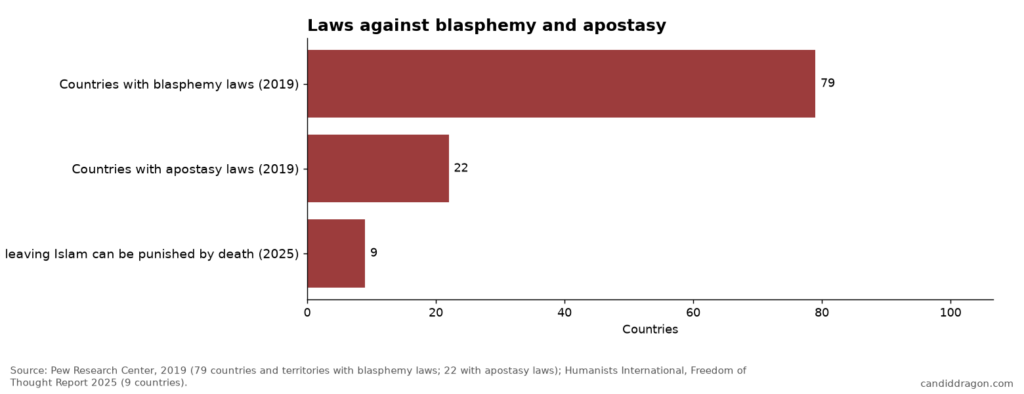
- Laws, not just attitudes. Pew counted 22 countries with apostasy laws in 2019, 13 of them in the Middle East and North Africa. No country in Europe or the Americas had one.
- The debate in the West is usually muddled. One side calls any criticism of sharia bigotry; the other treats every Muslim as an ideology. Both mistakes fail the people who suffer most under religious law, many of whom are Muslims.
How the church and the synagogue made peace with the state
Christianity began as a persecuted minority with no state of its own, and its founding texts show it. When Jesus was asked whether Jews should pay taxes to Rome, he answered: “Render therefore unto Caesar the things which are Caesar’s; and unto God the things that are God’s” (Matthew 22:21, KJV). The New Testament contains no criminal code and no blueprint for a Christian government.
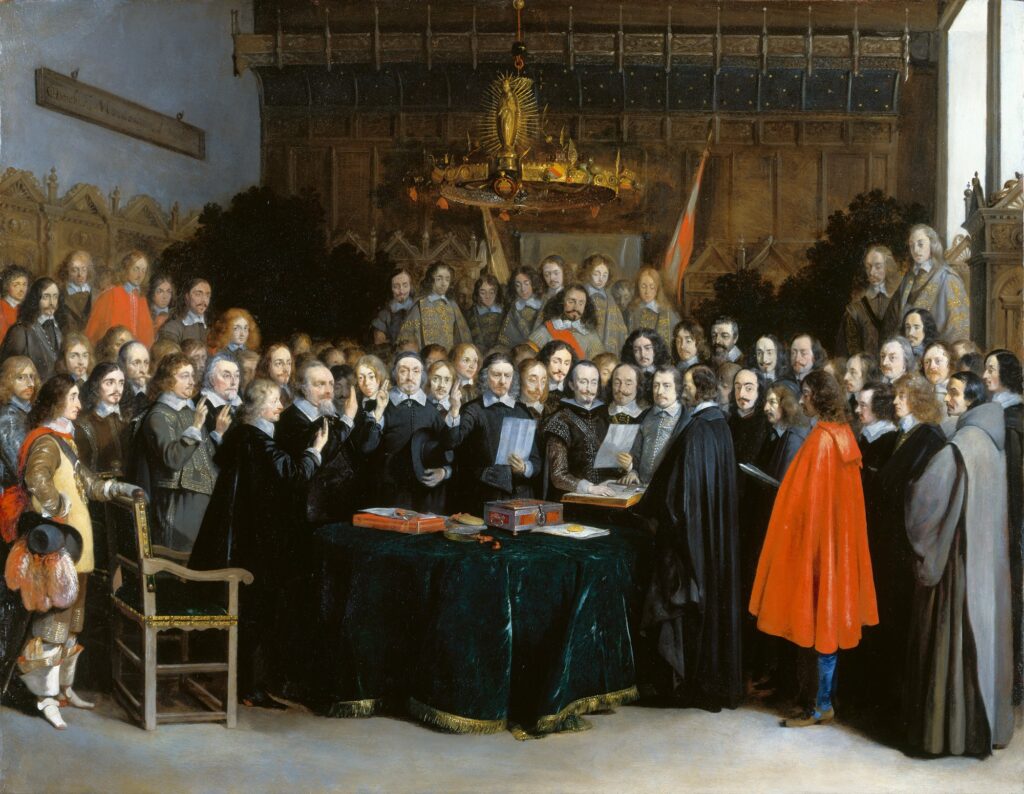
That did not stop Christians from building one. For centuries popes crowned kings and heretics were burned. Separation came late and at great cost. After the Reformation split Western Christianity, Europe fought wars of religion until the Peace of Westphalia in 1648, which ended the German phase of the Thirty Years’ War and extended toleration to Lutherans and Calvinists. Some scholars credit it with founding the modern state system.
Americans took the idea furthest. The First Amendment barred Congress from making any law “respecting an establishment of religion, or prohibiting the free exercise thereof.” In 1802 Thomas Jefferson wrote to the Danbury Baptist Association that this built “a wall of separation between Church & State.”
Judaism had its own path. After the Babylonian exile, the prophet Jeremiah told the captives to “seek the peace of the city whither I have caused you to be carried away” (Jeremiah 29:7, KJV). In the third century A.D., the Babylonian sage Samuel gave the Talmud a lasting rule: dina d’malkhuta dina, “the law of the kingdom is the law.” Jews were bound by the civil laws of the country they lived in, such as taxes and property law, as long as those laws did not force them to break the Torah.
Neither faith was always tolerant. But both had texts that let believers accept a government they did not control, and both eventually did.
Sharia as law and government: a short history
Where the law comes from
Sharia means God’s law. In practice it reaches believers through fiqh, the human work of interpreting it. As the Council on Foreign Relations explains, its two main sources are the Quran and the Sunna, the sayings and practices attributed to the Prophet Muhammad. The Shafi’i school was the first to rank the sources of law in order of authority: Quran, then Sunna, then the consensus of scholars, then reasoning by analogy. The four Sunni schools are the Hanafi, Maliki, Shafi’i and Hanbali; the Hanbali, the most conservative, gave rise to the Wahhabi and Salafi movements. Shia Muslims have their own jurisprudence.
Unlike the New Testament, this law covers prayer and fasting but also marriage, inheritance, contracts, crime, war and the status of non-Muslims. Muhammad was both prophet and ruler in Medina, and the caliphs who followed led faith and state together.
Conquest, the dhimmi, and the millet
As Arab armies conquered the Middle East, North Africa and Spain in the seventh and early eighth centuries, Christians and Jews were not usually forced to convert. They became dhimmis, “protected” people who paid a poll tax, the jizya named in Quran 9:29, and accepted a lower legal status. A later text called the Pact of Umar spelled out restrictions, such as bans on building new churches or displaying crosses in public. The historian David Wasserstein calls it “probably a literary forgery of the ninth century or later,” but it became a template. Over time, he writes, “Separation turned into subordination and restrictions encouraged conversion.”
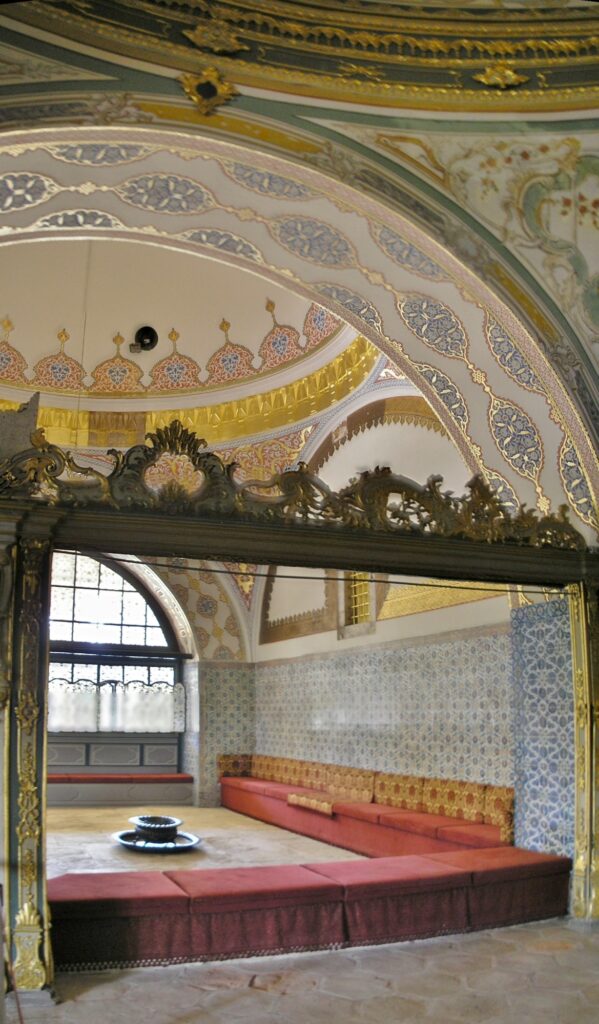
The Ottoman Empire formalized this as the millet system: each recognized religious community ran its own affairs under its own law and leaders, paid its taxes and answered to the sultan. It was tolerance by rank, not equality, and not freedom of conscience.
Codes, reform and the end of the caliphate
Starting in 1856, Britannica notes, Ottoman reform edicts brought in secular law codes for all citizens. Between 1869 and 1876 the empire drew up the Mecelle, a civil code based on Hanafi jurisprudence. Then the empire collapsed. On March 3, 1924, the Grand National Assembly of the new Turkish Republic abolished the caliphate, the Muslim world’s last widely recognized one, and in 1926 Turkey replaced the Mecelle with a new civil code.
Religion, government, or both?
Modern Islamist thinkers answered the caliphate’s fall with a slogan: Islam is din wa dawla, “religion and state.” Hassan al-Banna, founder of Egypt’s Muslim Brotherhood, used the phrase to argue that Islam must govern public life as well as private faith. He rejected the Western model of secular government.
Not every Muslim scholar agreed. In 1925 an Egyptian judge, Ali Abd al-Raziq, published Islam and the Foundations of Governance. He argued that neither the Quran nor the Sunna requires a caliphate, and that Muslims are free to choose their own form of government. Al-Azhar’s council of senior scholars stripped him of his credentials for it. Today the legal scholar Abdullahi An-Na’im makes a related case in Islam and the Secular State (Harvard, 2008). In his publisher’s summary, state enforcement of sharia “betrays the Qur’an’s insistence on voluntary acceptance of Islam,” and the very idea of an “Islamic state” owes more to modern European ideas of the state than to Islamic tradition.
So the scholarly answer to “religion or government?” is contested. The political answer, in the places where Islamists won, is not.
When sharia became the law of the land
Iran, 1979. After the Shah fell, Iranians voted March 30–31, 1979, to create an Islamic Republic, and Ayatollah Khomeini proclaimed it on April 1. Its constitution says “all civil, penal, financial, economic, administrative, cultural, military, political, and other laws and regulations must be based on Islamic criteria” (Article 4). It recognizes only Zoroastrians, Jews and Christians as religious minorities (Article 13), which leaves out Iran’s Baha’is.
The cost in Iran. Between late July and September 1988, after a secret religious order (fatwa) from Khomeini, committees appointed under that order questioned political prisoners, many of them already serving sentences, about their loyalties and their faith (“Are you a Muslim? Do you pray?”) and sent those who stayed “steadfast” to their deaths. The bodies went into unmarked individual and mass graves. The toll is contested: Khomeini’s own deputy, Hossein Ali Montazeri, put it at 2,800 or 3,800 in his memoir; Human Rights Watch gives 2,800 to 5,000 in at least 32 cities; Amnesty International’s minimum estimate is about 5,000; one 1996 study put it at 12,000 (Human Rights Watch; Amnesty International). The killing has not stopped. Amnesty recorded at least 2,159 executions in Iran in 2025, the most it has recorded there since 1981 (Amnesty International); Iran Human Rights counted at least 1,639, the highest since 1989, including 48 women and 795 people executed for drug offences (Iran Human Rights). Both groups count only cases they can document, so the real numbers are likely higher; their counts differ because their methods differ.
Afghanistan, 1996 and 2021. The Taliban took Kabul on September 27, 1996, and again on August 15, 2021. By March 2022 they had kept girls above sixth grade out of school, and in December 2022 they banned women from universities.
Punishment in public. The Taliban flog people in public every week. In the last three months of 2025 alone, UN monitors documented court-ordered corporal punishment of at least 287 people: 253 men, 30 women, three boys and one girl. On November 17, a court in Qalat publicly flogged 18 men and a woman between 10 and 39 times each for crimes including theft, adultery and homosexuality. On December 2, in the sports stadium in Khost, a relative of the victims shot a man convicted of murdering 13 members of one family; the UN counted it as the twelfth court-ordered public execution since the Taliban returned in August 2021 (UN Assistance Mission in Afghanistan, October–December 2025 update).
The “Islamic State,” 2014. On June 29, 2014, ISIS declared a caliphate over the territory it held in Iraq and Syria. In Mosul it ordered Christians to convert, pay the jizya, or leave, reviving the old dhimmi terms. Its assault on the Yazidis of Sinjar that August has been documented by UN investigators as genocide.
What genocide meant in Sinjar. ISIS separated captured Yazidi men and older boys from the women and children, and killed those who refused to convert; women, girls and younger boys were also killed, and many were enslaved and raped. UN investigators estimate that 1,434 to 3,100 Yazidis were killed in the attack itself and about 6,800 kidnapped; as of 2022 the fate of 2,693 was still unknown. In all, almost 10,000 Yazidis were killed or abducted (UNITAD, 2024). The UN’s envoy on sexual violence said more than 6,400 Yazidis, mostly women and children, were taken to ISIS prisons and camps “where they were raped, beaten, and sold” (UN Office on Sexual Violence in Conflict). The killing toll is an estimate; UN investigators say it remains unconfirmed.
Saudi Arabia. No revolution was needed. The kingdom’s Basic Law says the Quran and the Sunna “rule over this and all other State Laws” (Article 7). The U.S. State Department’s 2023 religious freedom report found that the government still prohibits the public practice of any religion other than Islam, and that mosques are the only legal public places of worship.
Executions in Saudi Arabia. Amnesty International recorded at least 345 executions in Saudi Arabia in 2024 and at least 356 in 2025, the highest it has recorded there in any year; five of those executed in 2025 were women (Amnesty International). A documented minimum; the kingdom does not publish full figures.
Pakistan. Pakistan inherited a blasphemy law from British rule, but General Zia-ul-Haq’s military government expanded it between 1980 and 1986. The 1986 clause on insulting the Prophet carried “death, or imprisonment for life.” In 1990 the Federal Shariat Court ruled that life imprisonment was un-Islamic, leaving death as the only penalty. Pew found that at least 17 people were sentenced to death for blasphemy in 2019, though Pakistan has never executed anyone for it. Mobs and assassins have done the killing instead. Punjab governor Salman Taseer, who tried to reform the law, was assassinated in 2011; a month later Shahbaz Bhatti, the Christian minister for religious minorities, was shot dead. In 2019 the Supreme Court upheld the acquittal of Asia Bibi, a Christian woman who had been sentenced to death.
Killed over an accusation. Pakistan’s Centre for Social Justice, a rights group, counts at least 104 people killed outside the courts over blasphemy allegations between 1994 and 2024, 10 of them in 2024 alone, and at least 2,793 people charged under the blasphemy laws since 1987. In the 344 new cases filed in 2024, 70 percent of the suspects were Muslims, followed by Ahmadis, Hindus and Christians (Dawn, reporting the centre’s figures). Most of the accused are themselves Muslims.
Brunei, 2019. On April 3, 2019, Brunei put into force the final phases of its Syariah Penal Code, under which adultery and sex between men can be punished by stoning to death. After a global boycott, the sultan extended the country’s moratorium on executions to the new code, but the law stayed on the books, along with caning and prison.
The reciprocity gap, by the numbers
- ✅ Confirmed Apostasy. Pew counted 22 countries with apostasy laws in 2019. Humanists International’s 2025 Freedom of Thought Report lists nine where leaving the faith can be punished by death in all or part of the country: Afghanistan, Brunei, Iran, Malaysia, the Maldives, Mauritania, Qatar, Saudi Arabia and Yemen. All nine are Muslim-majority.
- ✅ Confirmed Blasphemy. Pew counted 79 countries and territories with blasphemy laws in 2019, including 18 of the 20 countries in the Middle East and North Africa. In Afghanistan, Brunei, Iran, Mauritania, Nigeria, Pakistan and Saudi Arabia, blasphemy can carry the death penalty. For fairness, 14 European countries and 12 in the Americas also had blasphemy laws on the books.
- ✅ Confirmed Gay people. ILGA World’s June 2026 data counts 65 UN member states that criminalize consensual same-sex relations, and 7 where death is the legally prescribed penalty. ILGA’s 2023 list of the countries with a death penalty named Brunei, Iran, Mauritania, northern Nigeria, Saudi Arabia and Yemen, all applying sharia-based penal law. Many of the 65 are not Muslim-majority, especially in Africa and the Caribbean.
- ✅ Confirmed Christians. Seven of the top 10 countries on Open Doors’ 2026 World Watch List are Muslim-majority: Somalia, Yemen, Sudan, Syria, Pakistan, Libya and Iran. North Korea, a communist state, is No. 1.
- ✅ Confirmed Women. Brunei’s code punishes women for adultery and giving birth outside marriage. Afghanistan bars girls from school after sixth grade. Iran’s constitution guarantees equality only “in conformity with Islamic criteria.”
Context matters both ways. The U.S. Commission on International Religious Freedom’s 2026 report recommends 18 “countries of particular concern” for severe abuses. Afghanistan, Iran, Pakistan, Saudi Arabia and Tajikistan are on it, but so are China, North Korea, Russia, India and Cuba. Persecution is not only an Islamic problem, but the specific penalties for leaving Islam, insulting its prophet, or being gay cluster where sharia is state law.
What Muslims themselves say
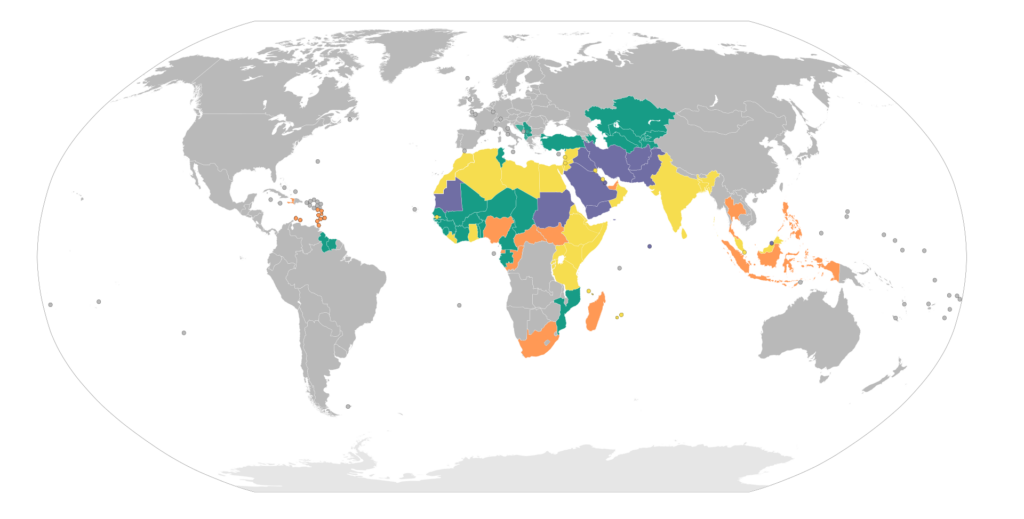
Pew’s landmark 2013 survey, The World’s Muslims, found huge differences by country. Support for making sharia the official law was 99% in Afghanistan, 91% in Iraq, 84% in Pakistan and 72% in Indonesia. It was 12% in Turkey, 10% in Kazakhstan and 8% in Azerbaijan, and in Lebanon, 66% of Muslims opposed it. Most supporters said sharia should apply only to Muslims. Among those who wanted sharia as law, support for executing people who leave Islam reached 86% in Egypt but was 8% in Albania and 4% in Kazakhstan.
In the West the picture is mixed. In Pew’s 2017 survey of U.S. Muslims, 65% said there is no natural conflict between Islam and democracy, and 52% said homosexuality should be accepted by society, up from 27% in 2007. In Britain, a 2015 ICM poll for Channel 4 found that 86% of Muslims felt a strong sense of belonging to Britain. But 23% supported areas of Britain where sharia would replace British law, and 52% disagreed that homosexuality should be legal. ICM interviewed only in areas where Muslims make up at least 20% of residents.
Counterpoints
- Secular Muslim-majority states exist. Turkey’s constitution still calls the republic “democratic, secular and social.” Kosovo’s calls it “a secular state,” Albania’s says there is “no official religion,” Senegal’s says the republic is “secular, democratic, and social,” and Kazakhstan’s proclaims a “secular” state.
- Indonesia chose not to. On August 18, 1945, its founders struck seven words from the draft charter that would have obliged Muslims to follow sharia, and built the state on the Pancasila, whose first principle is belief in one God. (CFR notes Indonesia still carries out floggings in places.)
- Tunisia’s 1956 Personal Status Code made taking a second wife a crime.
- Muslim reformers are fighting this from the inside. The Muslim Reform Movement’s 2015 declaration, whose founding signers included Zuhdi Jasser and Asra Nomani, says: “We reject the idea of the Islamic state,” “There is no need for an Islamic caliphate,” and “We reject blasphemy laws.”
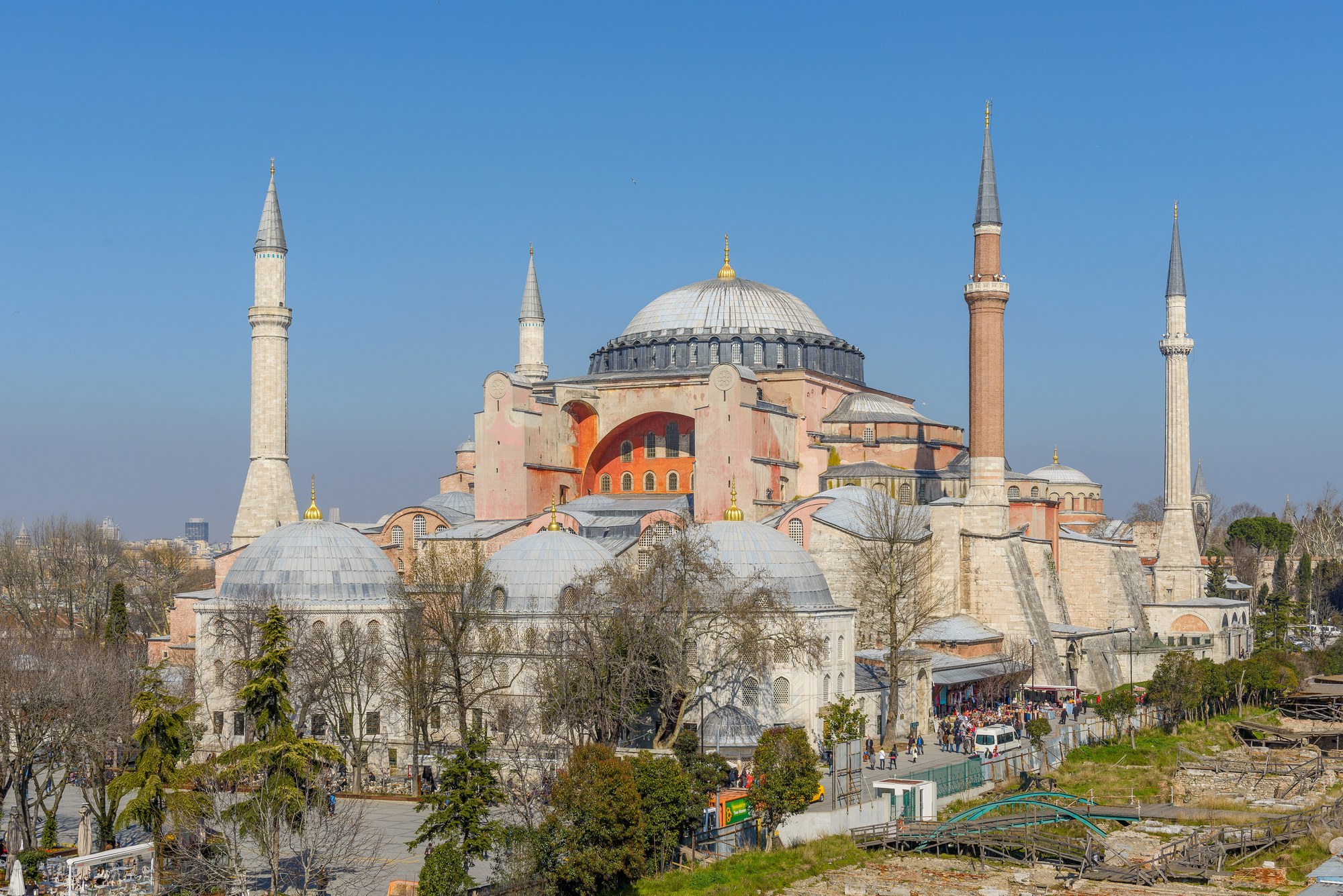
- Secular is not the same as free. Officially secular Tajikistan is on USCIRF’s list of the worst violators. And secularism can erode: in 2020 a Turkish court ruling and a presidential decree turned Hagia Sophia from a museum back into a mosque.
- Christian history is not spotless. Europe went through wars of religion and the Inquisition before it arrived at toleration. Some argue Islam is on a slower version of the same road.
Our view (opinion)
This section is opinion. Religions differ in what their founding texts say about power, and that difference is real. A faith whose founder said “render unto Caesar” had an easier road to the secular state than one whose founder ruled a state and whose classical law covers crime, war and the status of unbelievers. Pretending otherwise does no one any favors.
But “Islam” is not the right target. Sharia as state law is. The test we would apply to any religion is simple: can you leave it, criticize it, and live differently from it without the government punishing you? By that test Saudi Arabia, Iran, Afghanistan and Brunei fail, and a democracy should say so plainly. Western Muslims who pass that test every day, and Muslim reformers who risk their lives to defend it, are allies, not suspects. The fair demand is reciprocity: the same freedom of worship and conscience that Muslims rightly enjoy in the West, for Christians, Jews, apostates, gay people and women in Muslim-majority countries.
Patterns to recognize (analysis)
Analysis and opinion. Tactics from the history of religious law that are worth recognizing anywhere, whatever the faith:
- Laws against “insulting” a faith used to silence dissent and settle private scores.
- Accusation followed by mob violence before any court can act.
- Tolerating vigilante killings by failing to punish them.
- Penalties for leaving a religion that make belief compulsory.
- Unequal law: rules that fall hardest on minorities.
- Merging religious and state authority so there is no appeal against either.
These are general warning signs drawn from the history above. They describe tactics, not any modern party or person.
Talk it over
Questions worth discussing:
- Is it fair to judge a religion by what governments do in its name? Why or why not?
- Should Western governments tie trade or aid to whether a country allows people to leave Islam or build churches?
- Ali Abd al-Raziq lost his career for saying Islam requires no caliphate. What would it take for that view to become mainstream?
- Is a polling figure like 23% supporting sharia areas in Britain alarming, reassuring, or both?
Ground rules: Argue the idea, not the person. Name your source. Assume good faith. No slurs or dehumanizing labels for anyone. Reader comments are not open on Candid Dragon yet, so share this piece and talk it over with people you trust, including someone who sees it differently.
Who is behind the numbers
- Factual Pew Research Center: nonpartisan research and polling.
- Factual U.S. State Department and USCIRF: official U.S. government reporting. USCIRF is a bipartisan federal commission whose recommendations are advisory.
- Factual National constitutions and court rulings: primary legal documents, read via the Constitute Project.
- Factual Council on Foreign Relations, Britannica, Harvard University Press, Yale University Press: reference and scholarly sources.
 Leans Left ILGA World: a global federation of LGBTI rights groups. Its legal mapping is widely cited and lists the actual statutes.
- Leans Left Humanists International: advocates for atheists and the nonreligious. Its country lists cite specific laws.
 Leans Right Open Doors: a Christian ministry that supports persecuted Christians. Its ranking measures pressure on Christians only, uses its own scoring, and is part of its advocacy. We use only its rank order.
- Factual ICM / Channel 4: a professional polling firm commissioned by a public broadcaster for a documentary. It interviewed only in areas where Muslims are at least 20% of residents.
- Leans Left Amnesty International, Iran Human Rights and Human Rights Watch: human rights advocacy groups that oppose the death penalty everywhere. Their counts list documented cases and are minimums.
- Factual United Nations (UNITAD, UNAMA, the Office on Sexual Violence in Conflict): UN investigators and monitors working from interviews, forensic work and court records.
- Factual Dawn: Pakistan’s leading English-language newspaper, here reporting figures from the Centre for Social Justice, a Pakistani rights group.
Label key
- ✅ Confirmed An official record, or two or more independent outlets, agree.
- ❓ Unconfirmed Reported or claimed, but not yet independently verified.
- ⚠️ Disputed Contradicted by the evidence or by credible sources, or actively contested.
- Factual Straight reporting that holds up across outlets on different sides.
- Leans Left The facts hold, but the coverage tilts left: one-sided, loaded language, missing context or a single anonymous source.
- Leans Right The facts hold, but the coverage tilts right: one-sided, loaded language, missing context or a single anonymous source.
Each story gets one confidence tag and one source-lean label, plus a one-line Lean note explaining the call. Every side is held to the same standard. More on how we cover the news.
Sources
- Pew Research Center, “Restrictions on religion rose in most regions in 2023 but declined in sub-Saharan Africa” (June 15, 2026)
- Pew Research Center, “Four-in-ten countries and territories worldwide had blasphemy laws in 2019” (Jan. 25, 2022)
- Pew Research Center, The World’s Muslims: Religion, Politics and Society, Chapter 1: Beliefs About Sharia (April 30, 2013)
- Pew Research Center, The World’s Muslims, Overview (April 30, 2013)
- Pew Research Center, “Political and Social Views,” U.S. Muslims survey (July 26, 2017)
- Channel 4, “C4 survey and documentary reveals What British Muslims Really Think” (April 11, 2016)
- The Guardian, “Half of all British Muslims think homosexuality should be illegal, poll finds” (April 11, 2016)
- ILGA World, “Pride Month: new ILGA World data and maps on laws affecting LGBTI people globally” (June 1, 2026)
- ILGA World, “ILGA World launches Database with key data” (2023)
- Humanists International, Freedom of Thought Report 2025: Key Countries Edition (PDF)
- Open Doors International, World Watch List 2026
- Open Doors US, “Methodology: How Open Doors measures Christian persecution”
- U.S. Commission on International Religious Freedom, 2026 Recommendations
- U.S. Department of State, 2023 Report on International Religious Freedom: Saudi Arabia
- Britannica, “Peace of Westphalia”
- Library of Congress, Jefferson’s Letter to the Danbury Baptists (Jan. 1, 1802)
- Posen Library of Jewish Culture and Civilization, “The Law of the Kingdom Is the Law”
- Council on Foreign Relations, “Understanding Sharia: The Intersection of Islam and the Law”
- David J. Wasserstein, “ISIS, Christianity, and the Pact of Umar,” Yale University Press (Aug. 16, 2017)
- Britannica, “Millet”
- Wikipedia, “Mecelle” (dates of drafting and 1926 replacement)
- Wikipedia, “Abolition of the Caliphate” (March 3, 1924)
- Hudson Institute, “Conflicting Currents in Egyptian Thought” (on al-Banna and din wa dawla)
- MERIP, “Islamist Notions of Democracy” (1993)
- The Guardian, “The first Muslim secularist” (on Ali Abd al-Raziq, April 9, 2009)
- Harvard University Press, Abdullahi Ahmed An-Na’im, Islam and the Secular State (2008)
- Wikipedia, “1979 Iranian Islamic Republic referendum”
- Constitute Project, Constitution of the Islamic Republic of Iran (1979, rev. 1989)
- AP, “Today in History: September 27” (Taliban take Kabul, 1996)
- AP, “Events in Afghanistan in the four years since the Taliban’s takeover”
- Al Jazeera, “Timeline: Taliban crackdown on Afghan women’s education, rights” (Dec. 21, 2022)
- Reuters, “Al Qaeda splinter group declares Islamic ‘Caliphate’” (June 29, 2014)
- Human Rights Watch, “Iraq: ISIS Abducting, Killing, Expelling Minorities” (July 19, 2014)
- UNITAD, “The ISIL Attack on Sinjar in August 2014 and Subsequent Acts Committed Against the Yazidi Community in Iraq” (PDF)
- Constitute Project, Saudi Arabia’s Basic Law of Governance (1992, rev. 2013)
- BBC News, “What are Pakistan’s blasphemy laws?” (May 8, 2019)
- Federal Shariat Court of Pakistan, Muhammad Ismail Qureshi v. Pakistan (1990) (PDF)
- BBC News, “Brunei says it won’t enforce death penalty for gay sex” (May 2019)
- Human Rights Watch, letter to the Sultan of Brunei on the Syariah Penal Code (May 22, 2019) (PDF)
- ABC News (Australia), “Brunei won’t impose death penalty for gay sex — but it’s still illegal” (May 9, 2019)
- Constitute Project, Constitution of Turkey (rev. 2017)
- Constitute Project, Constitution of Kosovo (rev. 2016)
- Constitute Project, Constitution of Albania (rev. 2016)
- Constitute Project, Constitution of Senegal (rev. 2016)
- Constitute Project, Constitution of Kazakhstan (rev. 2017)
- Cornell eCommons, “Another look at the Jakarta Charter controversy of 1945” (Indonesia journal)
- Tunisia, Code of Personal Status, Article 18 (1956), via lois.tn
- Muslim Reform Movement, Declaration (Dec. 4, 2015)
- Reuters, “Erdogan declares Hagia Sophia a mosque after Turkish court ruling” (July 10, 2020)
- Amnesty International, Blood-Soaked Secrets: Iran’s 1988 prison massacres (2018) (Leans Left)
- Human Rights Watch, Iran’s 1988 Mass Executions (June 8, 2022) (Leans Left)
- Amnesty International, Death penalty in 2025: facts and figures (May 2026) (Leans Left)
- Iran Human Rights and ECPM, 2025 Annual Report on the Death Penalty in Iran (Leans Left)
- UNITAD, The ISIL Attack on Sinjar in August 2014 and Subsequent Acts Committed Against the Yazidi Community (2024) (Factual)
- UN Office of the Special Representative on Sexual Violence in Conflict, Four years after Da’esh’s attacks on Sinjar (Aug. 3, 2018) (Factual)
- UNAMA, Update on the human rights situation in Afghanistan, October–December 2025 (Factual)
- Dawn, “70pc suspects in blasphemy cases last year were Muslims” (Centre for Social Justice data) (Factual)
Featured image: Hagia Sophia, Istanbul, by Arild Vågen. CC BY-SA 3.0, via Wikimedia Commons. See all image credits.