

Quick take
- Adolf Hitler was appointed chancellor of Germany on January 30, 1933, after the Nazi Party won 37 percent of the vote in July 1932. Within 18 months he had abolished the constitution’s protections, outlawed opposition and murdered rivals.
- Propaganda did much of the work: a scapegoat (Jews and communists), a myth of betrayal, mass spectacle, a cheap radio in every home, a captured press and indoctrinated children.
- The regime and its collaborators murdered six million Jews, at least 250,000 Roma, about 250,000 disabled people and 3.3 million Soviet prisoners of war, by gas, mass shooting, starvation and disease.
Our rating: ✅ Confirmed  Factual
Content warning: this post describes mass murder, gas chambers, mass shootings and deliberate starvation in plain terms.
Hitler did not seize power in a single coup. He was appointed through a legal deal, then used a staged emergency, a captured press and his own private army to dismantle a democracy in months. What followed was the most thoroughly documented genocide in history. This is how it happened, in the regime’s own numbers and those of the historians who have counted its victims. (For the book itself, see our guide to Mein Kampf.)
The rise to power, 1918–1933
The Weimar Republic was born out of defeat in 1918. Many Germans despised its leaders for signing the Treaty of Versailles in June 1919 (U.S. Holocaust Memorial Museum). Hitler’s party built a paramilitary wing, the SA (storm troopers), by 1921, and added the SS in 1925 and the Hitler Youth in 1926. During the prosperous late 1920s its radical antisemitism won few votes. Then the Depression hit, unemployment soared, and the Nazis grew by doing two things at once: “disrupt and destabilize the country while simultaneously promising that they alone could bring stability and restore order” (USHMM). SA men beat opponents, abused Jews and smashed the windows of Jewish-owned shops.
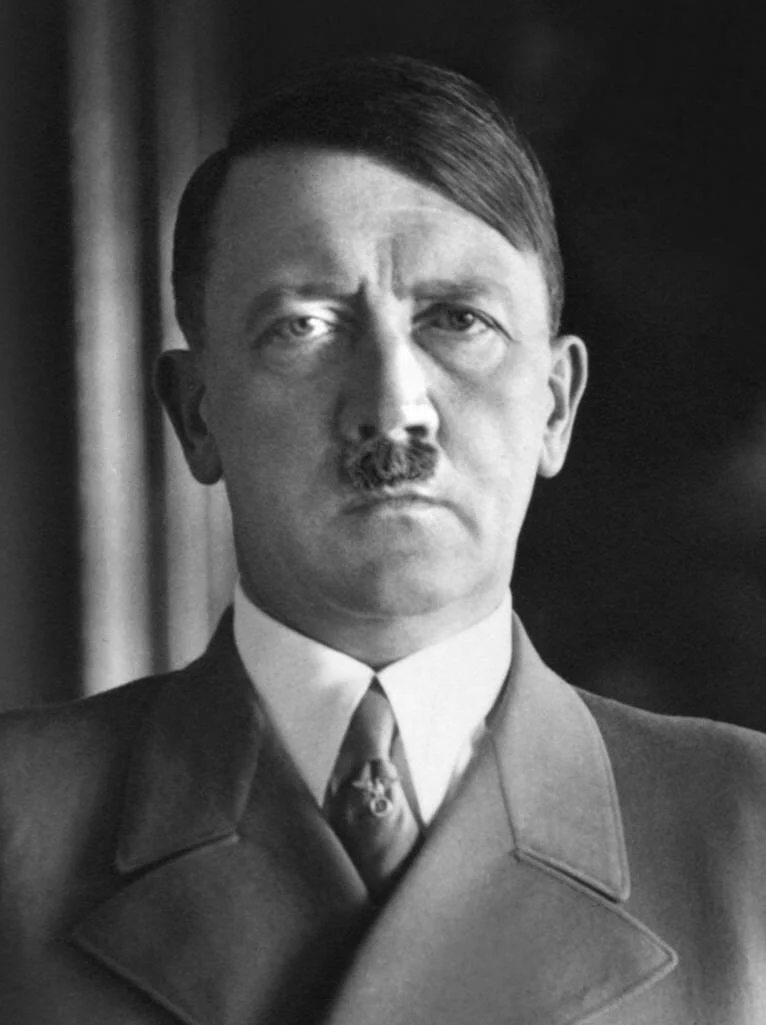
- The votes: just under 37 percent for Hitler in the 1932 presidential runoff; 37 percent for the party in July 1932, making it the largest in parliament; 33 percent in November 1932 (USHMM). The Nazis never won a majority in a free election.
- The deal: conservative politicians persuaded President Paul von Hindenburg to appoint Hitler chancellor on January 30, 1933, believing they could control him (USHMM).
How propaganda brought him to power and kept him there
Nazi propaganda “played an integral role in advancing the persecution and ultimately the destruction of Europe’s Jews” (USHMM). It was not a sideline. It was the method.
The stab in the back
The “stab-in-the-back” myth held that the German army had not been beaten in 1918 but betrayed by civilians and politicians at home. It was promoted first by generals, including Erich Ludendorff, who wanted to avoid admitting how desperate the army’s position had been. Hitler and the Nazis took it up and amplified it, blaming the politicians who signed the armistice, Social Democrats and, above all, Jews (Britannica). It turned a real national humiliation into a story about traitors.
The Big Lie, in his own words
The phrase “big lie” comes from Mein Kampf (1925). Hitler used it to accuse Jews and Marxists of lying about Ludendorff’s role in the defeat, and in doing so described the technique he went on to use himself. In James Murphy’s 1939 English translation (Volume 1, Chapter 10):
“…in the big lie there is always a certain force of credibility; because the broad masses of a nation are always more easily corrupted in the deeper strata of their emotional nature than consciously or voluntarily, and thus in the primitive simplicity of their minds they more readily fall victims to the big lie than the small lie, since they themselves often tell small lies in little matters but would be ashamed to resort to largescale falsehood. … For the grossly impudent lie always leaves traces behind it, even after it has been nailed down…”
Adolf Hitler, Mein Kampf, Vol. 1, Ch. 10, trans. James Murphy (1939), pp. 198–199 (text via Wikiquote)
Context matters: in the original passage Hitler attributes the technique to Jews. The antisemitic accusation was itself the big lie.
Scapegoats: Jews and communists
Nazi propaganda gave every problem the same culprits. It portrayed Jews as conspiring to provoke war, and after 1941 it linked Soviet communism to European Jewry, presenting Germany as the defender of “Western” culture against a “Judeo-Bolshevik threat” (USHMM). Films such as The Eternal Jew (1940) portrayed Jews as “subhuman” parasites, and newspapers, above all Der Stürmer, printed antisemitic caricatures of Jews. Propaganda campaigns were timed to come before new anti-Jewish laws, in 1935 before the Nuremberg Race Laws and in 1938 around Kristallnacht, to create “an atmosphere tolerant of violence against Jews” and to make the measures look like the government “restoring order” (USHMM).
The Reichstag fire and the emergency decree
On February 27, 1933, four weeks after Hitler took office, the parliament building burned. Who set the fire is still unclear, but Hitler blamed the Communists and claimed they were planning an uprising (USHMM). The next day, February 28, the Reichstag Fire Decree suspended freedom of speech, of the press and of assembly, removed restraints on police investigations, and let the regime arrest political opponents without charge, dissolve organizations and seize property. It stayed in force until Germany’s defeat in May 1945.
The Enabling Act
On March 23, 1933, parliament passed the “Law to Remedy the Distress of the People and the Reich,” which let Hitler’s cabinet make laws without parliament. It needed a two-thirds majority, so the regime made sure of one: all 81 Communist deputies and 26 of the 120 Social Democrats were kept out, held in so-called protective detention, and SS troops were sent into the makeshift parliament building, the former Kroll Opera House, to intimidate the other parties. Only the Social Democrats voted against (USHMM). The act became “the cornerstone of Adolf Hitler’s dictatorship.”
Goebbels and the Ministry of Propaganda
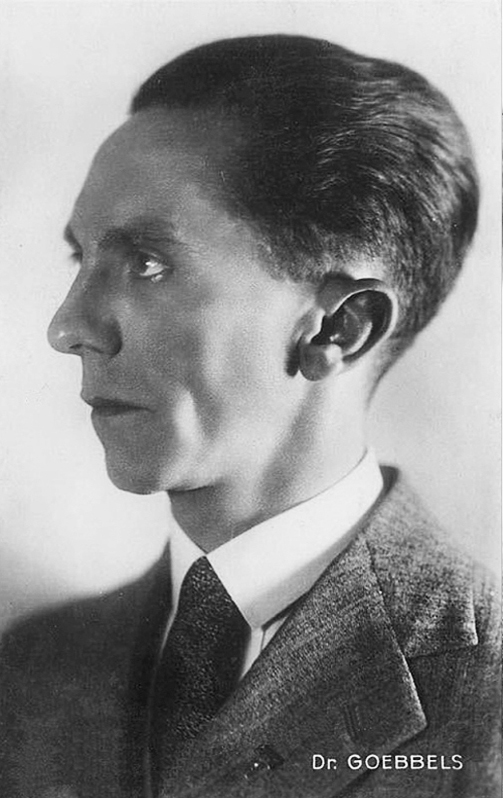
In March 1933 Hitler created the Reich Ministry of Public Enlightenment and Propaganda under Joseph Goebbels, to control the message in “art, music, theater, films, books, radio, educational materials, and the press” (USHMM; USHMM).
Taking over the press (Gleichschaltung)
The regime called the process of bringing every institution into line Gleichschaltung, “coordination.” For the press, it worked through a licensing system. Under the Editors Law of October 4, 1933, journalists had to be registered, and Jews and people married to Jews were barred. Clause 14 ordered editors to leave out anything “calculated to weaken the strength of the Reich abroad or at home,” and the ministry handed out daily directives on what to print (USHMM). Anti-Nazi papers were shut or taken over, and from 1934 it was illegal to criticize the government (USHMM).
Radio in every home
Goebbels made no secret that “radio belongs to us.” Shortly after Hitler took office he compelled manufacturers to sell a cheap set (Deutsche Welle), the Volksempfänger (people’s receiver), sold for 76 Reichsmarks, about half the price of comparable radios. Its model number, VE 301, referred to January 30, the day Hitler took power. It was about half of all radio sales in 1933 and 75 percent in 1934 (USHMM). The share of German households with a radio rose from about 25 percent in 1933 to 57 percent in 1939 and 65 percent in 1941 (German History in Documents and Images).
Rallies and spectacle
The party staged huge, choreographed rallies, plastered Hitler’s image on posters and postcards, and broadcast his speeches over radio and public loudspeakers (USHMM). Leni Riefenstahl’s film of the 1934 Nuremberg rally, Triumph of the Will (1935), glorified Hitler and the movement (USHMM).
Burning books
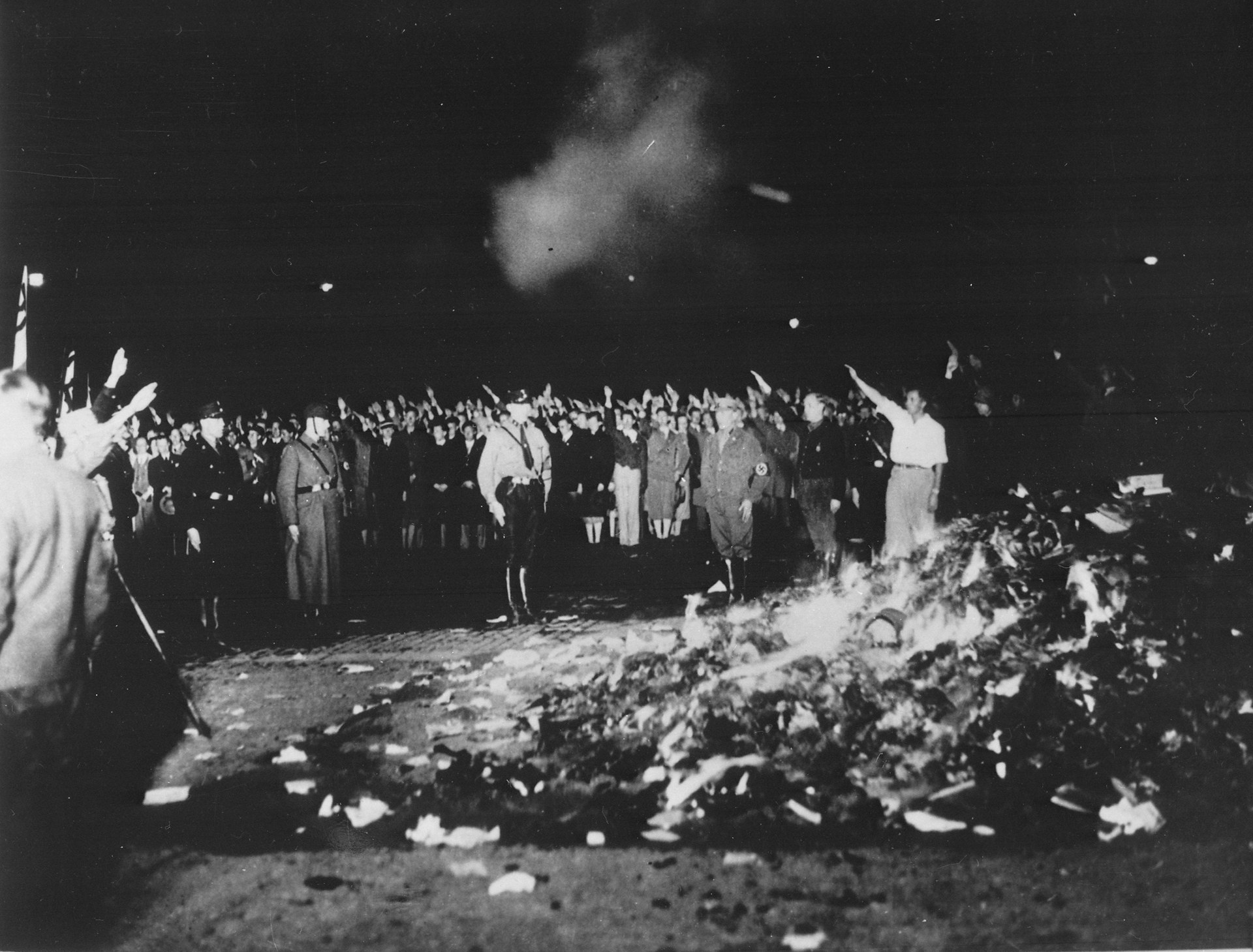
On May 10, 1933, about three and a half months after Hitler came to power, pro-Nazi university students in towns across Germany threw tens of thousands of “un-German” books into bonfires: works by Jewish authors, pacifist books and socialist and communist writing. In Berlin they burned them on the Opernplatz, the scene in this post’s featured image (USHMM).
Capturing the young
The Hitler Youth had about 100,000 members in January 1933, more than 2 million by the end of that year, and 5.4 million by 1937; membership became mandatory in 1939. By 1936, 97 percent of public school teachers, some 300,000 people, had joined the Nazi teachers’ league. New textbooks taught children “to obey the Nazi Party, love Hitler, and hate Jews,” and training aimed to produce Germans “willing to die for Führer and Fatherland” (USHMM; USHMM).
The Night of the Long Knives, June 30, 1934
Hitler’s last obstacles were the SA, whose leader Ernst Röhm wanted his street army merged into the military, and the army itself. Claiming Röhm was plotting a coup, Hitler had the SS shoot Röhm and many other SA leaders. Old enemies were murdered too: former chancellor Kurt von Schleicher, Gregor Strasser, Gustav von Kahr, the conservative writer Edgar Jung and the Catholic leader Erich Klausener. Britannica says hundreds were killed (Britannica). When Hindenburg died on August 2, 1934, the offices of president and chancellor were merged in Hitler, and soldiers swore an oath to him personally. The death toll is uncertain; the regime published no full list.
The camps
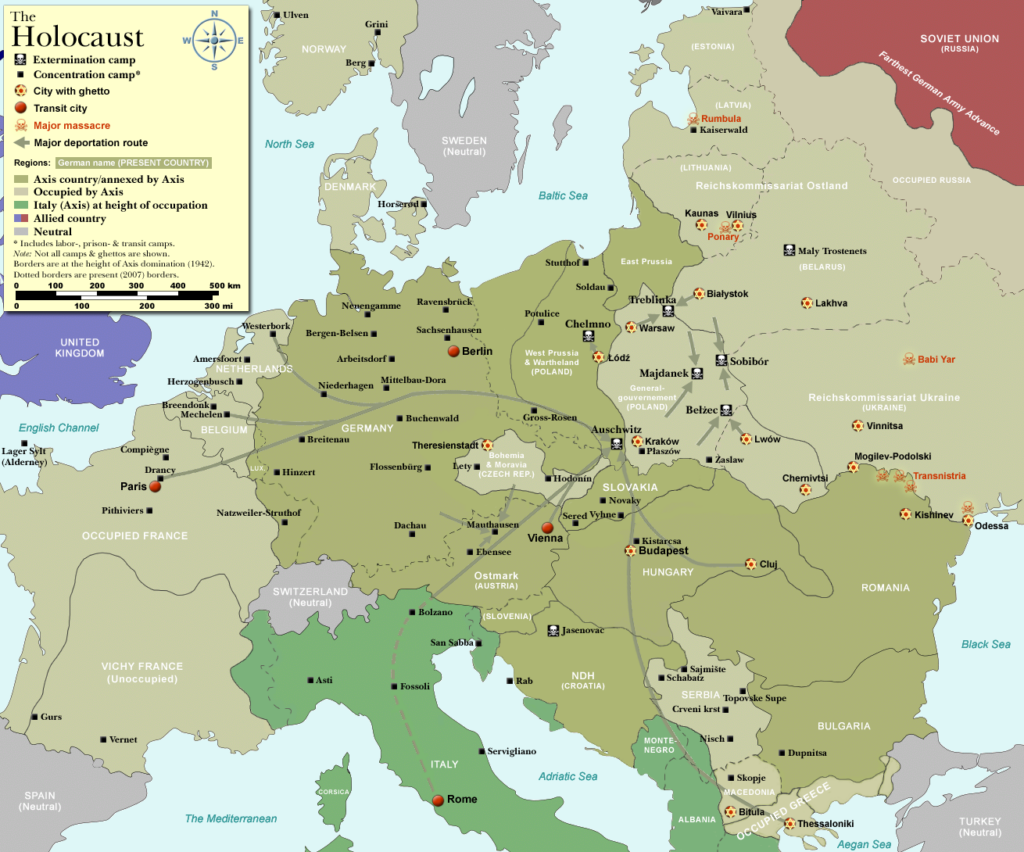
The first regular concentration camp, Dachau, opened in March 1933. More than 200,000 people passed through it by 1945, and at least 40,000 died there. In all, Germany and its allies set up more than 44,000 camps and other sites of incarceration, including ghettos (USHMM). On Kristallnacht, November 9–10, 1938, Nazis burned more than 1,400 synagogues, wrecked thousands of Jewish businesses and homes, assaulted and killed Jews, and police sent about 26,000 Jewish men to concentration camps (USHMM).
The Holocaust: six million Jews
The Nazis and their allies and collaborators murdered six million Jewish men, women and children (USHMM). They did it in four main ways:
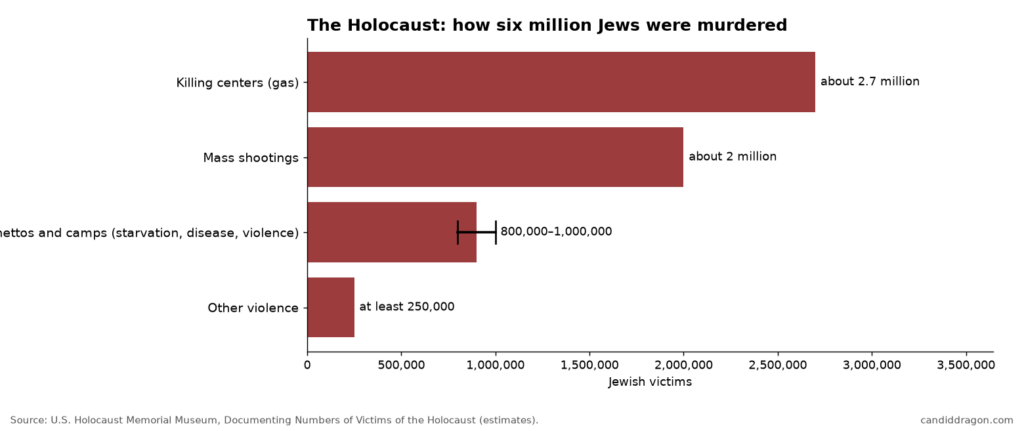
| How | Jewish victims (USHMM estimate) |
|---|---|
| Gassed or killed at the five killing centers | about 2.7 million |
| Mass shootings and related massacres in more than 1,500 towns and villages | about 2 million |
| Ghettos, labor camps and concentration camps: deliberate starvation, disease, brutal treatment, violence | 800,000 to 1,000,000 |
| Other violence outside camps and ghettos | at least 250,000 |
The Einsatzgruppen
Behind the invading armies in the Soviet Union came the Einsatzgruppen, SS and police “mobile killing squads.” With the Waffen SS, police, the army, Romanian forces and local collaborators, they shot more than half a million people, most of them Jews, in the first nine months of the invasion. At Babi Yar, a ravine outside Kyiv, they reported shooting 33,771 Jews in two days in September 1941. About one third of all Jewish victims of the Holocaust died in shootings (USHMM).
The gas chambers
The Nazis built five killing centers whose only purpose was murdering Jews with gas. The first mass gassing was at Chełmno on December 8, 1941, using engine exhaust piped into sealed vans; Belzec, Sobibor and Treblinka used carbon monoxide from stationary diesel engines; Auschwitz-Birkenau used Zyklon B, a pesticide (USHMM). The Nazis had first used gas chambers to murder disabled people in the T4 “euthanasia” program (below).
| Killing center | Jewish victims |
|---|---|
| Treblinka II | about 925,000 |
| Auschwitz complex | about 1,000,000 (of about 1.1 million total victims) |
| Belzec | about 435,000 |
| Sobibor | at least 167,000 |
| Chełmno | at least 152,000 |
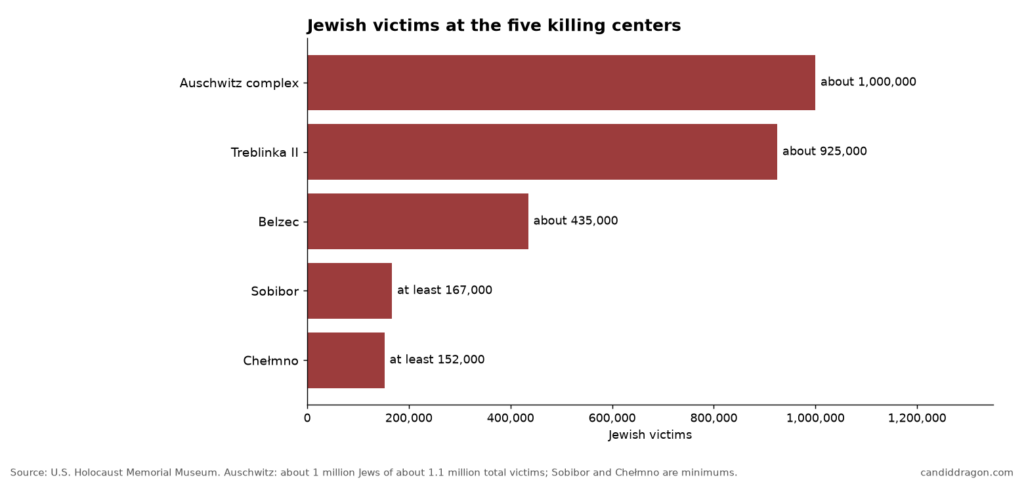
At Auschwitz the Germans also killed 70,000–75,000 Poles, about 21,000 Roma, more than 14,000 Soviet prisoners of war and 10,000–15,000 others (USHMM).
Who organized it
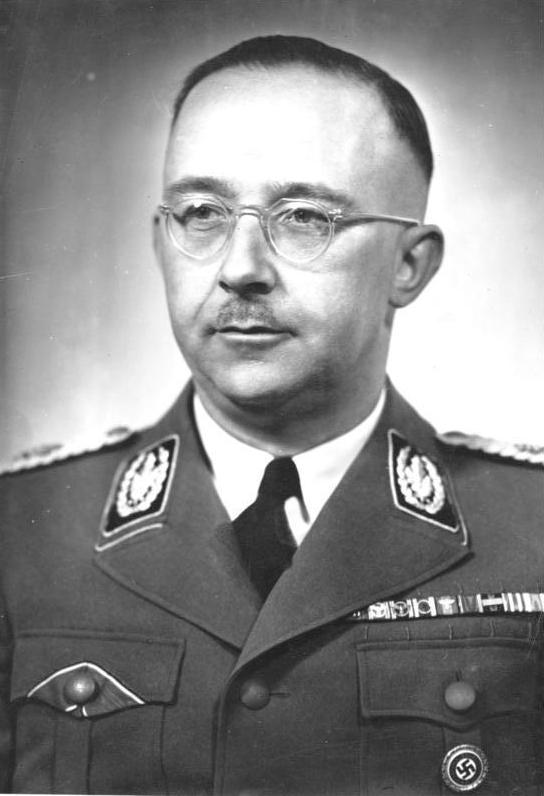
- Heinrich Himmler, head of the SS from 1929 and chief of all German police from 1936 (USHMM).
- Reinhard Heydrich, chief of the SD (Security Service), who convened the Wannsee Conference on January 20, 1942, where 15 senior officials coordinated the “Final Solution”; none objected (USHMM).
- Adolf Eichmann, who managed the mass deportation of Jews to ghettos and killing centers (USHMM).
- Rudolf Höss, commandant of Auschwitz from May 1940 (USHMM).
- Operation Reinhard staff, who murdered about 1.7 million Jews in Belzec, Sobibor and Treblinka and related shootings (USHMM).
- And many thousands more: soldiers, police, railway officials, civil servants, doctors and local collaborators across occupied Europe.
Other victims
- Roma and Sinti: at least 250,000 and possibly up to 500,000 European Roma were killed, shot in occupied eastern Poland, the Soviet Union and Serbia or murdered at Auschwitz-Birkenau, Chełmno, Belzec, Sobibor and Treblinka; some 23,000 were deported to Auschwitz (USHMM). The range is wide because records are poor.
- Disabled people (Aktion T4): from autumn 1939, under Hitler’s own directive and led by Philipp Bouhler and the physician Karl Brandt, staff gassed about 70,000 patients with carbon monoxide at six installations: Brandenburg, Grafeneck, Bernburg, Sonnenstein, Hartheim and Hadamar (USHMM). At least 10,000 disabled children were killed by drug overdoses or starvation. Historians estimate the program and its successors killed about 250,000 people (USHMM).
- Soviet prisoners of war: about 5.7 million Soviet soldiers fell into German hands, and about 3.3 million, 57 percent, were dead by the end of the war (USHMM). Many were held in open fields and left to starve, freeze and die of disease; others were murdered (USHMM). The Commissar Order of June 6, 1941, told soldiers to shoot captured Communist Party officials (USHMM).
Why it matters
The Nazi regime came to power through a democracy, not around it. Each step had a justification ready: a fire became an emergency, an emergency became a decree, a decree became a dictatorship. The propaganda prepared people to accept each new measure against a scapegoated minority as “restoring order.” By the time the killing started, there was no free press, no opposition and no court left to stop it.
Patterns to recognize (analysis)
Analysis and opinion. Tactics the Nazi regime used that have appeared under other regimes and are worth recognizing early:
- Scapegoating a minority for national problems: defeat, inflation, unemployment, crime.
- A myth of betrayal that explains a loss as the work of internal traitors.
- Using a crisis to grab emergency powers, then never giving them back.
- Getting a legislature to vote away its own power, especially after opposition members have been arrested or kept out.
- Capturing or licensing the press, controlling who may be a journalist, and making criticism of the government a crime.
- Dehumanizing language: calling people vermin, parasites or subhuman.
- Private or party militias that use street violence, then purges once they are no longer useful.
- Indoctrinating children and requiring teachers to join a political organization.
- Spectacle and saturation: rallies, a leader’s image everywhere, and cheap technology to put the message in every home.
- Burning or banning books and purging art and ideas labeled disloyal.
These are general warning signs drawn from the history above. They describe tactics, not any modern party or person.
Bottom line: Hitler won power with 37 percent of the vote and a backroom deal, then used a fire, an emergency decree and an Enabling Act to become a dictator. Propaganda turned Jews and communists into enemies; the regime then murdered six million Jews and millions of others. Every number here is documented.
Label key
- ✅ Confirmed An official record, or two or more independent outlets, agree.
- ❓ Unconfirmed Reported or claimed, but not yet independently verified.
- ⚠️ Disputed Contradicted by the evidence or by credible sources, or actively contested.
- Factual Straight reporting that holds up across outlets on different sides.
 Leans Left The facts hold, but the coverage tilts left: one-sided, loaded language, missing context or a single anonymous source.
 Leans Right The facts hold, but the coverage tilts right: one-sided, loaded language, missing context or a single anonymous source.
 Likely Propaganda State-run or state-aligned media, a militant press office, a partisan campaign or group, or unverifiable spin.
Each story gets one confidence tag and one source-lean label, plus a one-line Lean note explaining the call. Every side is held to the same standard. More on how we cover the news.
Sources
- USHMM, Adolf Hitler and the Nazi Rise to Power, 1918–1933 (Factual)
- USHMM, Hitler Comes to Power (Factual)
- Britannica, Stab in the back (Factual)
- Wikiquote, Mein Kampf (James Murphy translation, 1939) (Factual)
- USHMM, Nazi Propaganda (Factual)
- USHMM, Ministry of Propaganda and Public Enlightenment (Factual)
- USHMM, Nazi Propaganda and Censorship (Factual)
- USHMM, The Reichstag Fire (Factual)
- USHMM, The Enabling Act (Factual)
- USHMM, State of Deception: German Radio, The People’s Receiver (Factual)
- Deutsche Welle, Nazi Germany: Radio propaganda turns 90 (Factual)
- German History in Documents and Images, Radio Use in Germany, 1929–1941 (Factual)
- USHMM, Book Burning (Factual)
- USHMM, Indoctrinating Youth (Factual)
- Britannica, Night of the Long Knives (Factual)
- USHMM, Dachau (Factual)
- USHMM, Kristallnacht (Factual)
- USHMM, Documenting Numbers of Victims of the Holocaust and Nazi Persecution (Factual)
- USHMM, Einsatzgruppen (Factual)
- USHMM, Killing Centers: An Overview (Factual)
- USHMM, Auschwitz (Factual)
- USHMM, Heinrich Himmler (Factual)
- USHMM, Wannsee Conference and the “Final Solution” (Factual)
- USHMM, Adolf Eichmann (Factual)
- USHMM, Operation Reinhard (Einsatz Reinhard) (Factual)
- USHMM, Genocide of European Roma (Gypsies), 1939–1945 (Factual)
- USHMM, The Euthanasia Program (Factual)
- USHMM, Nazi Persecution of Soviet Prisoners of War (Factual)
- USHMM Experiencing History, Soviet POWs in German Captivity (Factual)
- USHMM, Commissar Order (Factual)
Featured image: Book burning on the Opernplatz, Berlin, May 10, 1933, by Georg Pahl (Bundesarchiv, Bild 102-14597). CC BY-SA 3.0 DE, via Wikimedia Commons. See all image credits.